Triple-Digit Gains Propel GOAT and APE to the Top This Week, But Not All Coins Thrived

News.bitcoin.comPublicado em 2024-10-21Última atualização em 2024-10-21

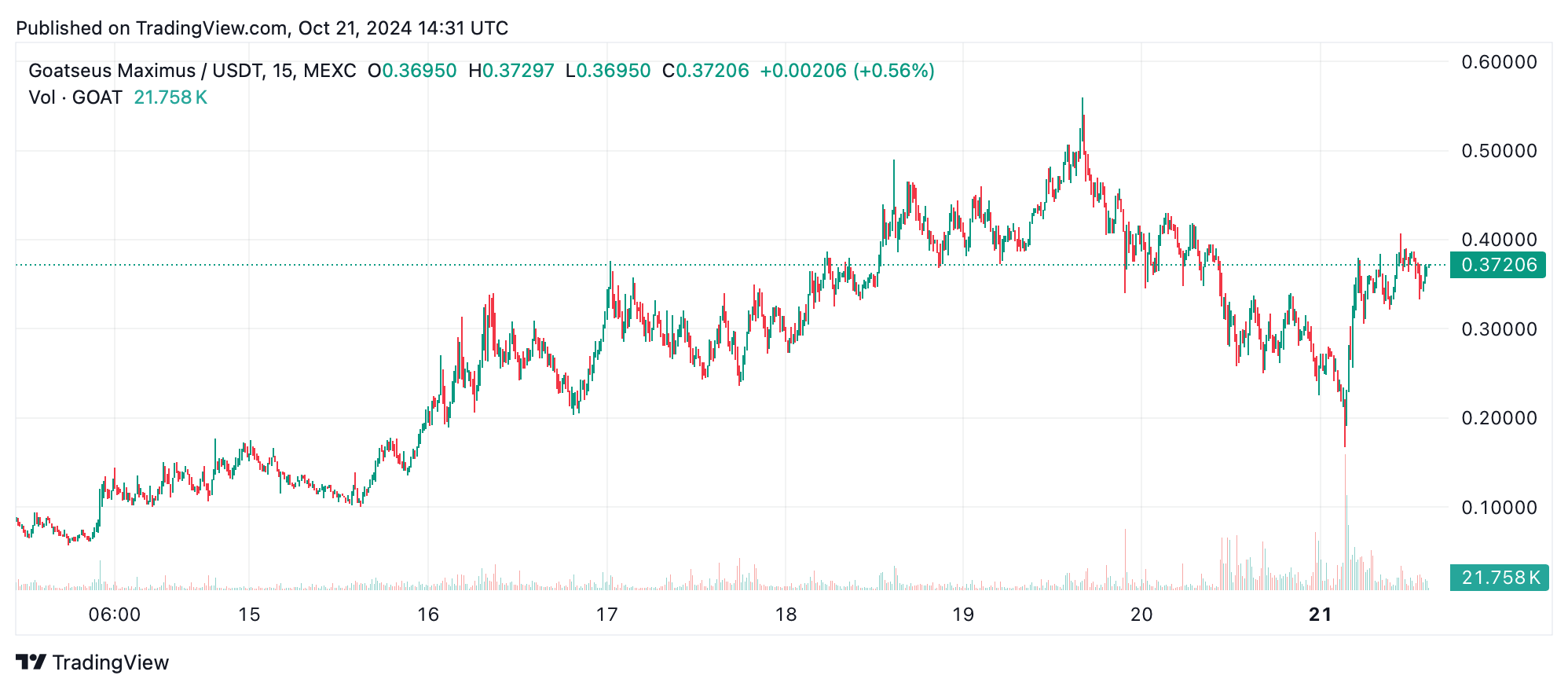
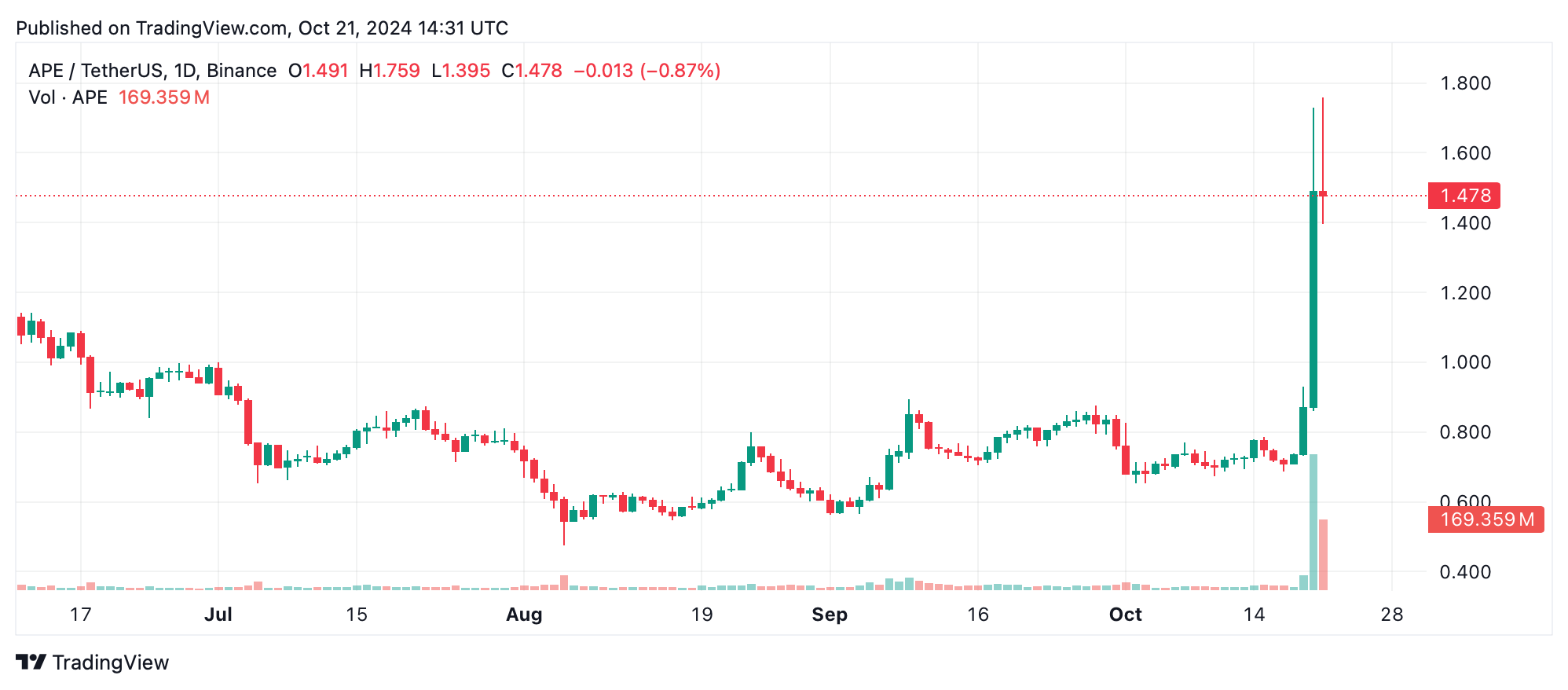
While bitcoin is up 4.6% this past week and ethereum gained 5.2% over the seven day run, a large number of crypto assets saw double-digit weekly gains and some managed to capture triple-digit rises. The leaders of the pack this week included GOAT and APE which rose 191% to 102% respectively.

While Bitcoin Remained Steady, These Altcoins Exploded With Double and Triple-Digit Gains

This week around 16 coins saw double and triple digit gains and out of the group only two rose to the triple-digit range. The AI-crafted goatseus maximus (GOAT) rose 191% against the U.S. dollar and ape coin (APE) saw a 102% increase over the past week.
Triple-Digit Gains Propel GOAT and APE to the Top This Week, But Not All Coins Thrived
GOAT/USDT on Oct. 21, 2024, via Mexc.

Following APE’s lead was GIGA which jumped 30.27% and the world’s oldest meme coin dogecoin (DOGE) jumped 26.24%. Other notable gainers this week included DYDX, MEW, METIS, SCR, and RAY rising between 16.94% to 25.54%.
Triple-Digit Gains Propel GOAT and APE to the Top This Week, But Not All Coins Thrived
APE/USDT on Oct. 21, 2024, via Binance.

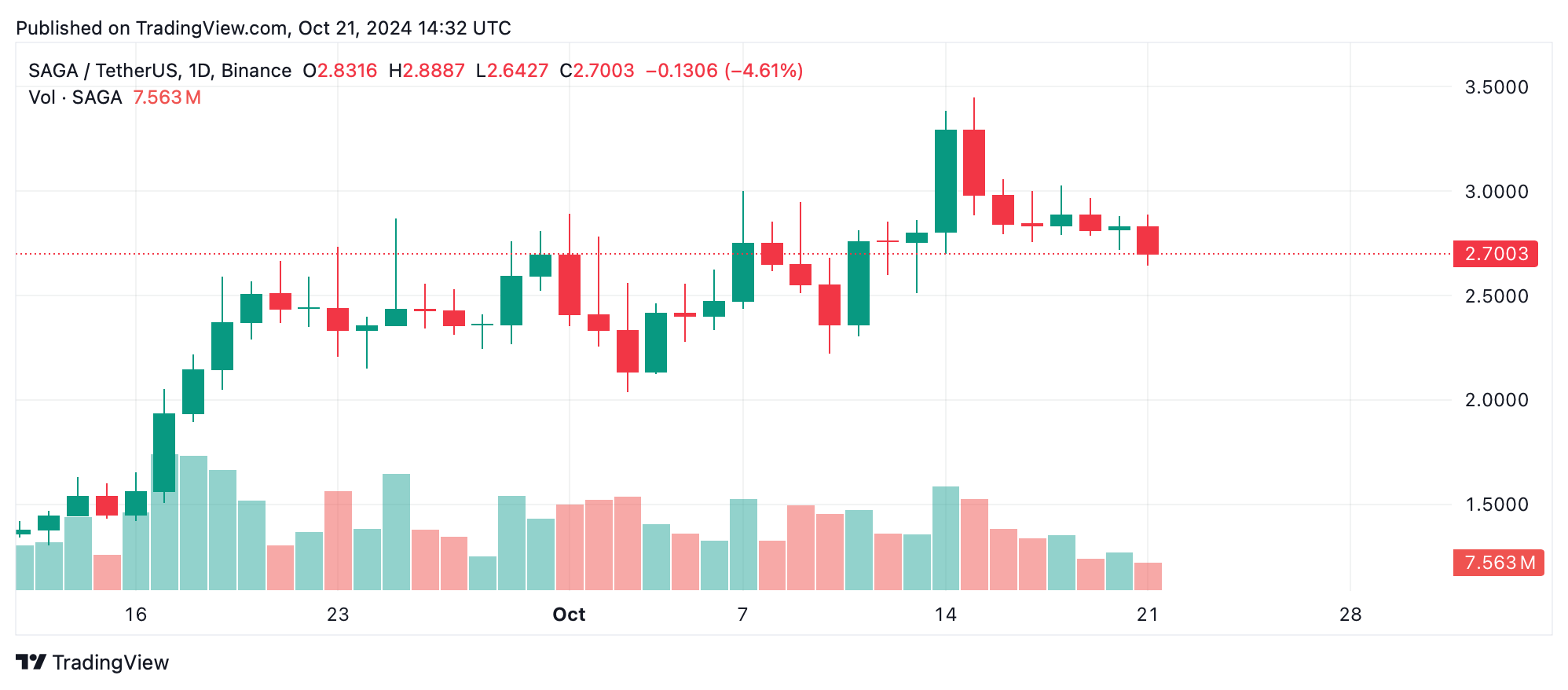
The crypto economy today stands at $2.35 trillion and the top coins with the most volume this week (excluding BTC, ETH, and stablecoins) included SOL, DOGE, BNB, APE, XRP, PEPE, SUI, WIF, MEW, and SHIB. Not all coins saw decent gains this week and SAGA was the biggest loser shedding 16.29%.
Triple-Digit Gains Propel GOAT and APE to the Top This Week, But Not All Coins Thrived
SAGA/USDT on Oct. 21, 2024, via Binance.

Other notable losers include ROOT down 15.12%, NEIRO down 14.30%, TAO down 12.37% and W shed 11.67% this week. SPX, WIF, MKR, and SEI all saw losses between 9.89% to 11.18%.

The varied performance of crypto assets this week highlights the sector’s dynamic nature in recent times, with several altcoins experiencing substantial gains, while others faced steep declines.

GOAT and APE stood out, significantly outperforming the market, while coins like SAGA and ROOT struggled. These contrasts highlight the fluctuating fortunes within the broader crypto economy over the past few weeks.

Leituras Relacionadas

The Trillion-Yuan Market Cap 'Yi Zhong Tian': Who is the True Value King?

The article analyzes the three leading Chinese optical module companies, collectively nicknamed "Yi Zhong Tian": Xinyisheng, Zhongji Innolight, and TFC Optical Communication. It evaluates their "cost-performance" not by current stock price, but through three lenses: PEG ratio (growth vs. valuation), earnings quality, and premium/discount for certainty. Xinyisheng shows the most attractive PEG ratio and high profitability, but its valuation reflects discounts for risks like high customer concentration and reliance on overseas markets. Zhongji Innolight, the most expensive, commands a premium for its market leadership, dominant share in key products like 800G/1.6T modules, and higher earnings certainty, though it faces geopolitical risks. TFC Optical, as an upstream component supplier ("water seller"), has the highest gross margin and bets on the long-term CPO/NPO architecture trend, but trades at a high valuation with more stable, less explosive growth. The core argument is that while these companies dominate module assembly, the true profit pool and technological moat lie upstream in laser and switch chips, currently controlled by U.S. firms like Lumentum and Coherent. The long-term "cost-performance" for these Chinese leaders hinges on whether the domestic industry, exemplified by companies like Yuanjie Technology, can successfully move up the value chain into high-power laser chips. Otherwise, their high growth may remain confined to the lower-margin assembly segment.

marsbitHá 4m

The Trillion-Yuan Market Cap 'Yi Zhong Tian': Who is the True Value King?

marsbitHá 4m

Has the Crypto Market Bottomed? Here's What Institutions Think

The crypto market is in a period of significant debate, with leading institutions offering differing views on whether a bottom has been reached. Three prominent firms have published detailed analyses: * **Galaxy Digital** argues Bitcoin has **not yet bottomed**. Their analysis of 13 historical indicators across six dimensions (valuation, profit-taking, miner pressure, etc.) shows only four are fully met. They project a potential bottom range between $30k and $54k. * **NYDIG** states a bottom is **possible but not likely**. While metrics are close to historic bear market extremes, they note the absence of a classic panic-selling event. They also suggest increased institutional adoption may have structurally altered the market cycle, potentially leading to a shallower downturn. * **Standard Chartered Bank** asserts the **bottom has already occurred** at around $59k. They cite two key factors: potential US-Iran diplomatic progress and the anticipated SpaceX IPO, which they believe absorbed capital and caused ETF selling pressure that is now subsiding. They forecast a year-end price target of $100k. Despite the surface-level disagreement, the reports share critical common ground more valuable for long-term investors: 1. All three believe the market bottom will form **within this year**. 2. All agree the current price is **closer to the bottom than to previous highs**. 3. All maintain a **bullish long-term outlook** for Bitcoin and a new cycle. The core takeaway is that while the exact bottom price ($40k, $50k, or $60k) is debated, the consensus is that a bottom is imminent. For long-term holders, the primary focus should not be pinpointing the absolute low, but on the future potential for prices to reach $100k, $200k, or higher. The fundamental thesis for Bitcoin—sovereign debt accumulation, inflation, declining trust in centralized institutions, global digitization, and improved accessibility—remains intact and is arguably strengthening. The overall landscape is viewed as more favorable than in previous crypto winters.

marsbitHá 14m

Has the Crypto Market Bottomed? Here's What Institutions Think

marsbitHá 14m

The 'Chip' Challenge and Breakthroughs in China's Optical Industry Chain

China's Photonics Industry: Bottlenecks and Breakthroughs In the global AI race, computing chips dominate the narrative, but the underlying bottleneck increasingly defining the scale of AI clusters is light—or more specifically, optical connectivity. Optical modules, which translate electrical signals to light and vice versa, are crucial for connecting thousands of GPUs in AI data centers, preventing data congestion and ensuring efficient model training. High-speed modules (800G, 1.6T) are now standard, with performance hinging on advanced DSP (Digital Signal Processor) chips. This is where a critical dependency lies. Two US giants—Marvell and Broadcom—collectively dominate over 90% of the high-end DSP chip market. Chinese optical module leaders like Zhongji Innolight and Eoptolink rely on these chips to manufacture modules for overseas AI customers, primarily in North America. While this creates a supply chain vulnerability, complete decoupling is difficult. Marvell derives over half its revenue from Greater China, and the US firms depend on Chinese partners for chip packaging and optical components. The risk from laser chips (e.g., from Lumentum), another key component, is considered more manageable due to multiple global suppliers and faster progress in domestic alternatives from companies like YOFC and Accelink. To mitigate risks, China's industry is pursuing a multi-pronged strategy: diversifying supply chains and locking in long-term orders; fostering a domestic market ecosystem to adopt homegrown DSPs from firms like Huawei HiSilicon and CETC; accelerating R&D in high-speed DSPs and advanced packaging; and investing in next-gen technologies like silicon photonics and Co-Packaged Optics (CPO) to reduce reliance on discrete DSPs. The ultimate solution lies not in short-term博弈 but in persistent advancement of domestic high-end chip R&D and manufacturing. While challenges remain in performance, certification, and ecosystem building, China's vast domestic market and manufacturing base provide a crucial buffer, buying time for the industry to achieve greater technological independence.

marsbitHá 28m

The 'Chip' Challenge and Breakthroughs in China's Optical Industry Chain

marsbitHá 28m

Behind SpaceX's $2 Trillion Market Cap: Why Does Musk Always Have the Next Move Planned?

On June 12th, SpaceX debuted on the Nasdaq, reaching a valuation that briefly touched $2 trillion. This marked the culmination of a 24-year journey from its founding in 2002, driven by Elon Musk's frustration at the high cost of buying rockets. The company's path was defined by early failures, with its first three Falcon 1 launches ending in explosions before a successful 2008 flight opened the era of commercial spaceflight. Key to its model was a fixed-price NASA contract, incentivizing cost reduction. SpaceX mastered rocket reusability, first achieving a Falcon 9 landing in 2015, which drastically cut launch costs. This enabled its profitable Starlink satellite internet constellation, envisioned years before reusability was proven, to create an internal market for frequent launches. Similarly, the next-generation Starship rocket was in development long before its first flight, with its business case evolving from Mars colonization to supporting the emerging concept of in-orbit data centers for AI—a story now central to its valuation. The company's recent IPO, a reversal of its long-standing "no IPO" stance, is funding this ambitious "space-based compute" vision. While major tech players like Google, Blue Origin, and others are investing heavily, significant technical and cost hurdles remain. Ultimately, SpaceX's history is one of creating its own demand: first with Starlink and now with space-based AI compute, betting that its next rocket will enable its next giant market.

marsbitHá 31m

Behind SpaceX's $2 Trillion Market Cap: Why Does Musk Always Have the Next Move Planned?

marsbitHá 31m

Trading

Spot
Futuros

Artigos em Destaque

O que é APECOIN

Compreender a Moeda Eletrónica da Ásia-Pacífico ($APECoin) Num era em que a interseção entre tecnologia e ambientalismo se torna cada vez mais crítica, as criptomoedas estão a deixar a sua marca como potenciais catalisadores para a mudança. Entre estas inovações, a Moeda Eletrónica da Ásia-Pacífico ($APECoin) destaca-se como um projeto distinto concebido para apoiar iniciativas ambientais em toda a região da Ásia-Pacífico. Este artigo explora a fundação, características únicas e impacto do $APECoin no panorama mais amplo da blockchain. O que é a Moeda Eletrónica da Ásia-Pacífico ($APECoin)? A Moeda Eletrónica da Ásia-Pacífico ($APECoin) é um token ERC20 e TRC20, realizado em abril de 2020 após a sua concepção em dezembro de 2019. Esta inovação nasceu do desejo de promover práticas ecológicas e apoiar um conjunto de projetos ambientais visando a sustentabilidade e iniciativas verdes. Objetivos e Finalidades $APECoin não é apenas uma moeda digital; é concebida como um meio de troca que permite aos utilizadores realizarem transações que beneficiam diretamente causas ambientais. O seu ecossistema é projetado para facilitar diversas atividades financeiras enquanto promove a adoção de práticas ecológicas. A moeda tem como objetivo principal: Apoiar Iniciativas Ambientais: Através de cada transação, uma parte é alocada para financiar projetos sustentáveis direcionados à conservação e energia renovável. Promover Inovações Ecológicas: Incentivar startups e projetos que se alinhem com a sustentabilidade ambiental através do uso do seu token como meio de valor. Criar um Mercado Sustentável: A plataforma inclui um e-mercado onde transações financeiras podem ocorrer dentro de um quadro dedicado à promoção de práticas ecológicas. Criador da Moeda Eletrónica da Ásia-Pacífico ($APECoin) Embora os detalhes sobre o criador individual do $APECoin não sejam divulgados ao público, o projeto é significativamente apoiado pelo Grupo APEC, um consórcio focado na defesa de iniciativas ambientais. Este apoio acrescenta credibilidade e relevância ao projeto, ligando-o a uma rede mais ampla comprometida com a sustentabilidade e práticas ecológicas. Investidores da Moeda Eletrónica da Ásia-Pacífico ($APECoin) O panorama de investimento em torno do $APECoin permanece em grande parte não divulgado. Nomes específicos de fundações ou organizações de investimento que apoiam esta criptomoeda ainda não foram revelados. Contudo, o que é evidente é um crescente interesse entre investidores ansiosos por apoiar projetos sustentáveis que demonstram potencial de impacto no espaço cripto. Como funciona a Moeda Eletrónica da Ásia-Pacífico ($APECoin)? O $APECoin destaca-se devido ao seu modelo operacional inovador, que utiliza a tecnologia blockchain e contratos inteligentes. Esta combinação não só garante eficiência nas transações, mas também assegura a conformidade com estruturas regulatórias, aumentando a segurança e transparência das transações. Características Únicas do $APECoin Operações Baseadas em Blockchain: Ao estabelecer as suas operações numa plataforma de blockchain, o $APECoin garante que todas as transações são imutáveis e seguras através de técnicas criptográficas avançadas. Esta descentralização sublinha a integridade do token dentro do seu ecossistema. Contratos Inteligentes: O $APECoin emprega contratos inteligentes que facilitam transações sem costura enquanto asseguram conformidade com as regulações aplicáveis. Estes acordos automatizados minimizam a possibilidade de disputas, simplificam processos e contribuem para um quadro de transação fiável. E-Mercado: Uma das características principais do $APECoin é o seu e-mercado dedicado. Este ambiente digital serve como um centro para serviços que promovem práticas ecológicas, proporcionando uma plataforma para trocas que reforçam a visão verde do projeto. Através destas características, o $APECoin carve um nicho para si mesmo dentro da vasta extensão do mercado de criptomoedas, casando efetivamente os princípios da blockchain com a gestão ambiental. Cronologia da Moeda Eletrónica da Ásia-Pacífico ($APECoin) Compreender a trajetória do $APECoin fornece uma visão sobre os seus marcos de desenvolvimento e aspirações futuras. Aqui está uma cronologia que destaca eventos significativos na história do projeto: Dezembro de 2019: Conceção da Moeda Eletrónica da Ásia-Pacífico, iniciada com a ambição de promover a sustentabilidade através da criptomoeda. Abril de 2020: Lançamento oficial do $APECoin, assinalando a sua entrada no mercado como um token dedicado a projetos ambientais. 2020-2021: Realização da Oferta Inicial de Troca (IEO), permitindo aos utilizadores adquirir $APECoin, juntamente com o registro em várias plataformas de troca eletrónica para aumentar a acessibilidade. Na sua jornada relativamente curta, o $APECoin fez progressos significativos na construção das bases para uma criptomoeda segura e impactante, impulsionada por objetivos ambientais. Conclusão A Moeda Eletrónica da Ásia-Pacífico ($APECoin) corporifica a união entre tecnologia e responsabilidade ambiental, promovendo o crescimento no ecossistema cripto enquanto defende a sustentabilidade. Com a sua estrutura única, apoio de entidades respeitáveis e visão para um futuro mais verde, o $APECoin é mais do que apenas uma criptomoeda; é um projeto pioneiro destinado a nutrir a inovação responsável na região da Ásia-Pacífico. Através do seu compromisso com a inclusão financeira e seu suporte a iniciativas ambientais, destaca-se como um exemplo formidável de como as moedas digitais podem ser aproveitadas para um impacto societal positivo. À medida que o projeto continua a evoluir, os intervenientes na comunidade cripto e além estarão ansiosos para ver como o $APECoin moldará a conversa em torno de práticas sustentáveis no mundo em crescimento das criptomoedas.

85 Visualizações TotaisPublicado em {updateTime}Atualizado em 2024.12.03

O que é APECOIN

Como comprar APE

Bem-vindo à HTX.com!Tornámos a compra de ApeCoin (APE) simples e conveniente.Segue o nosso guia passo a passo para iniciar a tua jornada no mundo das criptos.Passo 1: cria a tua conta HTXUtiliza o teu e-mail ou número de telefone para te inscreveres numa conta gratuita na HTX.Desfruta de um processo de inscrição sem complicações e desbloqueia todas as funcionalidades.Obter a minha contaPasso 2: vai para Comprar Cripto e escolhe o teu método de pagamentoCartão de crédito/débito: usa o teu visa ou mastercard para comprar ApeCoin (APE) instantaneamente.Saldo: usa os fundos da tua conta HTX para transacionar sem problemas.Terceiros: adicionamos métodos de pagamento populares, como Google Pay e Apple Pay, para aumentar a conveniência.P2P: transaciona diretamente com outros utilizadores na HTX.Mercado de balcão (OTC): oferecemos serviços personalizados e taxas de câmbio competitivas para os traders.Passo 3: armazena teu ApeCoin (APE)Depois de comprar o teu ApeCoin (APE), armazena-o na tua conta HTX.Alternativamente, podes enviá-lo para outro lugar através de transferência blockchain ou usá-lo para transacionar outras criptomoedas.Passo 4: transaciona ApeCoin (APE)Transaciona facilmente ApeCoin (APE) no mercado à vista da HTX.Acede simplesmente à tua conta, seleciona o teu par de trading, executa as tuas transações e monitoriza em tempo real.Oferecemos uma experiência de fácil utilização tanto para principiantes como para traders experientes.

126 Visualizações TotaisPublicado em {updateTime}Atualizado em 2026.06.02

Como comprar APE

Discussões

Bem-vindo à Comunidade HTX. Aqui, pode manter-se informado sobre os mais recentes desenvolvimentos da plataforma e obter acesso a análises profissionais de mercado. As opiniões dos utilizadores sobre o preço de APE (APE) são apresentadas abaixo.

活动图片