Dogecoin Price Prediction: Analyst Says Massive Parabolic Run Is Coming, Here’s The Target

bitcoinistPublicado em 2024-10-18Última atualização em 2024-10-18

Resumo

Crypto analyst Javon Marks has predicted that the Dogecoin price will soon witness a parabolic run. This prediction follows his...

Crypto analyst Javon Marks has predicted that the Dogecoin price will soon witness a parabolic run. This prediction follows his analysis of the meme coin’s historical performance, which he claimed could lead to a price rally of over 400%. 

Dogecoin Price To Reach All-Time High Soon Enough

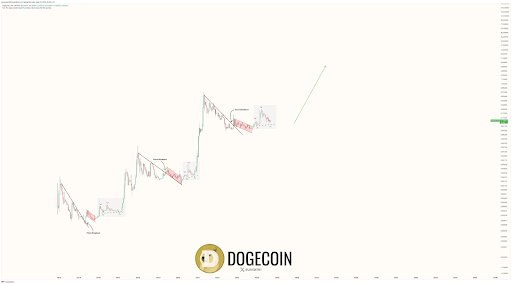
Marks predicted in an X post that the Dogecoin price could reach its current all-time high (ATH) of $0.73 as it enjoys a quick 431% rally from its current price. The analyst noted that this price prediction was based on the meme coin’s price and past performances in previous cycles. In line with this, Marks believes that DOGE could be in the early stages of another parabolic run.  

Dogecoin
Source: X

Based on Marks’ analysis, the Dogecoin price’s rally to its current ATH will likely be the start of its bull run in this cycle. The analyst predicts that the foremost will rise beyond the $0.7 price level and reach as high as $3. This isn’t the first time Javon Marks has predicted that DOGE could enjoy such a massive rally. 
Dogecoin 2
Source: X

The analyst previously predicted that Dogecoin could enjoy a 21,700% rise to $17 based on its bull market trend. He noted that Dogecoin has always enjoyed larger price gains in every successive market cycle. As such, he doesn’t expect this time to be different, with DOGE topping its last cycle’s gains in this bull run. 

Crypto analyst Dima James also recently echoed a similar sentiment, asserting that DOGE will surpass its previous gains in the last two cycles and outperform Bitcoin in the process. James also believes the Dogecoin price could reach double digits with a price target of $10 in this market cycle. 

Dogecoin Rallies Again Thanks To Elon Musk

The Dogecoin price has increased by over 7% in the last 24 hours. This price rally followed Elon Musk’s appearance at a Pennslyvania town hall, where he discussed his plans for the proposed ‘Department of Government Efficiency’ (D.O.G.E). 

DOGE continues to react positively to Musk’s mention of the D.O.G.E department because of the world’s richest man’s ties to the meme coin. Dogecoin had also rallied by over 7% on October 16 following Musk’s mention of the D.O.G.E department in an X post. 

Meanwhile, thanks to the most recent rally, DOGE reached its highest level since late July, sparking optimism that it is time for the meme coin to make its run in this market cycle. The foremost meme coin has so far underperformed compared to other top meme coins like Pepe (PEPE) and Dogwifhat (WIF)

At the time of writing, the Dogecoin price is trading at around $0.13, up in the last 24 hours, according to data from CoinMarketCap. 

Dogecoin price chart from Tradingview.com
DOGE price shows bullish strength | Source: DOGEUSDT on Tradingview.com
Featured image created with Dall.E, chart from Tradingview.com
Scott Matherson

Scott Matherson

Scott Matherson is a leading crypto writer at Bitcoinist, who possesses a sharp analytical mind and a deep understanding of the digital currency landscape. Scott has earned a reputation for delivering thought-provoking and well-researched articles that resonate with both newcomers and seasoned crypto enthusiasts. Outside of his writing, Scott is passionate about promoting crypto literacy and often works to educate the public on the potential of blockchain.

Leituras Relacionadas

The Invisible Force in Bitcoin's Bear Market: Accelerating On-Chain Payments and Institutional Adoption

Amidst ongoing Bitcoin price volatility, the quiet acceleration of on-chain payments and tokenized trading holds significant importance for investors and policymakers, especially with legislation like the CLARITY Act on the horizon. Major traditional financial institutions adopting these technologies are driving crucial discussions on compliance, security, and transparency, which are vital for broader market adoption. Key developments are shaping this evolution. First, blockchain traceability is moving beyond a simple "public vs. private" debate. New frameworks aim to standardize how financial data from immutable ledgers is analyzed and interpreted, making it as crucial as standardized financial reporting for building institutional trust. Second, while traditional finance supports clear digital asset regulation, they emphasize that an asset's economic function should dictate its regulatory treatment, advocating for robust consumer protections over broad exemptions. Furthermore, the growth of on-chain deposits at regulated institutions signals a shift. Major banks are leveraging blockchain not to replace but to upgrade existing services—like deposits and cross-border settlements—with benefits like 24/7 operations and programmable treasury management. This trend focuses more on modernizing financial infrastructure than creating speculative assets. Despite market turbulence, these underlying advancements in on-chain infrastructure point toward a more robust foundation for the industry's future.

Foresight NewsHá 10m

The Invisible Force in Bitcoin's Bear Market: Accelerating On-Chain Payments and Institutional Adoption

Foresight NewsHá 10m

Crypto Payment Cards with $1.5 Billion Monthly Transaction Volume, Stuck in the 1990s

Monthly crypto payment card transaction volume has reached $15 billion, but the industry's development stage is comparable to debit cards in the 1990s, before they became a mainstream financial staple. A key limitation is the lack of established daily financial relationships, such as direct salary deposits and recurring bill payments, with crypto wallets. Despite annualized transaction volumes of approximately $18 billion, the market is concentrated and immature. The leading provider, RedotPay, commands over half the market share. User adoption is heavily skewed towards emerging markets like Bangladesh, India, and Nigeria, where access to USD and stable financial services is limited, rather than developed economies. The sector features four primary business models: 1) Card-issuing infrastructure providers, 2) Exchange-affiliated cards for user retention, 3) Decentralized wallet/DeFi cards with self-custody but high complexity, and 4) Stablecoin-focused digital banks, which dominate transaction volume by offering integrated financial services. The article argues that a pure payment functionality is insufficient for long-term success, mirroring the historical trajectory of traditional debit cards. Future winners will need to: 1) Control the upstream flow of funds, 2) Secure defensible niches in underserved markets, and 3) Most crucially, build core account relationships that integrate into users' daily financial lives. Without this evolution, crypto cards risk remaining niche prepaid tools rather than becoming universal financial infrastructure.

Foresight NewsHá 40m

Crypto Payment Cards with $1.5 Billion Monthly Transaction Volume, Stuck in the 1990s

Foresight NewsHá 40m

$7.8 Billion in Theft and Losses Reveals the Truth: Security Costs Have Become an Unavoidable Liquidity Tax for DeFi

"7.8 Billion in Thefts Reveals the Truth: Security Costs Have Become DeFi's Unavoidable 'Liquidity Tax'" A summary of Q2 2026 data reveals that security risks are now a fundamental capital cost in DeFi, directly impacting user returns and liquidity decisions. DeFiLlama recorded 88 hacking incidents with quantified losses totaling $780.3 million in Q2. April was the worst month with $644.8 million lost. DeFi protocol attacks accounted for $735.8 million, while cross-chain bridge exploits resulted in $354.4 million in losses (note: some event categorizations overlap). Cumulatively, DeFi hacks have reached $7.85 billion, with bridge losses at $3.26 billion. The quarter highlighted two primary risk categories: high-value infrastructure vulnerabilities (e.g., bridges, oracles, admin keys) causing massive single losses, and more frequent contract logic bugs. This signals a critical market shift: from post-incident analysis to preemptive pricing of risk. Users and liquidity providers now implicitly factor in the security of the entire asset pathway—not just pool APY—into their decisions. This hidden "risk premium" manifests through wider spreads, higher liquidity incentives, and capital migration towards perceived safer routes. Cross-chain bridge risks, responsible for over $353 million in Q2 losses, exemplify this change. Asset routing credibility is now part of the transaction. Following incidents like KelpDAO and THORChain, markets are demanding safer bridges, asset insurance, and clearer risk disclosure, increasing the cost of capital for riskier pathways. Consequently, security spending is transforming from a defensive cost into a core distribution cost for attracting liquidity. Protocols must invest more in audits, bug bounties, real-time monitoring, and insurance to remain competitive. Users are increasingly demanding transparency about fund flow paths, associated risks, and contingency plans. The key indicators for the industry's direction will be whether capital continues consolidating in trusted channels, if projects delay launches for enhanced audits, if insurance premiums rise, and if aggregators start displaying security risk metrics. Q2 2026 may be remembered not just as a bad period, but as the point when DeFi underwent a fundamental asset risk repricing, where security became a persistent,隐性 tax on all on-chain activity.

Foresight NewsHá 1h

$7.8 Billion in Theft and Losses Reveals the Truth: Security Costs Have Become an Unavoidable Liquidity Tax for DeFi

Foresight NewsHá 1h

Trading

Spot
活动图片