复盘近5年美国加密执法行动:和解金累计达320亿美元,FTX和Alameda占大头

Odaily星球日报Publicado em 2024-10-10Última atualização em 2024-10-10

Resumo

过去5年,加密公司与美国监管机构之间的和解金额已达320亿美元,其中金额最大的是FTX和Alameda,和解金额达127亿美元。

原文作者:Coingecko

原文编译:Felix, PANews

近日,Coingecko 发布了关于美国加密执法行动的研究报告,该研究基于 2019 年 1 月 1 日至 2024 年 10 月 9 日的官方公告,研究了加密公司与美国监管机构在联邦和州法院案件中达成的货币价值和解,但不包括针对个人提出的指控。以下为报告详情。

和解金累计近 320 亿美元,FTX 和 Alameda 占近四成

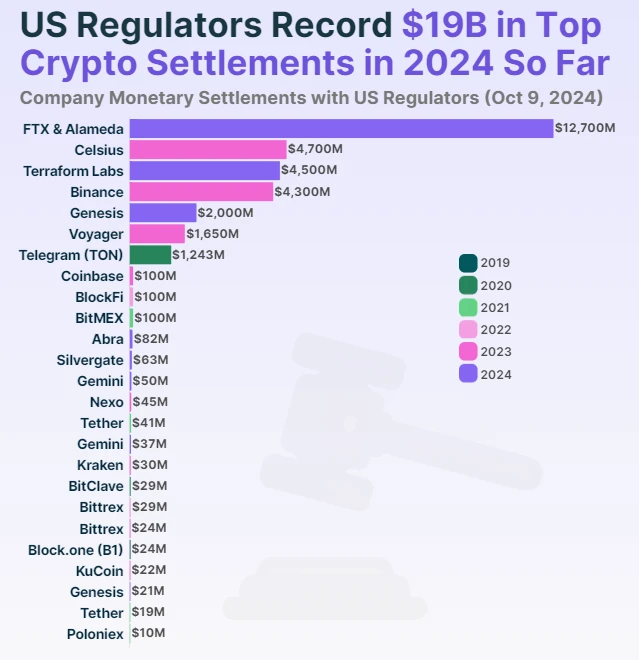
美国监管机构开展的最主要加密执法行动是针对破产的加密交易所 FTX 及其附属交易公司 Alameda,这两家公司共同支付了迄今为止最大的和解费用 127 亿美元。FTX 和 Alameda 的诉讼由商品期货交易委员会(CFTC)牵头,和解协议于 2024 年 8 月宣布,距离 FTX 倒闭不到两年。虽然这一判决不包括 CFTC 对个别公司高管的诉讼,但这笔 127 亿美元的和解金将用于偿还 FTX 客户和债权人(约 112 亿美元)。
复盘近5年美国加密执法行动:和解金累计达320亿美元,FTX和Alameda占大头

美国监管机构第二大加密执法行动是针对破产的加密贷款机构 Celsius(47 亿美元)、前行业领导者 Terraform Labs(45 亿美元)和加密交易所 Binance(43 亿美元)。值得注意的是, 2022 年年中 Celsius 和 Terraform Labs 的倒闭是标志着加密市场牛转熊的关键事件,最终导致了 FTX 的下跌,引发了美国新一轮的监管审查。

币安的和解对美国监管机构来说是一项里程碑式的胜利,尽管在和解金额上仅排第四,但却是迄今为止唯一一家支付数十亿美元和解金的运营中的加密公司。这家全球领先的加密交易所于 2023 年 11 月同意认罪,以解决与包括司法部(DOJ)、财政部和商品期货交易委员会(CFTC)在内的多家美国监管机构的诉讼。

目前美国监管机构采取了 25 项加密执法行动,并且每次和解金额均超过 1000 万美元。总体而言,美国监管机构对加密公司的最高和解金额累计达到 319.2 亿美元。

过去两年执法行动激增,仅今年和解金超 194 亿美元

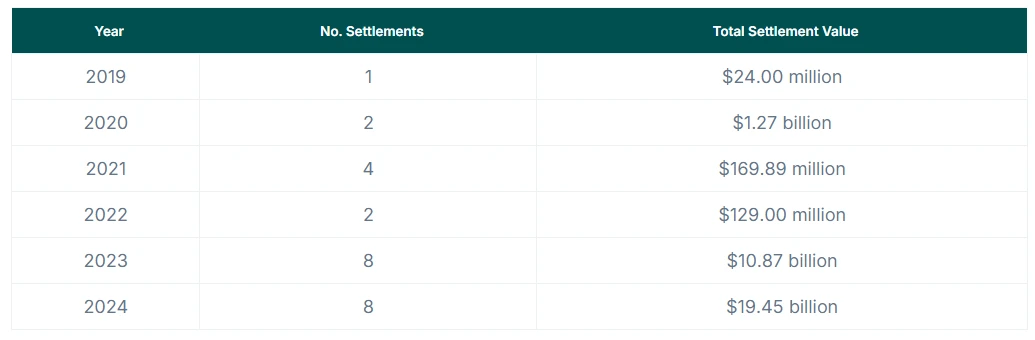
在美国 25 项主要的加密执法行动中,有 16 项是在过去两年内达成的和解,反映出自 2022 年底 FTX 崩盘以来监管审查力度加强。具体而言,美国监管机构在 2023 年解决了 8 起诉讼,总金额为 108.7 亿美元,创历史新高,与前一年相比,和解金额增长了 8327.1% 。

随后,美国监管机构已在 2024 年达成另外 8 项和解,价值 194.5 亿美元,几乎占和解总金额的三分之二。即使今年只剩几个月, 2024 年的和解金额也已经比 2023 年增长 78.9% 。鉴于美国监管机构没有放缓加密行业审查的迹象, 2024 年可能会比去年有更多的诉讼和解记录。
复盘近5年美国加密执法行动:和解金累计达320亿美元,FTX和Alameda占大头

而在 2019 年至 2022 年期间,美国监管机构则赢得了 8 起加密诉讼和解。2019 年底,美国监管机构与 EOS 背后的公司 Block.one(现已更名为 B 1)达成了首起重大加密货币诉讼和解。美国证券交易委员会(SEC)与 Block.one 达成了 2400 万美元的和解协议。

SEC 在 2020 年又赢得了两起重大加密诉讼,其中IC0发行人 BitClave 在 5 月达成了 2934 万美元的和解,Telegram 就其子公司 TON Issuer 旗下的 Gram 代币发行达成了 12.4 亿美元的和解。12.4 亿美元的 Telegram 和解包括 12.2 亿美元的非法所得和 1850 万美元的民事罚款。

在 2021 年的牛市中,美国监管机构成功地对知名行业参与者采取了三次加密执法行动。稳定币发行人 Tether 在 2 月份与纽约总检察长(NY AG)达成了 1850 万美元的和解协议,随后在 10 月份与 CFTC 达成了 4100 万美元的和解协议,声称 USDT 完全由美元资产支持。CFTC 还与 Tether 的母公司 Bitfinex 达成和解,对非法交易的罚款较低,为 150 万美元。与此同时,加密交易所 Poloniex 和 BitMEX 在 8 月份分别以 1039 万美元和 1 亿美元达成和解。

2022 年,加密货币借贷机构 BlockFi 与美国 SEC 和北美证券管理员协会(NASAA)达成了 1 亿美元的和解协议,而加密货币交易所 Bittrex 与财政部达成了 2900 万美元的和解协议。

Leituras Relacionadas

A 10,000-Word Interpretation of the "Optical Interconnect" Industry Chain: The AI Infrastructure Bottleneck Obscured by GPU Glare

**Summary: The Rise of Optical Interconnect in AI Infrastructure** This analysis explores the critical, yet often overlooked, role of optical interconnects in large-scale AI data centers. While GPUs provide raw computational power, the efficiency of AI clusters depends heavily on high-speed data transfer between thousands of cooperating GPUs during both training and inference tasks. Copper-based electrical connections are hitting physical limits in bandwidth, distance, and power consumption. Fiber optics, using light signals, offer a superior solution with exponentially higher bandwidth and lower energy use over longer distances. This shift is driving rapid growth in the optical interconnect market. The core translation device is the pluggable optical transceiver (or module), which converts electrical signals from GPUs into optical signals for fiber transmission and vice versa. Its manufacturing involves two distinct semiconductor domains: indium phosphide (InP) for optical chips (lasers, modulators, detectors) and silicon for digital signal processing (DSP) chips. A transformative next-generation technology is Co-Packaged Optics (CPO). CPO moves the optical engine (a silicon photonic integrated circuit, or PIC) much closer to the GPU or switch inside the same chip package, drastically reducing power loss and latency. CPO necessitates an external laser source and relies on silicon photonics (using Silicon-on-Insulator/SOI wafers) for integration with silicon chips. The optical interconnect ecosystem is highly fragmented, unlike the concentrated GPU market. Key bottlenecks and players span the entire supply chain: InP substrates (e.g., AXT), epitaxial wafers (e.g., IQE), laser chips (e.g., Sivers, Lumentum, Coherent), silicon photonics foundries (e.g., Tower Semiconductor), SOI wafers (e.g., Soitec), DSP/switch chips (e.g., Broadcom, Marvell), and underlying fiber (e.g., Corning). The article posits that AI infrastructure competition is extending from "who has more GPUs" to "who can secure the scarce optical interconnect supply chain." CPO represents the largest potential growth variable, with projections suggesting it could become a market worth tens of billions of dollars by 2028. Investment opportunities vary from conservative (large, diversified players) to aggressive (small, high-beta companies focused on specific bottleneck technologies), but the sector carries significant volatility and execution risks.

marsbitHá 17m

A 10,000-Word Interpretation of the "Optical Interconnect" Industry Chain: The AI Infrastructure Bottleneck Obscured by GPU Glare

marsbitHá 17m

a16z: RWA Has Passed the Proof of Concept, but the Real Challenges Are Just Beginning

a16z highlights that the tokenized real-world asset (RWA) market, excluding stablecoins, has grown tenfold in under two years to roughly $340 billion. This surge is primarily driven by US Treasury bonds and gold, offering investors yield on idle stablecoins and providing institutions with more efficient settlement and collateral flows. However, the core insight is that most tokenized assets today are simply digital certificates for off-chain holdings—used for ownership and transfer but not deeply integrated into DeFi as composable financial building blocks. For instance, only about 5% of tokenized bonds ($8B) are actively used in DeFi protocols. Smaller categories like reinsurance tokens show much higher DeFi utilization (84%), indicating they were designed for on-chain composability from the start. The market remains concentrated, with US Treasuries and commodities comprising two-thirds of the total. Gold dominates the commodities segment. While Ethereum holds over half the market, activity is spreading across multiple chains like BNB Chain and Solana. Predictions for the market's future size vary widely (from $2 trillion to over $30 trillion by 2030/2034), reflecting different definitions of what constitutes tokenization. All agree on significant growth. The current market is minuscule compared to traditional finance (e.g., tokenized bonds are 0.01% of the global bond market). The key takeaway is that the initial "proof-of-concept" phase for moving familiar assets on-chain is proving successful. The next, harder challenge is moving more complex financial instruments onto blockchains and enabling true on-chain composability, where these assets become programmable components within a native digital financial system, rather than just digitized records.

marsbitHá 54m

a16z: RWA Has Passed the Proof of Concept, but the Real Challenges Are Just Beginning

marsbitHá 54m

The Wind of 'Proactive' AI Blows into Silicon Valley: Hark Secures $700 Million in Funding

Hark, an AI startup founded in late 2025, has raised $700 million in Series A funding at a $6 billion valuation. Led by Parkway Venture Capital with participation from NVIDIA, AMD Ventures, Intel Capital, Qualcomm Ventures, and Salesforce Ventures, the company aims to develop next-generation human-computer interfaces using a combination of proprietary foundational models and custom-built AI-native hardware. Founded by serial entrepreneur Brett Adcock, Hark envisions a system of multimodal devices equipped with agentic capabilities, end-to-end voice models, and personalized memory. This "active" AI approach seeks to move beyond passive chatbots, creating collaborative companions that anticipate needs and interact naturally within the real world. Adcock's experience with Figure, a humanoid robotics company, informs this hardware-focused venture. The article argues that while current AI is powerful, it remains confined to screens and traditional interfaces like chat. The next paradigm shift requires dedicated hardware that is always-on, possesses persistent memory, and enables intuitive interaction, potentially rivaling the impact of the iPhone. Hark is assembling a team with talent from Apple, Meta, Google, and Tesla to tackle this complex engineering challenge across models, hardware, and interaction design. Finally, the piece suggests Chinese startups may have an advantage in this "active" AI hardware space due to strong manufacturing ecosystems, a vast domestic market, and supportive government policies, framing the competition as one that requires integrated progress in models, operating systems, and devices.

marsbitHá 58m

The Wind of 'Proactive' AI Blows into Silicon Valley: Hark Secures $700 Million in Funding

marsbitHá 58m

Trading

Spot
Futuros
活动图片