Amazon To Offer Xbox Game Pass-Like Subscription For Web3 Games, Here’s How

bitcoinistPublicado em 2024-10-01Última atualização em 2024-10-01

Resumo

Amazon is set to launch 1KIN Lab’s new Web3 gaming subscription on its platform. The new service, developed by the...

Amazon is set to launch 1KIN Lab’s new Web3 gaming subscription on its platform. The new service, developed by the company behind GR1D Network, aims to enhance users’ experience with exclusive content and early access opportunities within its GR1D TERMINAL platform and GR1D ecosystem.

Amazon Makes Deal to Change Gaming

1KIN Labs recently announced the launch of its GR1D TERMINAL platform and 1PASS subscription service on Amazon. The project is set to offer a “unified discovery and management hub” for content across several networks and change blockchain-based gamers’ experience.

The new platform will allow users to explore the extensive Web3 gaming ecosystem and delve into numerous titles, aiming to transform how gamers discover, manage, and collect exclusive rewards across Web3 and simplify the sector’s “fragmented” gaming landscape.

Following its closed Beta period with over 25,000 participants, the platform seeks to introduce “new levels of interoperability” and user-friendly features, offering access to a growing catalog of Web3 games across networks like Solana, Avalanche, Polygon, and others.

Moreover, 1KIN Labs also announced 1PASS alongside GR1D TERMINAL. The new subscription service will be available on Amazon, allowing players to unlock exclusive content, early access, and special discounts through the newly launched platform.

Like Xbox Games Pass, Amazon Prime Gaming, and other traditional Web2 subscription services, 1PASS subscribers can pick from monthly unique in-game assets and other exclusive content provided by over 100 Web3 games and studios within the GR1D ecosystem.

1PASS will be the first Web3 gaming subscription on the Amazon platform, enabling distribution to the multinational e-commerce company’s massive user base.

Web3 And Blockchain Gaming ‘Promising’ Future

The announcement follows the launch of the modular Layer-2 (L2) gaming-focused blockchain, GR1D Network, in June. The network is set to foster an ecosystem where gamers can easily interact with exclusive assets and rewards and “ensure a dynamic and interconnected future for the industry.”

 Jack O’Neill, founder of 1KIN Labs, emphasized the company’s goal to make blockchain gaming more accessible and gratifying for users through a unified and friendly ecosystem:

With the GR1D TERM1NAL, we’re taking a major stride toward realizing our vision of a more cohesive and user-friendly Web3 gaming ecosystem. Our goal has been to create a single access point that bridges the gap between various games and blockchain networks. In essence, we’re bringing the ease and convenience that gamers have come to expect from platforms like Xbox Game Pass into the world of blockchain gaming. This is about making Web3 gaming more accessible and enjoyable for everyone involved.

Similarly, industry experts discussed the future of Web3 gaming, the sector’s shift and maturity at the 10th edition of the European Blockchain Convention (EBC10) in Barcelona.

As reported by Bitcoinist, Pablo Monti, BingX’s Brand Manager, highlighted the sector’s growth after moving from the “play-to-earn fever” to a service supporting the broader gaming industry.

Meanwhile, Sebastien Borget, co-founder and COO of The Sandbox, underscored how players experiment with blockchain and earn their first NFTS through gaming.

Borget noted that blockchain games have become a gateway to Web3, emphasizing that the industry has moved toward empowering the creator economy to offer a “fresh approach” to the challenges of traditional Web2 gaming.
amazon, total

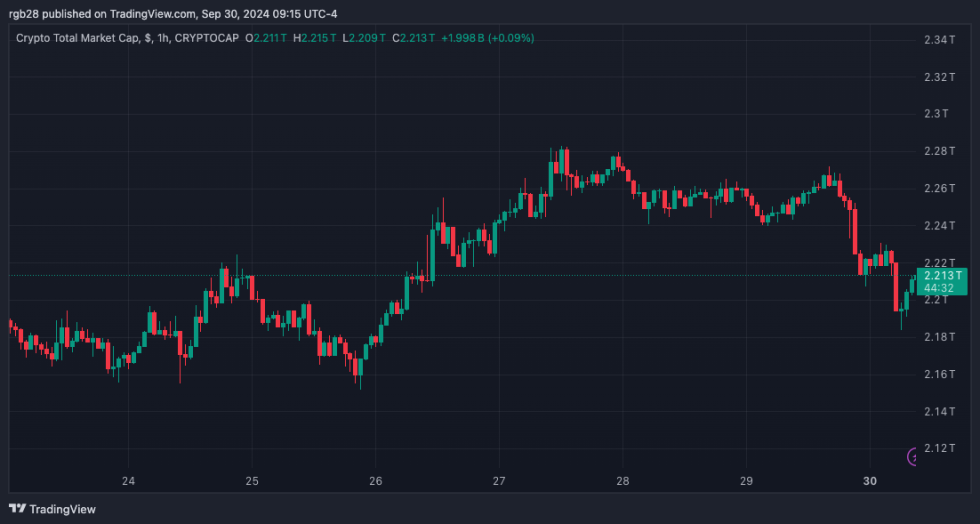
Total crypto market capitalization is at $2.21 trillion in the weekly chart. Source: TOTAL on TradingView
Featured Image from Unsplash.com, Chart from TradingView.com
Rubmar Garcia

Rubmar Garcia

Rubmar is a crypto enthusiast who likes learning and improving constantly. She enjoys reporting on the latest news and developments in the crypto industry. Rubmar also enjoys scrapbooking, crafting, simulation games, and watching football.

Leituras Relacionadas

A History of Technological Evolution Powered by Electricity: Aluminum, Bitcoin, and AI

The journey from the Rockdale aluminum smelter in Texas to space-based data centers illustrates a core economic principle: whoever controls the cheapest electricity dictates the use of computing power. The evolution is clear. Old industrial sites with pre-existing, high-capacity power grids are being repurposed. In Rockdale, a former Alcoa plant now houses vast Bitcoin mining rigs, which are increasingly being replaced by AMD chips for AI training. The logic is purely financial: while smelting aluminum yields $0.17–0.27 per kWh and Bitcoin mining $0.05–0.11, AI inference on H100 GPUs generates $1.27–3.67 per kWh. Recent deals confirm the rush for power infrastructure. Riot Platforms leases space to AMD; TeraWulf bought an old Kentucky aluminum plant for its grid; NYDIG secured a New York site for its cheap hydropower to mine Bitcoin. As AI giants like Anthropic, Microsoft, Google, and Amazon aggressively expand, they now directly compete with crypto miners for the same industrial power resources, often outbidding them. This has led to a decline in Bitcoin's global hash rate and a wave of miner conversions to AI data centers. This "digital resource curse" extends globally. Gulf nations, long offering subsidized power to attract heavy industry like aluminum, are now pivoting to become AI and cloud computing hubs—exporting computational power instead of physical commodities. Similarly, Bhutan halted its sovereign Bitcoin mining to sell hydropower directly to India for a steadier return. The frontier is space. Projects like Starcloud plan orbital solar-powered data centers, leveraging constant sunlight and natural cooling, with Bitcoin mining as a secondary use for surplus power. Even consumer brands are transforming; Allbirds shifted from footwear to AI infrastructure, causing its stock to surge. Meanwhile, crypto projects like Bittensor, Render, and Akash propose a decentralized alternative, creating markets to aggregate distributed, idle computing resources from individual hardware. The underlying infrastructure—the power grid—remains constant. As profit margins shift, the facilities built upon it will continue to evolve, from aluminum to Bitcoin to AI and beyond, always chasing the highest yield per kilowatt-hour, whether in Texas, Abu Dhabi, or low Earth orbit.

marsbitHá 8m

A History of Technological Evolution Powered by Electricity: Aluminum, Bitcoin, and AI

marsbitHá 8m

Conquering is easy, governing is hard: Polymarket must bow to regulations to plant its flag globally

Polymarket, a decentralized prediction market platform, faces significant regulatory hurdles in its global expansion. Its "permissionless" model, which bypasses traditional identity and financial controls, has led to widespread crackdowns. India recently blocked the site, categorizing it as illegal online gambling under new 2025 laws. Brazil also banned it and similar platforms, though it simultaneously authorized a regulated, investor-only version on its national exchange. Across Europe, countries like France, Portugal, and the Netherlands are enforcing bans based on existing gambling and financial regulations. To enter key markets, Polymarket is adopting a pragmatic, compliant approach. In the U.S., it paid a $1.12 million fine, acquired a CFTC-licensed exchange, and now operates a regulated, KYC-mandatory platform for American users. It also secured a major investment from Intercontinental Exchange (ICE), which will distribute its prediction data to institutional investors. In Japan, where gambling laws are strict, Polymarket has begun a long-term lobbying effort, aiming for legalization by 2030 through building institutional partnerships and community presence. Despite these challenges, the prediction market industry is booming, with global volume projected to surge from $51 billion to potentially $1 trillion by 2030. Polymarket's core dilemma remains: adapting its decentralized, anonymous model to fit within sovereign regulatory frameworks focused on licensing, consumer protection, and anti-money laundering rules. Its survival in each market depends on navigating this complex political and legal landscape.

marsbitHá 11m

Conquering is easy, governing is hard: Polymarket must bow to regulations to plant its flag globally

marsbitHá 11m

It's Easier to Conquer than to Govern: Polymarket Must Bend to Every Rule to Plant Its Flag Globally

Polymarket, a decentralized prediction market platform, is facing significant regulatory hurdles as it expands globally, illustrating the tension between permissionless, crypto-native platforms and national legal frameworks. The platform, which allows users to bet on event outcomes, was recently blocked in India under new online gambling laws and faces similar outright bans in Brazil and Ukraine, the latter citing moral objections to wagering on active war events. In Europe, countries like France, the Netherlands, and the UK are restricting access by enforcing existing gambling and financial derivatives regulations, forcing Polymarket to geo-block users or operate in view-only modes. To navigate this complex landscape, Polymarket is adopting a market-by-market, compliant strategy. In the U.S., it paid a $1.4 million CFTC fine, acquired a licensed exchange (QCEX) for $112 million, and now operates a regulated U.S. entity with strict KYC, abandoning anonymity. It also secured a major investment from Intercontinental Exchange (ICE), which will distribute its prediction data to institutional investors. In Japan, a high-potential market, it has begun a long-term lobbying effort aiming for legalization by 2030, acknowledging the country's strict anti-gambling laws and slow regulatory processes. The article concludes that while the global prediction market is growing rapidly—projected to reach $2.4 trillion by 2030—Polymarket's core challenge is transforming its decentralized model to fit sovereign regulatory systems built on licensing, consumer protection, and anti-money laundering rules. Its survival depends on proving its legitimacy in each jurisdiction.

链捕手Há 16m

It's Easier to Conquer than to Govern: Polymarket Must Bend to Every Rule to Plant Its Flag Globally

链捕手Há 16m

Trading

Spot
Futuros
活动图片