Crypto Veteran Turns Bullish On Dogecoin, But What About Shiba Inu?

bitcoinistPublicado em 2024-09-28Última atualização em 2024-09-29

Resumo

Crypto veteran Peter Brant has become bullish on Dogecoin (DOGE). At the same time, Shiba Inu (SHIB), the second-largest meme...

Crypto veteran Peter Brant has become bullish on Dogecoin (DOGE). At the same time, Shiba Inu (SHIB), the second-largest meme coin’s outlook is also bullish. However, the on-chain analytics platform Santiment suggested that investors might have to wait a while to witness new highs. 

Crypto Veteran Turns Bullish On Dogecoin

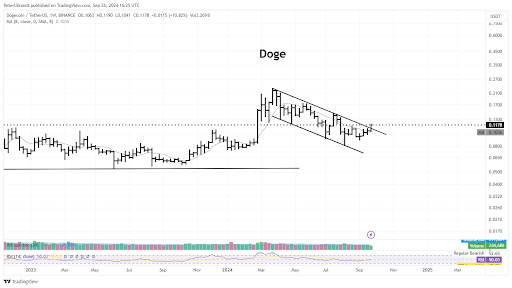
Crypto veteran Peter Brandt has turned bullish on Dogecoin. In a recent X post, he suggested that the foremost meme coin could enjoy a massive rally soon enough. Brandt highlighted a channel breakout on the DOGE chart, which he shared. Based on the chart, Dogecoin could rise to its current all-time high (ATH) of $0.7 if it breaks above that channel. 
Dogecoin Shiba Inu 1
Source: X

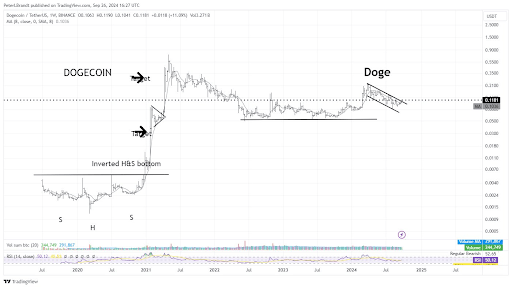
The trader also remarked that the longer term could be constructive. He highlighted a historical inverse head-and-shoulders pattern that had previously formed on DOGE’s chart before it broke out. Dogecoin looks to have completed this pattern again and is ready for a breakout to the upside. Based on his accompanying chart, the trader’s price target for the meme coin in the long term is $2.5. 
Shiba Inu 2
Source: X

This provides a more bullish outlook for Dogecoin, considering that most crypto analysts like Crypto Kaleo have predicted that the meme coin would at least reach $1 in this bull run. Kaleo recently reaffirmed his prediction again, stating that DOGE to $1 isn’t a “meme.”

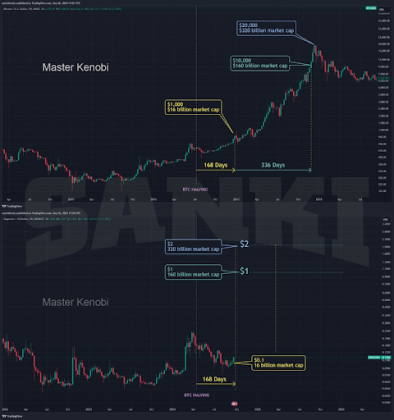
Crypto analyst Master Kenobi stated that Dogecoin’s rise to $1 could mirror Bitcoin’s 2017 rally from $10,000 to $20,000 in just under two weeks. However, he is confident DOGE’s rally from $0.10 to $1 could even be faster. Master Kenobi also believes that the meme coin could still rally to $2 or higher, just like Brandt predicts. He stated that Dogecoin’s rally from $1 to $2 could happen “in a single day, or two at most.”
Shiba Inu 3
Source: X

Shiba Inu Is Also Gaining Attention

Shiba Inu’s outlook is also bullish. The meme coin has surged over 47% in the last seven days and is back above $0.00002. The on-chain analytics platform Santiment revealed that there has been a significant rise in SHIB’s discussion rate. These discussions have included the recent 33,000% surge in Shiba Inu’s burn rate, contributing to the price surge

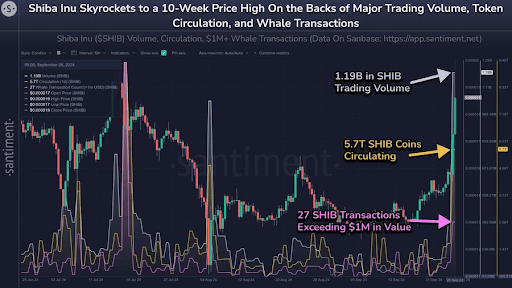
Meanwhile, Santiment also revealed in an earlier X post that Shiba Inu’s on-chain activity is surging compared to other altcoins and meme coins. Metrics like volume, circulation, and social dominance have spike. Whale transactions also recently rose to a 10-week high. 
Dogecoin Shiba Inu 4
Source: X

Santiment warned that this indicates that the FOMO toward Shiba Inu is currently high. Therefore, there is a considerable likelihood that a local top is near. The platform added that these bullish metrics might need to calm down slightly before SHIB surpasses its year-high of $0.000043, recorded earlier this February. 

Dogecoin price chart from Tradingview.com
DOGE price holding $0.12 | Source: DOGEUSDT on Tradingview.com
Featured image created with Dall.E, chart from Tradingview.com
Scott Matherson

Scott Matherson

Scott Matherson is a leading crypto writer at Bitcoinist, who possesses a sharp analytical mind and a deep understanding of the digital currency landscape. Scott has earned a reputation for delivering thought-provoking and well-researched articles that resonate with both newcomers and seasoned crypto enthusiasts. Outside of his writing, Scott is passionate about promoting crypto literacy and often works to educate the public on the potential of blockchain.

Leituras Relacionadas

Refunds! Claude 4.8 Sees Overnight Major 'Dumb-Down', GPT-5.6's Computational Power Reportedly 'Halved'

The AI community is currently alarmed by widespread reports of significant performance degradation in two leading models. This article details a "mass self-testing frenzy" triggered by a mysterious prompt designed to detect a hidden "Juice" value, representing a model's reasoning compute budget. On OpenAI's side, users suspect a covert, limited test of a "GPT-5.6-sol" model is underway. When using a specific XML prompt on the Codex platform, a normal "gpt-5.5 xhigh" model reportedly returns a Juice value of 768. However, some users routed to the suspected GPT-5.6 test receive a drastically reduced value of 128—a six-fold decrease. This has sparked debate on whether it signifies a major efficiency leap or a "watered-down, low-cost version" achieved by slashing reasoning depth to save computational expenses. Simultaneously, Anthropic's Claude models, particularly the flagship Opus 4.8 Max, are facing intense user backlash for a perceived "physical brain cut." Users on platforms like Reddit report a dramatic decline in the model's once-impressive reasoning, with complaints of it becoming "absurdly" weakened, performing worse than older, lighter models like Haiku. Specific criticisms include: losing long-context memory, refusing to think deeply even in high-reasoning modes, providing instant incorrect answers, and engaging in unhelpful, argumentative, or "gaslighting" behavior where it contradicts users unnecessarily. The article speculates these "stealth downgrades" might be a calculated corporate strategy. Companies could initially release models with temporarily boosted compute to create an illusion of a major breakthrough, then silently scale back parameters later to manage unsustainable inference costs. A proposed underlying cause is a tightened funding environment, potentially exacerbated by SpaceX's massive IPO soaking up market liquidity, which could delay AI company IPOs and force cost-cutting measures like model "nerfing." The core issue highlighted is the asymmetry of information: subscribers pay for a service that can be silently and fundamentally altered without notification or explanation. The viral "Juice test" resonates because it represents users' desire for transparency about what they are actually paying for.

marsbitHá 6m

Refunds! Claude 4.8 Sees Overnight Major 'Dumb-Down', GPT-5.6's Computational Power Reportedly 'Halved'

marsbitHá 6m

Earning Six Figures and Still Struggling to Rent in San Francisco

A couple in San Francisco with a combined tech income over $360,000 struggled for months to find a one-bedroom apartment under $5,000 per month. Their story highlights how the AI wealth boom, driven by upcoming IPOs from companies like OpenAI and Anthropic, is dramatically escalating the city's cost of living. Even six-figure salaries are becoming insufficient for a comfortable lifestyle. The article details the financial reality for tech workers earning around $180,000 annually. After taxes, retirement contributions, and healthcare, take-home pay is roughly $7,000 per month. With average rents exceeding $3,800 and one-bedrooms often costing $4,500-$5,200, discretionary income shrinks to $1,500-$2,500. This contrasts sharply with reported median total compensations of $640,000 at OpenAI and $420,000 at Anthropic. The AI gold rush is identified as the primary driver. The scale of potential wealth from these IPOs, far surpassing previous tech booms, is flooding the housing market. Data shows San Francisco's average rent is now the highest in the U.S., with vacancy rates in desirable neighborhoods plummeting to around 3%. The overall cost of living is 65.6% above the national average. The piece features multiple professionals, including a 25-year-old with a $250,000 salary, facing housing instability, fierce competition for rentals, and a persistent, low-grade financial anxiety despite high earnings. It concludes that the rapid concentration of AI wealth is redefining what constitutes a "high salary" in San Francisco, pushing out mid-tier tech talent and creating a stark divide between those in the AI sector and everyone else.

marsbitHá 1h

Earning Six Figures and Still Struggling to Rent in San Francisco

marsbitHá 1h

Trading

Spot
活动图片