Chainalysis: Гонконг становится криптоцентром Восточной Азии

investing.ruPublicado em 2024-09-18Última atualização em 2024-09-18

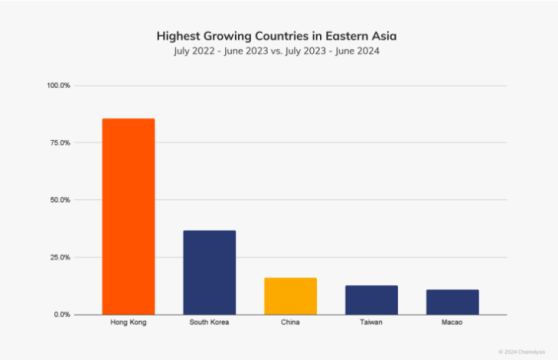
Happycoin.club - Согласно последнему отчёту аналитической компании Chainalysis, показатель внедрения криптовалют в Гонконге превысил 85,6%. Это ставит регион на 30-е место мирового рейтинга и делает лидером по внедрению в Восточной Азии.

По данным аналитиков Chainalysis, Восточная Азия играет важную роль в мировой криптоиндустрии, занимая 6-е место в мире по величине криптовалютной экономики. На долю региона приходится 8,9% глобального внедрения цифровых активов.

Криптоландшафт Восточной Азии начал меняться с 2021 года, после того, как власти Китая ввели жёсткие ограничения на использование цифровых активов. Однако с середины 2023 года ситуация снова стала меняться. Граждане КНР нашли альтернативные способы взаимодействия с криптовалютой через р2р-площадки и внебиржевые платформы.

Несмотря на ограничения в Китае, Гонконг позиционирует себя как криптохаб с гибким регулированием и стимулированием инноваций. По подсчётам экспертов Chainalysis, каждый квартал в регион поступает более 40% от всего предложения стейблкоинов. Это началось после того, как в июне 2023 года государственный регулятор ценных бумаг представил новые правила для криптовалютных платформ, которые поощряют розничное и институциональное внедрение цифровых активов.

Читайте оригинальную статью на сайте Happycoin.club
Leituras Relacionadas

Pantera Capital: As Perpetual Contracts Move Towards the Financial Center, Hyperliquid Aims to Be All-Encompassing

Perpetual futures ("perps"), once a crypto-native phenomenon, are becoming a dominant global financial instrument, evolving into a fundamental market structure shift that traditional finance can no longer ignore. This article outlines the advantages of perpetual contracts over traditional futures, highlighting their simplicity (no expiry/rollover), easier risk management, and native 24/7 operation. While the concept is not new, digital assets provided the ideal environment for its explosive growth. Initially dominated by centralized exchanges (CEX), perps have recently migrated significantly to decentralized exchanges (DEX), with Hyperliquid emerging as the leading DEX for perps, capturing ~40% of the on-chain volume. Hyperliquid, built on its own purpose-built L1 blockchain, has successfully expanded beyond crypto into traditional assets like stocks, commodities, and indices, driven by its permissionless listing framework (HIP-3) and 24/7 availability. It has become a crucial price discovery venue during off-hours and for pre-IPO companies, attracting attention from traditional hedge funds and major exchanges like ICE, which now views it as serious competition. The investment thesis for Hyperliquid's token, HYPE, rests on its large and growing total addressable market (TAM) across all finance, strong execution, superior user experience, and direct value accrual via aggressive token buybacks using 99% of protocol revenue. Key risks remain, primarily regulatory uncertainty in the U.S., though recent CFTC actions approving certain regulated crypto perp contracts signal a potential shift toward broader acceptance. The core question is no longer if perpetuals matter beyond crypto, but whether blockchain-based infrastructure like Hyperliquid can become the primary venue for pricing, trading, and discovering risk across all financial domains.

marsbitHá 1h

Pantera Capital: As Perpetual Contracts Move Towards the Financial Center, Hyperliquid Aims to Be All-Encompassing

marsbitHá 1h

Tiger Research: Zuckerberg Begins Betting on Prediction Markets, While Asian Nations Still View Them as Gambling

This article examines the rise of prediction markets, contrasting their growing institutional acceptance in the West with their restrictive regulation in Asia. It details how prediction markets, which originated from informal political betting and academic experiments like the Iowa Electronic Market, aggregate crowd wisdom into probabilistic prices through binary contracts. Their growth accelerated around 2020, reaching over $14 billion in monthly volume. A key driver is the "skin in the game" principle, where users risk their own capital, leading to high accuracy in predicting events like Fed rate decisions and elections, as demonstrated by platforms like Polymarket. Meta's entry, with Mark Zuckerberg reportedly leading the development of the Arena app, signals the market's maturation. In the U.S., court rulings have distinguished prediction markets from gambling, facilitating entry by traditional financial institutions. However, most Asian jurisdictions still classify them as gambling, focusing on social control rather than financial innovation. The article argues this stance creates three problems for Asia: 1) regulatory arbitrage pushes users to riskier offshore platforms, 2) loss of sovereign information infrastructure as valuable social sentiment data accumulates abroad, and 3) abandonment of user protection. It concludes that Asia needs a policy shift from prohibition to constructive regulation, integrating these markets into the formal system to harness their data as a national asset, as initiatives like Limitless Research are beginning to do.

marsbitHá 4h

Tiger Research: Zuckerberg Begins Betting on Prediction Markets, While Asian Nations Still View Them as Gambling

marsbitHá 4h

Trading

Spot
活动图片