‘Anti-American’ Crypto Crackdown: Former Presidential Candidate Slams US Regulators

bitcoinistPublicado em 2024-09-06Última atualização em 2024-09-06

Resumo

Former Republican Presidential Candidate Vivek Ramaswamy recently criticized the US regulators for the crackdown on the crypto sector. The industry-friendly...

Former Republican Presidential Candidate Vivek Ramaswamy recently criticized the US regulators for the crackdown on the crypto sector. The industry-friendly politician shared his thoughts on the unclear regulation of digital assets during the Biden-Harris administration, the state of the US economy, and Republican candidate Donald Trump’s financial approach.

Ex-Presidential Candidate Slams US Regulators’ Crypto Stance

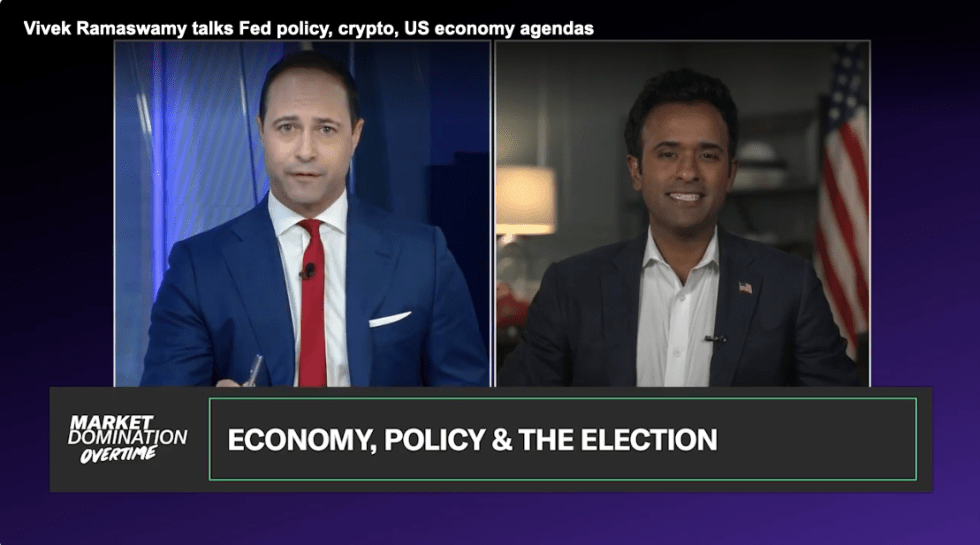
Vivek Ramaswamy recently joined Yahoo Finance’s Market Domination Overtime to discuss the US economy, digital assets’ regulations, and the upcoming elections. During the interview, the pro-crypto former presidential candidate criticized the US Federal Reserve’s “unsustainable” effort to hit unemployment and inflation “with one arrow” as it often “badly” misses both targets.
crypto

Ramaswamy discusses the US economy, crypto policies, and the election with Brian Sozzi. Source: Yahoo Finance

To the republican politician, market actors’ focus on the Fed is not based on the institution’s “special knowledge,” but rather on the curiosity to see that they “screw up next.”

Similarly, the former hedge fund manager slammed the US’s regulatory stance. Ramaswamy considers the US “regulation by enforcement” approach a problem for the country’s technological development, emphasizing the need for clear policies.

He explained that industry players discover the real rules once regulators like the Securities and Exchange Commission (SEC) enforce them based on the alleged violations. To Ramaswamy, this is “anti-American at its core” and has created an unfair and hostile environment for crypto firms.

Ramaswamy asserted that US investors and companies deserve clarity since that’s “the American way” the country was founded on:

That’s not how this country is supposed to work. Whether it’s crypto or financial services more broadly, we deserve greater clarity rather than ambiguity. Ambiguity is the friend of the tyrant.

Donald Trump, The Industry’s “Friend”?

The former presidential candidate also declared that former US president Donald J. Trump would be a “friend” to the crypto industry. He suggested that Trump’s reelection would be a positive development for the country’s regulatory stance.

I know he would be a friend. I’ve had many conversations with him about this (…) He’s been very public about it.

As reported by Bitcoinist, Ramaswamy influenced Trump’s position against a Central Bank Digital Currency (CBDC) in the US and the crypto industry earlier this year. The entrepreneur has repeatedly praised the Republican Candidate’s “open mind” and willingness to learn about the emerging sector.

To Yahoo Finance, Ramaswamy emphasized that Trump is someone “who favors financial freedom” like him, adding that the former president has evolved his view on digital assets and the necessary regulatory clarity that the crypto sector lacks:

Donald Trump is someone who favors financial freedom. I know that’s important to him, as it is important to me (…) He’s developed his views on financial freedom; on the ability to self-custody your own assets; on what some leadership changes look like in the regulatory state;(…) and the importance of regulatory clarity.

The ex-candidate referred to Trump’s speech at the Bitcoin 2024 Conference as evidence of his friendly approach to the industry. During his appearance as a keynote speaker, the former president pledged to end the Biden-Harris administration’s “anti-crypto crusade.” The Republican candidate also promised to fire SEC’s chair Gary Gensler if reelected president.

Conversely, Ramaswamy said that the Biden-Harris administration’s decisions were “undoubtedly responsible” for the struggle of the average American with inflation. He also expressed concern about Vice President Kamala Harris’ proposed capital gains tax policies.

Ultimately, the entrepreneur considers that “in the name of addressing that problem, we’re going to get even worse solutions that actually leave those everyday Americans worse off.”
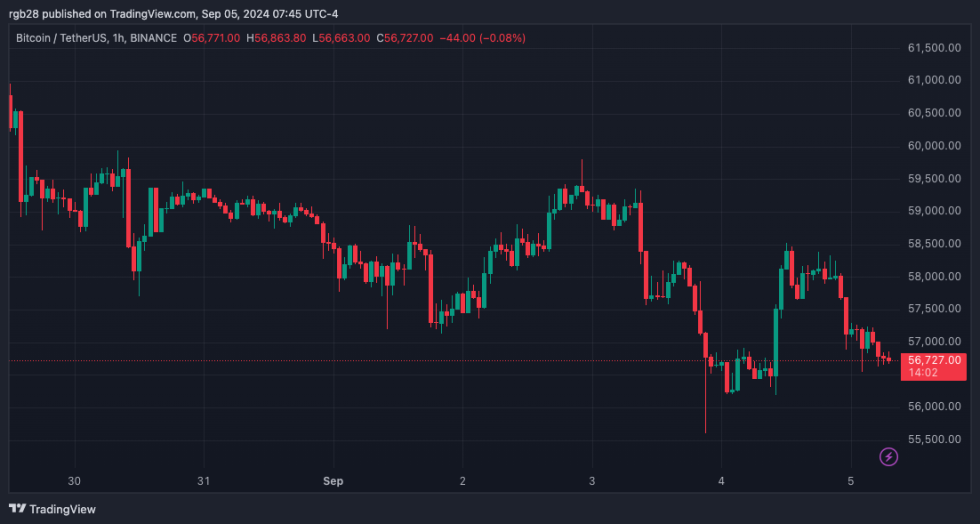
crypto, BTC, BTCUSDT

Bitcoin (BTC) is trading at $56,727 in the weekly chart. Source: BTCUSDT on TradingView
Featured Image from Unsplash.com, Chart from TradingView.com
Rubmar Garcia

Rubmar Garcia

Rubmar is a crypto enthusiast who likes learning and improving constantly. She enjoys reporting on the latest news and developments in the crypto industry. Rubmar also enjoys scrapbooking, crafting, simulation games, and watching football.

Leituras Relacionadas

A Group of Suzhou Engineers Unexpectedly Attain Financial Freedom

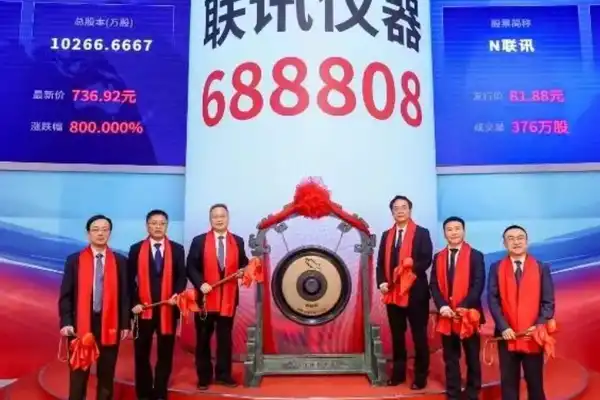
In Suzhou, a group of engineers from Lianxun Instruments, a leader in optical communication testing equipment, have achieved remarkable wealth after the company's IPO. Listed just two months ago on the STAR Market, the company's stock price surged approximately 30 times, making it the only A-share stock priced above 2,000 yuan. This surge created substantial fortunes for nearly 100 technical employees who held a collective 15.91% stake through employee stock ownership platforms, valued at over 36 billion yuan at the current market cap. Among them, nearly 40 became billionaires, while even the smallest holdings exceeded 5 million yuan in value. Founded in 2017 by Hu Haiyang, Yang Jian, and Huang Jianjun, Lianxun Instruments was established to address China's reliance on foreign high-end testing instruments. The company grew rapidly with a strong focus on R&D, where technical staff make up nearly 80% of its workforce. Early implementation of employee stock plans helped retain this core talent. The company's explosive growth is fueled by booming AI computing demand, with clients including major global optical module leaders. Its revenue skyrocketed from 276 million yuan in 2023 to 1.194 billion yuan in 2025, turning a profit in 2024. The IPO has also generated massive returns for early investors, including Suzhou's state-owned capital, which saw a hundredfold return. This story reflects a broader trend in China's markets, where technology firms in AI, semiconductors, and optics are creating new wealth, rewarding engineers and technical teams who are now central to modern capital-driven success stories, marking a shift from previous eras dominated by internet and real estate tycoons.

marsbitHá 2h

A Group of Suzhou Engineers Unexpectedly Attain Financial Freedom

marsbitHá 2h

NVIDIA's Annual 'Most Dangerous' Paper: AI Self-Replicating Code, Unlimited Leveling and Evolution

NVIDIA's "Red Queen Gödel Machine" (RQGM) paper proposes a potentially groundbreaking AI self-evolution framework. It breaks from the long-stalled concept of the "Gödel Machine," which required mathematically proven beneficial self-modifications, by adopting an evolutionary approach. The core, and most striking, innovation is that the AI does not just evolve its own code in a static environment. Instead, it co-evolves both the "student" (the task-performing agent) and the "examiner" (the evaluation system that judges it). This creates a dynamic, recursive self-improvement loop inspired by the biological "Red Queen Hypothesis"—where continuous adaptation is needed just to maintain relative fitness. The mechanism operates in epochs. Within an epoch, a fixed examiner evaluates all candidate code variants. At epoch boundaries, a new, potentially more rigorous examiner can replace the old one, but only if it proves statistically superior on a held-out "ground truth" dataset. This "controlled utility evolution" aims to ensure progress is measurable and grounded. The paper demonstrates RQGM's effectiveness across three domains: 1. **Code Generation:** It achieved a 71.7% test-set pass rate (improving over a 69.9% SOTA) while using 1.35-1.72x fewer computational tokens. 2. **Paper Writing:** In a subjective task, the co-evolved writer and reviewer achieved a 40.5% acceptance rate by a fixed human panel, up from 21.8%. 3. **Math Proofs:** It evolved more accurate graders (at 3x lower cost) and higher-scoring provers. Notably, RQGM also mitigated a known LLM bias where AI reviewers favor AI-generated content. By specifically rewarding reviewers that correctly rejected AI-written papers from a historical pool, the evolved system achieved impartiality while maintaining 80% accuracy. The research has sparked significant discussion about the acceleration of Recursive Self-Improvement (RSI). Some, like Anthropic's Jack Clark, have predicted a high probability of highly autonomous, self-evolving AI emerging by 2028. The paper suggests that when an AI begins to design its own evaluators and push itself toward ever-higher standards in a recursive loop, it may be taking a fundamental step toward redefining intelligence and autonomy.

marsbitHá 2h

NVIDIA's Annual 'Most Dangerous' Paper: AI Self-Replicating Code, Unlimited Leveling and Evolution

marsbitHá 2h

Apple and the Power Rebalancing with 'The Microns': Dissecting the Profit Ledger Behind the iPhone

The article analyzes the shifting profit dynamics and power balance between Apple and memory suppliers like Micron within the iPhone supply chain. It highlights a social media post criticizing Apple for raising iPhone prices while blaming memory chip cost increases, despite historically paying suppliers like Micron very little. An estimated iPhone 18 cost breakdown is referenced. Historically, memory was a minor cost component. In 2017's iPhone X, memory accounted for only about 1.6-2.3% of the price, with Apple capturing nearly 50% net profit. Over time, memory's share of the Bill-of-Materials (BOM) cost has grown significantly, reaching an estimated 12-15% for the iPhone 17 series. The core driver of this change is soaring demand for memory from the AI industry, particularly for High Bandwidth Memory (HBM) and AI servers, which is diverting production capacity and squeezing supply for consumer electronics. Memory manufacturers, after enduring periods of low profits, now hold greater pricing power. This is reflected in their recent strong financials, like Micron's 84.6% gross margin. Apple CEO Tim Cook initially described the memory price pressure as unprecedented in his 40-year career, later calling it a "once-in-a-century flood," before Apple announced price hikes across several product lines, causing a significant stock drop. Elon Musk echoed Cook's sentiment about the dramatic cost surge. The article concludes that the era of memory suppliers being at the mercy of Apple's pricing power has temporarily reversed, thanks to AI-driven demand. It notes Apple is reportedly seeking to diversify its supply chain, including exploring chips from China's CXMT.

Odaily星球日报Há 4h

Apple and the Power Rebalancing with 'The Microns': Dissecting the Profit Ledger Behind the iPhone

Odaily星球日报Há 4h

Trading

Spot
活动图片