Сложность биткоин-майнинга выросла почти на 3%

cryptonews.ruPublicado em 2024-04-29Última atualização em 2024-08-29

  • 28 августа показатель сложности майнинга первой криптовалюты увеличился на 2,99%.
  • На текущий момент он держится на уровне 89,47 T.
  • Средний хешрейт в сети биткоина составляет 743,28 EH/s.

28 августа 2024 года сложность биткоин-майнинга достигла отметки в 89,47 T. Иными словами, показатель увеличился на 2,99%, по данным BTC.com.

Средний хешрейт в сети биткоина составляет 743,28 EH/s. При прошлом изменении сложности он держался на уровне 641.08 EH/s.
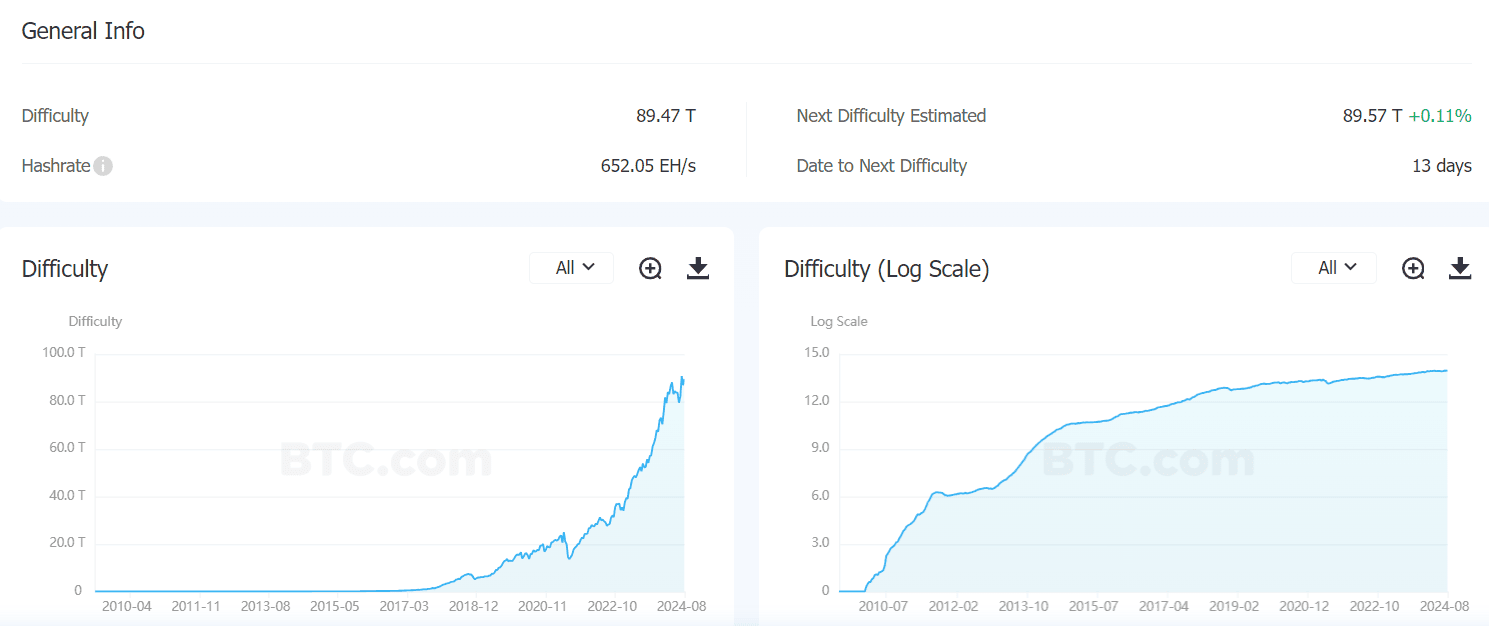
Сложность биткоин-майнинга и актуальный хешрейт. Источник: BTC.com.

Согласно имеющимся данным, в следующий раз показатель сложности биткоин-майнинга может увеличиться до 89,57 T. Прирост в процентном выражении при этом составит 0,11%.

Напомним, что сложность майнинга — это определение необходимой совокупной мощности оборудования для добычи криптовалюты. Если она растет, это может свидетельствовать об увеличившейся активности среди майнинговых компаний. В случае падения показателя ситуация выглядит противоположным образом.

Увеличение сложности приближает дату следующего халвинга первой криптовалюты. В последний раз он состоялся в апреле 2024 года и стал четвертым по счету сокращением вознаграждения за добычу блока биткоина вдвое.

Следующий перерасчет показателя должен произойти через 13 дней — 11 сентября 2024 года.

Напомним, мы писали, что в секторе биткоин-майнинга началась фаза консолидации.

Leituras Relacionadas

The Impact of OUSD on Circle, Tether, and Paxos: Not a Simple Negative, but a More Complex Competitive Landscape

OUSD's Impact on Circle, Tether, and Paxos: A Nuanced Competitive Reshuffle The launch of OUSD, a new stablecoin initiative, has complex implications for the stablecoin market. For Circle (CRCL), the initial 15-20% stock drop reflects legitimate competitive concerns but is not a "death sentence." Circle retains deep liquidity, existing integrations, and first-mover advantages. A potential restructuring or termination of its Coinbase partnership could even double its net revenue in the short term, providing more competitive freedom. However, OUSD, backed by Stripe's engineering and product strengths, could become the default stablecoin within the Stripe ecosystem for new adopters, challenging USDC's position. OUSD does not solve the core barrier for corporate adoption: it remains a credit exposure to its issuer (likely a Bridge-related entity), which, like Circle, is not an investment-grade entity. Large banks and asset managers could still capture the most lucrative enterprise use cases. Circle must accelerate its payment/fintech product development and consider defensive M&A. For Tether, OUSD targets a different market segment. Tether will continue focusing on distribution channels not prioritized by Stripe or Circle. Its market share may decline over time, but within a significantly growing total market. Paxos faces the greatest pressure. OUSD undermines the key selling points of its USDG stablecoin, and Paxos's regulatory advantages may diminish as frameworks mature. This poses a more existential challenge, explaining Paxos's recent shift back to its brokerage-as-a-service business.

marsbitHá 2h

The Impact of OUSD on Circle, Tether, and Paxos: Not a Simple Negative, but a More Complex Competitive Landscape

marsbitHá 2h

OUSD's Impact on Circle, Tether, and Paxos: Not a Simple Negative, but a More Complex Competitive Reshuffle

This article analyzes the impact of the newly announced stablecoin OUSD, backed by a consortium including Stripe, on major incumbents like Circle (USDC), Tether (USDT), and Paxos (USDG). For Circle, the announcement is not a simple negative. While the initial market reaction was rational, it's not a "death sentence." Circle retains deep liquidity, existing integrations, and first-mover advantage. A potential restructuring or termination of its exclusive revenue-sharing deal with Coinbase could even near-double its net income in the short term, providing more competitive flexibility. However, within the Stripe ecosystem, OUSD, with its strong engineering and product focus, could become the default choice, displacing USDC for new integrations. Circle must accelerate its own fintech product development and consider defensive M&A. OUSD does not directly threaten Tether's core markets, which focus on different distribution channels. Tether's market share may decline over time but within a significantly growing overall market. Paxos faces the greatest pressure. OUSD undermines the primary value proposition of its USDG stablecoin, and Paxos's regulatory advantages may erode as frameworks mature, posing a more existential challenge. This explains Paxos's recent strategic pivot towards brokerage-as-a-service. A fundamental unresolved issue for enterprise adoption remains: if issued by a Bridge-related entity, OUSD, like USDC, still represents a credit exposure to a non-investment-grade issuer, unless a parent company guarantee is provided. Large banks and asset managers entering the space later could still compete for the most lucrative enterprise use cases.

链捕手Há 2h

OUSD's Impact on Circle, Tether, and Paxos: Not a Simple Negative, but a More Complex Competitive Reshuffle

链捕手Há 2h

Trading

Spot
活动图片