Crypto Taxes: What New Zealand’s New Bill Proposal Means

bitcoinistPublicado em 2024-08-28Última atualização em 2024-08-28

Resumo

On August 26, 2024, New Zealand’s Minister of Revenue, Simon Watts, introduced a new bill proposal into the House that...

On August 26, 2024, New Zealand’s Minister of Revenue, Simon Watts, introduced a new bill proposal into the House that could have major implications for the cryptocurrency ecosystem for the island nation. 

OECD Crypto Reporting Framework To Be Implemented

Titled Taxation (Annual Rates for 2024–25, Emergency Response, and Remedial Measures), the new bill seeks to give legislative effect to the Crypto-Asset Reporting Framework and Amendments to the Common Reporting Standard (CARF) developed by the Organisation for Economic Co-Operation and Development (OECD).

The proposed amendments are slated to take effect on April 1, 2026, and require New Zealand-based reporting crypto-asset service providers (RCASPs), such as exchange platforms, to conform to new regulatory requirements. Such entities will have until July 30, 2027, to report all the relevant user information to New Zealand’s tax authority, Inland Revenue (IR).

Specifically, exchanges must report their users’ personal information, such as their name, address, date of birth, and tax identification number. In addition, they will have to report the users’ aggregate level data on all relevant digital-asset transactions, crypto-to-fiat transactions, and transfers to digital assets to wallet addresses to ensure that profits are taxed accurately.

Subsequently, the IR will share this information with all relevant tax authorities worldwide in cases where the information applies to users in other jurisdictions by September 30, 2027.

The bill notes that currently, there is little oversight of digital asset transactions and income derived from profits through digital assets trading. It adds:

On an international stage, there has been increased impetus to ensure that tax authorities retain visibility over income or investment earning opportunities that are facilitated for individuals through large-scale intermediaries.

Repercussions Of Not Complying With Reporting Requirements

The bill proposes new penalties for RCASPs that fail to comply with their crypto-asset transactions reporting obligations. For each instance of non-compliance, they will be penalized NZD 300 (USD 187), capped at a maximum of NZD 10,000 (USD 6,231) per year. 

Notably, RCASPs will not be liable to pay penalties if the circumstances are outside their control. Additionally, trading platform users who do not follow the reporting rules could be imposed with fines as high as NZD 1,000 (USD 621).

The strict digital-asset reporting rules highlighted in the bill hardly come as a surprise. In July 2024, New Zealand’s tax authorities stated that more than 200,000 people had failed to declare crypto income in their tax returns.

It’s worth highlighting that in 2020, New Zealand’s tax watchdog revised its guidelines to include cryptocurrencies under the category of taxable assets, essentially treating digital assets as a form of property for tax purposes. 

Against that backdrop, the new bill proposal holds the potential to transform the existing cryptocurrency ecosystem in New Zealand completely. Should the bill be approved, the New Zealand tax agency will have access to users’ transactions on registered exchanges and be able to compute the amount of taxes they owe on their profits, if any.

While some countries are ramping up cryptocurrency regulations for better tax compliance, others are delaying taking such measures due to a lack of clarity regarding the new asset class. 

For instance, earlier this month, South Korean lawmakers proposed postponing the enforcement of cryptocurrency taxation in the country due to investor concerns. 

In Japan, the Japan Blockchain Association opines that stringent cryptocurrency taxes should be slashed to encourage wider participation in the burgeoning digital assets space. Observing the long-term effects of lax and strict cryptocurrency regulations on a country’s digital assets ecosystem will be interesting.
crypto
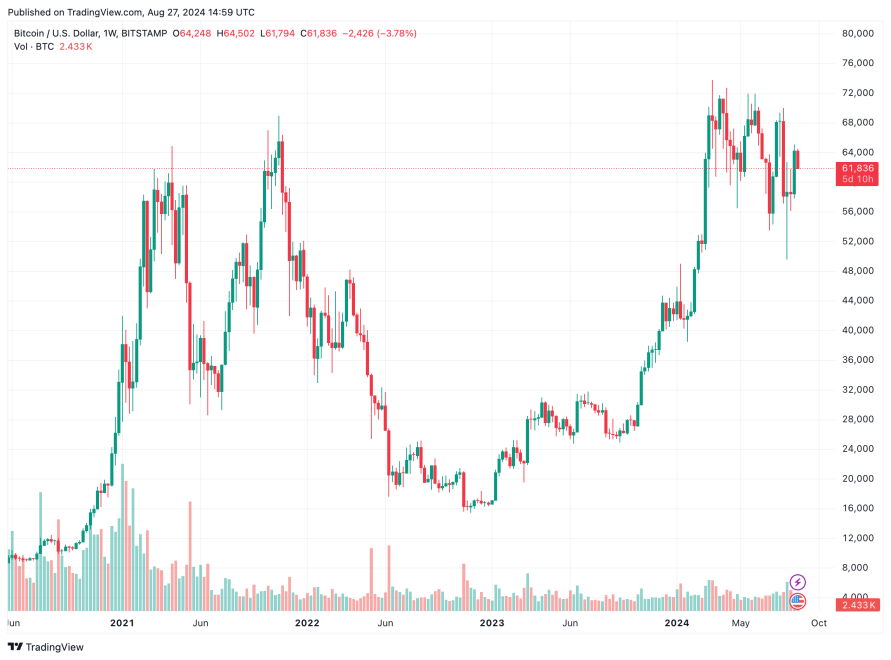
Bitcoin’s weekly price action | Source: BTCUSD on TradingView.com
Featured image from Unsplash, Chart from TradingView

Leituras Relacionadas

BIT Research: The 2028 Halving Is Not the End, the Real Shake-Up of the Bitcoin Mining Industry Is Just Beginning

The Bitcoin mining industry is undergoing its most complex structural adjustment since inception. Despite Bitcoin's price holding near $61,000 and the network hash rate approaching a record 1 ZH/s, miner profitability is deteriorating. The industry is operating close to its breakeven point, with the 2028 halving expected to accelerate consolidation. The challenges extend beyond the halving's subsidy reduction; the industry's revenue model has yet to successfully transition towards a fee-driven structure. Increasingly, mining companies are evolving from simple Bitcoin producers into infrastructure and energy operators, including providers of AI/HPC computing power. Competition is shifting from pure hash rate expansion to business model upgrades. Economic pressure is evident. The theoretical daily mining revenue at current prices is around $78 million, yet the actual figure is only about $33 million—a 136% gap. Transaction fees remain low at roughly $220k daily, far below historical implied levels. With a current estimated industry-wide breakeven price near $65,000, mining alone is struggling to generate ideal profits. The 2028 halving is projected to push the fundamental production cost floor to approximately $93,289. This will likely accelerate a shift towards consolidation among larger, well-capitalized miners with diversified revenue streams. Competitive advantage will belong to institutionalized players with access to low-cost energy, AI/HPC hosting operations, and stronger balance sheets. In essence, Bitcoin mining is transitioning from a "mining business" to an "infrastructure business." Future profitability and resilience will depend less on block rewards and more on diversified income sources like energy management and computational infrastructure services. For investors, the key question is not the halving itself, but which miners can successfully navigate this business model transformation.

marsbitHá 1h

BIT Research: The 2028 Halving Is Not the End, the Real Shake-Up of the Bitcoin Mining Industry Is Just Beginning

marsbitHá 1h

This is How God Karpathy Uses Claude?

Andrej Karpathy, a prominent figure in AI, has reportedly joined Anthropic, leading to a noticeable decrease in his open-source contributions and social media activity. A document claiming to be his personal "CLAUDE.md" file—a set of instructions for the Claude AI to follow within a specific codebase—has been circulating online. While its authenticity is unverified, the content aligns closely with Karpathy's publicly shared principles on effective AI-assisted programming. The document outlines key rules for AI coding assistants, emphasizing the importance of reading existing code thoroughly before writing new code to maintain consistency. It advises against over-engineering, advocating for simple, surgical modifications that match the project's existing style. Other guidelines include clarifying assumptions upfront, writing meaningful tests, thoughtful debugging, and carefully considering dependencies. The core message is that these principles help prevent common AI coding failures, such as introducing unnecessary abstractions, style drift, or making invisible architectural decisions. The community has noted that even experts like Karpathy require detailed instructions to guide AI effectively, akin to managing a junior developer. A related GitHub repository, "andrej-karpathy-skills," which encapsulates these ideas, is reported to significantly reduce Claude's code error rate. Ultimately, the advice stresses that the best CLAUDE.md is tailored to one's own tech stack and coding practices.

marsbitHá 1h

This is How God Karpathy Uses Claude?

marsbitHá 1h

Trading

Spot
活动图片