Celsius Bankruptcy Admin Distributes $2.5 Billion In Cash And Crypto To Creditors

bitcoinistPublicado em 2024-08-28Última atualização em 2024-08-28

Resumo

Bankrupt crypto lender Celsius Network has completed the payouts to two-thirds of the creditors despite the challenges of the distribution...

Bankrupt crypto lender Celsius Network has completed the payouts to two-thirds of the creditors despite the challenges of the distribution process. In its first report, the plan administrator detailed the status of the distribution plan and the following steps for the repayment process.

Celsius Distribution Plan Targets 375,000 Creditors

On Monday, Celcius’ plan administrator offered its first Status Report on distributions to the US Bankruptcy Court for the Southern District of New York. In the court document, the administrator revealed that, by August 2024, Celsius had successfully distributed over $2.5 billion of the eligible value owed to creditors.

In the last seven months, the plan administrator has worked to make successful distributions to creditors, answer questions, and resolve issues experienced by Celsius customers. According to the report, the distribution plan is “likely the most complicated and ambitious distribution process ever attempted in a Chapter 11 case.”

The plan seemingly required months of diligence, evaluation, and collaboration between Celsius’ bankruptcy administrator and several advisors as it involves the distribution of “Liquid Cryptocurrency, Cash, and for those creditors outside of the Convenience Class, MiningCo Common Stock.”

The repayments are done through Coinbase, PayPal, Venmo, and other platforms. The administrator tries distributions through Coinbase every two weeks, and cash distributions are attempted once per week. Meanwhile, PayPal claim codes can be redeemed at any time once issued.

In total, approximately 375,000 creditors in over 165 different countries were eligible for the repayments, which increased the complexity of the distribution process. Per the court document, the distribution plan’s difficulty increased as many regulators pursued enforcement actions against Celsius for not being a “fully regulatory compliant business.”

$2.5 Billion Sent To Creditors

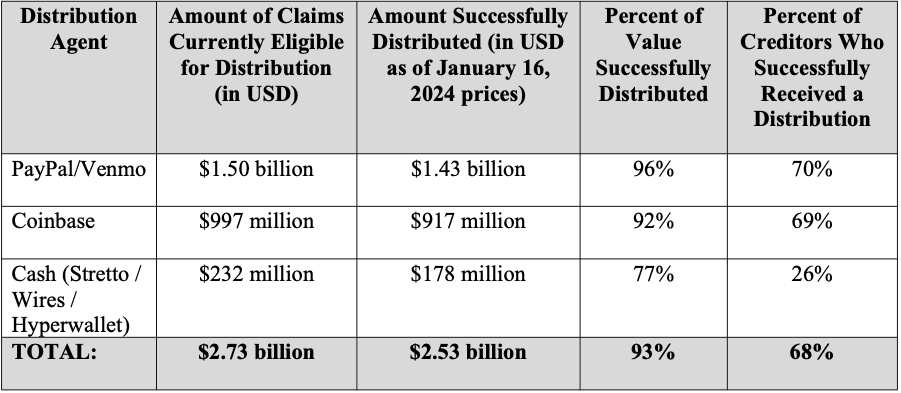
Since January 31, Celsius has successfully made distributions to 251,000 creditors. This number represents around two-thirds of all eligible creditors and approximately 93% of the eligible value.

Despite the challenges, the bankrupt crypto lender has progressively made payouts worth around $2.53 billion in cash and cryptocurrencies at prices set on January 16, meaning that the initial distribution to eligible creditors has been successful “for a substantial majority of creditors.”
Celsius

Distribution plan's progress by August, 2024. Source: Celsius' Plan Administrator Status Report

In the first two weeks of distribution, Celsius creditors received approximately 65% of all the eligible value, worth around $1.7 billion. This number increased to 80% of the then-eligible value a month later, which accounted for approximately $2 billion.

Since March, the crypto lender has distributed approximately 30%-40% of the remaining amount, leaving around 121,000 eligible creditors. Nonetheless, the remaining creditors reportedly have “overwhelmingly small distributions,” which might not incentivize them to go through the repayment process.

Per the report, of the 121,000 remaining creditors, 64,000 have a distribution of less than $100. Meanwhile, 41,000 creditors have between $100 and $1,000 distributions. Ultimately, “the Plan Administrator has attempted more than 2.7 million distributions in total for the approximately 372,000 currently eligible creditors” and will continue retrying repayments according to the plan.
Celsius, TOTAL, crypto TOTAL

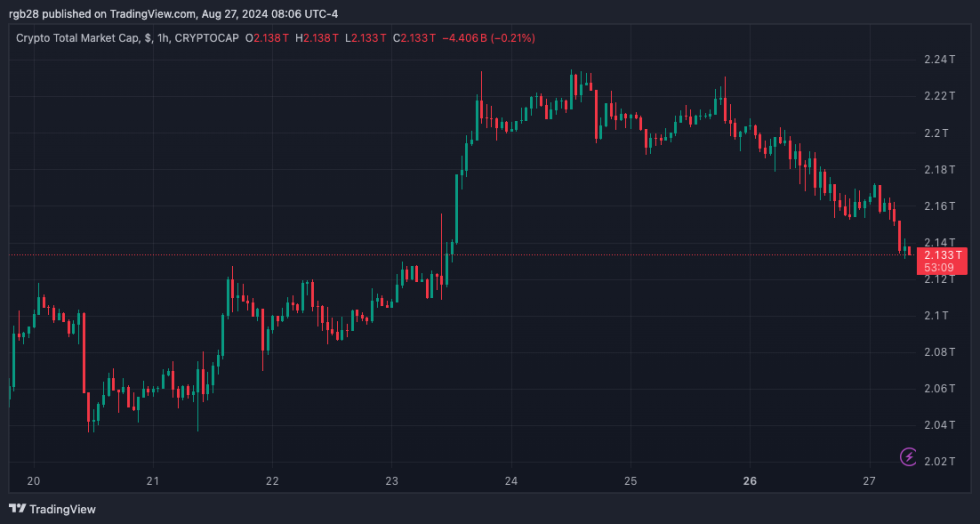
Total crypto market capitalization is at $2.13 trillion in the weekly chart. Source: TOTAL on TradingView
Featured Image from pexels.com, Chart from TradingView.com
Rubmar Garcia

Rubmar Garcia

Rubmar is a crypto enthusiast who likes learning and improving constantly. She enjoys reporting on the latest news and developments in the crypto industry. Rubmar also enjoys scrapbooking, crafting, simulation games, and watching football.

Leituras Relacionadas

BIT Research: The 2028 Halving Is Not the End, the Real Shake-Up of the Bitcoin Mining Industry Is Just Beginning

The Bitcoin mining industry is undergoing its most complex structural adjustment since inception. Despite Bitcoin's price holding near $61,000 and the network hash rate approaching a record 1 ZH/s, miner profitability is deteriorating. The industry is operating close to its breakeven point, with the 2028 halving expected to accelerate consolidation. The challenges extend beyond the halving's subsidy reduction; the industry's revenue model has yet to successfully transition towards a fee-driven structure. Increasingly, mining companies are evolving from simple Bitcoin producers into infrastructure and energy operators, including providers of AI/HPC computing power. Competition is shifting from pure hash rate expansion to business model upgrades. Economic pressure is evident. The theoretical daily mining revenue at current prices is around $78 million, yet the actual figure is only about $33 million—a 136% gap. Transaction fees remain low at roughly $220k daily, far below historical implied levels. With a current estimated industry-wide breakeven price near $65,000, mining alone is struggling to generate ideal profits. The 2028 halving is projected to push the fundamental production cost floor to approximately $93,289. This will likely accelerate a shift towards consolidation among larger, well-capitalized miners with diversified revenue streams. Competitive advantage will belong to institutionalized players with access to low-cost energy, AI/HPC hosting operations, and stronger balance sheets. In essence, Bitcoin mining is transitioning from a "mining business" to an "infrastructure business." Future profitability and resilience will depend less on block rewards and more on diversified income sources like energy management and computational infrastructure services. For investors, the key question is not the halving itself, but which miners can successfully navigate this business model transformation.

marsbitHá 1h

BIT Research: The 2028 Halving Is Not the End, the Real Shake-Up of the Bitcoin Mining Industry Is Just Beginning

marsbitHá 1h

This is How God Karpathy Uses Claude?

Andrej Karpathy, a prominent figure in AI, has reportedly joined Anthropic, leading to a noticeable decrease in his open-source contributions and social media activity. A document claiming to be his personal "CLAUDE.md" file—a set of instructions for the Claude AI to follow within a specific codebase—has been circulating online. While its authenticity is unverified, the content aligns closely with Karpathy's publicly shared principles on effective AI-assisted programming. The document outlines key rules for AI coding assistants, emphasizing the importance of reading existing code thoroughly before writing new code to maintain consistency. It advises against over-engineering, advocating for simple, surgical modifications that match the project's existing style. Other guidelines include clarifying assumptions upfront, writing meaningful tests, thoughtful debugging, and carefully considering dependencies. The core message is that these principles help prevent common AI coding failures, such as introducing unnecessary abstractions, style drift, or making invisible architectural decisions. The community has noted that even experts like Karpathy require detailed instructions to guide AI effectively, akin to managing a junior developer. A related GitHub repository, "andrej-karpathy-skills," which encapsulates these ideas, is reported to significantly reduce Claude's code error rate. Ultimately, the advice stresses that the best CLAUDE.md is tailored to one's own tech stack and coding practices.

marsbitHá 1h

This is How God Karpathy Uses Claude?

marsbitHá 1h

Trading

Spot
活动图片