This Bitcoin price fractal from 2018 could trap bulls, sink BTC price to $25K — analyst

CointelegraphPublicado em 2022-02-15Última atualização em 2022-02-16

Resumo

The eerie fractal risks sending Bitcoin's price to $25,000 despite its sharp recovery in the previous weeks.

A recent price recovery in the Bitcoin (BTC) market risks getting erased due to an eerie fractal from 2018.

Bitcoin price cycle similarities

First spotted by CryptoBullet, an independent market analyst, the fractal shows Bitcoin recreating an inverse head-and-shoulders (IH&S) pattern that preceded its price decline toward $3,100 later in December 2018. As a result, anticipations that BTC's price will undergo similar declines in 2022 might grow.

That is primarily because of the strikingly similar price trends between the pric downtrends in 2018 and 2021-2022. For instance, Bitcoin formed two higher highs in April and May 2018 around $10,000 before plunging below $6,000 in July while constructing the IH&S pattern.

BTC/USD daily price chart featuring IH&S fractal from 2018. Source: TradingView

Interestingly, in October 2021-February 2022, Bitcoin underwent an identical price trajectory, forming two higher highs — near $65,000 in April and $69,000 in November. Later, the price corrected to below $33,000 in early February while forming another IH&S pattern.

With IH&S being a bullish reversal pattern, BTC now awaits a breakout move towards or above $50,000. A similar technical setup shared by market analyst Lark Davis projects Bitcoin above $60,000.

2018 BTC price fractal risks trapping bulls

But a climb to $50,000 — or even $60,000 — may not absolve Bitcoin from its prevailing bearish bias. If the 2018 fractal repeats itself religiously in 2022, BTC's likelihood of falling toward $25,000 appears higher, as explained in the chart below.
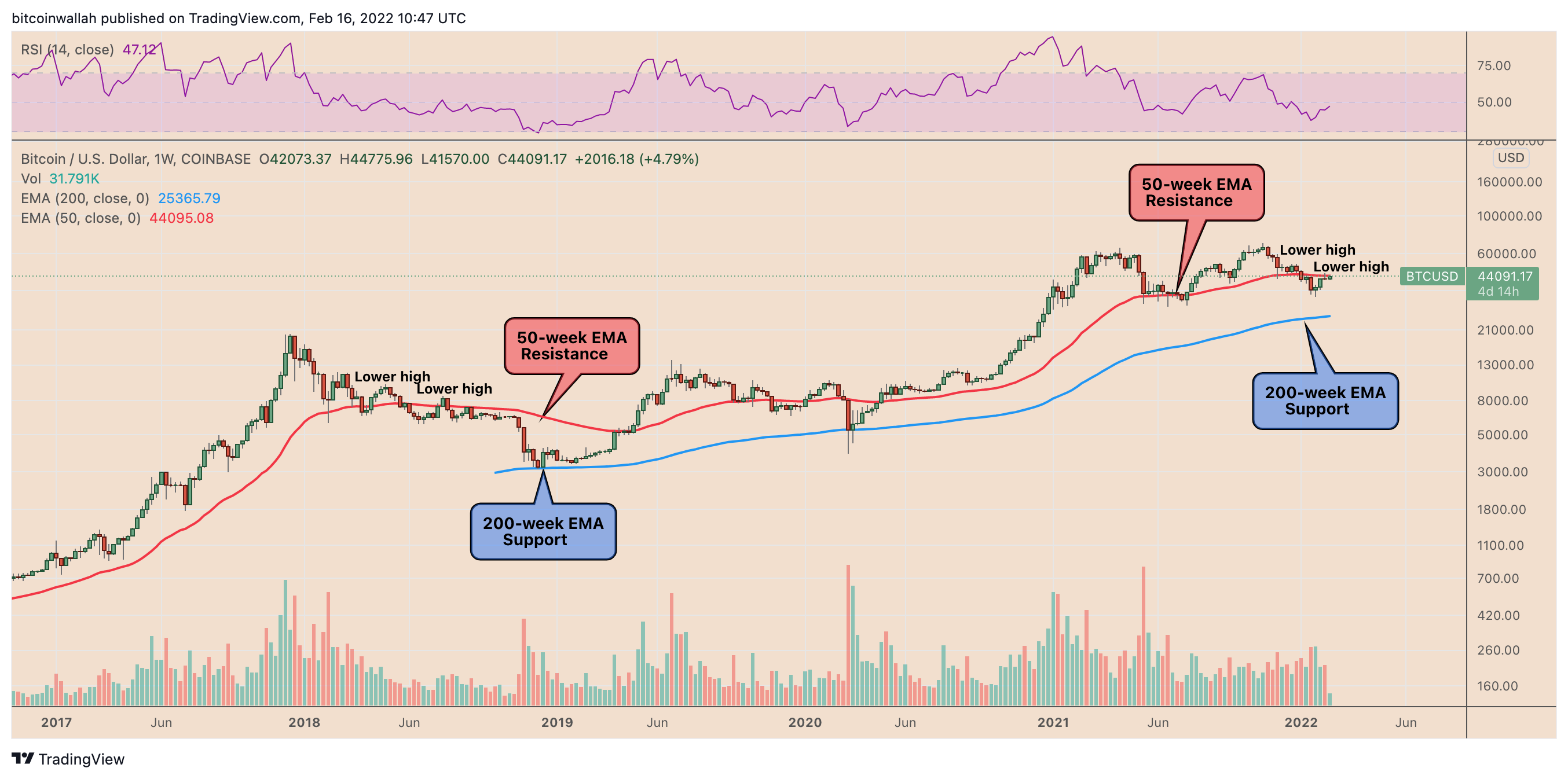
BTC/USD weekly price chart. Source: TradingView

Notably, the 2018 price action saw Bitcoin breaking out to the upside after its IH&S formation, reaching almost $10,000.

In doing so, BTC's price briefly reclaimed its 50-week exponential moving average (50-week EMA; the red wave) as support, only to break below it later. As it did, the price further declined towards the 200-week EMA (the blue wave) near $3,000, where it bottomed out in December 2018.

Applying the same fractal to the ongoing price action, Bitcoin might end up closing above its 50-week EMA, eventually hitting levels in the $50,000-$60,000 range. Nonetheless, it will move back below the red wave, and extend its decline towards the 200-week EMA, which sits near $25,000.

The negative outlook aligns with what Ari Rudd, an independent market analyst, shared in a Twitter thread on Feb. 14.

As Cointelegraph covered, the chartist cited Logarithmic Fractal Growth and moving average ribbon supports, suggesting that BTC's price might fall to the $24,000-$27,000 range in the coming months.

Not another 2018?

On the brighter side, Bitcoin has been treading ahead against more optimistic fundamentals than in 2018. Notably, BTC's price has rallied from under $4,000 in March 2020 to as high as $69,000 in November 2021, amid an increase in retail and institutional adoption led by macroeconomic risks such as higher inflation.

A November 2021 opinion editorial penned by Bloomberg Opinion’s John Authers points out that headline inflation, the consumer price index (CPI), rose roughly 28% in the past ten years. But denominating the same gauge in Bitcoin returned 99.99% deflation. But the mathematics came with a warning.

"If you put all your life savings into bitcoin a decade ago, well done. Should you do that now? Perhaps not," wrote Authers, adding:

"Over the last 10 years, bitcoin has delivered a lot of deflation, including 76% in the last 12 months alone, but also a couple of terrifying episodes when annual inflation ran at more than 200%."

Interestingly, the "terrifying episodes" occurred during the bearish cycles of 2015 and 2018.

Leituras Relacionadas

SaaS Battle Royale: The Survivors Who Win All Share One Common Trait

**Summary** The AI revolution has triggered a "SaaS apocalypse," forcing a brutal market shakeout. The key dividing line is the pricing model. Companies like Snowflake and Datadog, which charge based on consumption (e.g., data processed or compute used), are thriving. AI workloads actively *generate* more demand for their services, fueling growth. Datadog's accelerating revenue is a prime example. Microsoft and Palantir, as platform/ecosystem players, also benefit by acting as essential channels for AI deployment. In contrast, traditional SaaS firms built on per-seat or per-task licensing (e.g., Intuit, Adobe) face direct pressure, as AI threatens to automate the very human tasks their software supports. Companies like Salesforce, a per-seat giant, are caught in the middle. While showing strong AI monetization (e.g., its Agentforce platform) and experimenting with consumption-based "Flex Credits," its stock remains under pressure, illustrating that the market rewards *completed* transitions, not just the intent. The recent Microsoft Build conference underscored key trends: AI is evolving from an assistant to an autonomous "agent," and platform providers like Microsoft are consolidating their control. The market's recovery is highly selective, focused on identifying which companies are "fed by AI" versus "eaten by AI." Future focus will be on the diffusion of this recovery to transforming companies and the real-world adoption data of AI agents like Microsoft Copilot.

marsbitHá 11m

SaaS Battle Royale: The Survivors Who Win All Share One Common Trait

marsbitHá 11m

Can DeepSeek Save China One Trillion Dollars?

"DeepSeek and the $1 Trillion Infrastructure Question" The article examines whether DeepSeek's AI optimization breakthroughs could potentially save China $1 trillion in future AI infrastructure costs. The analysis begins with Nvidia's upcoming Vera Rubin AI platform, costing ~$7.8 million, where memory (HBM4/LPDDR5X) constitutes $2 million—a 435% cost increase in one year, highlighting how AI hardware spending is shifting toward expensive memory components. DeepSeek's approach works in the opposite direction. Through three key technical innovations showcased in DeepSeek V4, the company dramatically improves hardware efficiency: 1. **Memory Compression (MLA)**: Re-engineers the attention mechanism to compress long-context memory (KV Cache) by over 90%, drastically reducing expensive HBM usage. 2. **Selective Activation (MoE)**: Employs Mixture-of-Experts architecture where only a small fraction of parameters (e.g., 49B out of 1.6T in V4-Pro) are activated per token, allowing most parameters to reside in cheaper memory/SSD. 3. **Computation Caching**: Reuses previously computed results via cache hits, replacing expensive GPU computations with cheap memory reads. Combined, these optimizations allow the same hardware to produce approximately 4x more tokens, effectively reducing required hardware investment by 75%. DeepSeek's pricing reflects this: a 10-billion token workload costs ~$522 monthly versus ~$9,000-$10,000 for competitors. The $1 trillion savings projection stems from McKinsey's estimate that global AI infrastructure will require ~$5.2 trillion investment by 2030. As China's daily token consumption grows toward quadrillions, even marginal efficiency gains scale massively. With a conservative 4x throughput improvement, China could avoid building tens of thousands of AI data centers equivalent to ~7 trillion RMB ($1 trillion) in saved investment. Critically, this strategy shifts dependency from scarce, expensive GPU/HBM—where China lags—toward more accessible storage, caching, and systems engineering where domestic suppliers like CXMT are gaining strength. Rather than "replacing Nvidia," DeepSeek rebalances AI's value chain away from monolithic hardware dependency. Ultimately, DeepSeek's technical breakthroughs could lower the barrier to AI adoption across Chinese industries by making advanced capabilities affordable at scale—transforming who can access next-generation AI.

marsbitHá 1h

Can DeepSeek Save China One Trillion Dollars?

marsbitHá 1h

Trading

Spot
Futuros
活动图片