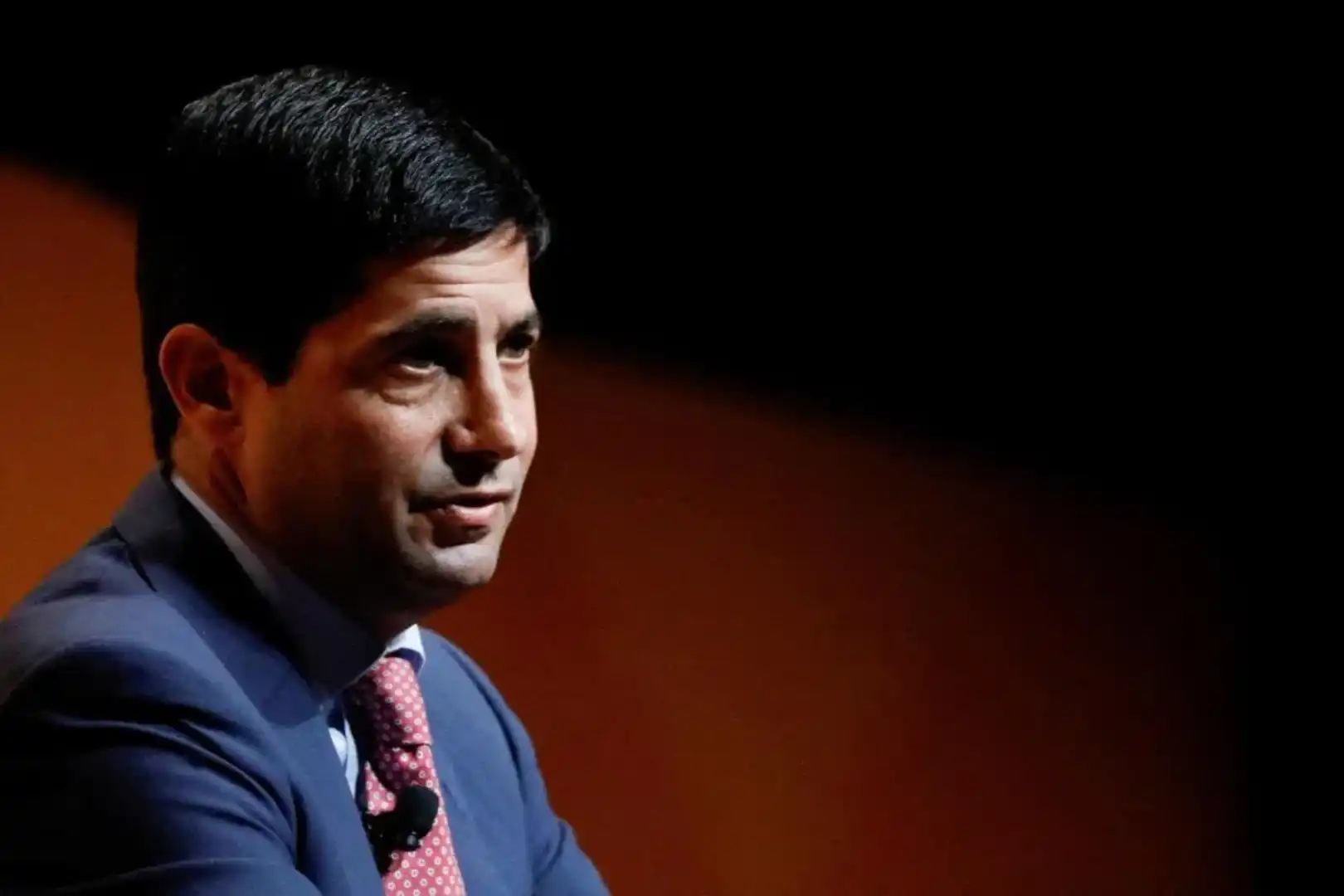
Генеральный директор Франклин Темплтон заявил, что TradFi недооценивает огромные масштабы биткоина

cryptonews.ruPublicado em 2023-08-21Última atualização em 2024-08-21

  • Генеральный директор Franklin Templeton Дженни Джонсон заявила, что традиционные Финансы недооценивают размер Bitcoin.
  • Она сослалась на объем транзакций криптовалюты, который в 2023 году был в два раза выше, чем у Mastercard и Visa вместе взятых.
  • Во вторник Джонсон выступил на симпозиуме по блокчейну в Вайоминге в Джексон-Хоуле.

ДЖЕКСОН-ХОУЛ, ВАЙОМИНГ — Генеральный директор Franklin Templeton Дженни Джонсон, которая направила гиганта по управлению активами в сферу цифровых активов после того, как в 2020 году возглавила семейную компанию, потрясена тем, насколько традиционные финансовые компании не осознают масштабов биткоина.

В ходе беседы на симпозиуме по блокчейну в Вайоминге в Джексон-Хоуле во вторник Джонсон заявила, что 30% ее повседневной работы уходит на изучение прорывных Технологии, поскольку ее основное внимание уделяется позиционированию фирмы для следующего поколения.

Сюда входят цифровые активы, которые Джонсон считает ONE из двух крупных и очевидных трендов, которые она T хотела бы пропустить. (Другой — искусственный интеллект.)

«Для меня безумием является то, что в традиционных Финансы люди не имеют ни малейшего представления о количестве денег и объеме [ Bitcoin]», — сказал Джонсон.

В 2023 году блокчейн Bitcoin (BTC) обработал транзакции на сумму более 36,6 триллионов долларов, поскольку рынок оправился от тяжелого года. Это контрастирует с Mastercard и Visa , двумя крупнейшими платежными сетями мира, которые обработали 9 триллионов и 14,8 триллионов долларов соответственно.

«Существует целая экосистема, которая практически игнорирует параллельную, огромную экосистему», — сказал Джонсон.

Mastercard и Visa T игнорируют Технологии блокчейна. Обе компании в последние годы прилагали усилия для добавления Криптo в свои сети. В частности, Visa проводила испытания за испытаниями, чтобы протестировать новые предложения продуктов, и сотрудничала с несколькими фирмами, работающими с криптовалютами, включая Circle и Solana, чтобы укрепить свои позиции в этой сфере. Mastercard выпускает дебетовую карту на основе блокчейна .

Franklin Templeton после назначения Джонсона генеральным директором компании быстро стал лидером среди традиционных управляющих финансовыми активами. Его OnChain US Government Money Market Fund (FOBXX) стал первым фондом, который использовал публичный блокчейн для записи транзакций и права собственности в 2021 году.

Ранее на этой неделе компания подала в Комиссию по ценным бумагам и биржам предложение о запуске нового биржевого фонда, торгующегося под тикером EZPZ, который откроет инвесторам ряд цифровых активов. Coinbase будет кастодианом этого фонда.

Leituras Relacionadas

Continuous Net Outflows from ETFs, Are Institutions Exiting?

US spot Bitcoin ETFs have experienced approximately $6 billion in net outflows over the past six weeks, marking the longest consecutive weekly withdrawal streak since their launch in 2024. The iShares Bitcoin Trust (IBIT) from BlackRock has been particularly affected, accounting for over 70% of recent outflows. On-chain analysis indicates that long-term Bitcoin holders (holding for over 155 days), who control about 83% of the circulating supply, remain steadfast. The selling pressure is primarily coming from allocators who entered through ETF brokerage accounts. This represents the first major collective capitulation since Bitcoin gained mainstream Wall Street recognition, driven more by risk-off portfolio adjustments than a fundamental rejection of the asset. Factors such as rising inflation, a hawkish shift in Federal Reserve policy, massive capital inflows into AI infrastructure, and attractive IPO opportunities have redirected speculative funds. Bitcoin, treated as a high-beta risk asset, was among the first to be sold. While the pace of outflows has slowed significantly—from $1.72 billion in early June to $226.8 million mid-month—the structural issue remains. IBIT's large size means its outflows alone exert substantial market pressure. With spot market volume thin, new capital inflows absent, and ETF buying muted, the market lacks sufficient buying support to absorb this selling. The coming sessions are critical. If IBIT outflows decelerate and Bitcoin reclaims $60,000, this phase could be seen as a healthy reset. However, if heavy IBIT redemptions resume and the price falls below $58,000, it would signal a more sustained institutional exit, requiring non-ETF buyers to shoulder the entire selling pressure alone. The ETF, while lowering entry barriers, has not removed Bitcoin's inherent volatility.

marsbitHá 3m

Continuous Net Outflows from ETFs, Are Institutions Exiting?

marsbitHá 3m

Introduction to the Concept of World Models: A Story from Psychology to the Main Battlefield of AI

**World Models: From Psychology to AI's Core Concept** "World model" is a trending but often confusing term in AI, describing a system that allows machines to internally simulate, predict, and rehearse potential outcomes before taking real-world action—like a mental "sandbox." While definitions vary—Yann LeCun emphasizes physical understanding, OpenAI's Sora is a video-based "world simulator," Google DeepMind's Genie 3 creates interactive 3D environments, and companies like Alibaba and Tesla focus on practical applications—the core goal is consistent: reduce reliance on vast real-world data by creating an internal, predictive model for safer and more efficient AI. The concept has deep roots, tracing back to psychologist Kenneth Craik (1943). In AI, it was revitalized by researchers like David Ha and Jürgen Schmidhuber (2018). Major technical approaches include: 1) generative video models (e.g., Sora) for visual realism; 2) abstract predictive models (e.g., LeCun's JEPA) for efficiency and physical reasoning; and 3) explicit 3D simulators (e.g., NVIDIA Omniverse) for precision. Fei-Fei Li proposes a classification based on the AI action loop: renderers (output observations), simulators (output world states), and planners (output actions). The emerging "World Action Model" (WAM) paradigm aims to unify future prediction and action generation. An industry framework is forming: upstream (data, compute, sensors), midstream (general and vertical platforms), and downstream applications (autonomous driving, robotics, gaming, etc.). Autonomous driving is currently the most mature use case. The current lack of a unified definition reflects the field's early, dynamic stage, similar to past tech revolutions. Different approaches—focusing on pixels, physics, or behavior—represent parallel explorations of how best to compress and understand the world. This diversity, while seemingly chaotic, signals that world models have moved from an academic idea to a critical industrial battleground, ultimately aiming to give machines the ability to understand, imagine, and reason about the world.

marsbitHá 28m

Introduction to the Concept of World Models: A Story from Psychology to the Main Battlefield of AI

marsbitHá 28m

Building the Bright Path While Secretly Crossing Chencang: Is Walsh Paving the Way for a September "Rate Cut"?

The title "Building the Plank Road Openly While Secretly Crossing at Chencang: Is Walsh Paving the Way for a September 'Rate Cut'?" suggests Federal Reserve Chair Kevin Walsh's hawkish stance may be a deliberate smokescreen. Academy Securities analyst Peter Tchir argues in a report that markets, currently pricing a 75% chance of a September hike, are missing a potential path to a September rate cut that Walsh himself might be quietly preparing. Tchir posits that Walsh's hawkish rhetoric aims to suppress long-term yield risks (with the 10-year Treasury yield falling recently) while creating room for a narrative shift based on upcoming data. The potential political endgame, according to this view, could be rate cuts in September and October, ahead of the midterm elections. This hinges on a political logic where the Trump administration's preference for lower rates remains unchanged. A core part of Tchir's argument involves redefining inflation metrics. He contends the Fed under Walsh may deprioritize the PCE index, criticizing its lagging components like Owners' Equivalent Rent (OER). Instead, he points to alternative, more real-time indicators like the New Tenant Repeat Rent Index (NTRR) and the Truflation daily index, which shows core inflation around 1.45%. He suggests the Fed could shift its data narrative to justify policy easing. Furthermore, Tchir downplays AI-driven inflation fears. He argues that consumer price sensitivity, evidenced by negative market reactions to price hikes (e.g., Apple), contradicts persistent inflation narratives. He also separates AI/data center spending—which he sees as relatively rate-insensitive—from broader consumer affordability issues, implying rate hikes are misdirected. Based on this analysis, Tchir sees a re-pricing of rate cut expectations as likely, creating opportunities in short-duration Treasuries. He maintains a neutral-to-slightly-bullish view on the long end of the yield curve. For equities, he recommends a significant overweight in energy (especially global nuclear assets) and, within defense/security themes, an overweight in biotech/pharma versus an underweight in semiconductors, expressing caution on AI/data center valuations.

marsbitHá 54m

Building the Bright Path While Secretly Crossing Chencang: Is Walsh Paving the Way for a September "Rate Cut"?

marsbitHá 54m

Trading

Spot
活动图片