Снова $50 000 за один биткоин? Анализ ситуации и прогнозы экспертов

cryptonews.ruPublicado em 2021-04-19Última atualização em 2024-08-19

На этой неделе биткоин демонстрирует слабую динамику, что заставляет трейдеров готовиться к возможному повторному тестированию уровней поддержки. После многообещающих выходных, которые закончились разочаровывающе, первая криптовалюта не вдохновляет участников рынка, уставших от движений в узком диапазоне.

Ключевые факторы влияния

В центре внимания на этой неделе оказалась Федеральная резервная система США с ее ежегодным симпозиумом в Джексон-Хоул. Трейдеры с нетерпением ждут выступления главы ФРС Джерома Пауэлла (Jerome Powell) 23 августа, надеясь получить четкий сигнал относительно возможного снижения процентных ставок в сентябре.

Это может привести к повышенной волатильности в конце недели. Тем временем растут опасения, что биткоин может потянуть весь крипторынок вниз. Некоторые аналитики предупреждают о возможном падении до $50 000, хотя майнеры пока сохраняют спокойствие.

Технический анализ

На момент написания статьи биткоин торгуется около $58 314. Популярный трейдер Roman считает, что цена может опуститься до уровня поддержки около $55 000. Он отметил, что индикатор волатильности Bollinger Bands должен дать предварительный сигнал о готовности рынка к прорыву в определенном направлении.
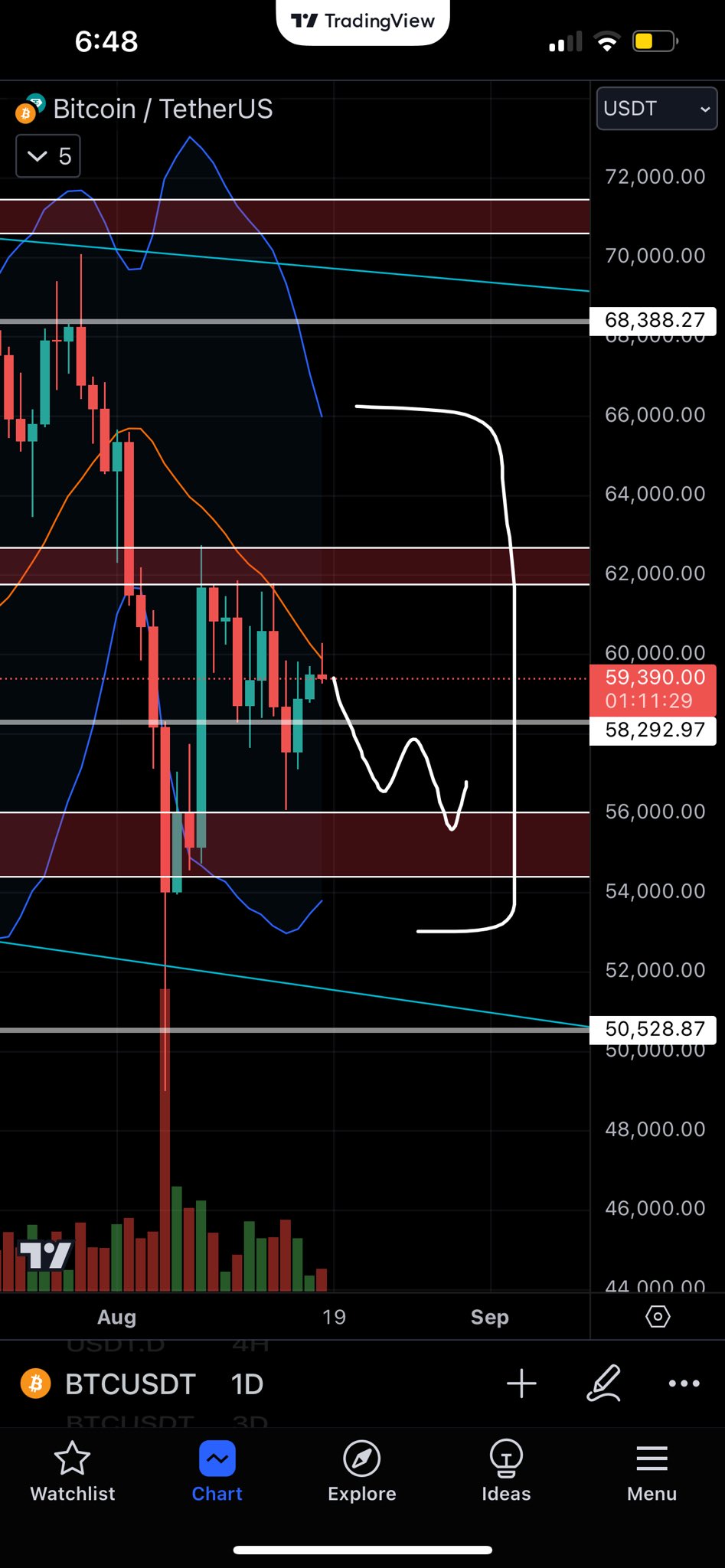
1-дневный график BTC/USDT. Аналитика: Roman

Аналитик CrypNuevo видит потенциальную «возможность для покупки» ближе к $50 000. Он предупреждает о возможном ложном прорыве вверх перед снижением цены в ближайшие дни:

  • $53 600 и $51 500 — потенциальные уровни, до которых может опуститься цена, чтобы заполнить фитили на недельном и дневном графиках
  • Возможен ложный прорыв выше текущего диапазона в начале недели с последующим падением до $56 000
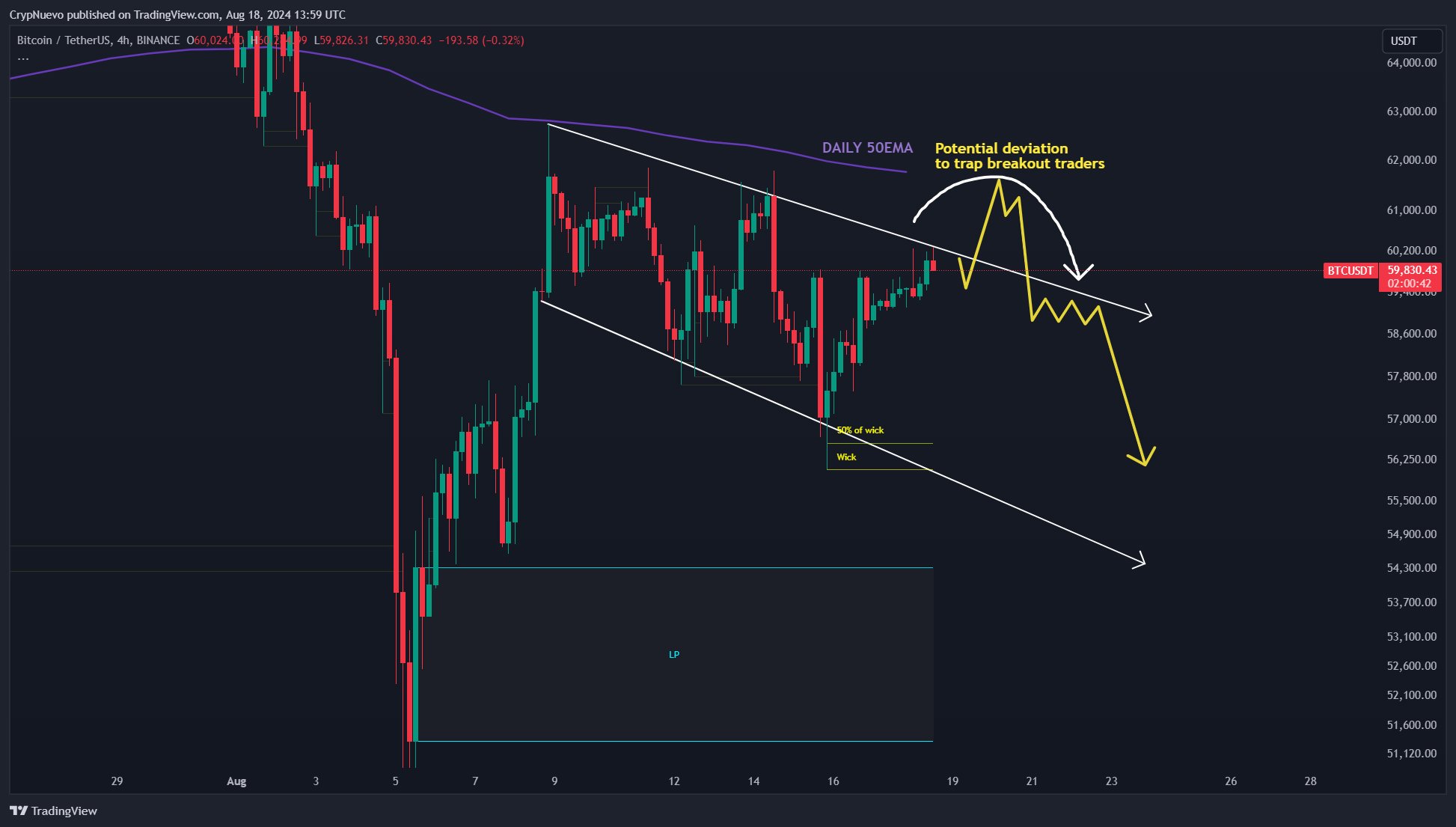
4-часовой график BTC/USDT. Аналитика: CrypNuevo

Настроения на рынке

Согласно данным индекса «Страха и жадности», настроения инвесторов находятся всего в трех пунктах от «крайнего страха», составляя 28 из 100.

Аналитик CryptoQuant Axel Adler Jr. отмечает, что цена биткоина торгуется ниже 200-дневной скользящей средней, что формально указывает на медвежьи настроения. Он также предупреждает о росте использования кредитного плеча на ведущих биржах, что может усилить волатильность.

Позиции майнеров

Несмотря на недавнее значительное снижение цены, майнеры пока не спешат продавать свои запасы биткоинов. По данным CryptoQuant, резервы BTC в известных кошельках майнеров начали стабилизироваться.

«Майнеры продавали свои биткоины через внебиржевые сделки и биржи до недавнего времени, но с конца июля не демонстрируют признаков продаж», — отмечает аналитик Crypto Dan.

Рыночная доминация биткоина

Доля биткоина в общей капитализации крипторынка достигла локального пика и начинает снижаться. Трейдеры предполагают, что это может привести к росту альткоинов в четвертом квартале.

Популярный трейдер Mikybull Crypto прогнозирует «большое падение» индекса доминирования биткоина, что должно спровоцировать ренессанс альткоинов.
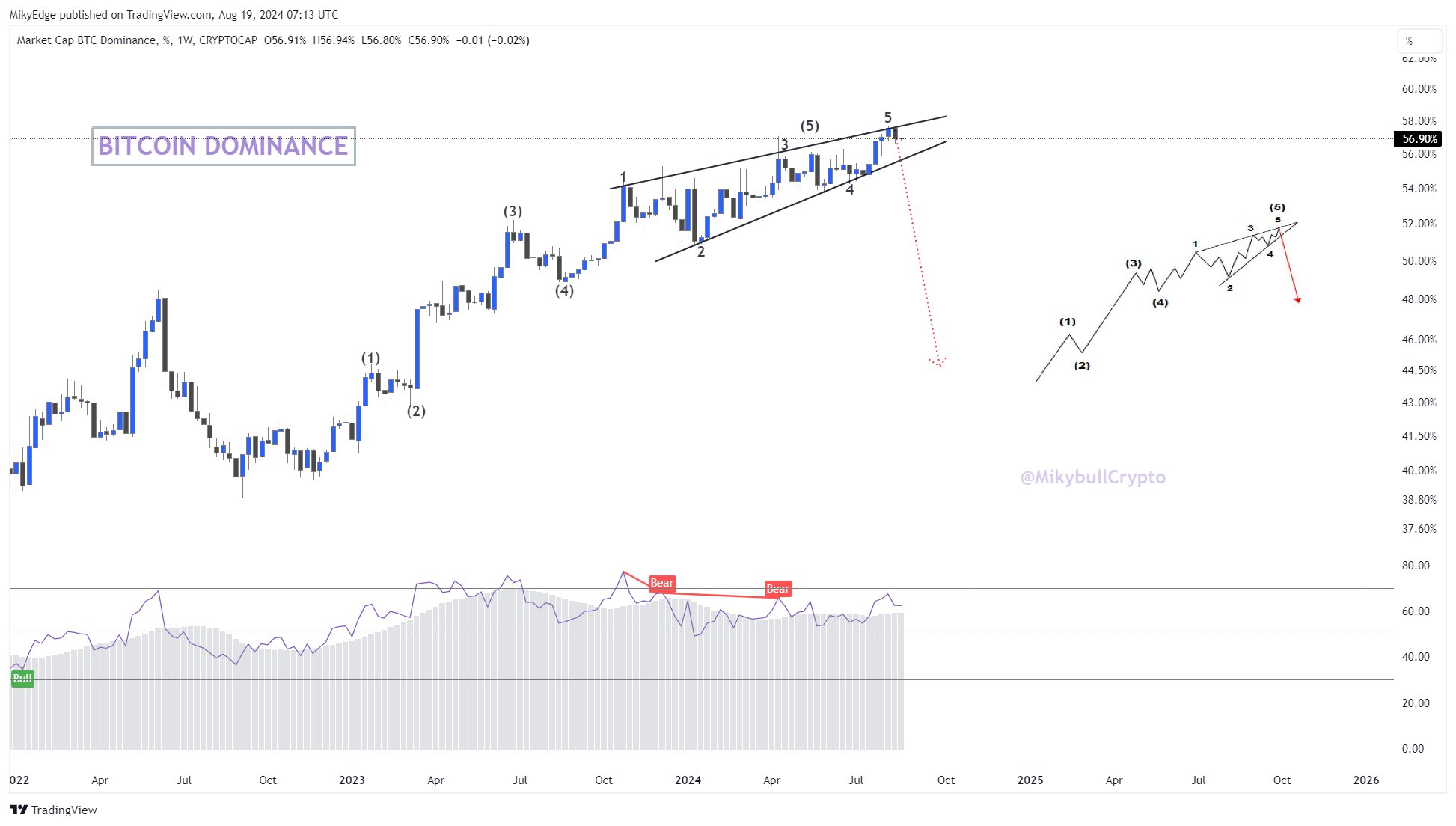
1-недельный график доминирования биткоина. Аналитика: Mikybull Crypto

Глава и основатель MN Trading Михаэль ван де Поппе (Michaël van de Poppe) считает, что в результате этого закончится «медвежий рынок» альткоинов.

Текущая ситуация на крипторынке остается неопределенной. Инвесторы внимательно следят за макроэкономическими факторами и техническими индикаторами, пытаясь определить дальнейшее направление движения цены биткоина. Волатильность может усилиться после выступления главы ФРС на симпозиуме в Джексон-Хоул.


Leituras Relacionadas

1996 or 1999? Walsh's First Test is 'How to View AI'

"1996 or 1999? Wall's First Big Test Is 'How to View AI'" Federal Reserve Chairman Wall's initial challenge is not whether to raise or cut rates, but a more fundamental judgment: what kind of boom is the current AI boom? This will determine the Fed's policy path and define his legacy. Economics is split between two opposing views, according to reporter Nick Timiraos. One sees imminent productivity gains that will increase supply and cool inflation, allowing the Fed to hold steady. The other argues that while productivity benefits are distant, demand shocks are here now, and waiting for data confirmation risks missing the intervention window, forcing sharper rate hikes later. Wall has signaled a leaning toward the first view, echoing 1996-era Alan Greenspan, who embraced strong, productivity-driven growth without fear of inflation. However, Wall faces a different macro environment than Greenspan did, with tariff pressures, expanding fiscal deficits, and diminishing globalization benefits, which could force more significant inflation pressures even if AI benefits materialize. Wall's logic, expressed before taking office, is that AI-driven productivity gains won't show in official data for years. If the Fed waits for confirmation, it might mistakenly tighten policy and choke off the very growth that could suppress inflation. This argues for using forward-looking narratives over lagging data. Chicago Fed President Austan Goolsbee presents a key counter-argument. He distinguishes between expected and unexpected productivity booms. A widely anticipated boom, like the current AI wave, can cause people to spend future wealth gains in advance, overheating the economy before productivity actually rises, thus requiring preemptive rate hikes. He cites rising costs for AI data centers as evidence of such overheating. Fed Governor Christopher Waller offers a rebuttal to Goolsbee, noting the "expected spending" mechanism only works if people can borrow against future income, which many households cannot do due to borrowing constraints. Wall also faces a paradox related to his desire to reduce the Fed's use of "forward guidance" (pre-announcing policy moves). This practice was established in 1999 when Greenspan began signaling hikes to avoid market shocks. If the economy follows a less optimistic path, Wall may be forced to choose between using the guidance he wants to abolish or risking market volatility by staying silent. The ultimate question defining Wall's first major test remains: Is this 1996 or 1999?

marsbitHá 24m

1996 or 1999? Walsh's First Test is 'How to View AI'

marsbitHá 24m

Ethereum Q1 2026 Report: Fees Decline, Users and Transaction Volume Hit New Highs

Ethereum Q1 2026 Report: Fees Down, Users & Transactions Hit New Highs Token Terminal's Q1 2026 report on Ethereum presents a pivotal development: the network achieved record highs in monthly active users (13.2M, +85.9% YoY), total transactions (200.4M, +81.5% YoY), and throughput (25.78 TPS), while transaction fees on the mainnet plummeted by 47.9% quarter-over-quarter. This shift is attributed to the network's strategic move into a "low fees for scale" phase, exemplified by the Fusaka upgrade which increased data capacity and lowered block space costs, releasing pent-up demand (a manifestation of Jevons's Paradox). The report highlights a core narrative shift for Ethereum: from a DeFi-centric blockchain to a global financial settlement layer. It maintains a dominant position in tokenized assets, holding majority market shares among top chains in stablecoins (61.8%), tokenized funds (73.0%), and tokenized commodities (84.0%). Growth in tokenized funds (+73.1% YoY) and commodities (+325.9% YoY) was particularly strong, driven by institutions like BlackRock and JPMorgan entering the space. Contrasting these usage gains, several USD-denominated value metrics declined in Q1: fully diluted market cap fell 30.3% QoQ, total value locked (TVL) dropped 11.0%, and ecosystem transaction volume decreased 24.0%. The report interprets this as Ethereum prioritizing long-term network expansion and cementing its role as the default settlement layer for finance over short-term fee capture. The commentary from Etherealize argues that, much like the early internet, Ethereum's open, permissionless model is poised to win over closed alternatives as institutional tokenization accelerates.

marsbitHá 2h

Ethereum Q1 2026 Report: Fees Decline, Users and Transaction Volume Hit New Highs

marsbitHá 2h

He Just Raised 2.7 Billion, and Li Fei-Fei Also Invested

Pete Florence, a former senior research scientist at Google DeepMind and a key contributor to the Vision-Language-Action (VLA) model architecture, is deliberately distancing his startup, Generalist AI, from the trendy "world model" label. He argues that the industry should prioritize concrete goals over buzzwords. His goal is to create robots that can perform a vast range of unseen tasks with high speed and success rates, without needing task-specific training data. Recently, his company raised $400 million (¥2.7 billion) at a $2 billion valuation. Notable investors include NVIDIA's NVentures, Bezos Expeditions, NFDG, as well as Xiaomi co-founder Lin Bin, Zoom founder Eric Yuan, and renowned AI scientist Fei-Fei Li. Florence's approach stems from his academic background at MIT under Professor Russ Tedrake, focusing on understanding the physical world. After joining DeepMind, he developed models like Transporter Network and co-created the VLA framework. He left in 2025 to found Generalist AI. The company has launched two models: GEN-0, which demonstrated that scaling laws apply to physical motion, and GEN-1. GEN-1 was trained on over 500,000 hours of physical interaction data collected via a specialized wearable device. It achieves a 99% success rate on precise mechanical tasks like folding boxes and maintains performance three times faster than its predecessor. Florence believes GEN-1 is reaching a commercial utility threshold similar to the GPT-3 inflection point. The substantial funding round, following GEN-1's release, signifies strong investor confidence in Generalist AI's practical, goal-driven path to creating versatile, useful robots, regardless of the "world model" terminology.

marsbitHá 2h

He Just Raised 2.7 Billion, and Li Fei-Fei Also Invested

marsbitHá 2h

Two Legends Lost in Three Days: Is Google's AI Talent Dam Cracking?

In three days, Google lost two AI legends. On June 18, Noam Shazeer, co-author of the seminal "Attention is All You Need" paper and Gemini co-lead, left for OpenAI. Just 48 hours later, John Jumper, 2024 Nobel laureate and AlphaFold lead, departed DeepMind for Anthropic. This follows Andrej Karpathy joining Anthropic in May. These moves highlight a structural trend: top AI talent is concentrating at mission-driven, pre-IPO firms like OpenAI and Anthropic, while Google becomes a primary source. The exodus stems from a core mission mismatch. Google's ad-centric model often subordinates AI research to product and revenue goals, creating friction for pioneers like Shazeer, who returned in 2024 only to leave again. In contrast, OpenAI and Anthropic offer singular focus on pushing AI boundaries, whether towards AGI or safety-aligned models, which deeply appeals to top researchers like Jumper. Financial incentives amplify the pull. With both OpenAI and Anthropic nearing IPO, employees stand to gain immensely from equity, an upside Google's mature stock cannot match. Furthermore, the 2023 merger of Google Brain and DeepMind, intended to consolidate strength, has instead created cultural tension and slowed the path from research to product, as evidenced by Gemini's pace. This talent redistribution is reshaping the AI landscape. While Google retains vast data and compute resources, its true crisis is the quiet, continuous loss of the people who define the field's future. The real moat in AI is not infrastructure, but the concentration of brilliant minds—a battle Google is currently losing.

marsbitHá 4h

Two Legends Lost in Three Days: Is Google's AI Talent Dam Cracking?

marsbitHá 4h

Trading

Spot
Futuros
活动图片