$2.5 Billion Liquidated: Crypto Market Cursed with Following Declines but Not Rallies

Odaily星球日报Publicado em 2026-02-01Última atualização em 2026-02-01

Resumo

A massive crypto market crash on January 31 led to $2.522 billion in liquidations, with Bitcoin falling below $78,000 (a 7.6% drop) and Ethereum plunging over 12% to under $2,400, erasing gains from mid-2025. Solana also dropped sharply, falling below $100. The sell-off was triggered by broader financial turmoil, beginning with escalating geopolitical tensions and accelerated by a severe crash in precious metals. Gold and silver saw dramatic drops—15.7% and 37%, respectively—after reports suggested former Fed official Kevin Warsh, perceived as hawkish, might be nominated as the next Fed chair. This sparked a repricing of expectations around U.S. monetary policy and a stronger dollar. The crypto market, positioned at the bottom of the risk asset hierarchy, suffered disproportionately—falling more sharply than traditional markets during downturns without matching their rallies. Major players were heavily impacted: trader Garrett Bullish saw over $700 million liquidated in a single position on Hyperliquid, while institutional entity Trend Research faces nearly $500 million in unrealized losses on its Ethereum holdings. Despite Bitcoin’s price relative to gold hitting historic lows—a signal some interpret as a potential long-term buying opportunity—the event underscores crypto’s current role as a high-risk asset vulnerable to macro shocks, lacking the stable store-of-value status of traditional safe havens. The market is now questioning what will sustain long-term holding thro...

Original | Odaily Planet Daily (@OdailyChina)

Author | Ding Dang (@XiaMiPP)
A flash crash has happened again.

On the night of January 31, Bitcoin briefly fell below $78,000, hitting a low of $75,700, with a 24-hour drop of 7.6%. This decline was not only extremely rapid but, more critically, it directly broke through the price range where BTC had been consolidating for nearly three months, retreating to lows not seen since April 2025.

The situation for ETH is even more concerning, with its price falling below the $2,400 mark, a 24-hour plunge of 12.28%, almost completely erasing all gains since July 2025. Solana was not spared either, with its price dropping below $100, a single-day decline of 13.74%, returning to levels last seen in February 2025.

The collective downturn of mainstream assets seems to be approaching a new critical point.

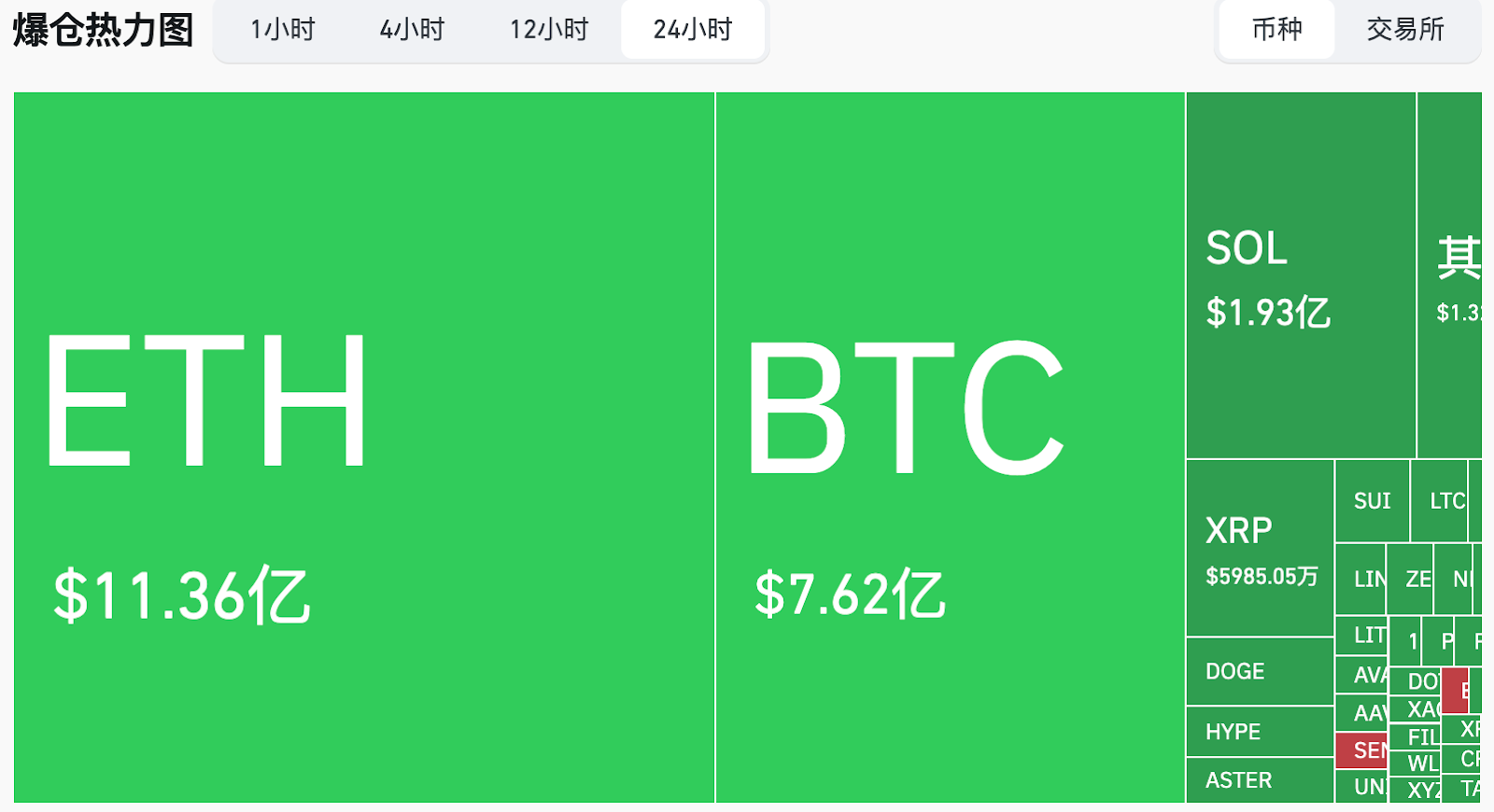
In derivatives, over the past 24 hours, $2.522 billion was liquidated, with long positions accounting for $2.411 billion and short positions $115 million. The largest single liquidation occurred on Hyperliquid - ETH-USD, worth approximately $222 million. Notably, in just the past hour, liquidation amounts reached as high as $1.14 billion.
The Starting Point of the Decline Lies Not Only Within the Crypto Market

The first domino of this round of market movement was not on-chain.

Looking at the timeline, market tension began to noticeably intensify from January 29. The sudden escalation of geopolitical risk was one of the earliest triggering factors captured by the market. The U.S. aircraft carrier USS Abraham Lincoln and its strike group entered a "lights-out" status with communications cut off, while statements from Iran also clearly shifted to a combat-ready posture. Odaily Planet Daily had previously provided a detailed analysis in From Geopolitical Tension to Liquidity Tightening, BTC Dragged into Uncontrolled Market Conditions.

Even so, the speed of this crypto market decline far exceeded expectations. What truly caused the risk to spill over rapidly was the simultaneous crash in the precious metals market.

After Gold and Silver Fell, Crypto's Uncontrolled Decline Accelerated

On January 29, gold turned downward sharply after briefly breaking above $5,600, falling to a low of around $4,740, a maximum drop of 15.7%. The adjustment in silver was even more severe, plummeting after breaking above $120 to a low of $76.6, a maximum drop of 37%.

Dirk Malakie, Managing Director of SLC Management, pointed out that the plunge in gold and silver began with the market's reaction to reports that Trump would nominate Kevin Warsh as Fed Chair. Warsh's resume carries distinct hawkish tones, which somewhat weakened the expectation of a "long-term comprehensive devaluation of the U.S. dollar." The market is re-anchoring towards a more orderly monetary policy path. Related reading: "Estée Lauder Son-in-Law" Kevin Warsh Takes Helm at the Fed, Hawkish Bigwig Turns Out to Be a Crypto Ally?

Seth R. Freeman, Senior Managing Director at GlassRatner Advisory & Capital Group, also believes that the "good news" in this nomination is that the market might not have to repeatedly deal with the uncertainty and emotional disturbance caused by Trump's continuous pressure on the Fed. The sharp fall in gold and silver already reflects the market's repricing for a stronger dollar environment. In his view, it would not be surprising if metal prices fail to show a significant rebound in this context. On the contrary, traders heavily long precious metals without effective hedging may face continued pressure, especially silver bulls. By next Monday, some trading accounts might suffer severe losses.

Additionally, analysts mentioned that month-end concentrated profit-taking trading behavior, and hedging operations by banks to guard against sudden declines, may have amplified the selling pressure in a short period.

Adrian Ash, Head of Research at BullionVault, stated that he has been involved in the precious metals market for 20 years and has never seen a similar行情. However, he downplayed the theory of "retail concentrated withdrawal," pointing out that abnormal fluctuations also occurred in basic metal markets like copper—for example, copper futures fell 4.5% on Friday. If it were only gold and silver, it could be attributed to retail sentiment, but the basic metals market has almost no retail participation.

Bitcoin Fell to a Historical Low Relative to Gold

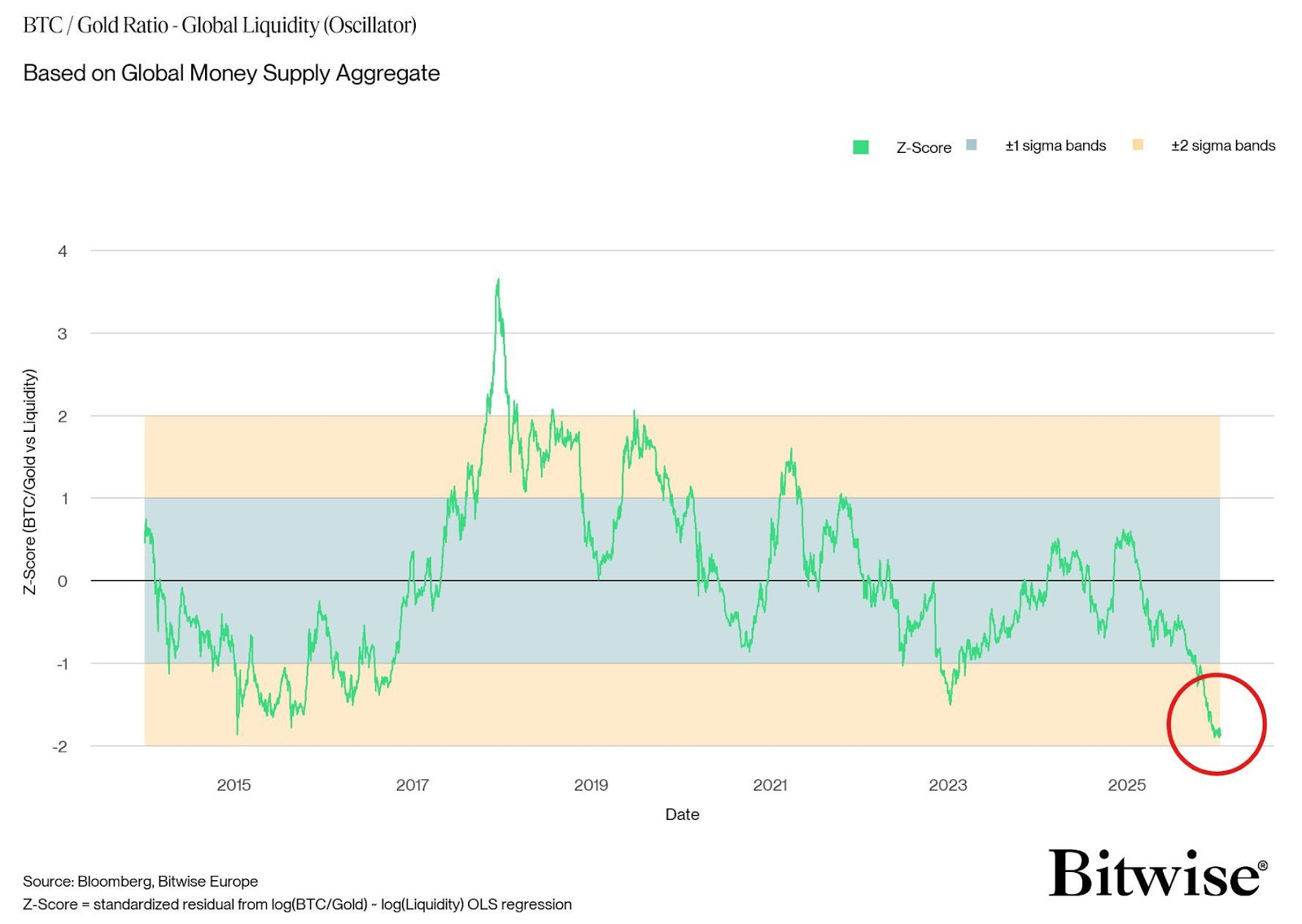
Data from Bitwise Europe shows that the price ratio of Bitcoin relative to gold has fallen to a historical low. This indicator has appeared multiple times in the past near the阶段性 bottoms of Bitcoin.

This implies two coexisting realities: on one hand, Bitcoin is currently weak relative to gold; on the other hand, this extreme weakness also leads some analysts to view the current environment as a potential accumulation zone similar to the pre-bull market launch period of 2015-2017.

The market widely observes that long-term holders are gradually absorbing recent selling pressure. As funds rotate between safe-haven assets and risk assets, some traders anticipate that a阶段性回流 from gold to Bitcoin may occur starting in February.

However, more cautious views point out that fund rotation is not inevitable and requires continuous observation of macro policy, dollar trends, and overall risk appetite changes.
Risk Transmission, Redistribution of Chips

The暴跌 in gold and silver ultimately transmitted to the crypto market. It must be said that the crypto market is now at the bottom of the food chain: when U.S. stocks rise, crypto may not rise; when U.S. stocks fall, crypto often falls deeper; and now, as precious metals fall, crypto cannot escape either. The crypto market seems to have fallen into a "follow declines but not rallies" curse.

In this situation, the "believers" long on crypto assets also seem to be losing their chips in this flood.

Garrett Bullish (@GarrettBullish), the lucky one who made the most profit in the 1011 flash crash, failed to escape this disaster. His position on Hyperliquid was fully liquidated, with a single liquidation规模 exceeding $700 million, leaving his account balance at just $53.68. This was also the largest single liquidation in this event. Data shows that his cumulative loss on Hyperliquid over the past two weeks was approximately $270 million.

On-chain records also show that since starting to use this account for trading in early October 2025, Garrett Bullish's historical cumulative PnL has lost over $128 million.
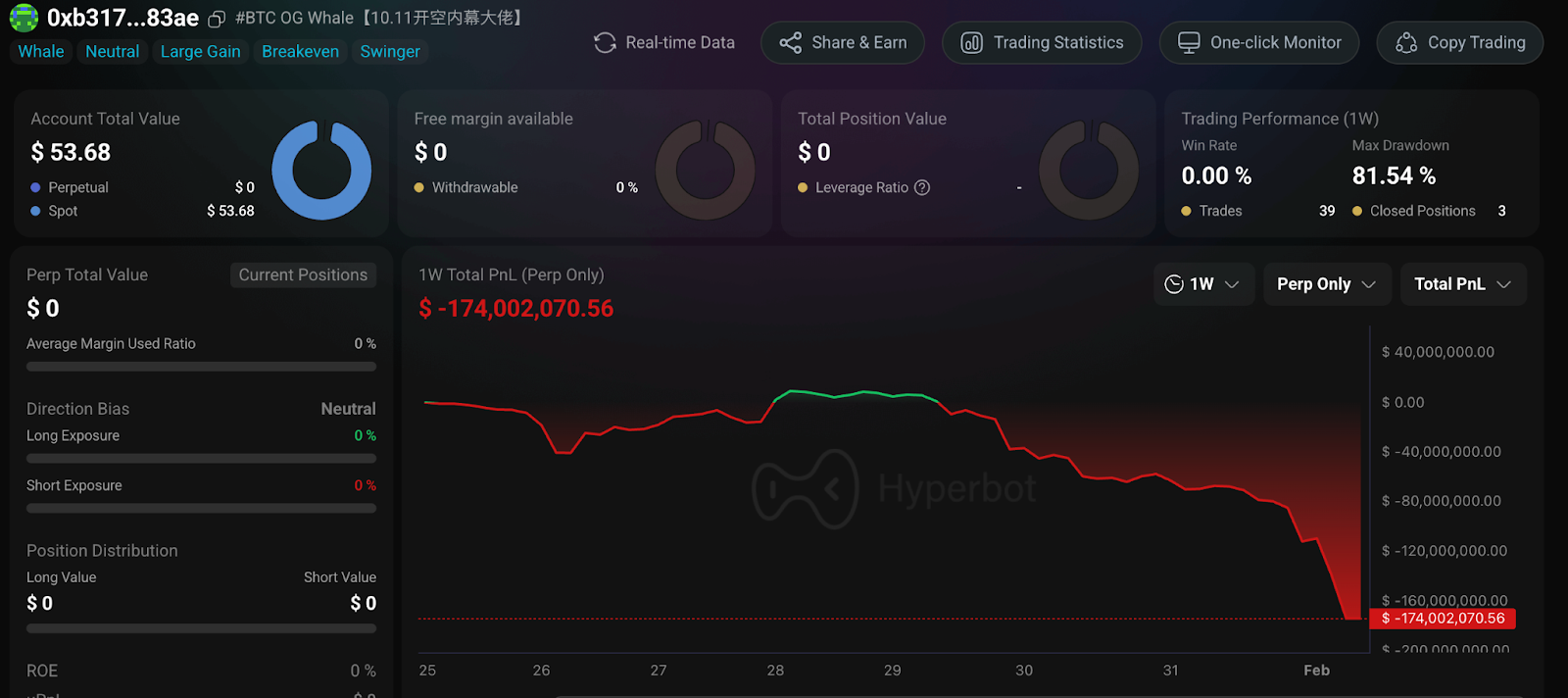
Behind the liquidations is protocol revenue. After Garrett Bullish's liquidation was completed, the Hyperliquid ecosystem treasury HLP gained approximately $15 million in收益. This single event brought HLP depositors a return of about 5.8%, translating to an annualized yield of about 110%. Data shows that HLP still holds an ETH long position worth approximately $230 million.

The whale高调做多 ETH also seems to be having a hard time. According to on-chain data monitoring, the secondary fund Trend Research under Yi Lihua has currently抵押 175,800 WETH on Aave V3, worth approximately $445 million, and borrowed about 274 million USDT. The liquidation price for the ETH position is $1,558, with a loan position health factor of 1.34. During the market decline, Trend Research continued to add margin. Yesterday, it withdrew approximately 109 million USDT from Binance and deposited it into Aave to reduce the liquidation risk of its Ethereum position.

As of January 29, Trend Research held approximately 651,300 ETH, with an average holding price of around $3,180. Calculated at the current price of $2,400, the floating loss is nearly $500 million.

Conclusion

From the升温 of geopolitical risks to the collapse of precious metals, crypto assets have become the first to be abandoned in this process. Does this indicate that it is not a safe-haven asset and has not yet truly gained the consensus support of a "value anchor,"只能 passively bearing pressure amidst the fluctuations of macro sentiment?

This round of market conditions is forcing the market to re-examine a question: In a deleveraging cycle, what justifies crypto assets being held long-term?


Perguntas relacionadas

QWhat was the total amount of liquidation in the crypto market over the past 24 hours, and what was the breakdown between long and short positions?

AThe total liquidation amount was $2.522 billion. Of this, long positions accounted for $2.411 billion, while short positions accounted for $115 million.

QWhat external event, outside of the crypto market, is cited as the initial trigger for the market's downturn?

AThe initial trigger was a sharp escalation in geopolitical risk, marked by the US aircraft carrier USS Abraham Lincoln and its strike group entering a 'lights out' and communications blackout status, coupled with Iran shifting to a more combat-ready posture.

QAccording to the article, why did the prices of gold and silver crash, and how did this affect the crypto market?

AGold and silver prices crashed due to market reactions to reports that former President Trump would nominate the perceived hawkish Kevin Warsh as Federal Reserve Chair, which led to a repricing for a stronger dollar environment. This暴跌 (crash) in precious metals subsequently accelerated the失控 (loss of control) in the crypto market.

QWho was the individual trader that suffered the largest single liquidation in this event, and what was the approximate size of that liquidation?

AThe individual trader was Garrett Bullish (@GarrettBullish). The approximate size of his single liquidation on Hyperliquid was over $700 million.

QWhat does the article suggest about the current status of Bitcoin as an asset class based on its reaction to the broader market sell-off?

AThe article suggests that Bitcoin is not seen as a safe-haven asset and has not yet gained consensus as a 'store of value.' It is positioned at the 'bottom of the food chain,' often falling more deeply when other markets decline and failing to rise when they do, indicating it is passively bearing the pressure of macro sentiment shifts.

Leituras Relacionadas

Analyzing the Impact of AI on Economic Growth and Productivity

**Title: Analyzing AI's Impact on Economic Growth and Productivity** This article examines three contrasting views on AI's influence on economic growth and productivity. **The Optimistic View** posits that AI, especially through automating R&D ("recursive self-improvement"), could dramatically accelerate growth, even triggering a technological "singularity" with explosive, potentially infinite, economic expansion. **The Moderate/Mainstream View** acknowledges AI's productivity benefits but emphasizes significant real-world constraints that could limit its impact. These include: limited cost savings per task, structural ceilings on which jobs and industries are "exposed" to AI, adoption bottlenecks (e.g., compute, energy, regulatory hurdles), and the "weak link" effect where non-automatable tasks cap overall gains. Consequently, the realized AI dividend may be far lower than optimistic projections, with estimates typically ranging from 0.1% to 1.3% annual productivity growth. **The Pessimistic View** stems from two strands. The first aligns with the moderate view but applies extremely conservative assumptions about task exposure and efficiency gains, yielding minimal projected impact. The second introduces a demand-side critique: if AI primarily replaces rather than augments labor, it could depress labor's share of income, weaken consumer demand, and create a "demand trap" that ultimately stifles growth, unless offset by redistribution policies. **The authors' assessment** is nuanced: * **Short-term (1-2 years):** AI will support growth primarily through investment spending, not significant productivity gains. * **Medium-term (3-5 years):** Three potential paths emerge based on AI demand and bottleneck severity: 1. **"Optimistic Path":** High demand, few bottlenecks. Rapid productivity gains but risk of major job displacement and social conflict without redistribution. 2. **"Moderate Path" (most likely):** High demand but significant, surmountable bottlenecks. Leads to moderate productivity gains, financial market volatility (K-shaped returns), and sectoral job losses. 3. **"Pessimistic Path":** Low demand or severe bottlenecks. Minimal productivity and growth impact, triggering financial market corrections but allowing a smoother societal transition with less labor disruption. * **Long-term:** AI holds potential for a major productivity revolution and prosperity. The conclusion stresses that no path is smooth. Technologically "optimistic" outcomes could be socially detrimental, while "pessimistic" technological diffusion might be more socially stable. Policymakers must monitor developments and prepare balanced responses to manage economic, financial, and social sustainability.

marsbitHá 3m

Analyzing the Impact of AI on Economic Growth and Productivity

marsbitHá 3m

The New Cold War is a Tech Stock War

The New Cold War is a Tech Stock War The article argues that the contemporary geopolitical and economic rivalry between the US and China represents a "New Cold War," but one fundamentally fought through technology and financial markets, not physical barriers or conventional trade. Historically, US dominance was secured through financial systems. The Soviet Union, reliant on the rigid "Transferable Ruble," was ultimately undermined by its dependency on the US dollar for oil trade. Later, Japan's semiconductor challenge was countered not just by tariffs (e.g., Plaza Accord, 301 investigations) but by binding it to US Treasury bonds. China presents a more complex, "embedded" challenger. While it holds vast dollar reserves and US debt like Japan, its industrial base is stronger and more diversified than the Soviet Union's. Surviving the initial 2018 trade war phase, the conflict has evolved into a "tech-financial war." The core battlefield is now the stock market. US tech stocks (AI, semiconductors) are treated as sovereign assets, buoyed by bipartisan national will. China is pushing to strengthen its own financial markets to convert industrial strength into financial power and fund its tech ambitions. Companies like ChangXin (semiconductors), Moonshot AI, and DJI compete not just for market share but as financial proxies for their respective systems. The new paradigm is moving from globally efficient monopolies (Apple, Google) towards companies that achieve monopolistic profits within their respective geopolitical spheres. This competition over "pricing power" and financial valuation in segmented markets defines the current era, making the stock market the primary arena for this tech-centric struggle.

marsbitHá 13m

The New Cold War is a Tech Stock War

marsbitHá 13m

RWA Weekly: Ten European Financial Institutions Establish Tokenized Asset Cooperative; Ondo Launches New Execution Network Ondo Network

RWA Weekly: European Banks Form Tokenized Asset Cooperative; Ondo Launches New Execution Network Ondo Network Covering July 24-31, 2026, the RWA sector saw a steady on-chain total value locked (TVL) of $36.8 billion, with holder count hitting a record high. However, stablecoin transfer volumes fell sharply (~30%), indicating low on-chain settlement demand. Key regulatory moves include South Korea advancing stablecoin legislation and a push to scrap crypto taxes, Kenya lowering capital requirements for stablecoin issuers, and Zimbabwe approving seven projects for its crypto sandbox. In project developments, BIS-led Project Agorá successfully tested cross-border payments with tokenized funds across six currencies. Ten major European financial institutions formed the RL1 blockchain cooperative to build tokenized asset infrastructure. Other notable updates: Aviva launched a tokenized dollar liquidity fund on XRPL, POSCO International tokenized commercial invoices on Injective, and a Brazilian farmer used tokenized cattle as collateral for a loan. Additional progress includes BNY Mellon migrating its core transfer agent operations to blockchain, Securitize gaining SEC investment advisor registration, and Tether’s compliant stablecoin USA₮ launching on Celo. Ondo Finance introduced Ondo Network, a new execution layer focused on speed and privacy, moving away from its initial chain plans. An analysis highlights that despite the growing scale of on-chain RWAs (~$32B), approximately 90% remain underutilized in DeFi, pointing to a critical challenge in unlocking liquidity and fostering real-world application beyond mere issuance.

marsbitHá 13m

RWA Weekly: Ten European Financial Institutions Establish Tokenized Asset Cooperative; Ondo Launches New Execution Network Ondo Network

marsbitHá 13m

South Korean Stock Market Sees Sharp Rebound After Forceful De-leveraging, SK Hynix Rises 30%

On July 31, South Korean stocks staged a historic rebound. The benchmark KOSPI index surged 18.27%, with chipmaker SK Hynix hitting a 30% gain limit. This followed a brutal, near-40% decline in the KOSPI over the previous month, driven largely by a deleveraging spiral involving leveraged ETFs. Analysts attributed the sharp sell-off to structural liquidity issues rather than deteriorating corporate fundamentals. The rally was triggered by a confluence of positive catalysts. Firstly, strong earnings from U.S. cloud giants Microsoft and Amazon alleviated fears of an "AI bubble burst," boosting global tech sentiment. Secondly, SK Group Chairman Chey Tae-won made a rare personal purchase of SK Hynix shares, seen as a strong vote of confidence. Thirdly, the South Korean government announced a 20 trillion won ($139 billion) AI investment fund. In response to the market turmoil, South Korean regulators are tightening controls on leveraged ETFs, admitting oversight shortcomings. Measures include raising minimum cash保证金 requirements for散户 investors and suspending new product launches. While the rebound signals eased liquidity pressure, analysts note deep structural issues remain. The market's future stability is seen as dependent on global tech capital expenditure trends and memory chip price cycles, with some viewing the surge as a technical correction rather than a definitive trend reversal.

marsbitHá 34m

South Korean Stock Market Sees Sharp Rebound After Forceful De-leveraging, SK Hynix Rises 30%

marsbitHá 34m

Trading

Spot
活动图片