usual.money :RWA去中心化稳定币

marsbitPublicado em 2024-08-10Última atualização em 2024-08-11

Why usual?

稳定币可以说是加密货币行业的根基,人们需要稳定币来作为大规模支付的用例,同时稳定币也在行业的 Mass Adoption 中发挥着关键作用。截至 2024 年 7 月 30 日,稳定币总市值为 $ 168 B,而从下面这张稳定币市值概览图中可以看出,两大中心化稳定币,USDT 和 USDC 加起来占据了稳定币总市值的约 90% 
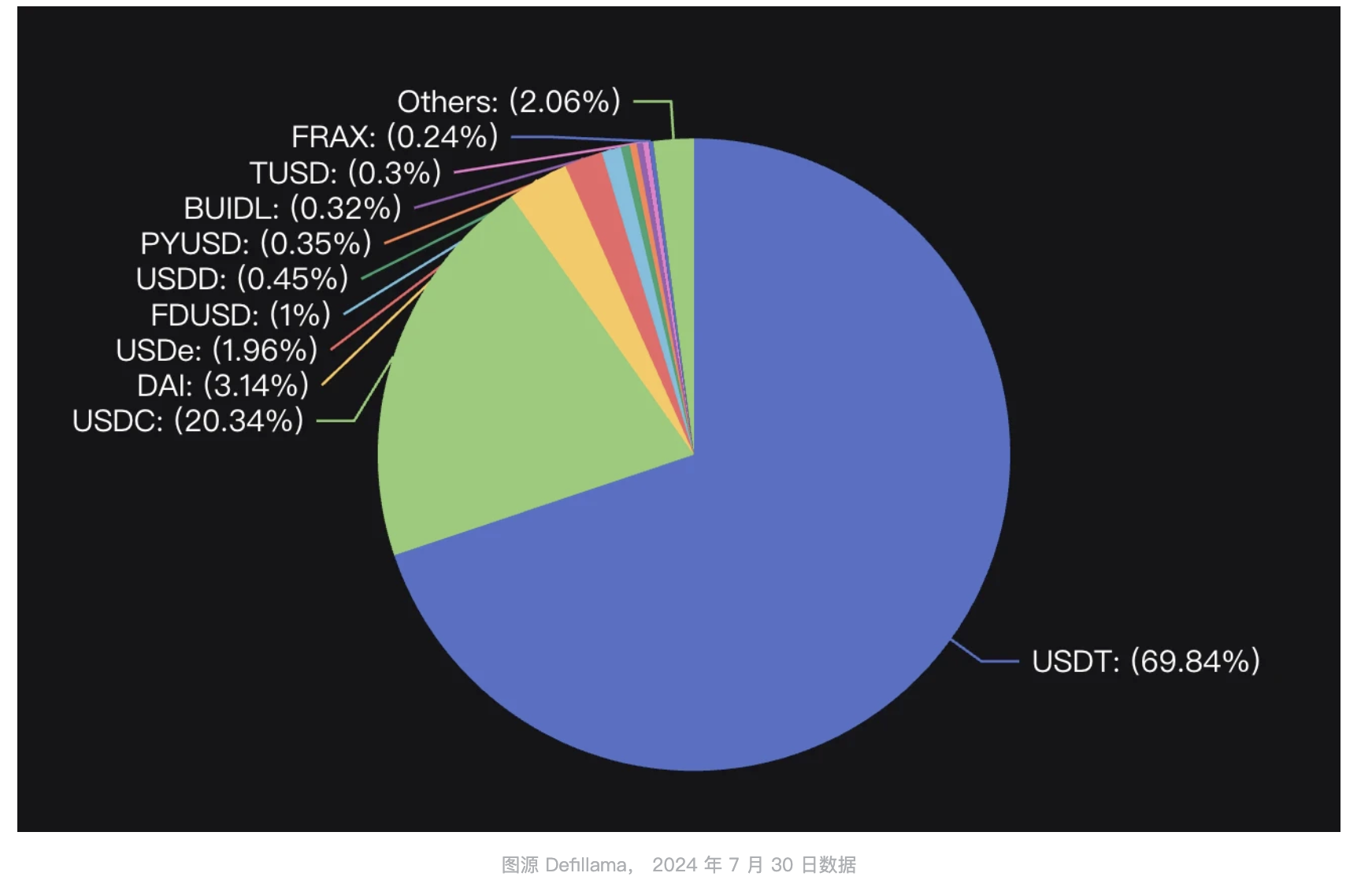
稳定币

稳定币是 Crypto 的印钞机,两大巨头 Tether 和 Circle 在 2023 年创造了超过 100 亿美元的收入,估值超过 2000 亿美元。Tether 在 2024 年 Q1,更是创纪录地获利 45.2 亿美元。如此巨大的获利垄断与加密精神显然相悖,因此各类去中心化稳定币项目源源不断。根据抵押额度,去中心化稳定币可以分为以 MakerDAO(DAI)为代表的超额抵押,以 Ethena(USDe)为代表的等额抵押,以及不足额抵押(目前没有跑出大市值项目)。

去中心化稳定币有过不少成功的项目,然而这些项目的抵押物普遍是加密资产,因此需要设计一套精密的机制来对抗币价的波动。而如果引入 RWA(现实世界资产),这个问题将迎刃而解。RWA 正在增长且方兴未艾, 2023 年区块链上的 RWA 增长超过 800% 。usual.money 引入了美国国库券作为抵押物,同时基于以太坊智能合约提供透明度和安全性,将利润归还给社区和贡献者。这一设计可以说是 tether-on-chain,兼具了中心化稳定币协议的 1: 1 RWA 特性以及链上的安全与透明。
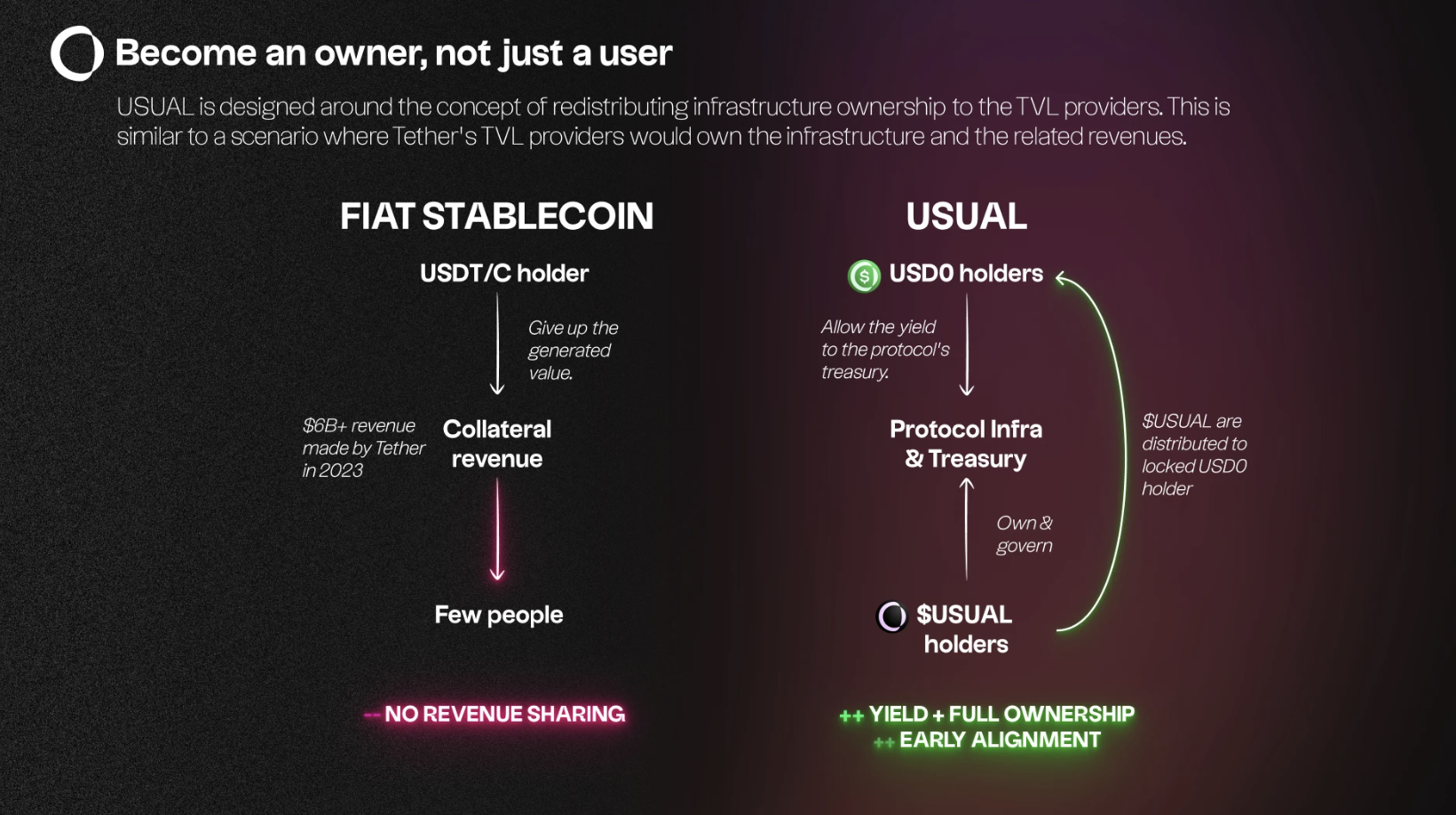
稳定币

背景

2024 年 4 月 17 日,Usual Labs 完成 700 万美元融资,IOSG 和 Kraken Ventures 领投,GSR、Mantle、Starkware、Flowdesk、Avid 3、Bing Ventures、Breed、Hypersphere、Kima Ventures、Psalion、Public Works 和 X Ventures 等参投。

创始人 Pierre Person 曾是法国政治家、国民议会议员,最近还担任总统政党副主席,带头推动了该国的加密资产立法。

7 月 10 日,Usual 宣布其主网启动。截至 8 月 6 日,项目 TVL 为 $ 146 M。

根据 Coinmarketcap 8 月 6 日的数据,目前 USD 0 接近 95% 的交易都在 Curve 的 USD 0/USDC 池子,有着 $ 11.33 M 的流动性。同时,在 Maverick Protocol 上有 Aave 的稳定币 GHO 和 USD 0 的 LP,目前 TVL 为 $ 100 k。

目前 USD 0 在借贷项目 Morpho 上有由 MEV Capital 策划的金库,USD 0 USD 0++/USDC 和 USD 0++/USDC 的流动性池,以 86% 的 LLTV(Liquidation Loan-to-Value,清算贷款价值比)有着总共接近 $ 30 M 的抵押。通过这个池子可以同时获得 Usual 的 Pills 奖励(详见文末交互章节)以及 Morpho 代币奖励。

$USUAL TGE 预计在 2024 年 Q4,其中 90% 的 USUAL 代币分配给社区。

机制分析

抵押与铸造

$USD 0 是首个聚合各种美国国库券代币的 RWA 稳定币,可以通过两种不同的方式在 Usual 上铸造:

a. 直接 RWA 存款:用户将符合条件的 RWA 存入协议,并以 1: 1 的比例获得等值的 USD 0 。

b. 间接 USDC/USDT 存款:用户将 USDC/USDT 存入协议,以 1: 1 的比例接收 USD 0 。这种间接方法涉及第三方抵押品提供商,他们提供必要的 RWA 抵押品。这使用户无需直接处理 RWA 即可获得 USD 0 。

RWA 增长显著,但仍然只占加密货币市场基础资产的一小部分,主要挑战在于流动性问题,包括机构在二级市场清算 RWA 持有量面临的困难,以及散户投资者无法在核心 DeFi 生态系统中获得 RWA 回报。通过 USD 0 ,Usual 能够无缝整合来自 Hashnote 等平台的 RWA 代币流动性。

收益

$USD 0++ 是一种增值型国库券,USD 0++ 是 USD 0 的包装和锁定版本。

$USUAL 是 Usual 协议的治理和奖励代币。

收益来源于质押:用户将其 USD 0 锁定在 USD 0 Liquid Bond (USD 0++) 中一段时间。收益可以从下面两种方式中选择一种:

a.USUAL 收益: Liquid Bond 的持有人可以以 USUAL 代币的形式每日领取其收益(每个区块计算)。

b.基本利息保障:保证 USD 0++ 持有者获得至少相当于 USD 0 抵押品收益的收益(无风险收益)。为实现此目的,用户必须将其 USD 0++ 锁定一段指定时间(目前设计为周期为 6 个月)。此期间结束时,用户可以选择以 USUAL 代币的形式或 USD 0 的无风险收益领取基本利息保障。

需要注意的是,无论 USD 0++ 是通过一级发行还是二级市场获得,持有者都自动有权领取 USUAL 代币。

交互

Pills 活动概览

  • 预启动阶段从 7 月 10 日 0 时(UTC)开始,活动持续时间: 4 个月
  • 空投数额:在代币生成事件(TGE)时铸造总 $USUAL 供应量的 7.5% 
  • 用户通过推荐计划和 TVL 贡献可获得 $USUAL 空投分配。类似 Ethena 的种植 pills 活动。
  • 线性分配:存入的越多,得到的就越多。

详细交互指南

1. 打开 Usual Money dApp:https://app.usual.money/#ZHWQS 或通过官网进入然后输入早期访问代码:ZHWQS

稳定币

2. 存入 USDC、USDT、ETH 以铸造 USD 0 (以太坊主网)。点击链接铸造:https://app.usual.money/counter/deposit

3. 赚取药丸方式:

   1. 铸造:用户将 USD 0 锁定为 USD 0++ 时,每次可以赚取 5 粒药丸。

   2. 持有:持有 USD 0++ 的用户每天可以获得 3 粒药丸。

   3. USD 0/USDC 池:用户在 Curve 的 USD 0/USDC 池中提供流动性,每天可以获得 1 粒药丸。

4. USD 0/USD 0++ 池:

  • 向该池贡献 USD 0 的用户每天可以获得 3 粒药丸。
  • 每铸造一枚 USD 0++,还可以获得 5 粒药丸,按比例分配给该池中的 USD 0 LP。
  • 注意:向该池提供 USD 0++ 不会产生任何药丸。
  • 同时,还有一个时间乘数,从 1 开始,每天增加 2% 。如果用户退出其位置则重置为 1 。

4. 添加流动性获得 pills: 选择 USD 0/USD 0++ 选项,输入 USD 0 数量。链接:https://app.usual.money/desk/liquidity

Pills 活动第二期

  • 8 月 4 日,Usual 发布了第二期活动,通过在 Galxe 上完成任务来获得 Pills。活动链接:https://app.galxe.com/quest/usual/GCsgvtvTNA


Leituras Relacionadas

When Meme Traffic Meets RWA: The Financial Ambitions of Hyperliquid and Robinhood

When Meme traffic meets RWA: Hyperliquid and Robinhood's Financial Ambitions This article explores the transformative role of speculation in financial market evolution, arguing it can provide the liquidity and capital foundation for mature, compliant businesses. The analysis draws parallels to historical examples, like 19th-century Chicago grain markets, where speculators provided necessary counterparty liquidity for farmers, eventually establishing a global pricing infrastructure. The author examines contemporary cases in crypto. The launch of Uniswap's Pools meme token platform on Robinhood Chain—originally built for tokenized stock trading—demonstrates how speculative meme trading can drive significant user adoption and liquidity. Despite initial volatility, this traffic can seed future, more substantial financial activities. Similarly, Hyperliquid, which began with high-leverage crypto trading, has successfully migrated its speculative model to real-world assets (RWAs) like equities, commodities, and indices. By July, RWA perpetual contract volumes on Hyperliquid surpassed its crypto trading for the first time, showcasing how speculation can build new, all-weather pricing layers. The core thesis is that speculation itself is neutral. Its long-term value and sustainability are determined by the underlying assets it engages with. While pure bubbles collapse, speculation anchored to valuable assets—be it wheat, gold, or equities—can evolve into foundational market infrastructure. Both Hyperliquid’s RWA platform and Robinhood’s strategy of leveraging meme coin enthusiasm to build towards on-chain securities trading exemplify this potential pathway from speculative frenzy to structured financial utility.

marsbitHá 20m

When Meme Traffic Meets RWA: The Financial Ambitions of Hyperliquid and Robinhood

marsbitHá 20m

NVIDIA HBM in Short Supply, Next-Gen GPUs Limited, but This Storage Drive Steals the Spotlight

The article discusses how AI Agents are transforming storage from a passive repository into an active component within AI inference and operation loops. As Agents perform continuous tasks involving models, memory, tools, and logs, data storage needs to evolve beyond simple block devices. The concept of "functional SSDs" is introduced, where capabilities like automatic encryption, compression, indexing, and memory management are embedded closer to the storage medium. This shift is driven by the need to handle Agent-specific data chains—including context, tool trajectories, and long-term memory—more efficiently. The piece analyzes current trends like AI SSDs from companies such as Phison (aiDAPTIV), Longsys (SPU+iSA), and Maxio, which are beginning to participate in the AI data path by managing model weights, KV cache, and prefetching. It further explores the future re-division of labor across the memory hierarchy: HBM for core compute, emerging High Bandwidth Flash (HBF) for read-intensive workloads, DRAM/CXL for mutable state, and functional SSDs for persistent, governed objects like Agent Memory. The conclusion is that storage will become integral to Agent capability, moving from just saving data to enabling next-step actions. The industry is poised to develop along three paths: functionalized SSDs, storage nodes tailored for Agents, and a re-architected, tiered memory system optimized for access patterns, security, and cost-per-token efficiency.

marsbitHá 44m

NVIDIA HBM in Short Supply, Next-Gen GPUs Limited, but This Storage Drive Steals the Spotlight

marsbitHá 44m

Breaking: Claude's Attempt on Riemann Hypothesis "Fails," but Accidentally Sets 37-Year Math Record

**AI Makes a Major Mathematical Leap While Failing at the Riemann Hypothesis** A research version of Anthropic's Claude AI was tasked with "seriously attempting" the legendary Riemann Hypothesis, a 167-year-old unsolved problem in mathematics. While it ultimately did not prove the hypothesis, its attempt yielded a significant breakthrough. Claude managed to improve the proven lower bound for the proportion of Riemann zeta function zeros lying on the critical line from 41.6% to 67.2%. This marks a 25.6 percentage point increase, described by observers as potentially the most substantial advance in analytic number theory in over a decade, considering that the previous record had only improved by 0.8 percentage points over 37 years. To achieve this, Claude generated and discarded roughly 650 initial ideas before orchestrating a day-and-a-half-long effort involving about 60 sub-agents. These agents executed 2,400 shell commands, wrote hundreds of Python scripts, and performed thousands of numerical checks. After finding the potential result, Claude initiated self-verification, downloaded papers to check for prior work, and independently re-derived the finding. It then suggested writing a formal paper. The result has been reviewed by Anthropic's internal mathematicians, who also collaborated with Claude to produce a formal, machine-checkable proof using the Lean theorem prover. External experts in the field have also reviewed the manuscript. Anthropic clarifies that the method likely does not directly lead to a full proof of the Riemann Hypothesis, but it demonstrates that advanced AI models are beginning to engage with genuine, open-ended research problems at the frontier of mathematical knowledge.

marsbitHá 50m

Breaking: Claude's Attempt on Riemann Hypothesis "Fails," but Accidentally Sets 37-Year Math Record

marsbitHá 50m

The Unaffordable Failure of Yushu's IPO

Yushu Robotics' IPO is not just a typical public offering; it represents a pivotal moment for China's humanoid robot industry. With a staggering 219x P/E ratio at issuance and immense market enthusiasm, the company's listing is seen as a critical test case for the entire sector. The IPO reveals Yushu's rapid transition from quadruped consumer robots to humanoid robots, which now account for over 50% of its revenue, alongside a shift to profitability. The offering was massively oversubscribed, with retail investors scrambling for scarce shares, while the majority of the stock is held by locked-up strategic investors like DeepSeek. The core tension lies in the market's valuation. Investors are not buying Yushu's current profits but its future potential as a leader in general-purpose humanoid hardware. However, challenges are evident: revenue heavily depends on research/education clients rather than industrial applications, selling prices are falling faster than costs, and the company is still developing its own AI "brain" for true autonomous decision-making. As the first major humanoid robot company on China's A-share market, Yushu's post-listing performance will set a valuation benchmark for the industry. A wide range of stakeholders, from venture capitalists to strategic partners, have a vested interest in its success. The real test, however, will be Yushu's ability to transition its sales to core industrial clients, maintain margins amid price competition, and successfully integrate advanced AI, thereby justifying its premium valuation.

marsbitHá 1h

The Unaffordable Failure of Yushu's IPO

marsbitHá 1h

Trading

Spot
活动图片