Как мягкая политика ЦБ Японии помогает биткоин-инвесторам

cryptonews.ruPublicado em 2023-04-07Última atualização em 2024-08-07

Сегодня, седьмого августа, заместитель управляющего Банка Японии Синичи Учида объявил, что регулятор не будет повышать процентную ставку. По крайней мере до тех пор, пока не стабилизируются финансовые рынки

В ЦБ Японии заняли более «голубиную» позицию на фоне сильно возросшей волатильности на мировых рынках.

Банк Японии передумал повышать процентную ставку

Во время финансового форума в городе Хакодате заместитель управляющего Банка Японии подробно описал экономические вызовы, которые привели к решению не повышать процентную ставку. В частности, Учида выделил быстрое падение доллара и глобальное снижение цен на акции.

По его словам, такие тенденции в первую очередь связаны с замедлением экономики США.

«Мы учли тот факт, что цены на импорт начали снова расти из-за слабой иены. Это более нейтральная мера, поскольку этот фактор риска может вызвать рост цен на потребительские товары», — объяснил он.

Читайте также: Ищем самый точный прогноз биткоина на 2024 год

Значительные обменного курса иены к доллару привели к заметному снижению цен на японские акции по сравнению с акциями других стран. Учида отметил, что подобная волатильность напрямую влияет на спрос, приводит к снижению инвестиций и грозит более широким экономическим спадом.

Соучредитель криптовалютной биржи BitMEX Артур Хейес высказал свое мнение о текущей экономической ситуации и монетарной политике Японии. По его словам, низкие процентные ставки делают страну привлекательной для такой финансовой стратегии, как «кэрри-трейд».

Стратегия кэрри-трейд основана на разнице процентных ставок разных стран. По сути, это как получить деньги в долг под низкий процент и вложить их под более высокий. Работает это так:

  • Инвестор берет в долг валюту страны, где центральный банк установил низкую процентную ставку.
  • Заемные деньги конвертируются в валюту страны, где процентные ставки выше.
  • Полученные средства вкладываются в активы, приносящие доход.
  • Инвестор получает доход от разницы между процентной ставкой по вкладу и процентной ставкой по кредиту.

«Некоторые инвесторы хеджируют валютный риск; некоторые — нет. В этом случае, поскольку Банк Японии может печатать неограниченное количество иен, у Japan Inc. нет необходимости хеджировать заимствованные иены. Под Japan Inc. подразумеваются ЦБ Японии, корпорации, домохозяйства, пенсионные фонды и страховые компании. Некоторые из них государственные, некоторые — частные, все они действуют сообща, чтобы повысить привлекательность Японии, или, по крайней мере, они намерены это делать», — написал Хейес в своем последнем эссе.

Чем мягкая политика ЦБ Японии выгодна биткоин-инвесторам

Хейс утверждает, что кэрри-трейд создает благоприятную среду для инвестиций в высокорискованные активы — в частности, в криптовалюту. Постоянное снижение курса иены, подстегиваемое монетарной политикой Банка Японии, делает биткоин привлекательной инвестицией для тех, кто ищет более высокую доходность и защиту своего капитала.

Решение японской компании Metaplanet о последовательной покупке биткоина в контексте текущей экономической ситуации в Японии весьма показательно. Фирма стремится снизить свою зависимость от иены.

Вчера, шестого августа, инвестиционный гигант объявил о том, что планирует выпустить бесплатные права на покупку акций на сумму 10,08 млрд иен (около $70 млн). Акционеры получат возможность приобрести акции Metaplanet по фиксированной цене с шестого сентября по 15 октября.

Читайте также: У кого больше всех биткоинов
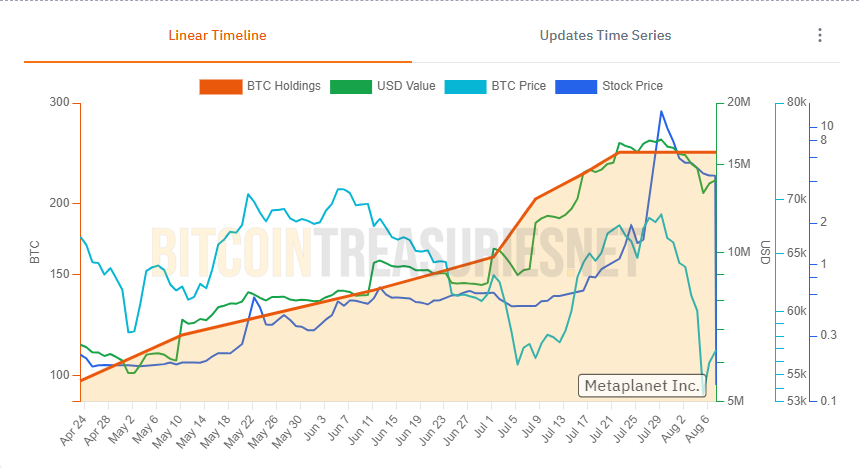
Сколько BTC есть у Metaplanet. Источник: bitcointreasuries.net

Компания направит 8,5 млрд иен (примерно $58,76 млн) на покупку дополнительных биткоинов. По последним данным, сейчас на балансе Metaplanet хранится 246 BTC, оценивающиеся в $13,98 млн.


Leituras Relacionadas

Just now, DeepSeek V4 updates with DSpark, improving inference speed by 80%

DeepSeek has updated its DeepSeek V4 model with the DSpark speculative decoding framework, achieving a significant 60-85% speedup in generation for Flash models and 57-78% for Pro models while maintaining the same overall throughput. This engineering-focused update, rather than a core architectural change, introduces DSpark to address latency and throughput bottlenecks in high-concurrency production environments. DSpark combines high-throughput parallel generation with adaptive load-aware verification. Its key innovations include a semi-autoregressive generation architecture to model dependencies within token blocks and a hardware-aware confidence-scheduled verification system. This system uses a confidence head to predict token acceptance probabilities, allowing it to dynamically optimize verification length per request and allocate compute only to tokens with the highest expected payoff. The asynchronous scheduler is designed for real-world deployment, ensuring zero-overhead scheduling and continuous CUDA graph replay while preserving the target model's output distribution. In tests across mathematical reasoning, code generation, and daily dialogue, DSpark outperformed state-of-the-art models like Eagle3 and DFlash, increasing average acceptance length by 26.7%-30.9% and 16.3%-18.4% respectively on Qwen3 target models. DeepSeek also open-sourced DeepSpec, a full-stack codebase for training and evaluating speculative decoding draft models, providing a standardized toolkit that includes data preparation tools, model implementations, training code, and evaluation scripts.

marsbitHá 2h

Just now, DeepSeek V4 updates with DSpark, improving inference speed by 80%

marsbitHá 2h

BIT Research: The 2028 Halving Is Not the End, the Real Shake-Up of the Bitcoin Mining Industry Is Just Beginning

The Bitcoin mining industry is undergoing its most complex structural adjustment since inception. Despite Bitcoin's price holding near $61,000 and the network hash rate approaching a record 1 ZH/s, miner profitability is deteriorating. The industry is operating close to its breakeven point, with the 2028 halving expected to accelerate consolidation. The challenges extend beyond the halving's subsidy reduction; the industry's revenue model has yet to successfully transition towards a fee-driven structure. Increasingly, mining companies are evolving from simple Bitcoin producers into infrastructure and energy operators, including providers of AI/HPC computing power. Competition is shifting from pure hash rate expansion to business model upgrades. Economic pressure is evident. The theoretical daily mining revenue at current prices is around $78 million, yet the actual figure is only about $33 million—a 136% gap. Transaction fees remain low at roughly $220k daily, far below historical implied levels. With a current estimated industry-wide breakeven price near $65,000, mining alone is struggling to generate ideal profits. The 2028 halving is projected to push the fundamental production cost floor to approximately $93,289. This will likely accelerate a shift towards consolidation among larger, well-capitalized miners with diversified revenue streams. Competitive advantage will belong to institutionalized players with access to low-cost energy, AI/HPC hosting operations, and stronger balance sheets. In essence, Bitcoin mining is transitioning from a "mining business" to an "infrastructure business." Future profitability and resilience will depend less on block rewards and more on diversified income sources like energy management and computational infrastructure services. For investors, the key question is not the halving itself, but which miners can successfully navigate this business model transformation.

marsbitHá 4h

BIT Research: The 2028 Halving Is Not the End, the Real Shake-Up of the Bitcoin Mining Industry Is Just Beginning

marsbitHá 4h

This is How God Karpathy Uses Claude?

Andrej Karpathy, a prominent figure in AI, has reportedly joined Anthropic, leading to a noticeable decrease in his open-source contributions and social media activity. A document claiming to be his personal "CLAUDE.md" file—a set of instructions for the Claude AI to follow within a specific codebase—has been circulating online. While its authenticity is unverified, the content aligns closely with Karpathy's publicly shared principles on effective AI-assisted programming. The document outlines key rules for AI coding assistants, emphasizing the importance of reading existing code thoroughly before writing new code to maintain consistency. It advises against over-engineering, advocating for simple, surgical modifications that match the project's existing style. Other guidelines include clarifying assumptions upfront, writing meaningful tests, thoughtful debugging, and carefully considering dependencies. The core message is that these principles help prevent common AI coding failures, such as introducing unnecessary abstractions, style drift, or making invisible architectural decisions. The community has noted that even experts like Karpathy require detailed instructions to guide AI effectively, akin to managing a junior developer. A related GitHub repository, "andrej-karpathy-skills," which encapsulates these ideas, is reported to significantly reduce Claude's code error rate. Ultimately, the advice stresses that the best CLAUDE.md is tailored to one's own tech stack and coding practices.

marsbitHá 4h

This is How God Karpathy Uses Claude?

marsbitHá 4h

Trading

Spot
活动图片