Web3 游戏构建心得:别总想着“全链”,要想着赢得注意力

深潮Publicado em 2024-07-18Última atualização em 2024-07-18

完全链上游戏将成为新颖链上用例的媒介,并将启用我们从未见过的创造性玩家行为。

作者:y77c

编译:深潮TechFlow
我们开发了 Project Mirage (@mirage_game_),这是一款休闲的链上岛屿建设游戏。自今年四月在测试网上线以来,我们每两到三周就会推出新的功能、修复和实验。尽管我们仍处于游戏开发的早期阶段,但这些迭代让我们在过程中学到了很多。

(注:这是我在 ETHCC 相关活动中的演讲稿)

我撒谎了。我并不看空。脱下你的鞋子,我们要构建链上游戏,直到它达到大规模采用

不要过于痴迷于理论/哲学

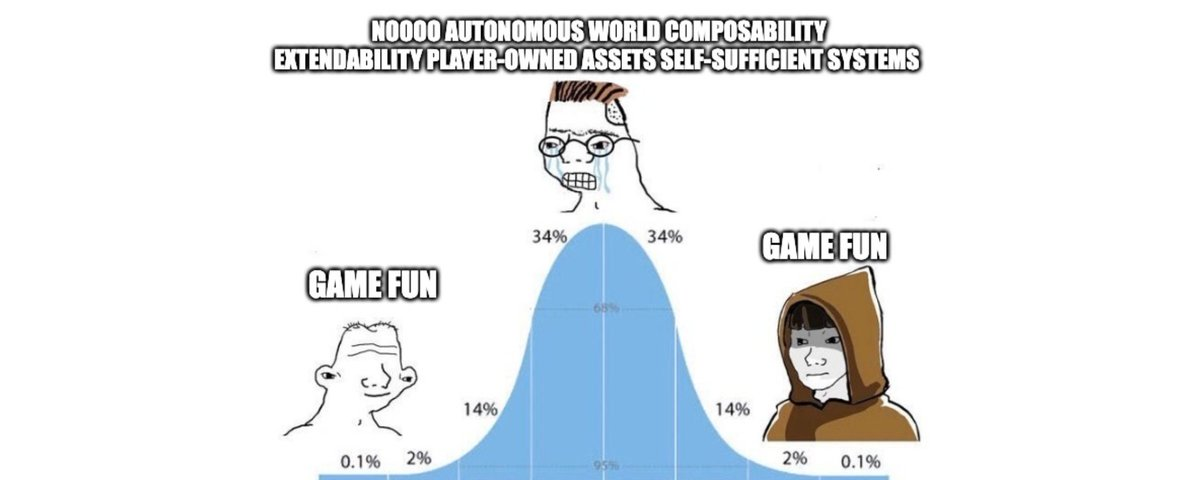
作为早期开发者,我们被链上游戏空间吸引的原因可能是自主世界(Autonomous Worlds)理论——一个永远运行、无许可和可组合的世界,在那里你真正拥有你的资产。残酷的事实是,对于大多数玩家来说,这些都不重要。玩家寻求的是有趣和吸引人的体验。也许 100 个玩家中有 1 个(由于链上开放后台已经是高端)会被游戏的可扩展性所启发并在其基础上进行构建。开放性和可组合性是不错的功能,但不会驱动你的游戏流量。真正驱动流量的是有趣、独特的体验。如果链上并不能增强游戏体验本身,你就不应该构建链上游戏。与其问“我们能构建什么链上游戏?”,更好的问题是“对于我想构建的游戏,链上如何使其更好?”

在一个小众、早期和研究驱动的空间中,我们常常说服自己,遵循理论将确保成功。然而,游戏就是游戏,游戏是一种消费产品,无论其底层技术如何。提供有趣和独特的体验是唯一成功的途径。这个空间的挑战和愿景使我们感到有趣,但作为游戏设计师,最终目标是创造带给玩家快乐的体验。

研究 GameFi

GameFi 经常被批评为不可持续,但我们必须承认,加密货币的投机性是一个极好的病毒传播工具。GameFi 项目在吸引用户和建立社区方面表现出色,“Fi”部分赋予人们权力并创造归属感。即使持有表现不佳的游戏资产,与社区一起也能促进玩家之间的联系并提供独特的体验。(事实上,这种惩罚行为可能会产生近乎胜利的效应,使游戏更具吸引力。)

构建链上游戏极具挑战性。你不仅需要应对资源限制,还面临与任何常规应用程序相同的挑战,如日活跃用户(DAU)和留存率。作为技术团队,我们最初专注于克服资源限制,但后来意识到及早在游戏中构建病毒性的重要性。幸运的是,我们还不算太晚。

如果你刚刚开始,重要的是思考你在为谁构建。你是针对加密玩家、普通玩家(目前难以接触)还是风险投资公司(VCs)?如果你是为加密玩家构建,知道他们过度刺激,注意力短暂,并且不断被新的游戏化形式吸引。如果你是为 VCs 构建,那么最好将你的游戏公司视为研究机构,尝试任何可能的新技术,而忘记用户,以便出售愿景和想象力。对于我们这些只想构建有趣东西的小脑袋来说,金融化是生存于此空间中不可避免的。

早期不必完全链上

现在,随着许多链上游戏在测试网和主网上上线,以及更大的加密游戏市场争夺注意力,无论你的理论是什么,你都需要赢得注意力之战。赢得这场战斗的一个方法是快速测试和迭代,以便确切了解玩家的需求。然而,完全链上构建很难快速迭代,因为它会受到资源限制或解决资源限制的复杂方案的困扰。

我们发现,对我们来说,最好的方法是将核心游戏逻辑放在链上,同时使用链下解决方案来处理实验性功能或那些尚无良好链上解决方案的功能。Mirage 的随机性和一些实验性功能是链下的,这使我们的小团队能够快速发布,而不受太多因素的限制。一旦我们确定某个功能是永久性的,我们就会将其移到链上以实现可扩展性和永久性。

如果我们重新开始,经典的 GameFi 方法,即仅将资产放在链上,可能是提高迭代速度的更好方法。然而,完全没有资源限制地开始会影响设计决策,可能会在迁移到有限的链上环境时导致更多的麻烦。这是一种权衡。完全链上或混合都是有效的方法,但也都可能出错。最终,无论你选择什么技术和方法,你都需要通过快速迭代和赢得注意力之战来生存。

总结

我相信完全链上游戏将成为新颖链上用例的媒介,并将启用我们从未见过的创造性玩家行为。没有更多的愿景要讨论了,现在去构建一个有趣的游戏吧。
Leituras Relacionadas

A Record $70 Billion Inflow in 5 Days! Investors Are No Longer Choosy, Buying Gold and Bitcoin Together

Investors are moving beyond "either/or" choices and are simultaneously pouring money into both gold and bitcoin ETFs. Over the past five trading sessions, ETFs tracking these assets attracted a record $7 billion in combined inflows, pushing some of the largest gold and bitcoin funds to the top of the U.S. weekly ETF inflow rankings. This surge was triggered by U.S. Treasury Secretary's announcement to at least double long-term bond buybacks, which initially pressured Treasury yields and the dollar, boosting prices for both assets. Gold has risen about 13% this month, while bitcoin reclaimed the $80,000 level. The synchronized rally signals the return of the "monetary debasement trade." Amid growing concerns over fiscal sustainability and easing financial conditions, investors are seeking scarce assets perceived as outside direct government control. Gold benefits from its traditional safe-haven role, while bitcoin's fixed supply of 21 million coins positions it as a potential hedge. The SPDR Gold ETF (GLD) attracted nearly $3.4 billion, and the iShares Bitcoin Trust (IBIT) saw $1.5 billion in inflows, both ranking in the weekly top ten. Analysts note the momentum behind the flows is as significant as the volume, indicating investors are aggressively adjusting previously underweight positions. While the narrative of hedging against fiscal stress and currency debasement is gaining traction, some analysts question its sustainability, suggesting equities might be a more reliable hedge in the long run.

华尔街日报Há 6m

A Record $70 Billion Inflow in 5 Days! Investors Are No Longer Choosy, Buying Gold and Bitcoin Together

华尔街日报Há 6m

Yangtze Memory: Is It the Second ChangXin?

The largest IPO in the history of the STAR Market is approaching. Yangtze Memory Technologies (YMTC) has filed for a listing on the Shanghai Stock Exchange's STAR Market, aiming to raise 33 billion yuan. This surpasses the previous record set by competitor ChangXin Memory Technologies (CXMT), which raised 29.5 billion yuan and saw its market capitalization surge on its debut. Despite both being leading Chinese memory chipmakers founded in 2016 and operating under the IDM model, the two companies are fundamentally different. CXMT focuses on DRAM, the memory used for temporary data processing, while YMTC specializes in NAND Flash, used for long-term data storage. Industry reports indicate the global DRAM market is significantly larger and more concentrated among three major players, where CXMT ranks as the fourth-largest supplier. The NAND Flash market is more fragmented, with YMTC ranking third globally by shipment volume in Q2 2026, though fifth by revenue due to a stronger focus on consumer-grade products. Experts are divided on whether YMTC can replicate CXMT's explosive market debut. Some analysts believe it is highly unlikely, citing a cooler market environment and YMTC's perceived lower strategic scarcity within the AI supply chain compared to DRAM/HBM-focused companies. They warn that aggressive IPO pricing could lead to downward pressure post-listing. Industry forecasts suggest the DRAM market may remain tight, while the NAND Flash market could face price corrections due to new capacity and weaker demand. Other experts argue that while short-term market sentiment differs, the long-term investment value of both companies is comparable, hinging on future performance and potential breakthroughs in areas like HBM. They believe YMTC's IPO is unlikely to face significant cooling given still-elevated market interest in the semiconductor sector.

marsbitHá 26m

Yangtze Memory: Is It the Second ChangXin?

marsbitHá 26m

Tether Completes Full Audit by KPMG U.S., 150 Tons of Gold and 100,000 BTC Reserves Verified

Tether Announces Completion of Full Financial Audit by KPMG US, Confirming Gold and BTC Reserves Tether CEO Paolo Ardoino announced that the company has completed its first-ever full financial audit by the "Big Four" accounting firm KPMG US. The audit covers the financial statements of Tether International, S.A. de C.V. as of December 31, 2025. Ardoino stated that Tether's delay in obtaining a full audit was primarily due to the previous US administration's hostile stance towards the digital asset industry. With a more favorable regulatory environment, the company engaged KPMG US for the rigorous review. Ardoino emphasized the audit confirmed the strength of Tether's reserves, including over $6 billion in excess equity. He also revealed the company holds substantial physical assets: approximately 150 tons of gold and over 100,000 Bitcoin (BTC). The audit process reportedly involved physically verifying each gold bar. Addressing past criticism and ongoing skepticism, Ardoino pointed to Tether's ability to handle large-scale redemptions, citing the processing of around $7 billion within 48 hours during market stress in 2022. He stated the company plans to undergo annual full financial audits alongside its ongoing quarterly attestation reports. Regarding a potential private equity round, Ardoino clarified that Tether, as a highly profitable company, does not require external capital but acknowledges significant market interest in its shares. The company remains private and mission-focused, aiming to serve users outside the traditional financial system. Looking ahead, Ardoino expressed Tether's interest in potentially funding initiatives like the "Bitcoin Red Team," which uses AI to audit Bitcoin's code and wallet security for vulnerabilities.

marsbitHá 45m

Tether Completes Full Audit by KPMG U.S., 150 Tons of Gold and 100,000 BTC Reserves Verified

marsbitHá 45m

Wall Street's Imagination Can't Keep Up with Nvidia's 'Speed'

NVIDIA once again delivered stellar earnings, with revenue, operating profit, and EPS all hitting record highs for Q2 FY2027 (ended July 26, 2026). Revenue reached $96.221 billion, a 106% YoY increase, while net profit surged 126% to $59.688 billion. The core driver remained the Data Center segment, which grew 117% YoY to $89.023 billion, fueled by ongoing global AI infrastructure investments. The company segmented its Data Center revenue into Hyperscale (large cloud providers) and ACIE (AI cloud, enterprise, industrial, and sovereign AI) categories, with the latter showing faster growth. Notably, shipments of Hopper architecture products to mainland China accounted for less than 1% of Data Center revenue this quarter, and future guidance excludes contributions from China's Data Center compute market. CEO Jensen Huang stated that AI has reached a "tipping point," directly generating productivity and revenue. Financially, NVIDIA maintained robust profitability with a gross margin of 75%. The company also returned approximately $26 billion to shareholders via buybacks and dividends. Looking ahead, product transitions are key. The Blackwell Ultra platform is now in large-scale deployment, while the next-generation Vera Rubin platform, including NVIDIA's first CPU designed for AI agents, has entered full production. The company is also expanding its software ecosystem with tools like the DSX platform for building AI factories. However, NVIDIA's role is evolving beyond chip supplier. It is increasingly involved in financing and facilitating massive AI infrastructure projects, exemplified by its credit support for the SB Energy project in Ohio intended for OpenAI. The company aims to mobilize over $500 billion in third-party capital for such builds, though this raises questions about future capital intensity. For Q3 FY2027, NVIDIA forecasts revenue of approximately $108 billion, signaling continued growth but at a potentially moderated pace. While still dominant, the competitive landscape is intensifying with rivals like AMD and in-house chips from major cloud customers. Key challenges include maintaining growth through the Blackwell-to-Rubin transition, sustaining the pace of AI infrastructure investment, and defending market share as inference workloads grow and competition increases.

marsbitHá 46m

Wall Street's Imagination Can't Keep Up with Nvidia's 'Speed'

marsbitHá 46m

MiniMax Starts Earning Money by Relying on Others

MiniMax, a Chinese AI company known initially for its consumer-facing products like Conch AI, has undergone a significant business shift according to its first post-IPO semi-annual report. While overall revenue grew to $117 million (surpassing its full-year 2025 projection), the revenue structure flipped dramatically. Revenue from its open platform and enterprise AI services surged 703.1% to $73.93 million, now constituting 63.4% of total income. In contrast, revenue from its own AI-native products, though doubling to $42.64 million, dropped from 69.7% to 36.6% of the total. This indicates MiniMax is transitioning from a product-centric to a platform-centric model, embedding its AI capabilities into other companies' workflows and developer applications rather than solely relying on its own apps. The company is now monetizing its core model technology as a service. However, profitability remains a challenge. Despite revenue growth of 283.1%, R&D expenses were $297 million—2.55 times revenue—leading to an adjusted net loss of $293 million. A positive sign is improving gross margin, which rose from 12.1% to 17.9%, suggesting initial progress toward scaling efficiently. Geographically, MiniMax demonstrates a "developed in China, monetized globally" model, with 60.8% of its revenue coming from outside mainland China. The report highlights that MiniMax has successfully moved past proving demand and model capability. The critical next phase is demonstrating that its growing enterprise and developer customer base can generate sufficient, sustainable profit to offset the high inherent costs of AI model training and inference.

marsbitHá 56m

MiniMax Starts Earning Money by Relying on Others

marsbitHá 56m

Trading

Spot
活动图片