Table of Contents
- 10,000 NVIDIA GPUs Dedicated to AI
- The Three Phases of Qtum’s Blockchain AI Ecosystem Rollout
- Emerging Areas in Artificial Intelligence
- Qtum is a Leader in Combining AI and Blockchain
- Conclusion
Business leaders are putting their money where the majority of interest is. Artificial Intelligence (AI) has already attracted interest from 250 million+ companies who are either using or exploring its use-cases across operations. For the last 10 years, Qtum Foundation has positioned itself as the creme-de-la-creme of leapfrogging the space by diligently innovating and launching potent solutions. The foundation is looking to seize AI’s market value which grew from $60 billion in 2022 to $196 billion in 2023, as per Grand View Research, projections have it that the value could grow to $1.81 trillion by 2030.
Qtum has already positioned itself as a game-changing scaling solution that has the best of the Bitcoin and Ethereum networks. With AI, the goal is to continue pursuing the blockchain project’s goal of producing cutting-edge technologies that will bring change, and drive innovation.
10,000 NVIDIA GPUs Dedicated to AI
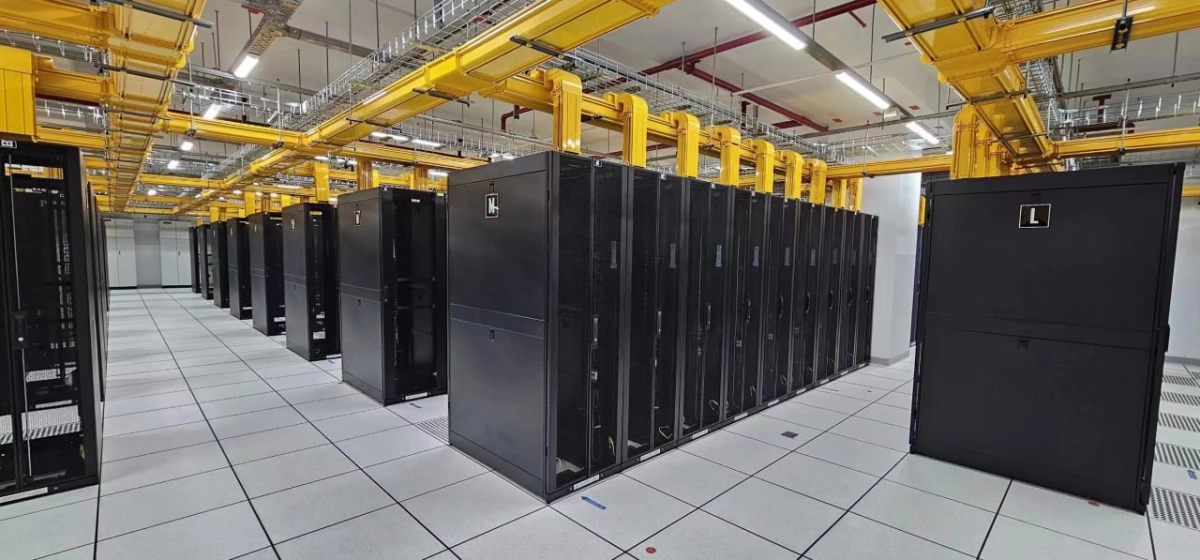
In the latest news, Qtum Foundation has rolled out its AI services after onlining 10,000 GPUs from NVIDIA. The services include a conversational chatbot much like ChatGPT and a text-to-image generator akin to Midjourney. Both of them, dubbed Qtum Solstice and Qtum Qurator are based on the latest open-source models and will run on vast amounts of computing power.
Qtum is betting that customers and businesses of the future will not only want innovative AI tools but they will also want to interact with these solutions in a decentralized environment.
For this reason, the foundation has rolled out its Artificial Intelligence plan in three phases. The first phase has come out,, and two more will be announced later.
The Three Phases of Qtum’s Blockchain AI Ecosystem Rollout
- Phase 1 focuses on the applications, with the Chabot and image generator already rolled out, Qtum will release more AI-based applications for Web3 users;
- Phase 2 will release more decentralized AI models;
- Phase 3 will add the decentralized infrastructure layer, matching computing power with AI computing needs. The long-term plan is to build a computing infrastructure that supports decentralized inference.
Immediately after this roll-out, Qtum’s engineers will start working on the infrastructure to improve the underlying technology and the available product offerings. According to Qtum’s Co-Founder Patrick Dai, the next logical step for Qtum Foundation is Artificial Intelligence. “We are unveiling the first phase today, an image generator and chatbot”
Emerging Areas in Artificial Intelligence
The engineers have been on top of their game since the release of ChatGPT. For this reason, they have acquired technical expertise across four major areas:
- Intelligent Dialogue which takes into account the knowledge base for intelligently answering questions, and text-based games.
- Image Generation for converting text to images, 3D cartoon image generation, image super-resolution, AI-based face swapping, and detection.
- Video Generation for face swapping, video-re-rendering, video manipulation, and animated illustrations.
- Speech Generation which involves speech-to-text, text-to-speech, cross-language conversations, and other speech-generation systems.
Thanks to the engineering team’s knowledge and expertise in Intelligent dialogue systems, image, video, and speech generation technologies, Qtum plans to launch the following Artificial Intelligence features:
- Keyword-based image/video generation for conveniently creating image/video assets using certain keywords.
- Emotional AI Voice-base Conversation Bots that are intelligent enough to understand user-behaviours, make sense of their queries and even address their questions via voice/text. This AI feature also means the bot will have a natural language understanding that can detect tone and respond to queries with empathy.
- Intelligent Image Recognition that integrates computer vision techniques to identify the content of an image. This will come in handy when organizing or sorting large files that contain images.
- AI-based Photo Effects and Filters for users to experience a diverse range of image filters, makeup, and effects.
Qtum is a Leader in Combining AI and Blockchain
Building Artificial Intelligence tools on top of Qtum’s blockchain infrastructure should come naturally to them. They have experience in this field from the earlier technical accomplishments achieved by combining Bitcoin’s UTXO model with Ethereum’s virtual machine in one package.
Since the organization is pursuing a three stage rollout plan with its blockchain AI ecosystem, the team will add 10 more AI-related offerings over the upcoming months to ensure complete utilization of its vast 10,000 GPUs. This amount of computing power is no small accomplishment, and should attract attention from other organizations and partners that are looking for resources in the AI field.
Qtum’s AI Services are free. However, one will need Qtum tokens to access or rent large amounts of computing power or blockchain-based intellectual property protection. $QTUM, the network’s utility token, is presently trading at $4.3 after gaining over 40% in the last 3-months since the beginning of January.
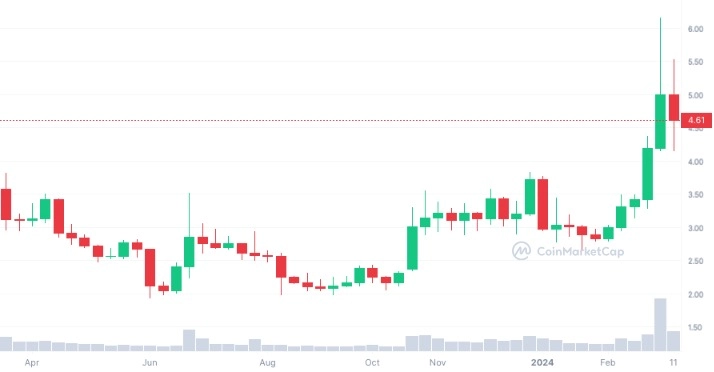
Qtum price by TradingView
While utility tokens are not a proportional reflection of a network’s health, $QTUM has been performing well in the last one year. From the chart above, the token’s price improved from $3.6 to a yearly high of $6.17.
Qtum intends to integrate the token with its blockchain AI offerings when building the decentralized economy layer. This means the fundamentals of the coin are looking good over the medium-term and even more promising for the long-term game on the account that emerging technologies will greatly become intertwined. More users coming to Qtum for AI solutions, and an increase of building activity of developers deploying on the open source model will create demand for the token.
Conclusion
The Qtum blockchain platform combines Ethereum’s smart contract capabilities with Bitcoin’s security features. Thanks to this, the platform has been lauded for its energy efficiency, speeds, scalability and the focus on governance. Layer 2 solutions building Qtum can achieve super speeds of billions of transactions per second while the average speed on the network is 1100 TPS. By deploying artificial intelligence services through its blockchain infrastructure, Qtum hopes to disrupt an industry valued at $196 billion. The blockchain platform has proved itself before by implementing solutions that other projects took years to fully implement. One of its testimonials was integrating its EVM-capable smart contracts engine with Bitcoin’s native UTXO support. This enabled the platform to benefit from Bitcoin’s security features and Ethereum’s programmability.
Disclaimer: This article is provided for informational purposes only. It is not offered or intended to be used as legal, tax, investment, financial, or other advice.
Read on Crypto Intelligence Investment Disclaimer