速读 Merlin Chain 代币效用和经济学:如何分配和释放?

MarsBitPublicado em 2024-04-22Última atualização em 2024-04-22

Resumo

比特币Layer2项目Merlin Chain开放原生代币MERL空投认领,总供应量21亿枚,可用于治理、质押、支付网络费用等。其中20%空投给Merlin's Seal活动参与者,私募投资者、顾问、团队分别占15.23%、3.00%、4.20%,有不同的锁仓期和释放方式。16.57%分配给社区作为奖励,40%通过生态系统拨款和激励措施分配,未来四年逐步释放。

今日,比特币 Layer2 项目 Merlin Chain 正式开放原生代币 MERL 空投认领,并公布了 MERL 效用、代币经济学和分配方案。
MERL 有何效用?


作为 Merlin Chain 生态系统中的原生代币,MERL 效用包括:


  • 治理:MERL 代币持有者有权通过对关键提案进行投票来塑造 Merlin Chain 的未来;
  • 质押:可以质押 MERL 以增强 Merlin Chain 的安全性,确保运营完整性和可靠性能;
  • 网络费用:MERL 可用于支付 Merlin L3 上的交易费用;
  • Collator 委托:MERL 代币持有者可以通过将其持有的资产委托给 Collator 或通过质押 MERL 来运行自己的 Collator,以积极参与网络的运营;
  • 原生流动性和抵押品:MERL 可以用作 Merlin 生态系统内的原生流动性和抵押品,从而实现平稳交易并支持借贷机制。


MERL 代币如何分配?


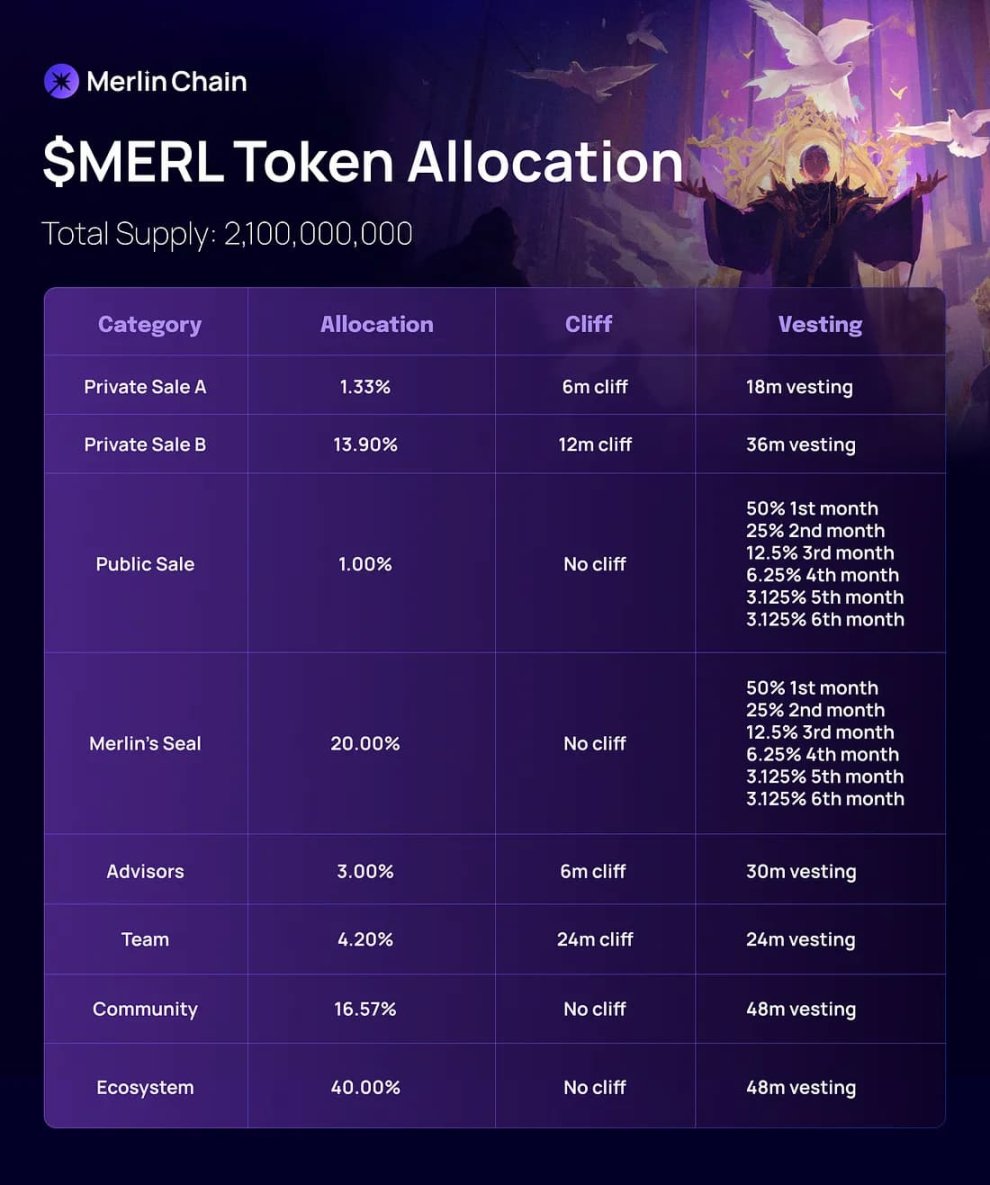
MERL 总供应量 21 亿枚,其中空投给 Merlin’s Seal 活动参与者 20%,不过在 TGE 时解锁一半,其余分五个月再进行释放。MERL 目前已经开放代币申领,用户申领 MERL 代币后,团队将于北京时间 4 月 19 日 14:00-16:00 进行代币空投。此外,MERL 分配给用户的代币在 TGE 时均未设有 cliff(完全锁仓),不过之后会逐步释放。而分配给私募投资者、顾问、团队的币会设置了 6 个月到 24 个月不等的 cliff。具体分配和释放如下:

速读 Merlin Chain 代币效用和经济学:如何分配和释放?


Merlin’s Seal 活动参与者:20% 的代币将空投给 Merlin’s Seal 活动参与者。此次活动的 TVL 达 36 亿美元,其中 91% 来自比特币原生社区(其中 17.5 亿美元的 BTC 和 9.8 亿美元的 BRC-20 资产)。代币释放方面,MERL 空投将在 TGE 时解锁这部分空投总量的 50%(共 2.1 亿枚),未来 5 个月每月可解锁 25%、12.5%、6.25%、3.125% 和 3.125%。


公开发售:MERL 总供应量的 1% 将分配用于公开发售(People’s Launchpad)。代币释放方面,第一个月在 TGE 时释放 50%,未来 5 个月每月释放 25%、12.5%、6.25%、3.125% 和 3.125%。


私募投资者:MERL 总供应量的 15.23% 将分配给私募投资者,有两种发行时间表。其中,A 轮私募(占总供应量的 1.33%)中,有 6 个月 cliff(完全锁定),后分 18 个月释放;B 轮私募中(占总供应量的 13.90%),有 12 个月 cliff,之后分 18 个月释放。


顾问:MERL 总供应量的 3.00% 将分配给顾问。这部分代币有 6 个月 cliff,之后分 30 个月释放。


团队:MERL 总供应量的 4.20% 将分配给团队,这些代币有 24 个月 cliff,后分 24 个月释放。


社区:MERL 总供应量的 16.57% 将在未来的生态系统计划中分配给支持社区作为奖励。这部分代币不需要完全锁定,但分 48 个月释放。


生态系统:MERL 总供应量的 40.00% 将通过生态系统拨款和激励措施进行分配,以促进 Merlin Chain 上蓬勃发展的应用程序环境。通过奖励贡献者、构建者和合作伙伴,Merlin Chain 的目标是加速利用比特币安全性和繁荣的创新应用程序的开发。分配给生态系统的代币不需要完全锁定,不过也分 48 个月释放。


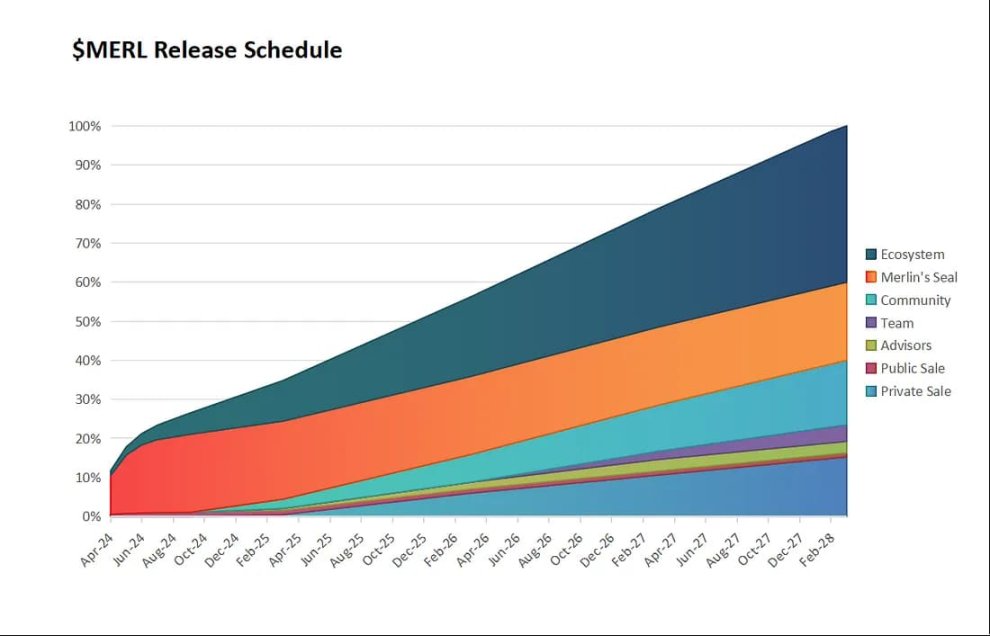
下图是 MERL 在未来四年的释放情况:
速读 Merlin Chain 代币效用和经济学:如何分配和释放?


Criptomoedas em alta

Leituras Relacionadas

Foundation Steps Back, Ethlabs Steps Forward: Ethereum Undergoes Its Largest Restructuring in History

On June 23rd, the Ethereum ecosystem witnessed two major shifts, signaling a significant governance realignment. First, former Ethereum Foundation researchers established Ethlabs, a new independent non-profit. Backed by major ETH holders like Bitmine and SharpLink, Ethlabs aims to address practical needs for institutional adoption, including faster settlement, native asset issuance, cross-chain transactions, and mainnet scaling. Secondly, the Ethereum Foundation announced a major restructuring, laying off 54 employees (20% of its staff) to become a leaner entity focused on protocol governance and maintenance rather than being the primary builder. This move represents a pivotal correction. Criticisms had mounted over the Foundation's perceived slowness, lack of clear strategy, and over-reliance on Vitalik Buterin's influence. Ethlabs emerges as a more execution-oriented, "industrialized" layer focused on market adoption—bridging the gap between research and real-world use. Notably, Vitalik Buterin is absent from its list of supporters, interpreted as an intentional step to avoid excessive personal endorsement and allow the organization to build independent credibility. The Ethereum Foundation's downsizing and redefinition mark a retreat from its former central coordinating role. It now aims to share the "privilege of stewarding Ethereum" with other emerging groups like Ethlabs, the Ethereum Applications Guild, and The Ethereum Economic Zone. Analysts frame this dual shift as the Foundation ensuring Ethereum remains "correct" (credibly neutral), while Ethlabs must prove it remains "effective" (competitive and attractive for capital and adoption). This addresses community "shareholder-like anxiety" about ETH's market performance. While risks exist—such as concerns over shifting from Foundation centrality to large-holder influence—the consensus is that the greater risk for Ethereum was inaction, caught between technical idealism and organizational inertia. These steps aim to create a more multi-stakeholder, execution-driven future for the network.

链捕手Há 4h

Foundation Steps Back, Ethlabs Steps Forward: Ethereum Undergoes Its Largest Restructuring in History

链捕手Há 4h

Second Half of U.S. Crypto Policy: The Clarity Act Aims for 60 Votes, CFTC's "One-Person Commission" Becomes Biggest Variable

In a pivotal year for US crypto policy, the "CLARITY Act" is advancing in the Senate but faces a high hurdle, needing 60 votes to pass. Key challenges include bridging partisan divides on ethics and swaying undecided Republican senators within a tight legislative calendar of only about 40 working days. The policy "second half" involves intense negotiations on a broader framework for Web3 and DeFi, including crypto tax reforms and the Blockchain Regulatory Certainty Act. A significant uncertainty is the understaffed CFTC, operating with four commissioner vacancies, which complicates regulatory clarity. Meanwhile, the departure of key "crypto champions"—SEC Commissioner Hester Peirce and Senator Cynthia Lummis—will impact ongoing policy efforts. Industry experts are cautiously optimistic but realistic. Sara K. Weed notes that while progress is being made, CLARITY is unlikely to pass this Congress, pushing agencies like the SEC and CFTC to provide more guidance. Sulolit Mukherjee suggests meaningful crypto tax legislation is more likely to be attached to larger must-pass bills. Rashan Colbert discusses the jurisdictional debate over prediction markets, emphasizing the need for a regulatory framework that fosters their development as financial tools rather than treating them broadly as gambling. The clock is ticking, but opportunities remain for substantive progress through continued bipartisan dialogue and pragmatic efforts.

marsbitHá 7h

Second Half of U.S. Crypto Policy: The Clarity Act Aims for 60 Votes, CFTC's "One-Person Commission" Becomes Biggest Variable

marsbitHá 7h

Research Report Analysis: Morgan Stanley Details SanDisk SNDK, The Truth About Cloud Data Center Pricing Power and AI Inference Benefits

Morgan Stanley raised its price target for SanDisk (SNDK) from $1100 to $1750 on June 22, maintaining an Overweight rating. The upgrade is driven by AI inference demand reshaping the NAND market, particularly for KV Cache and context window storage in cloud data centers. These cloud clients exhibit price inelasticity and sign long-term contracts, granting SanDisk significant pricing power. SanDisk's New Business Model (NBM) agreements, covering over one-third of FY27 bit shipments with 3-5 year terms and fixed price/price collar structures, are crucial. They are projected to sustain gross margins around 80% even at floor prices, providing a buffer against cyclical downturns. Morgan Stanley forecasts gross margins to surge from 30.3% in FY25 to 86.7% in FY27e. With NAND supply expected to remain tight into 2026/2027 and cloud/data centers becoming the largest end-market, SanDisk holds supply-side pricing power. The company targets 15-19% bit growth via technology transitions, not capacity expansion. Revenue is projected to grow ~6.6x from FY25 to FY27, with EPS rising from $2.74 to $14.73, driven by high-margin cloud business. Key upside catalysts include faster enterprise SSD adoption and edge AI growth. Downside risks involve slower industry growth, competitor capex increases, market share loss, and competition from Chinese players like YMTC. The investment thesis rests on AI-driven structural demand, NBM's margin protection, and sustained supply tightness. The $1750 target implies ~28x FY27e P/E.

marsbitHá 8h

Research Report Analysis: Morgan Stanley Details SanDisk SNDK, The Truth About Cloud Data Center Pricing Power and AI Inference Benefits

marsbitHá 8h

Trading

Spot
Futuros

Artigos em Destaque

Como comprar MERL

Bem-vindo à HTX.com!Tornámos a compra de Merlin chain (MERL) simples e conveniente.Segue o nosso guia passo a passo para iniciar a tua jornada no mundo das criptos.Passo 1: cria a tua conta HTXUtiliza o teu e-mail ou número de telefone para te inscreveres numa conta gratuita na HTX.Desfruta de um processo de inscrição sem complicações e desbloqueia todas as funcionalidades.Obter a minha contaPasso 2: vai para Comprar Cripto e escolhe o teu método de pagamentoCartão de crédito/débito: usa o teu visa ou mastercard para comprar Merlin chain (MERL) instantaneamente.Saldo: usa os fundos da tua conta HTX para transacionar sem problemas.Terceiros: adicionamos métodos de pagamento populares, como Google Pay e Apple Pay, para aumentar a conveniência.P2P: transaciona diretamente com outros utilizadores na HTX.Mercado de balcão (OTC): oferecemos serviços personalizados e taxas de câmbio competitivas para os traders.Passo 3: armazena teu Merlin chain (MERL)Depois de comprar o teu Merlin chain (MERL), armazena-o na tua conta HTX.Alternativamente, podes enviá-lo para outro lugar através de transferência blockchain ou usá-lo para transacionar outras criptomoedas.Passo 4: transaciona Merlin chain (MERL)Transaciona facilmente Merlin chain (MERL) no mercado à vista da HTX.Acede simplesmente à tua conta, seleciona o teu par de trading, executa as tuas transações e monitoriza em tempo real.Oferecemos uma experiência de fácil utilização tanto para principiantes como para traders experientes.

412 Visualizações TotaisPublicado em {updateTime}Atualizado em 2026.06.02

Como comprar MERL

Discussões

Bem-vindo à Comunidade HTX. Aqui, pode manter-se informado sobre os mais recentes desenvolvimentos da plataforma e obter acesso a análises profissionais de mercado. As opiniões dos utilizadores sobre o preço de MERL (MERL) são apresentadas abaixo.

活动图片