Bitcoin’s Correlation With Nasdaq at All Time Highs

KAIKOPublicado em 2022-05-18Última atualização em 2022-05-18

Resumo

Price Movements: Yuga Labs’ virtual land sale clogged the Ethereum network and caused ApeCoin to soar, then plummet.

Price Movements: Yuga Labs’ virtual land sale clogged the Ethereum network and caused ApeCoin to soar, then plummet.

Market Liquidity: Turkish lira crypto trade volume surged to yearly highs amid soaring inflation.

Derivatives: Funding rates spiked during last Thursday’s spot-driven sell off.

Macro Trends: Bitcoin’s correlation with the tech-focused Nasdaq is nearly as high as its correlation with Ethereum.

Special Feature: Introduction to Value at Risk (VaR) for cryptocurrencies.

Trend of the Week

TerraUSD de-pegs, highlighting algorithmic stablecoin risk.
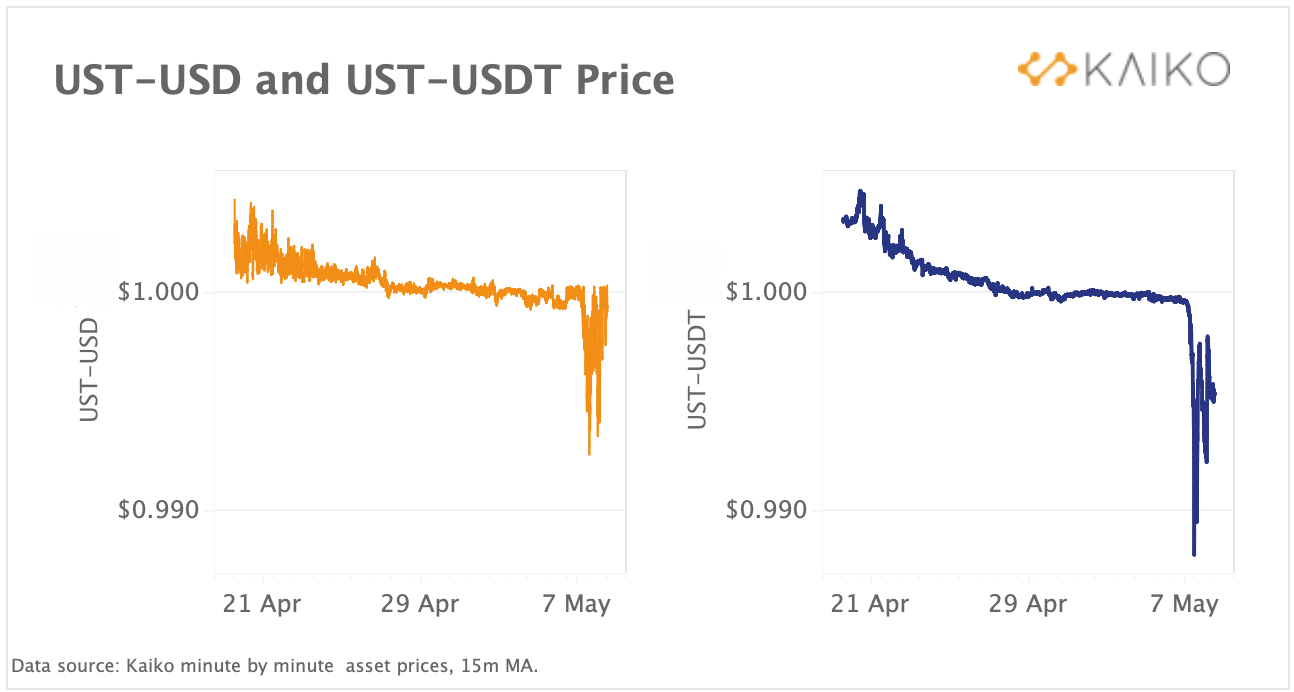
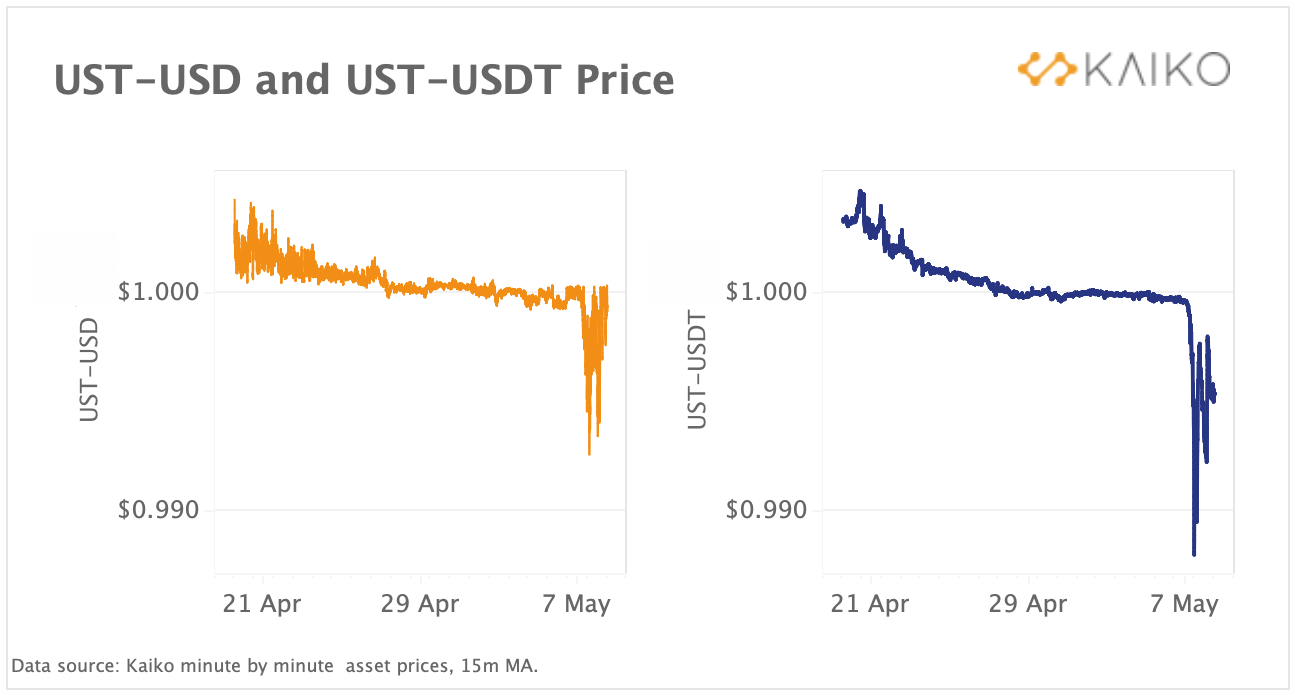
Terra’s UST stablecoin briefly lost its peg to the U.S. Dollar over the weekend due to strong selling pressure after a series of multi-million UST selloffs. The bulk of the selling was reportedly executed on stablecoin-focused decentralized exchange Curve and centralized exchange Binance. Above we chart UST’s price against Tether (USDT) and the U.S. Dollar, aggregated across all UST pairs on both CEXs and DEXs.

At around 11pm on May 7th, UST traded as low as .988 for 1 USDT. UST-USDT daily volumes also surged, hitting a record high level of over $1B, reportedly forcing Binance to temporarily halt UST borrowing. Last month, UST became the third largest stablecoin by market cap at around $18bn, flipping Binance’s BUSD. However, its tremendous growth has been mainly driven by the Terra ecosystem’s lending and borrowing protocol Anchor, which offers attractive double-digit yields to users, raising questions regarding the sustainability of this model.

Price Movements

Bitcoin trades at 10-month lows.
As of Monday morning, Bitcoin is now trading at 10-month lows in the latest sign that macro headwinds and the Fed’s hawkish policies could continue to weigh on risk assets in the near term. Equities didn’t fare much better, with the Nasdaq composite registering its biggest one-day loss since 2020, bringing its correlation with Bitcoin to historic highs. Despite the overall bearishness, Binance had a very good week. The exchange gained regulatory approval to operate in France, contributed $500 million to Elon Musk’s twitter takeover bid, and had its BUSD stablecoin listed on rival Coinbase.

ApeCoin plummets as land mint clogs Ethereum network.
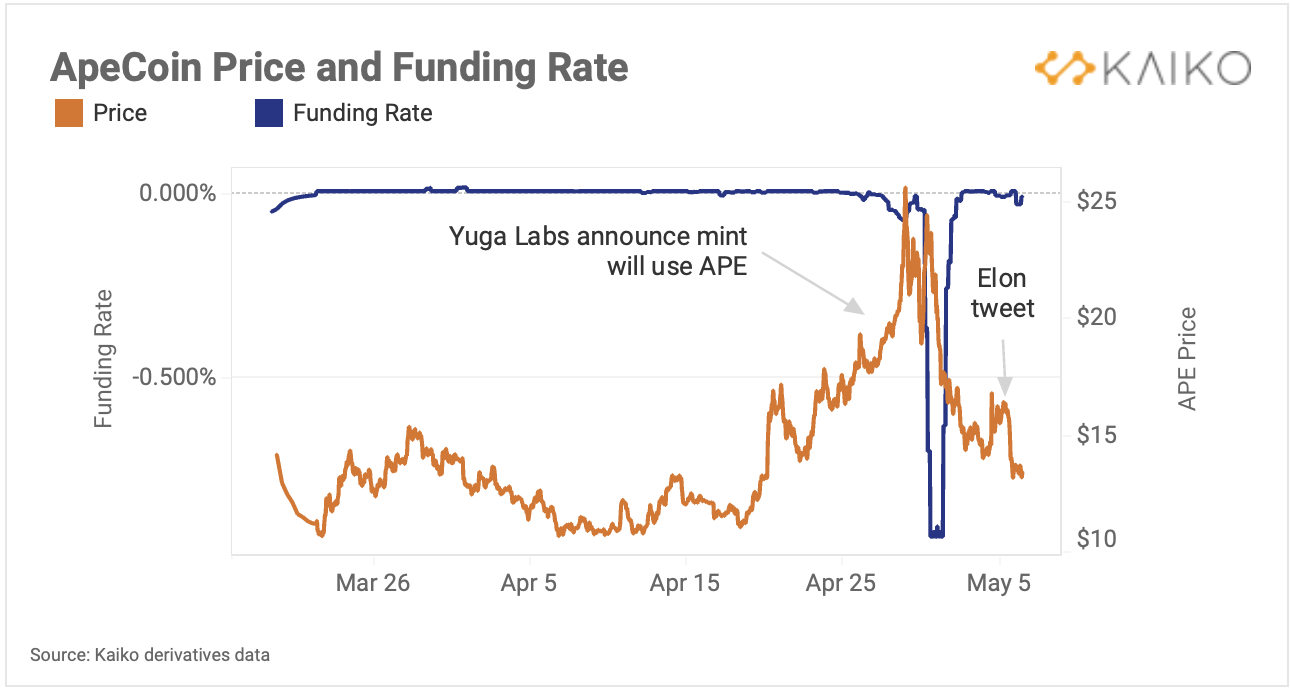
Yuga Labs, the company behind NFT collection Bored Ape Yacht Club, entered the metaverse last week with a much-anticipated virtual land sale for its forthcoming Otherside metaverse platform. A record $561 million in virtual parcels were sold in just 24 hours, which were paid for using the associated token ApeCoin(APE), creating a type of “pump and dump” which saw the value of APE surge to all time highs in the run-up to the mint, before plummeting more than 50%. Funding rates also dropped precipitously, suggesting that traders were aggressively shorting the token following completion of the hotly demanded sale.

In the aftermath of the NFT launch, Elon Musk briefly changed his twitter profile picture to Bored Apes, spiking APE’s price 20% before he tweeted “I dunno … seems kinda fungible”, after which price returned to previous levels.
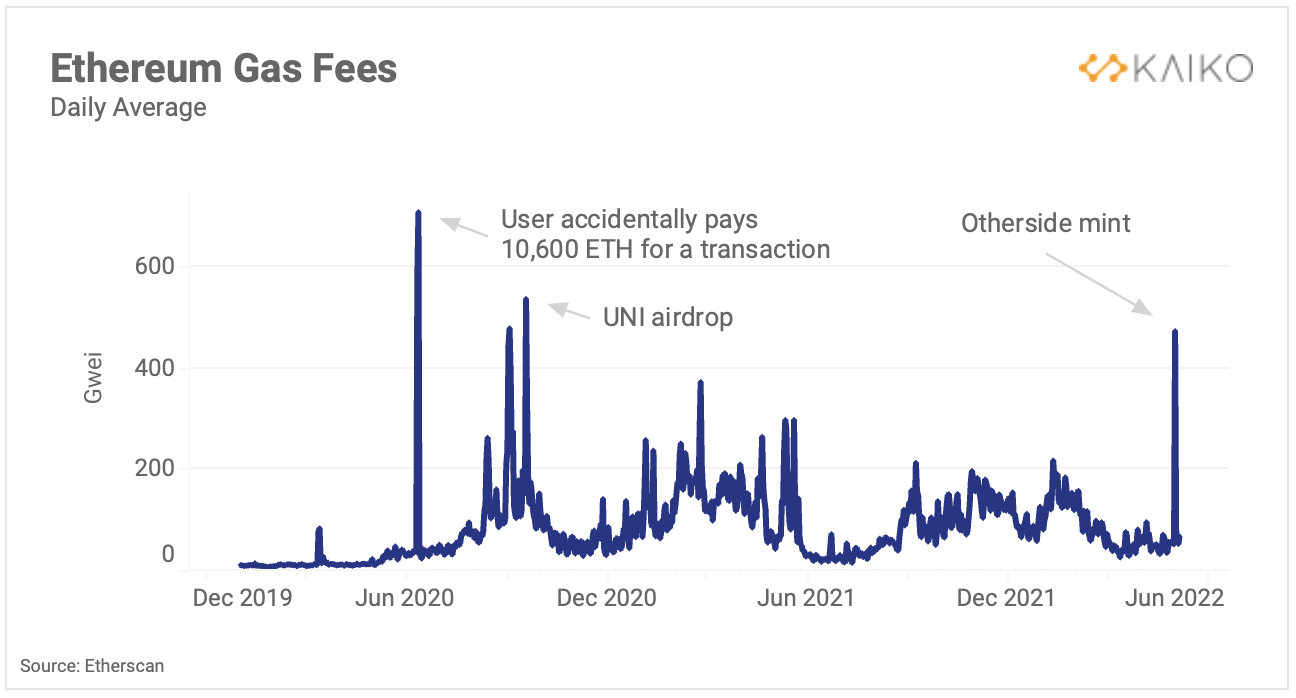
Not only did APECoin holders lose out during the minting frenzy, but the entire Ethereum network became clogged, causing gas fees to spike to levels not seen since the midst of DeFi summer. Transactions associated with the mint consumed more than $180 million in gas fees. Yuga Labs was severely criticized for the chaotic mint, and has promised to refund failed transaction fees.

Market Liquidity

Turkish crypto demand soars amid galloping inflation.
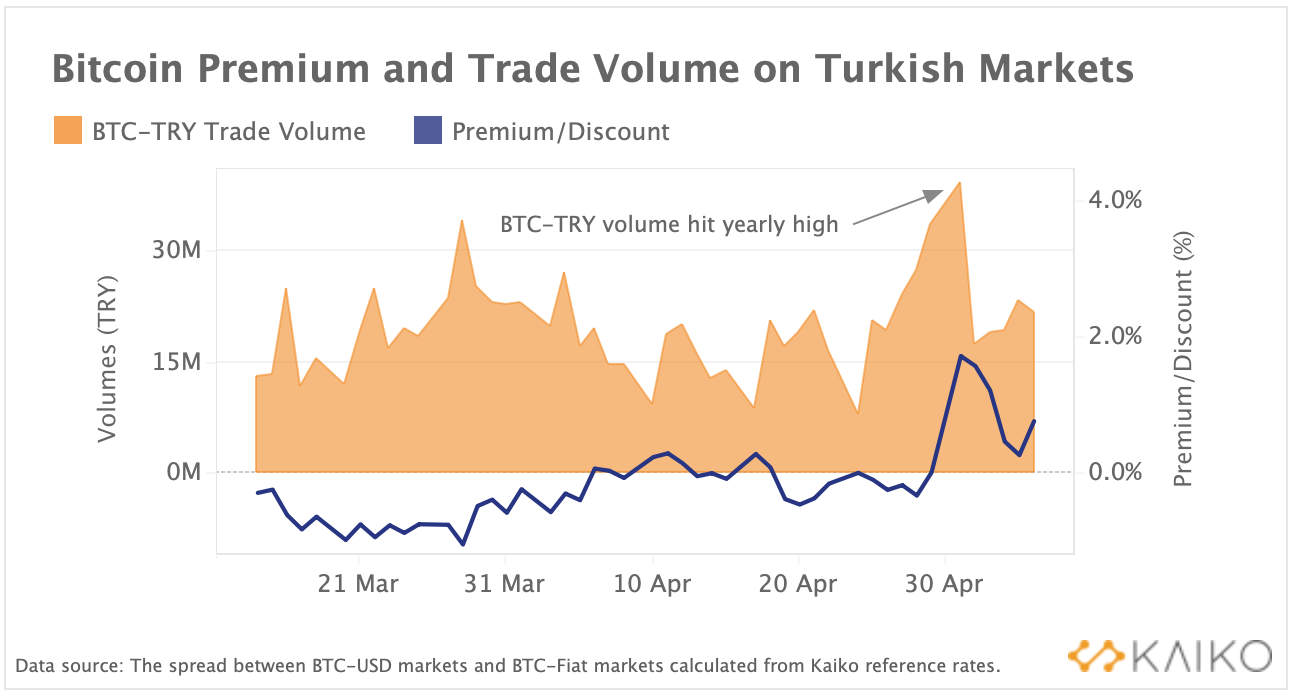
The recent decline in Bitcoin spot prices alongside geopolitical turmoil is boosting crypto adoption in inflation-ridden emerging economies such as Turkey, which saw volume spike to yearly highs in April. Bitcoin’s premium on Turkish markets rose to 1.7% in early May as inflation hit a staggering 70% in April. This has been mirrored by a steady rise in both BTC-TRY and USDT-TRY trade volumes since the start of the war in Ukraine suggesting geopolitical tensions have also played a role in boosting local crypto demand.

The fast growing Turkish market has attracted the attention of major crypto exchanges such as Binance and Coinbase which seek to expand their operations in the country, although Turkey has made recent attempts to regulate the industry.

Euro stablecoin volume spikes despite remaining relatively low.
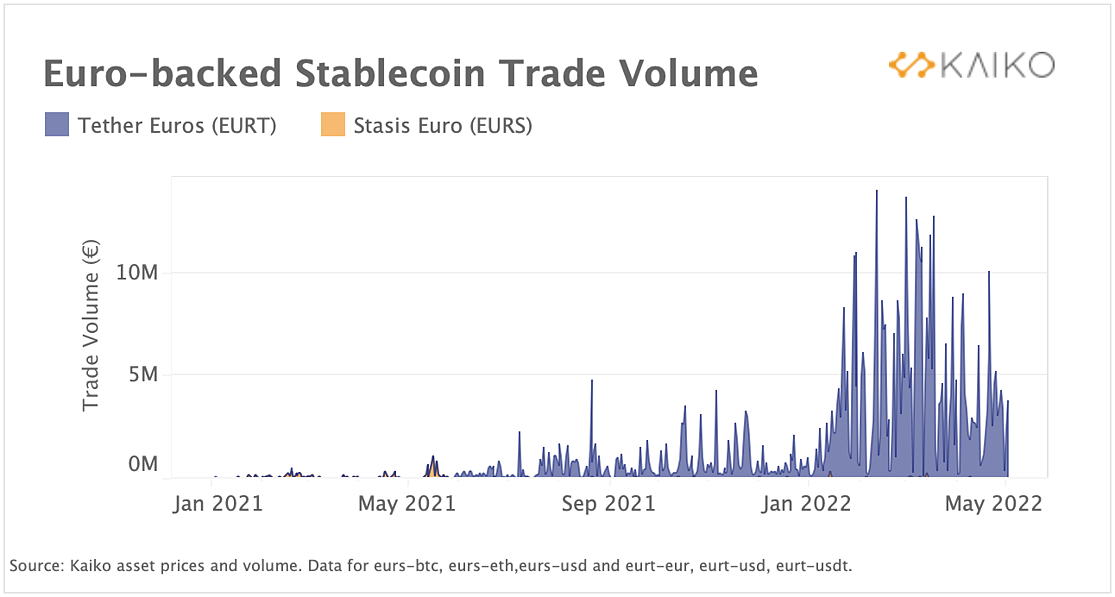
Euro stablecoin volumes have spiked to all time highs in 2022, despite remaining magnitudes lower than volumes for their USD-counterparts. There are only a handful of Euro backed stablecoins in the market today, and we’ve charted above the two largest: Tether Euros and Stasis. Both are operated by private, centralized companies; Tether Euros is a Euro-pegged stablecoin supported by Tether, the company that operates USD Tether (USDT).

Clearly EURT has the largest shares of volume on centralized exchanges and those volumes have spiked quite dramatically this year, albeit from a base considerably lower than the overall stablecoin market. It would be fair to expect Euro volumes to be larger asuuming European traders should want to avoid any FX exposure in their trades. Combine this with the current amount of USD-denominated stablecoin volume and we’re left wondering why Euro stablecoins have not had a similar rate of adoption.

The answer to this is twofold: stricter European regulation on stablecoins and their collateral; and the current regime of persistent negative interest rates from the ECB. The benchmark ECB deposit rate has been negative for over a decade now, which means anyone holding Euro collateral, i.e stablecoins, is actually guaranteed to lose money on their holdings. One thing to watch will be how trade volumes and Euro stables adoption will look if the ECB decides to adopt positive interest rates, something that was hinted at last week. It is very possible that the recent spike in volumes the last few months has been due to expectations that the ECB would follow a similar rate hike pattern as the Fed, which so far has failed to materialize.

Market depth dips before sell off.
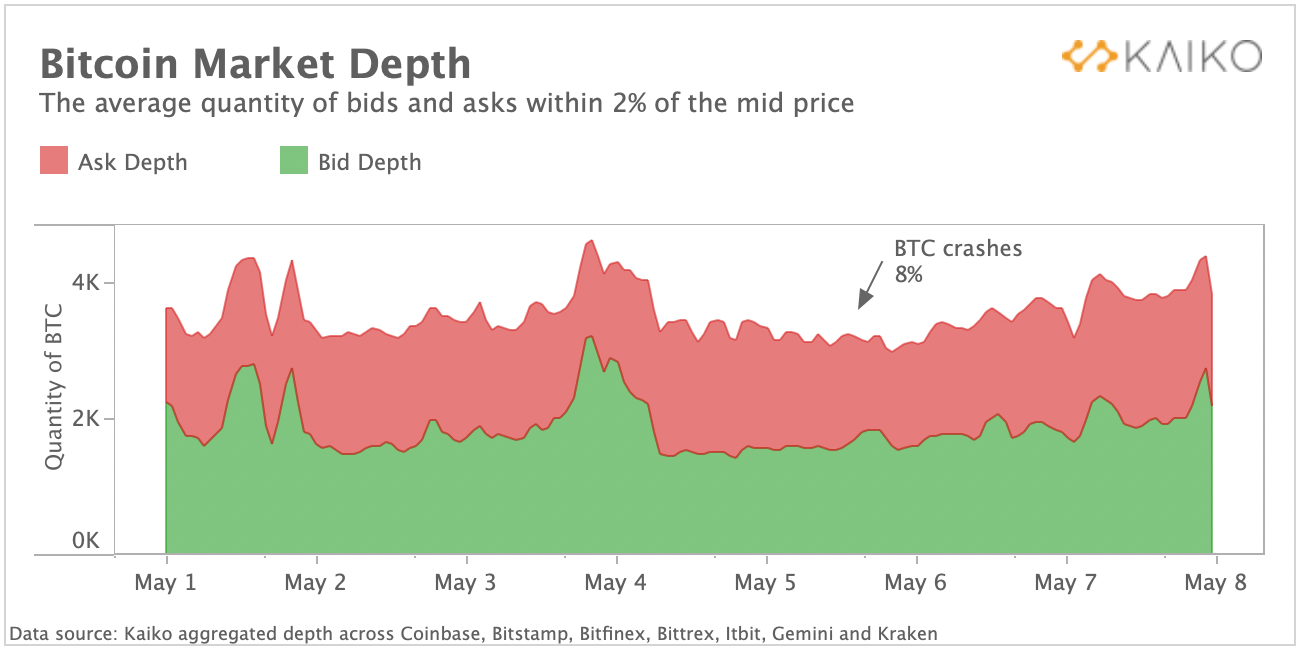
In the day preceding Bitcoin’s 8% price crash, market depth for BTC-USD within 2% of the mid price remained volatile, fluctuating between 3,400 and 4,400 BTC. The crash itself did not cause a noticeable dent in market depth, although liquidity conditions remained lower than earlier in the week, which can often perpetuate a sell-off as market makers remain cautious before re-entering their positions. Following the initial drop, Bitcoin’s price continued to dip over the weekend. However, we can observe that liquidity conditions improved by May 7th to pre-crash levels.

Special Feature: Value at Risk for Cryptocurrencies

Risk management is a crucial (and often obligatory) component of the investment lifecycle. In cryptocurrency markets, risk management remains a complex and evolving area of study due to frequent changes in market structure, high volatility, and limited availability of historical data.

Kaiko’s new Value at Risk (VaR) estimator leverages a proprietary and thoroughly backtested methodology that accounts for the idiosyncrasies of crypto market structure. Value at Risk is one of the most common risk indicators to quantify the extent and probability of potential losses in a portfolio. Kaiko’s VaR data can be applied to any cryptocurrency portfolio to accurately track VaR over time. For example, below we chart the Daily P&L and Daily VaR of an equally weighted $1 million portfolio of BTC and ETH.
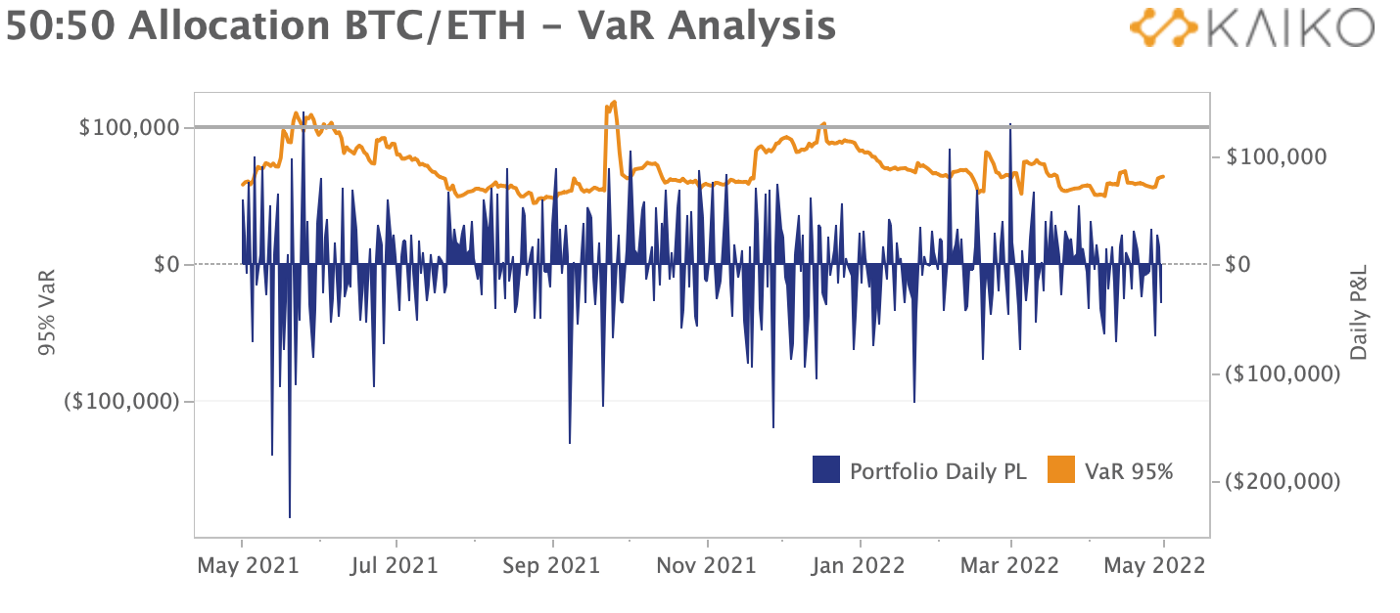
Suppose you are setting a risk budget for this portfolio, and don’t want to lose more than $100k one in every 20 days on average. You would set your VaR risk level to 95%, charted above, and monitor when your portfolio exceeds that $100k level. If VaR exceeds that level you would look to de-risk the portfolio until VaR remains under that $100k threshold. View our full VaR case study below:

VaR Case Study

Derivatives

Funding rates move positive during sell-off.

So far this year, BTC funding rates have remained mostly neutral amid Bitcoin’s sideways price action and low derivatives volumes. During last year’s bullish market conditions, funding rates were strongly positive as traders bid up futures prices, leaving the futures price higher than the spot price. However, recently we’ve noted a divergence in this trend, exemplified by last week’s sell off which saw funding rates flip positive despite bearish market conditions. The likely explanation is that spot markets sold off faster than futures, causing the funding rate to stay positive, which suggests bearish activity is spot-driven.

Bitcoin perpetual futures open interest showed resilience last week despite spot market volatility which spurred over $300mn in long liquidations.
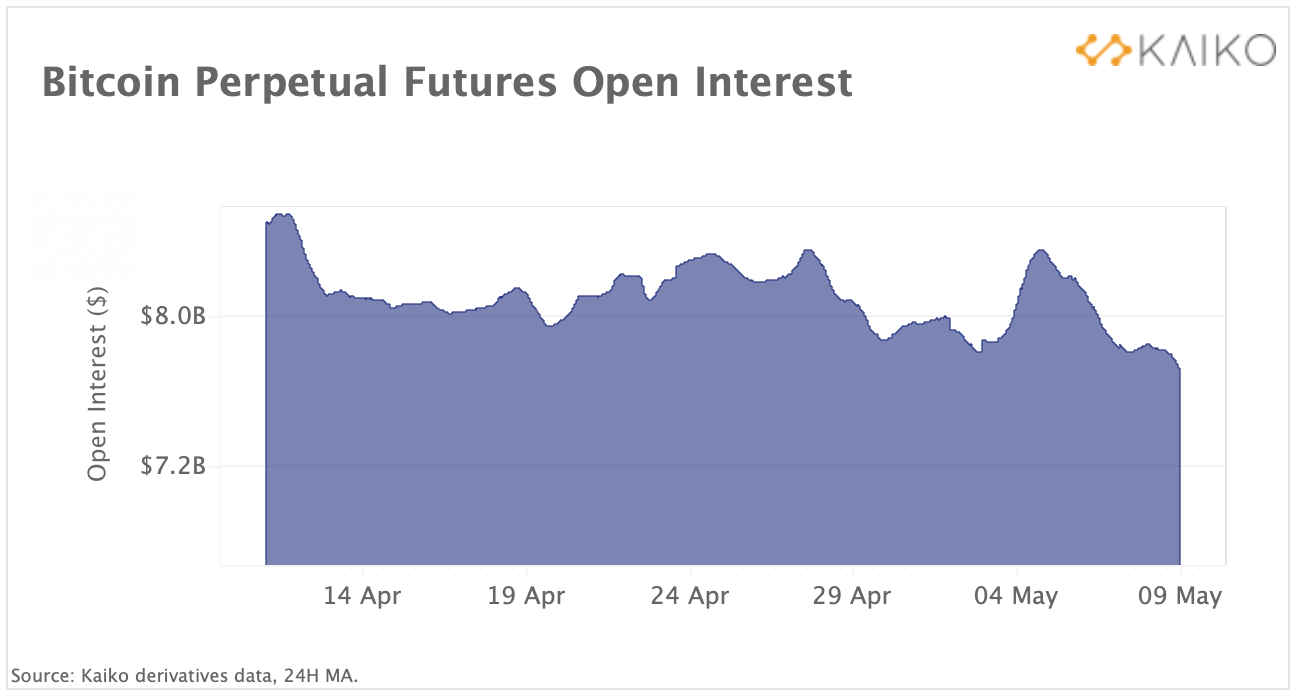
Above we chart the aggregated open interest on four exchanges — Binance, Derbit, FTX and Bybit. We observe the amount of open contracts shrank by just 8% to $7.7B between May 4–8 while spot prices tumbled by 13% over the same period. Overall, the decline in open interest was more gradual than during previous selloffs.

Macro Trends

Bitcoin’s correlation with Nasdaq at all time highs.
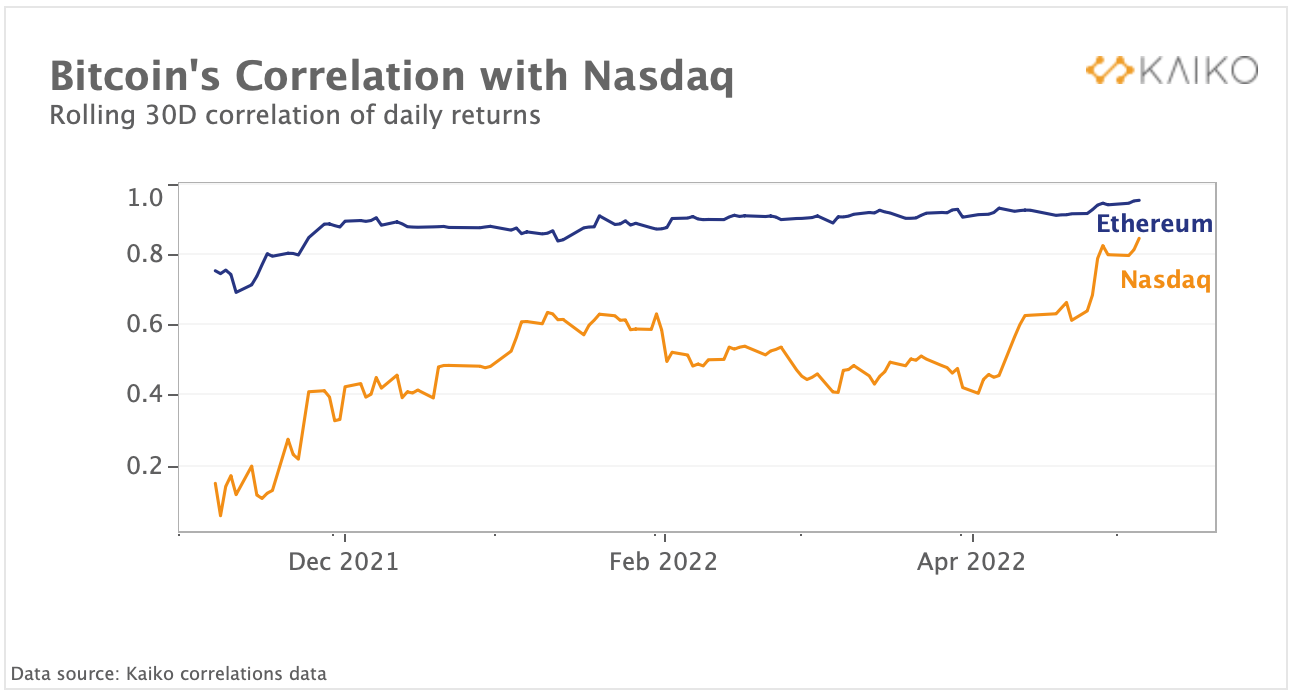
Risk assets continued to move in tandem last week, whipsawing as the U.S. Fed hiked its key policy rate by 50bps — the largest rate increase in about two decades. Bitcoin’s rolling correlation with the tech-focused Nasdaq 100 to hit a historically high level of .8. It is now nearing its traditionally strong correlation to Ethereum which is also on the rise and currently hovers around .9.

However, despite being strongly correlated with the Nasdaq 100, Bitcoin has been performing slightly better since the start of the year. We noticed that when inflation expectations are increasing, Bitcoin tends to outperform tech stocks, which could add credence to the narrative around BTC’s role as an inflation hedge.
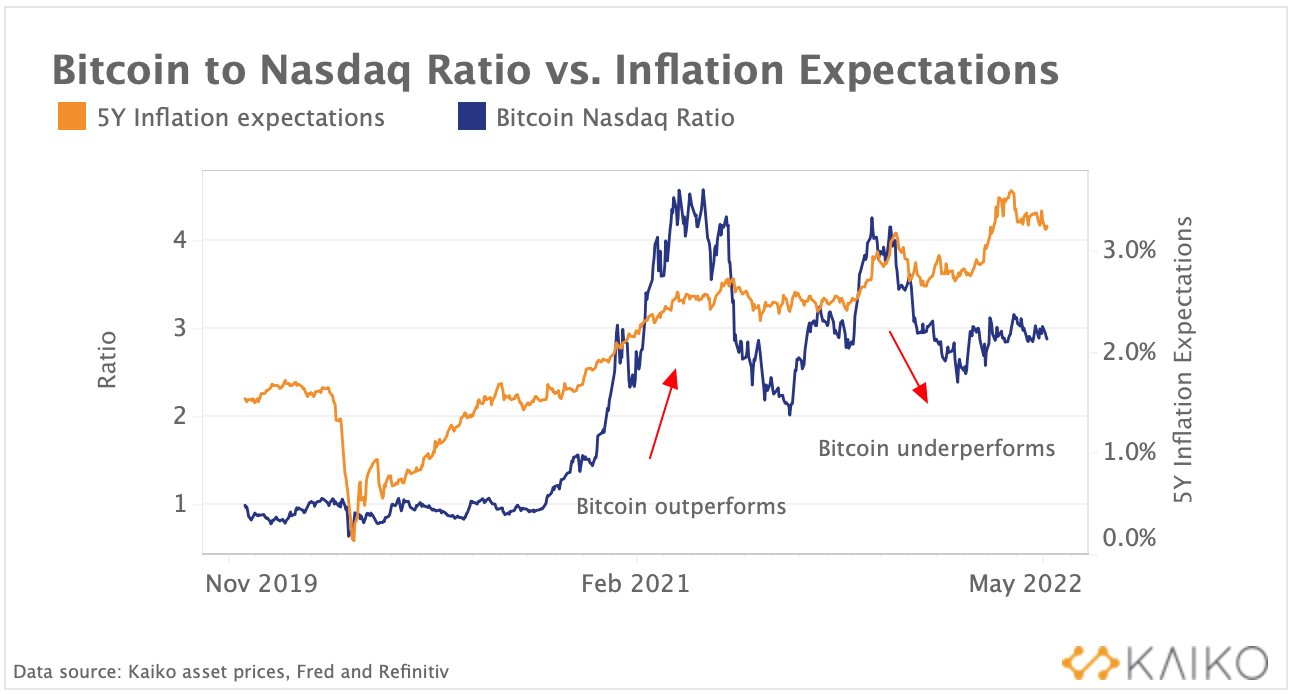
We chart the Bitcoin to Nasdaq price ratio alongside 5-year inflation expectations — a market based measure of the expected inflation over the next 5 years — and can observe this trend in action. However, it could also mean that Bitcoin is perceived as a riskier asset and it suffers more when the Fed’s credibility in fighting inflation is improving.

Bitcoin mining stocks are more volatile than Bitcoin.
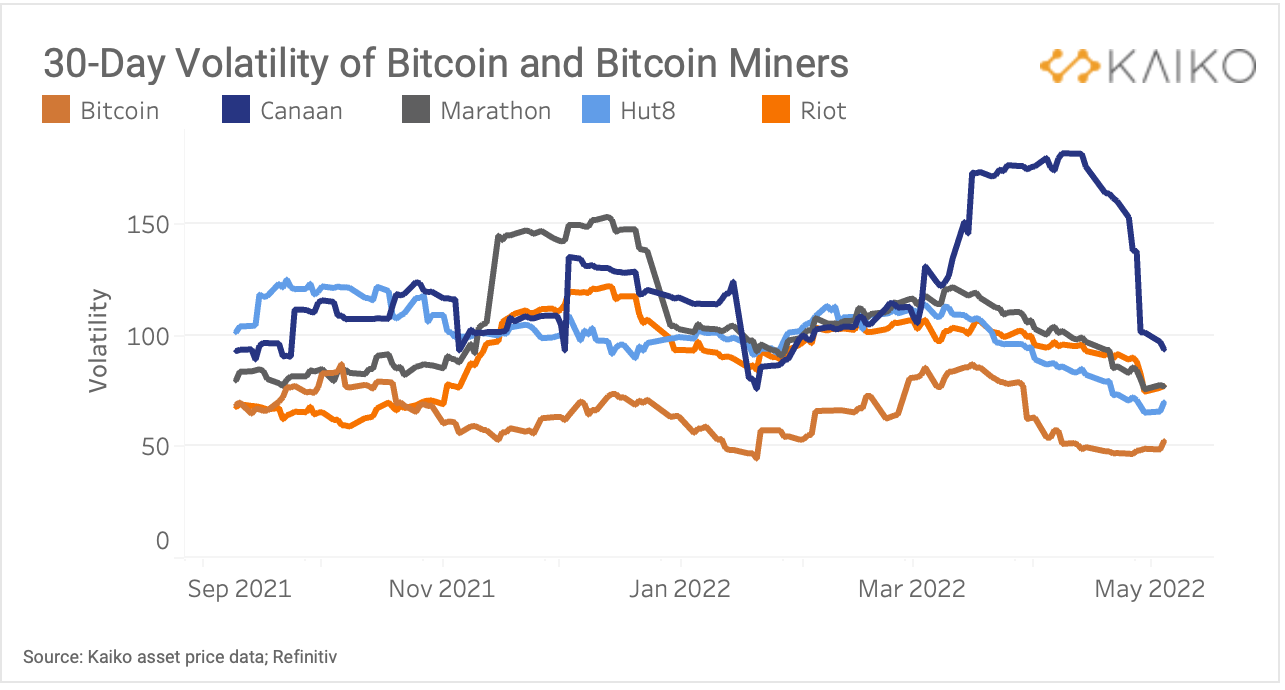
Bloomberg last week reported that Bitcoin miners are “selling Bitcoin call options to wring money out of their holdings, turning to a yield-generating strategy deployed throughout conventional finance.” This strategy involves selling calls on BTC, which often will expire worthless, generating a return for the miner. However, if BTC were to increase rapidly in price, the miners’ upside would be limited. One would thus expect that, all else being equal, miners would have relatively less volatility than BTC itself. However, as charted above, they are all more volatile, especially the Chinese company Canaan, which has seen significant swings as a result of regulatory changes in the country.
Leituras Relacionadas

BTC Faces Triple Resistance at $80,000 Milestone, HYPE Hits New Highs Signaling Potential | Invited Analysis

This weekly analysis maintains a structured framework, focusing on Bitcoin (BTC) and HYPE, dissecting their multi-timeframe price action to identify key support and resistance zones and formulate actionable trading plans. The previous week's short position on BTC yielded a 2.78% gain, reinforcing the "signal-driven, disciplined" approach. For Bitcoin, the core scenario revolves around the battle between the 78,500–79,500 USD resistance zone and the 73,500–75,000 USD support area. The daily chart shows BTC within a rising channel; a failure to hold support at the channel's midline could lead to a test of the lower boundary. The 4-hour chart details an 8-segment corrective structure from the 82,850 USD high. Two short-term strategies are proposed: (A) Selling on a failed rally into the 78.5k-79.5k zone, with a stop above 80,600, or (B) Selling a confirmed breakdown below the 73.5k-75k support, with a stop above 76,500. Medium-term positioning remains neutral. For HYPE, the 4-hour chart indicates a five-wave advance from the May 14th low, now showing potential exhaustion and a top warning signal near 65 USD. The core view is to watch for a potential short-term peak formation. The recommended strategy is to avoid chasing the rally and instead look for a long setup upon a pullback to the 47.5–50 USD support zone, provided clear stabilization and model confirmation signals appear. The report concludes with a detailed review of the prior BTC short trade, executed based on model signals and candlestick patterns, and reiterates strict risk management rules, including immediate stop-loss placement and trailing stops to protect profits. All analysis is presented as a personal trading log, not investment advice.

Odaily星球日报Há 4m

BTC Faces Triple Resistance at $80,000 Milestone, HYPE Hits New Highs Signaling Potential | Invited Analysis

Odaily星球日报Há 4m

The Standard-Bearer of a Trillion-Dollar Industry Falls on the Eve of Victory

Ondo Finance CEO Nathan Allman, a key figure in the RWA (Real World Assets) sector, has passed away unexpectedly. The company announced on May 26, 2026, that longtime president Ian De Bode will succeed him as CEO. Allman, a former Goldman Sachs digital assets executive, founded Ondo Finance in 2021. The company became a leader in tokenizing securities, starting with U.S. Treasury funds (OUSG/USDY) and expanding to a platform for tokenized U.S. stocks and ETFs (Ondo Global Markets). Its total value locked (TVL) surpassed $4 billion, capturing about 58% of the tokenized stock market. A major focus for Allman was navigating regulatory challenges. He personally led engagements with the SEC, which later closed a confidential investigation into Ondo without charges. Recently, Ondo achieved significant milestones: obtaining an SEC no-action letter for tokenized securities on Ethereum, partnering with DTCC in its tokenization initiative alongside BlackRock and Goldman Sachs, and completing a pilot for near-instant cross-border redemption of tokenized Treasuries with J.P. Morgan, Mastercard, and Ripple. The company emphasized that De Bode, a former McKinsey digital assets lead who has overseen strategy and operations for over two years, has the full support of the management team to continue Allman's vision. The ONDO token saw a relatively muted market reaction, dropping approximately 6% following the news.

marsbitHá 22m

The Standard-Bearer of a Trillion-Dollar Industry Falls on the Eve of Victory

marsbitHá 22m

Trading

Spot
Futuros

Artigos em Destaque

O que é BITCOIN

Compreender o HarryPotterObamaSonic10Inu (ERC-20) e a Sua Posição no Espaço Cripto Nos últimos anos, o mercado de criptomoedas assistiu a um aumento na popularidade das moedas meme, cativando não apenas os traders, mas também aqueles que procuram envolvimento comunitário e valor de entretenimento. Entre estes tokens únicos está o HarryPotterObamaSonic10Inu (ERC-20), um projeto intrigante que mistura referências culturais no tecido das criptomoedas. Este artigo explora os principais aspetos do HarryPotterObamaSonic10Inu, examinando os seus mecanismos, a sua ética orientada pela comunidade e o seu envolvimento com o vasto panorama cripto. O que é o HarryPotterObamaSonic10Inu (ERC-20)? Como o nome sugere, o HarryPotterObamaSonic10Inu é uma moeda meme construída na blockchain Ethereum, classificada sob o padrão ERC-20. Ao contrário das criptomoedas tradicionais, que podem enfatizar a utilidade prática ou o potencial de investimento, este token prospera no valor de entretenimento e na força da sua comunidade. O projeto visa promover um ambiente onde utilizadores envolvidos possam reunir-se, partilhar ideias e participar em atividades inspiradas por diversos fenómenos culturais. Uma característica notável do HarryPotterObamaSonic10Inu é a zero taxa sobre transações. Este elemento atraente visa encorajar a negociação e o envolvimento da comunidade, isento de encargos adicionais que podem desencorajar os traders de pequena escala. A oferta total da moeda está fixada em mil milhões de tokens, uma cifra que marca a sua intenção de manter uma circulação substancial dentro da comunidade. Criador do HarryPotterObamaSonic10Inu (ERC-20) As origens do HarryPotterObamaSonic10Inu estão um pouco envoltas em mistério; os detalhes sobre o criador permanecem desconhecidos. O desenvolvimento deste token carece de uma equipa identificável ou de um plano explícito, o que não é raro no setor das moedas meme. Em vez disso, o projeto surgiu de forma orgânica, com o seu progresso a depender fortemente do entusiasmo e da participação da sua comunidade. Investidores do HarryPotterObamaSonic10Inu (ERC-20) No que diz respeito a investimentos externos e apoios, o HarryPotterObamaSonic10Inu também permanece ambíguo. O token não lista quaisquer fundações de investimento conhecidas ou apoio organizacional significativo. Em vez disso, o “sangue vital” do projeto é a sua comunidade de base, que informa o seu crescimento e sustentabilidade através da ação coletiva e do envolvimento no espaço cripto. Como Funciona o HarryPotterObamaSonic10Inu (ERC-20)? Como uma moeda meme, o HarryPotterObamaSonic10Inu opera principalmente fora dos quadros tradicionais que muitas vezes governam o valor dos ativos. Existem vários aspetos distintivos que definem como o projeto funciona: Transações Sem Taxas: Sem taxas sobre transações, os utilizadores podem comprar e vender o token livremente, sem a preocupação de custos ocultos. Envolvimento da Comunidade: O projeto prospera na interação da comunidade, aproveitando plataformas de redes sociais para criar entusiasmo e facilitar a participação. Discussões, partilha de conteúdo e envolvimento são elementos cruciais que ajudam a expandir o seu alcance e a fomentar a lealdade entre os apoiantes. Sem Utilidade Prática: Deve ser notado que o HarryPotterObamaSonic10Inu não oferece utilidade concreta dentro do ecossistema financeiro. Em vez disso, é classificado como um token principalmente para entretenimento e atividades comunitárias. Referência Cultural: O token incorpora de forma inteligente elementos da cultura popular para atrair interesse, conectando-se tanto com entusiastas de memes como com seguidores de criptomoedas. HarryPotterObamaSonic10Inu exemplifica como as moedas meme operam de forma diferente de projetos de criptomoedas mais tradicionais, entrando no mercado como construções sociais inovadoras em vez de ativos utilitários. Linha do Tempo do HarryPotterObamaSonic10Inu (ERC-20) A história do HarryPotterObamaSonic10Inu é marcada por vários marcos notáveis: Criação: O token surgiu de um meme viral, capturando a imaginação de muitos entusiastas de criptomoedas. Datas específicas de criação não estão disponíveis, sublinhando a sua ascensão orgânica. Listagem em Exchanges: O HarryPotterObamaSonic10Inu conseguiu entrar em várias exchanges, permitindo um acesso e negociação mais fáceis pela comunidade. Iniciativas de Envolvimento da Comunidade: Atividades contínuas direcionadas a melhorar a interação comunitária, incluindo concursos, campanhas em redes sociais e geração de conteúdo por fãs e defensores. Planos de Expansão Futura: O roteiro do projeto inclui o lançamento de uma coleção de NFTs, mercadorias e um site de eCommerce relacionado aos seus temas culturais, envolvendo ainda mais a comunidade e tentando adicionar mais dimensões ao seu ecossistema. Pontos-Chave sobre o HarryPotterObamaSonic10Inu (ERC-20) Natureza Orientada pela Comunidade: O projeto prioriza a contribuição coletiva e a criatividade, assegurando que o envolvimento dos utilizadores está na vanguarda do seu desenvolvimento. Classificação como Moeda Meme: Representa o epítome da criptomoeda baseada em entretenimento, destacando-se dos veículos de investimento tradicionais. Sem Afiliação Direta com o Bitcoin: Apesar da semelhança no nome do ticker, o HarryPotterObamaSonic10Inu é distinto e não tem qualquer relação com o Bitcoin ou outras criptomoedas estabelecidas. Foco na Colaboração: O HarryPotterObamaSonic10Inu é projetado para criar um espaço de colaboração e partilha de histórias entre os seus detentores, proporcionando uma via para a criatividade e o fortalecimento da comunidade. Perspectivas Futuras: A ambição de expandir além da sua premissa inicial para NFTs e mercadorias delineia um caminho para o projeto potencialmente entrar em avenidas mais mainstream dentro da cultura digital. À medida que as moedas meme continuam a capturar a imaginação da comunidade cripto, HarryPotterObamaSonic10Inu (ERC-20) destaca-se devido aos seus laços culturais e abordagem centrada na comunidade. Embora possa não se encaixar no molde típico de um token orientado para utilidade, a sua essência reside na alegria e camaradagem fomentadas entre os seus apoiantes, destacando a natureza em evolução das criptomoedas em uma era cada vez mais digital. À medida que o projeto continua a desenvolver-se, será importante observar como as dinâmicas comunitárias influenciam a sua trajetória no panorama em constante mudança da tecnologia blockchain.

1.5k Visualizações TotaisPublicado em {updateTime}Atualizado em 2024.12.03

O que é BITCOIN

Como comprar BTC

Bem-vindo à HTX.com!Tornámos a compra de Bitcoin (BTC) simples e conveniente.Segue o nosso guia passo a passo para iniciar a tua jornada no mundo das criptos.Passo 1: cria a tua conta HTXUtiliza o teu e-mail ou número de telefone para te inscreveres numa conta gratuita na HTX.Desfruta de um processo de inscrição sem complicações e desbloqueia todas as funcionalidades.Obter a minha contaPasso 2: vai para Comprar Cripto e escolhe o teu método de pagamentoCartão de crédito/débito: usa o teu visa ou mastercard para comprar Bitcoin (BTC) instantaneamente.Saldo: usa os fundos da tua conta HTX para transacionar sem problemas.Terceiros: adicionamos métodos de pagamento populares, como Google Pay e Apple Pay, para aumentar a conveniência.P2P: transaciona diretamente com outros utilizadores na HTX.Mercado de balcão (OTC): oferecemos serviços personalizados e taxas de câmbio competitivas para os traders.Passo 3: armazena teu Bitcoin (BTC)Depois de comprar o teu Bitcoin (BTC), armazena-o na tua conta HTX.Alternativamente, podes enviá-lo para outro lugar através de transferência blockchain ou usá-lo para transacionar outras criptomoedas.Passo 4: transaciona Bitcoin (BTC)Transaciona facilmente Bitcoin (BTC) no mercado à vista da HTX.Acede simplesmente à tua conta, seleciona o teu par de trading, executa as tuas transações e monitoriza em tempo real.Oferecemos uma experiência de fácil utilização tanto para principiantes como para traders experientes.

4.0k Visualizações TotaisPublicado em {updateTime}Atualizado em 2025.03.21

Como comprar BTC

O que é $BITCOIN

OURO DIGITAL ($BITCOIN): Uma Análise Abrangente Introdução ao OURO DIGITAL ($BITCOIN) OURO DIGITAL ($BITCOIN) é um projeto baseado em blockchain que opera na rede Solana, com o objetivo de combinar as características dos metais preciosos tradicionais com a inovação das tecnologias descentralizadas. Embora partilhe um nome com o Bitcoin, frequentemente referido como “ouro digital” devido à sua percepção como uma reserva de valor, o OURO DIGITAL é um token separado projetado para criar um ecossistema único dentro da paisagem Web3. O seu objetivo é posicionar-se como um ativo digital alternativo viável, embora os detalhes sobre as suas aplicações e funcionalidades ainda estejam em desenvolvimento. O que é o OURO DIGITAL ($BITCOIN)? OURO DIGITAL ($BITCOIN) é um token de criptomoeda explicitamente projetado para uso na blockchain Solana. Em contraste com o Bitcoin, que fornece um papel amplamente reconhecido como armazenamento de valor, este token parece focar em aplicações e características mais amplas. Aspectos notáveis incluem: Infraestrutura Blockchain: O token é construído na blockchain Solana, conhecida pela sua capacidade de lidar com transações de alta velocidade e baixo custo. Dinâmicas de Oferta: O OURO DIGITAL tem um fornecimento máximo limitado a 100 quatrilhões de tokens (100P $BITCOIN), embora os detalhes sobre o seu fornecimento circulante ainda não tenham sido divulgados. Utilidade: Embora as funcionalidades precisas não estejam explicitamente delineadas, existem indicações de que o token poderia ser utilizado para várias aplicações, potencialmente envolvendo aplicações descentralizadas (dApps) ou estratégias de tokenização de ativos. Quem é o Criador do OURO DIGITAL ($BITCOIN)? Neste momento, a identidade dos criadores e da equipa de desenvolvimento por trás do OURO DIGITAL ($BITCOIN) permanece desconhecida. Esta situação é típica entre muitos projetos inovadores no espaço da blockchain, particularmente aqueles alinhados com finanças descentralizadas e fenómenos de moedas meme. Embora tal anonimato possa fomentar uma cultura orientada pela comunidade, intensifica as preocupações sobre governança e responsabilidade. Quem são os Investidores do OURO DIGITAL ($BITCOIN)? As informações disponíveis indicam que o OURO DIGITAL ($BITCOIN) não tem apoiantes institucionais conhecidos ou investimentos proeminentes de capital de risco. O projeto parece operar num modelo peer-to-peer focado no apoio e adoção da comunidade, em vez de rotas de financiamento tradicionais. A sua atividade e liquidez estão principalmente situadas em exchanges descentralizadas (DEXs), como a PumpSwap, em vez de plataformas de negociação centralizadas estabelecidas, destacando ainda mais a sua abordagem de base. Como Funciona o OURO DIGITAL ($BITCOIN) A mecânica operacional do OURO DIGITAL ($BITCOIN) pode ser elaborada com base no seu design de blockchain e nas características da rede: Mecanismo de Consenso: Ao aproveitar o exclusivo proof-of-history (PoH) da Solana combinado com um modelo de proof-of-stake (PoS), o projeto assegura uma validação eficiente das transações, contribuindo para o alto desempenho da rede. Tokenomics: Embora mecanismos deflacionários específicos não tenham sido extensivamente detalhados, o vasto fornecimento máximo de tokens implica que pode atender a microtransações ou casos de uso de nicho que ainda estão por definir. Interoperabilidade: Existe o potencial para integração com o ecossistema mais amplo da Solana, incluindo várias plataformas de finanças descentralizadas (DeFi). No entanto, os detalhes sobre integrações específicas permanecem não especificados. Cronologia de Eventos Chave Aqui está uma cronologia que destaca marcos significativos relacionados ao OURO DIGITAL ($BITCOIN): 2023: O lançamento inicial do token ocorre na blockchain Solana, marcado pelo seu endereço de contrato. 2024: O OURO DIGITAL ganha visibilidade ao tornar-se disponível para negociação em exchanges descentralizadas como a PumpSwap, permitindo que os utilizadores o negociem contra SOL. 2025: O projeto testemunha atividade de negociação esporádica e potencial interesse em envolvimentos liderados pela comunidade, embora não tenham sido documentadas parcerias ou avanços técnicos notáveis até ao momento. Análise Crítica Forças Escalabilidade: A infraestrutura subjacente da Solana suporta altos volumes de transações, o que pode aumentar a utilidade do $BITCOIN em vários cenários de transação. Acessibilidade: O potencial preço de negociação baixo por token pode atrair investidores de retalho, facilitando uma participação mais ampla devido a oportunidades de propriedade fracionada. Riscos Falta de Transparência: A ausência de apoiantes, desenvolvedores ou um processo de auditoria publicamente conhecidos pode gerar ceticismo em relação à sustentabilidade e confiabilidade do projeto. Volatilidade do Mercado: A atividade de negociação depende fortemente do comportamento especulativo, o que pode resultar em volatilidade significativa dos preços e incerteza para os investidores. Conclusão O OURO DIGITAL ($BITCOIN) surge como um projeto intrigante, mas ambíguo, dentro do ecossistema em rápida evolução da Solana. Embora tente aproveitar a narrativa do “ouro digital”, a sua divergência do papel estabelecido do Bitcoin como reserva de valor sublinha a necessidade de uma diferenciação mais clara da sua utilidade pretendida e estrutura de governança. A aceitação e adoção futuras dependerão provavelmente da abordagem da atual opacidade e da definição mais explícita das suas estratégias operacionais e económicas. Nota: Este relatório abrange informações sintetizadas disponíveis até outubro de 2023, e desenvolvimentos podem ter ocorrido além do período de pesquisa.

92 Visualizações TotaisPublicado em {updateTime}Atualizado em 2025.05.13

O que é $BITCOIN

Discussões

Bem-vindo à Comunidade HTX. Aqui, pode manter-se informado sobre os mais recentes desenvolvimentos da plataforma e obter acesso a análises profissionais de mercado. As opiniões dos utilizadores sobre o preço de BTC (BTC) são apresentadas abaixo.

活动图片