Ether.fi $210M Airdrop Sparks Market Turbulence, ETHFI Value Drops By 35%

newsbtcPublicado em 2024-03-19Última atualização em 2024-03-19

Resumo

ETHFI, the governance token of the decentralized liquid staking protocol Ether.fi, debuted for $4.13 following its distribution through its airdrop on March 18.  However, since the $210 million airdrop, the...

ETHFI, the governance token of the decentralized liquid staking protocol Ether.fi, debuted for $4.13 following its distribution through its airdrop on March 18.
However, since the $210 million airdrop, the value of ETHFI has experienced a significant decline, plummeting over 35% to its current trading price of $3.05, according to CoinGecko data.
ETHFI Airdrop Attracts 20,000 Participants
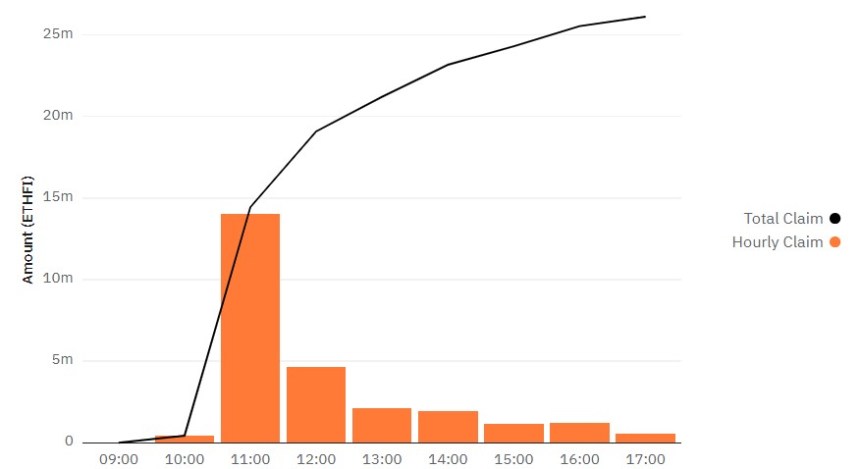
Market expert Tom Wan has provided a summary of the ETHFI airdrop. Out of the total supply of 16.8 million ETHFI tokens, approximately 28% have been claimed by participants.
The airdrop attracted around 20,000 claimers, showcasing considerable interest in the token distribution. Notably, the top wallets, accounting for 1.67% of the total distribution, have the potential to receive between 10,000 and 25,000 ETHFI tokens, reflecting substantial holdings.
Ether.fi

ETHFI amount claimed and a cumulative number of claimers. Source: Dune Most claimers, comprising approximately 67% of participants, are expected to receive a lower allocation of ETHFI tokens, ranging from 175 to 500.
This distribution strategy aims to ensure a broader and more equitable dispersion of the tokens among participants. However, an interesting observation is that 76% of claimers have transferred their ETHFI tokens to other wallets, indicating a potential desire for liquidity or trading activities.
Furthermore, it is noteworthy that 38% of the token receivers are new wallets, suggesting an expansion of the ETHFI user base as of May 1, 2023. This influx of new participants showcases a growing interest in the governance and utility offered by Ether.Fi’s protocol.
Ether.fi Witnesses Surge In Total Value Locked
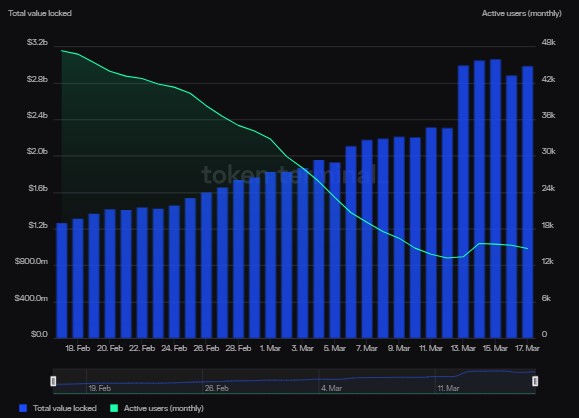
Ether.fi has experienced notable growth in net deposits and Total Value Locked (TVL), as evidenced by data provided by Token Terminal. However, the platform has faced fluctuations in its active user base.
According to Token Terminal, net deposits on Ether.fi have significantly increased, reaching $2.99 billion over the past 30 days alone. This marks a significant growth rate of 136.9%.
Simultaneously, the TVL on Ether.fi has mirrored the surge in net deposits, which also amount to $2.99 billion over the same 30-day period. This metric represents the total value of assets, predominantly cryptocurrency, locked within the protocol.
However, while Ether.fi has witnessed robust growth in net deposits and TVL, the platform has experienced fluctuations in its active user base. Daily active users have shown a considerable decline of 54.3% over the past 30 days, currently standing at 506.
Ether.fi

Ether.fi’s TVL and active users every week. Source: Token Terminal Similarly, weekly active users have experienced a more moderate decline of 3.5%, currently standing at 5,780. This suggests that while there has been a slight reduction in user engagement every week, a significant portion of the user base remains actively involved with the protocol.
The most substantial decline in user activity is observed in monthly active users, with a notable drop of 68.9% over the past 30 days. The figure currently stands at 14,740 users.
Overall, the distribution of the ETHFI token through the airdrop has garnered significant attention and participation. At the same time, the token’s value has experienced a decline since its initial listing, the long-term potential and impact of ETHFI within the Ether.Fi ecosystems are yet to be fully realized.

Ether.fi

The 1-minute chart shows ETHFI’s price drop. Source: ETHFIUSD on TradingView.com Featured image from Shutterstock, chart from TradingView.com


Criptomoedas em alta

Leituras Relacionadas

CPU Makes a Comeback to the Table, A $170 Billion "Power Seizure" Drama Begins

A new era is dawning for the server CPU (Central Processing Unit), driven by the shift from AI model training to large-scale reasoning and the rise of Agentic AI. This article explores how the CPU is reclaiming a central role in the AI data center. For years, the focus has been on the GPU (Graphics Processing Unit) for AI training. However, as AI moves to the inference and Agent phase—where tasks involve complex, multi-step reasoning, tool calls, and data management—the workload balance is flipping. Studies show CPUs now handle over 70% of the workload in Agentic AI, up from 10-30% in training. This is because Agent tasks generate massive intermediate data (KV Cache) that exceeds GPU memory, forcing it to be offloaded to the CPU's larger, more scalable memory pools. This increased importance is translating into market changes. Major players are taking note: NVIDIA launched its first standalone CPU line, Vera, based on ARM architecture and optimized for Agent performance. AMD doubled its server CPU market forecast to over $1200 billion by 2030. Analyst reports project the total server CPU market could reach $1700 billion by 2030, with AI-driven demand being a primary driver. Furthermore, the classic ratio of CPUs to GPUs in AI servers is rapidly changing, converging from 1:8 toward 1:1 for Agent deployments. This surge in demand has led to a rare industry-wide price increase of 10-15% for server CPUs from Intel and AMD, breaking a decade-long trend of "more performance for the same price." Demand is bifurcating into high-core-count CPUs for in-rack GPU support and moderate-core CPUs for standalone Agent task orchestration. In China, this global trend presents an opportunity for domestic CPU manufacturers like Hygon (海光信息) and Huawei Kunpeng, who are bolstered by both growing AI infrastructure needs and national policies promoting technological self-reliance ("xin chuang"). The maturity of their software ecosystems is also accelerating, evidenced by faster adaptation to new AI models. In conclusion, the narrative is shifting from a GPU-centric view to one where CPU-GPU synergy is critical. The CPU is no longer a peripheral component but a performance-defining bottleneck and a key growth driver in the AI hardware stack, opening a massive new market estimated in the hundreds of billions of dollars.

marsbitHá 9h

CPU Makes a Comeback to the Table, A $170 Billion "Power Seizure" Drama Begins

marsbitHá 9h

TechFlow Intelligence: AMD AI Director Publicly Criticizes Claude Code for "Becoming Dumber and Lazier", Trump Claims Full Ceasefire in Hormuz But Strait Still Has 80 Unexploded Mines

TechFlow Intelligence Report: This daily digest covers key developments in AI, crypto, hardware, and geopolitics. In AI, SK Telecom faces US export control scrutiny over its partnership with Anthropic, while a Gemini user reports being misled in a scam scenario, sparking safety debates. China's Z.AI launches the GLM-5.2 model, rivaling Claude Opus without NVIDIA chips. In crypto, Bithumb lists ReProtocol, and Upbit delists KernelDAO. On the hardware front, MIT researchers build a custom OS to study chips, ASML denies US claims its advanced lithography machines are in China, and Amazon considers selling its in-house AI chips. Apple's future A21 Pro chip may use TSMC's latest N2P process. Major tech issues include 10,000 GitHub repositories distributing malware and Apple patching a critical eavesdropping flaw in Beats earbuds. US stocks rise, led by semiconductors, with Intel surging 10.6%, while SpaceX falls 3.5%. Geopolitically, despite a US-Iran deal, the Strait of Hormuz remains risky with ~80 uncleared mines, stalling 80M barrels of oil on standby tankers. Iran postpones Switzerland talks, and Trump calls the agreement an "unconditional surrender." The report highlights a contrast: temporary geopolitical calm versus the ongoing, fundamental restructuring of tech supply chains and chip independence.

marsbitHá 9h

TechFlow Intelligence: AMD AI Director Publicly Criticizes Claude Code for "Becoming Dumber and Lazier", Trump Claims Full Ceasefire in Hormuz But Strait Still Has 80 Unexploded Mines

marsbitHá 9h

Trading

Spot
Futuros

Artigos em Destaque

Como comprar ETHFI

Bem-vindo à HTX.com!Tornámos a compra de ether.fi (ETHFI) simples e conveniente.Segue o nosso guia passo a passo para iniciar a tua jornada no mundo das criptos.Passo 1: cria a tua conta HTXUtiliza o teu e-mail ou número de telefone para te inscreveres numa conta gratuita na HTX.Desfruta de um processo de inscrição sem complicações e desbloqueia todas as funcionalidades.Obter a minha contaPasso 2: vai para Comprar Cripto e escolhe o teu método de pagamentoCartão de crédito/débito: usa o teu visa ou mastercard para comprar ether.fi (ETHFI) instantaneamente.Saldo: usa os fundos da tua conta HTX para transacionar sem problemas.Terceiros: adicionamos métodos de pagamento populares, como Google Pay e Apple Pay, para aumentar a conveniência.P2P: transaciona diretamente com outros utilizadores na HTX.Mercado de balcão (OTC): oferecemos serviços personalizados e taxas de câmbio competitivas para os traders.Passo 3: armazena teu ether.fi (ETHFI)Depois de comprar o teu ether.fi (ETHFI), armazena-o na tua conta HTX.Alternativamente, podes enviá-lo para outro lugar através de transferência blockchain ou usá-lo para transacionar outras criptomoedas.Passo 4: transaciona ether.fi (ETHFI)Transaciona facilmente ether.fi (ETHFI) no mercado à vista da HTX.Acede simplesmente à tua conta, seleciona o teu par de trading, executa as tuas transações e monitoriza em tempo real.Oferecemos uma experiência de fácil utilização tanto para principiantes como para traders experientes.

114 Visualizações TotaisPublicado em {updateTime}Atualizado em 2026.06.02

Como comprar ETHFI

Discussões

Bem-vindo à Comunidade HTX. Aqui, pode manter-se informado sobre os mais recentes desenvolvimentos da plataforma e obter acesso a análises profissionais de mercado. As opiniões dos utilizadores sobre o preço de ETHFI (ETHFI) são apresentadas abaixo.

活动图片