2026 TradFi x Crypto Outlook: 8 Macro Forces and 7 Investment Trends Driving 2026

marsbitPublicado em 2026-01-22Última atualização em 2026-01-22

Resumo

CoinFound's "TradFi x Crypto 2026 Outlook" report identifies 2025 as an inflection point of convergence and predicts an acceleration of "programmable finance" in 2026. It outlines eight key macro forces, including a fiat currency trust crisis driving demand for hard assets like Bitcoin, geopolitical shifts fostering parallel blockchain-based settlement systems, and AI automation necessitating machine-to-machine payments. The report also highlights seven major investment trends, forecasting a structural explosion in the RWA market, with stablecoins reaching a $320B base. Key developments include the evolution of stablecoins 2.0 competing for global payment infrastructure, rapid growth in tokenized stock liquidity, and a shift in private credit RWA towards asset-driven models due to default risks. A major prediction for 2026 is the shift of RWA from yield-bearing assets to high-frequency trading instruments, accompanied by credit expansion into riskier assets like corporate bonds. The overarching theme is the unification of TradFi and Crypto under "On-chain Finance," though the complexity of off-chain defaults triggering on-chain liquidations remains a significant systemic risk.

Author: CoinFound,A TradFi × Crypto Data Technology Company

On January 21, CoinFound officially released the "CoinFound Annual Report: TradFi x Crypto 2026 Outlook." This report focuses on the deep integration trends between TradFi and Crypto. Below is a summary of the report's content:

2025 is the "tipping point for integration," and 2026 will enter an acceleration period for "programmable finance."

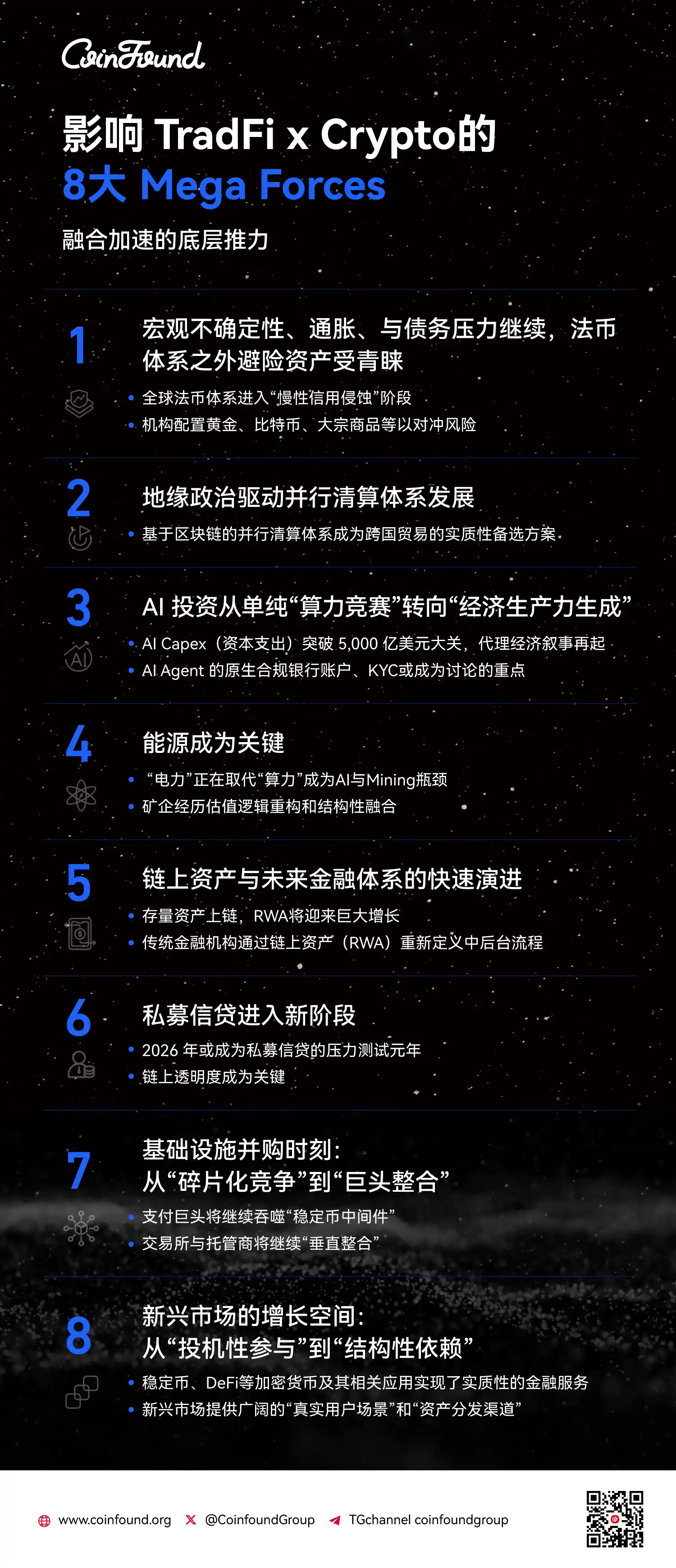
The report distills 8 Mega Forces and 7 trend outlooks: from Stablecoin 2.0 competing for global payment infrastructure, to RWA moving from "issuance" to "utility," and key variables such as stock tokenization, and the divergence and concentration of DATs.

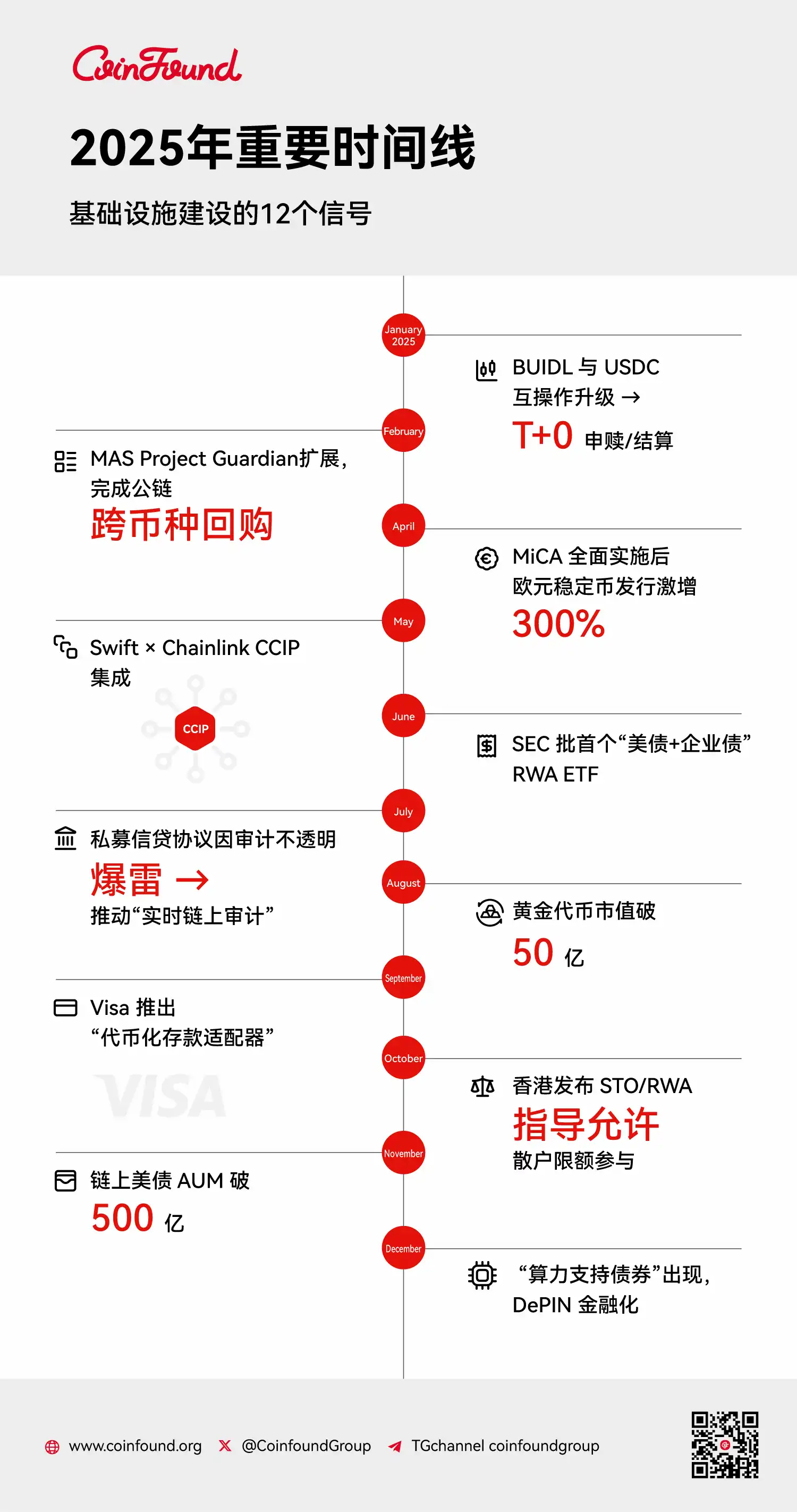
2025 Timeline of Key Events for Traditional Finance x Crypto
In 2026, the following macro trends will impact the TradeFi x Crypto field:

  • Fiat System Trust Crisis and Return to Hard Assets: Facing a global debt spiral and "fiscal dominance" risks, institutions are accelerating allocations to "hard assets" like gold, Bitcoin, and commodities to hedge against fiat currency credit erosion.
  • Geopolitics Driving the Implementation of Parallel Clearing Systems: The need for "de-weaponization" of financial infrastructure is pushing blockchain as an alternative settlement solution independent of SWIFT, with atomic settlement mechanisms effectively reducing trust and counterparty risks in cross-border transactions.
  • AI Productivity Monetization and the Rise of Machine Payments: The focus of AI investment is shifting from computing hardware to generating economic productivity, spurring a rigid demand from AI Agents for compliant stablecoins and on-chain automatic settlement to achieve value attribution between machines.
  • Energy as a Core Asset and the Infrastructure-ization of Mining Companies: Power shortages are driving mining companies to transform into "hybrid computing centers." Their scarce power access rights (Time-to-Power) are triggering acquisitions by tech giants, driving the revaluation of mining companies towards data center infrastructure.
  • On-Chain Assets (RWA) Moving from Issuance to Utility: Asset tokenization is entering the "programmable finance" stage. RWA is no longer just a digital certificate but serves as 24/7 core collateral, significantly enhancing the capital efficiency of repo markets and全域 liquidity.
  • Private Credit Faces Stress Tests and Transparent Transformation: The 2026 debt maturity wave may trigger default risks, forcing the industry to shift from "black boxes" to real-time on-chain transparent audits based on zero-knowledge proofs (ZK) to avoid DeFi chain liquidation crises.
  • Infrastructure Moves from Fragmented Competition to Giant Consolidation: The market is entering a consolidation period similar to the telecommunications industry. Payment and financial giants are acquiring stablecoin middleware and custodians to secure their positions, eliminating redundancy and building compliance moats. Emerging markets shift from speculation to structural dependence: Crypto assets have deepened into underlying tools for payments and remittances in emerging markets. Vast real-user scenarios make them a core hub connecting traditional financial assets with global retail liquidity.

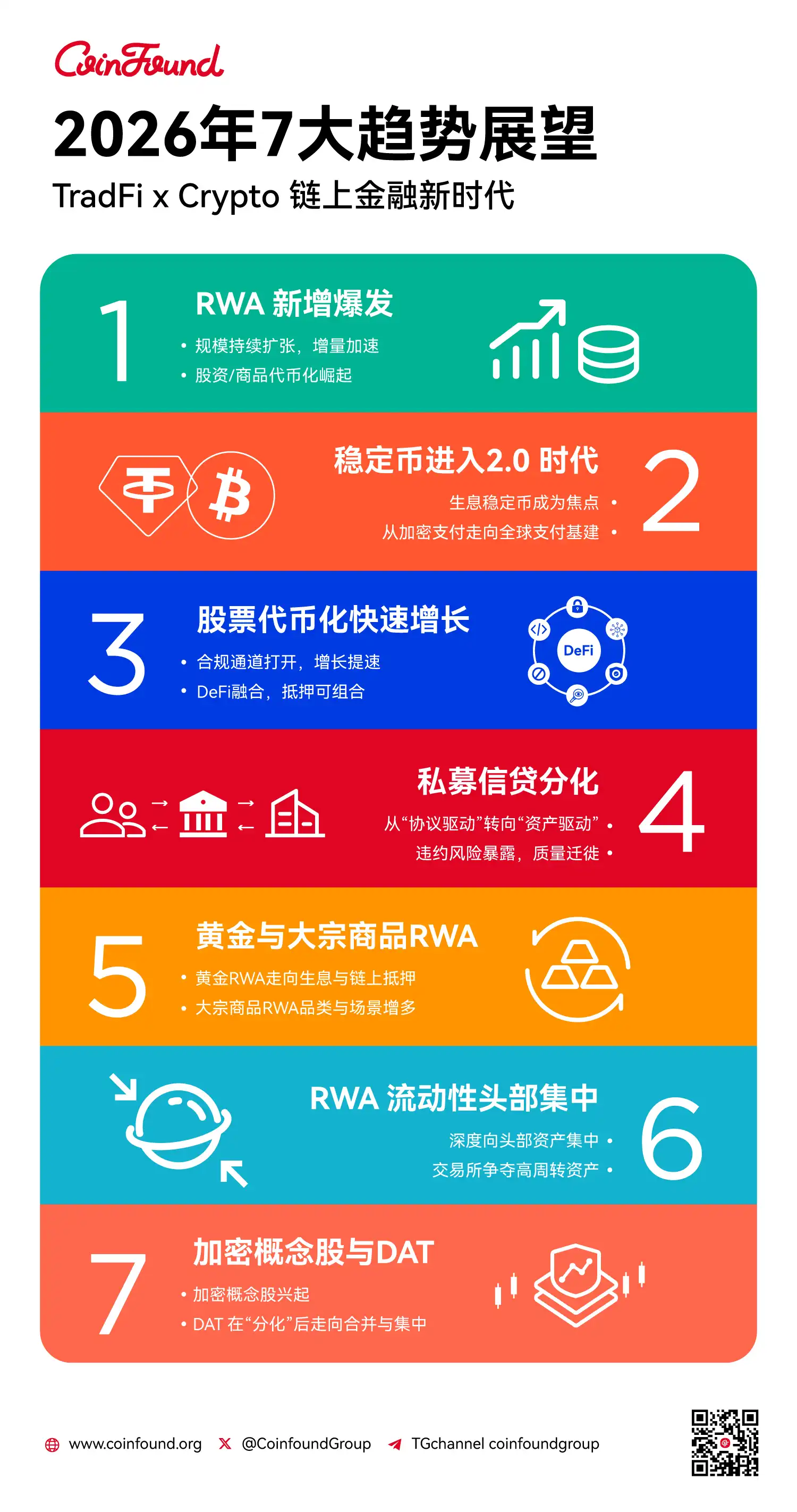
The trend outlook for 2026 is as follows:

1. Structural explosion in the RWA market, stablecoins forming a base of a 3200 billion market, equities and commodities becoming new growth points

2. Stablecoins enter the 2.0 era, moving from crypto payments to competing for global payment infrastructure

3. Stock tokenization liquidity may grow rapidly, DeFi integration will be key

4. Private credit RWA shifts to "asset-driven," may accelerate differentiation under "default" risk pressure

5. Gold and commodity RWA usher in a new era of "full asset collateral"

6. RWA liquidity will further concentrate, three types of RWA assets are gaining favor with exchanges

7. The "rise" of crypto concept stocks, the "divergence" and "concentration" of DATs
Summary

2025 Summary: 2025 was a year of "demystification and integration" for TradeFi and Crypto. Blockchain technology is being还原 (restored) from the光环 (halo) of "revolution" to an efficient bookkeeping and settlement technology. The success of treasury RWA proved the feasibility of putting traditional assets on-chain, and the full entry of giants like BlackRock provided irreversible credit endorsement for the industry.

2026 Prediction: 2026 will be a year of "secondary market explosion and credit expansion." We judge:

  • Liquidity Explosion: With the improvement of infrastructure, RWA will shift from "hold-to-earn" to "high-frequency trading."
  • Credit Downward Drift: Asset classes will drift down from high-credit government bonds to corporate bonds, stocks, and emerging market credit. Risk Premium will become a new source of yield.
  • Risk Warning: As the scale of RWA expands, the complexity of off-chain default transmission to on-chain liquidation will be the biggest systemic risk.

In 2026, both TradeFi and Crypto will be unified under the banner of "On-chain Finance."

Full report link for "CoinFound Annual Report: TradFi x Crypto 2026 Outlook": https://app.coinfound.org/zh/research/4


Perguntas relacionadas

QWhat are the 8 Mega Forces that will influence the TradFi x Crypto field in 2026 according to the CoinFound report?

AThe 8 Mega Forces are: 1. Fiat system trust crisis and the return to hard assets. 2. Geopolitics driving the implementation of parallel clearing systems. 3. AI productivity realization and the rise of machine payments. 4. Energy as a core asset and the infrastructuralization of mining companies. 5. On-chain assets (RWA) moving from issuance to utility. 6. Stress testing and transparency transformation in private credit. 7. Infrastructure moving from fragmented competition to giant integration. 8. Emerging markets shifting from speculation to structural dependence.

QWhat are the 7 key investment trends outlined for 2026 in the report?

AThe 7 key investment trends for 2026 are: 1. Structural explosion of the RWA market with stablecoins forming a $320B base. 2. Stablecoins entering the 2.0 era, competing for global payment infrastructure. 3. Rapid growth in stock tokenization liquidity, with DeFi integration being key. 4. Private credit RWA shifting to 'asset-driven' models, potentially accelerating differentiation under default risk. 5. Gold and commodity RWA ushering in a new era of 'full-asset collateralization'. 6. Further concentration of RWA liquidity, with three types of RWA assets favored by exchanges. 7. The rise of 'crypto concept stocks' and the 'differentiation' and 'concentration' of DATs.

QHow does the report summarize the key difference between 2025 and the predicted landscape for 2026?

AThe report summarizes 2025 as a year of 'disillusionment and integration' where blockchain technology was reduced from a 'revolutionary'光环 to an efficient bookkeeping and settlement technology. In contrast, it predicts 2026 will be a year of 'secondary market explosion and credit expansion', characterized by liquidity爆发 (shifting from 'holding for yield' to 'high-frequency trading'), credit下沉 (expanding from high-credit sovereign bonds to corporate bonds, stocks, and emerging market credit for risk premium), and new systemic risks from off-chain defaults triggering on-chain liquidations.

QWhat is identified as the major systemic risk associated with the growing RWA market in 2026?

AThe major systemic risk identified is the complexity of off-chain asset defaults (Off-chain Default) triggering chain上清算 (On-chain Liquidation) as the scale of Real-World Assets (RWA) expands.

QWhat overarching concept does the report predict will unify both TradFi and Crypto by 2026?

AThe report predicts that by 2026, both TradFi and Crypto will be unified under the banner of 'On-chain Finance'.

Leituras Relacionadas

Must-Watch Events Next Week|CLARITY Act Could Face Senate Vote; SpaceX, Circle to Report Earnings (8.3-8.9)

**Summary: Key Events and Developments to Watch (August 3-9)** The upcoming week is marked by significant financial disclosures, key legislative deadlines, and notable product updates. **Major Financial Events:** Several companies are scheduled to release their Q2 2026 earnings. American Bitcoin (ABTC) will report on August 3, followed by SpaceX and Hut 8 Mining Corp. on August 4, and Circle on August 5. Notably, a significant portion of SpaceX shares (up to 12% of total shares) will be unlocked on August 6 following their earnings release. **Key Legislative Deadline:** The U.S. Senate faces an August 7 deadline to secure 60 votes for the CLARITY Act, a bipartisan bill aiming to establish a federal regulatory framework for cryptocurrencies. The Senate may hold a full vote on the bill during the week. **Economic Data:** The U.S. July Non-Farm Payrolls report will be released on August 7, providing crucial labor market data. **Technology & Product Updates:** * **Shutdowns:** DeFi portfolio tracker Zapper and wallet app Ctrl Wallet will cease operations on August 3. * **Upgrades:** LayerZero will deprecate its v1 relayers on August 3. XRP Ledger's new version 3.3.0, featuring five new functions, is expected next week. * **AI:** Elon Musk announced that the advanced Grok 4.6 AI model is set for release around August 7. * **Bitcoin:** The BIP-110 forced signaling for a potential Bitcoin network change is scheduled to begin around August 8. **Other Notable Events:** Chinese robotics firm Unitree Tech has set its preliminary price inquiry for its IPO for August 5. South Korean exchange Upbit will delist AQT and AERGO tokens on August 3.

marsbitHá 1h

Must-Watch Events Next Week|CLARITY Act Could Face Senate Vote; SpaceX, Circle to Report Earnings (8.3-8.9)

marsbitHá 1h

Stocks Are Plummeting More Sharply Than Cryptocurrencies. Where Has the Money Gone?

Stock Markets Plunge Deeper Than Cryptocurrencies: Where Did the Money Go? In late July, Seoul's Kospi index triggered circuit breakers for two consecutive days, plummeting over 40% from its June high. The collapse was led by heavyweight stocks like SK Hynix, whose record profits still disappointed investors, and devastating leveraged ETFs, with one major product losing over 83% of its value. This signaled a global, forced deleveraging targeting the most crowded trades. Interestingly, while stocks exhibited extreme volatility akin to crypto markets, Bitcoin rose nearly 15% in July after a prior steep drop. Analysis shows the money fleeing equities did not flow into Bitcoin. Instead, Bitcoin had already absorbed its sell-off in May-June, when U.S. spot Bitcoin ETFs saw historic outflows. The true safe-haven beneficiary was gold, whose price rose over 20% year-on-year, highlighting a decoupling between Bitcoin and gold as "digital gold." The sell-off was a targeted unwinding of leveraged positions in tech and semiconductors, accelerated by broker-dealer risk management and shifts in the AI narrative, including new competition from Chinese memory chipmakers. The retreat path was clear: from high-valuation tech stocks to cash and U.S. Treasuries, then to gold. For Bitcoin to attract sustained institutional inflows, conditions like eased global liquidity pressure, a "soft-landing" Fed rate cut, and U.S. regulatory clarity via legislation like the stalled CLARITY Act are needed. Currently, Bitcoin is not a safe haven but an already-cleared asset. Its low correlation with tech stocks, however, makes it a potential diversification play for institutional portfolios once the storm passes. The money isn't here yet, but the positioning is underway.

marsbitHá 1h

Stocks Are Plummeting More Sharply Than Cryptocurrencies. Where Has the Money Gone?

marsbitHá 1h

In Conversation with Ray Dalio: We Are Currently in an AI Bubble, with 1% of My Portfolio in Bitcoin

Ray Dalio, founder of Bridgewater Associates, warns in an interview that the current AI boom shows classic bubble characteristics, which could lead to significant economic downturns as seen in past cycles like 1929 or 2000. He explains that speculative enthusiasm, fueled by debt and overvaluation, often precedes a crash when rising rates or taxation force asset sales, causing widespread losses and recession. Dalio also outlines his "Big Cycle" theory, describing an approximate 80-year pattern where widening wealth gaps, massive government deficits, and shifting geopolitical power (like China's rise) create internal conflict and global instability. He emphasizes that we are in a late-cycle, transitional phase where traditional powers like the US and UK face decline. For personal wealth protection, Dalio advises diversification beyond cash into assets like stocks, bonds, real estate, and particularly gold, which he prefers over Bitcoin. While he holds about 1% of his portfolio in Bitcoin as a non-printable hard asset, he views gold as more secure from technological or governmental threats. Regarding AI's impact, Dalio believes it will disproportionately benefit capital owners, worsening inequality by replacing both physical and cognitive labor. He suggests that human intuition and emotional intelligence, combined with AI, will be key for future workers. On taxation, Dalio argues that wealth taxes are impractical and risk triggering asset sell-offs, reducing productive investment. He points to the UK as a cautionary example of debt, low productivity, and political strife. Geopolitically, Dalio foresees a more regionalized world, with the US showing weakness in prolonged conflicts like with Iran, akin to past imperial declines. The ideal outcome, he suggests, is coexisting powerful blocs (e.g., Americas, China-Asia Pacific) without major war.

marsbitHá 5h

In Conversation with Ray Dalio: We Are Currently in an AI Bubble, with 1% of My Portfolio in Bitcoin

marsbitHá 5h

Trading

Spot
活动图片