2026 Outlook: The Next Phase of Quantitative Trading and Structural Opportunities in Alternative Assets

比推Publicado em 2026-01-27Última atualização em 2026-01-27

Resumo

The 2025/2026 China Quantitative Investment Summit highlighted key shifts in the quant industry. Traditional alpha is diminishing, prompting a move toward greater flexibility, domain-specific modeling, and advanced AI applications. Large language models (LLM), particularly the "Order as Token" concept, are revolutionizing trading by predicting price movements as sequences, similar to NLP models predicting words. Concurrently, alternative assets like cryptocurrencies are gaining institutional interest due to their low correlation with traditional markets and high alpha potential. Strategies such as funding rate arbitrage in crypto perpetual contracts offer market-neutral returns. In 2026, quant strategies will emphasize dynamism, anti-fragility, and dynamic asset allocation to manage crowding risks. Structured products with capital protection features will grow in demand. The industry is evolving through either technological innovation, like AI-driven models, or diversification into emerging asset classes such as crypto.

Author: Max.s

Original Title: Foreseeing 2026: Prospects of Quantitative Trading and How to Allocate Alternative Assets


After experiencing the extreme volatility of 2024 and the profound reshuffle of 2025, the quantitative finance industry stands at a new crossroads. At last week's 2025/2026 China Quantitative Investment New Year Summit, Dr. He Kang, Chief Strategist and Head of Financial Engineering at Huatai Securities Research Institute, delivered an in-depth speech titled "2025 Trends and 2026 Outlook for the Quantitative Industry." This is not just a strategic report on the A-share market; it is a field manual on how Alpha finds new survival space in an increasingly crowded market.

For practitioners at the intersection of Web3 and traditional finance, this report sends a clear signal: traditional Alpha is decaying, and new paradigms—whether the "Order as Token" based on large models or alternative assets represented by cryptocurrencies—are becoming must-haves for institutional investors.

Below is an in-depth review and industry outlook based on the content of Dr. He Kang's speech.

For the quantitative industry, 2025 was a year of both "high prosperity" and "high volatility." One notable data change is that while the scale of securities private equity remains high, the growth of public fund quant is even more rapid. By the third quarter of 2025, the scale of public fund index enhancement products had exceeded 200 billion yuan, with active quant strategies reaching 120 billion yuan.

Behind this lies an interesting structural change: the top player has changed.

The landscape of former leading players has been broken, with institutions like Bodo and Guojin rising rapidly through extremely flexible strategies. In Dr. He's research, these top-performing public quant funds are essentially "private funds in public fund clothing." They boast extremely high turnover rates, astonishingly fast strategy iteration speeds, and even rival top private funds in the use of intraday reversal (T+0) trading.

This phenomenon reveals the survival rule of 2025: as the difficulty of obtaining excess returns increases exponentially, only extreme flexibility can break through in a red ocean. For investors, the past logic of "choosing a big name and lying flat" is no longer applicable; they must use more refined attribution analysis to identify managers who truly possess "agile development" capabilities.

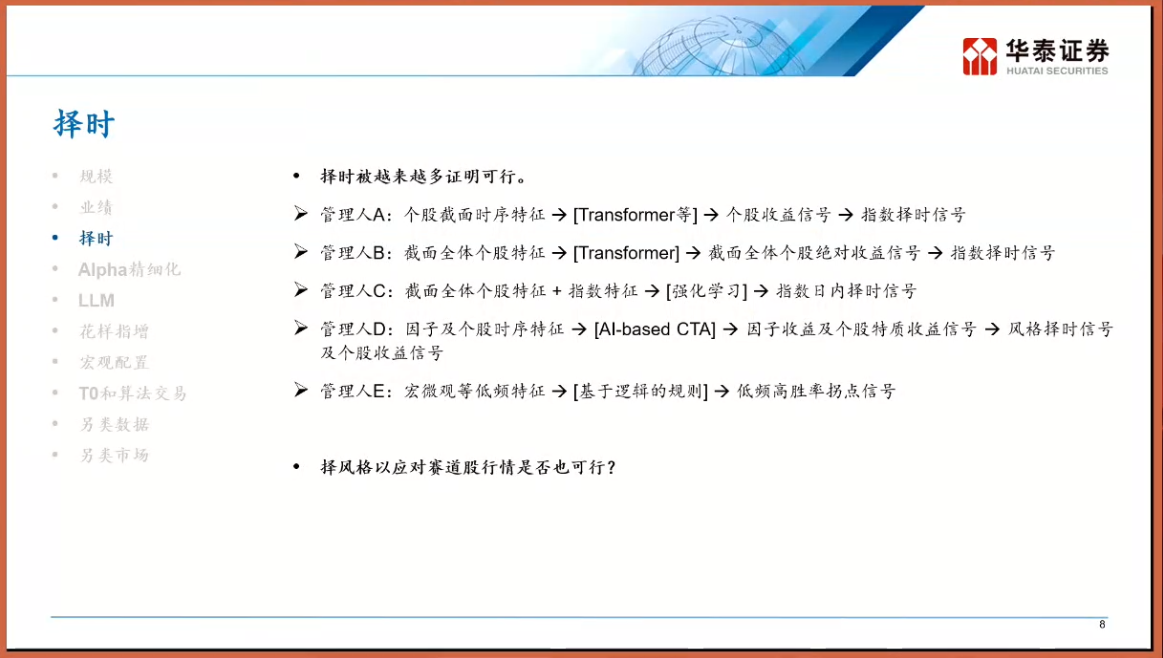
Over the past five years, the mainstream narrative of the quantitative industry has been "full position stock selection," using Alpha from the stock selection side to cover market fluctuations. However, after the market education of 2025, "timing" has returned to the center of the table. Dr. He Kang categorized managers in the market into five types, A through E, with the most noteworthy being Type E managers—those who time the market based on logical rules (Logic-based). Unlike black-box predictions, these strategies build explicit logical chains of "If A then B."
The rise of Sub-domain Modeling.

As market efficiency improves, factors applicable across the entire market are becoming increasingly difficult to unearth. Top managers have begun adopting a "divide and conquer" strategy: slicing the entire market stock universe into different "domains" such as growth, cyclical, small-cap, and micro-cap, and training models separately within each domain. This is akin to how in Web3, you cannot use the same logic to trade Bitcoin and on-chain Meme coins—their pricing logic, liquidity characteristics, and participant structures are completely different. Through sub-domain modeling, quantitative strategies can extract higher excess returns in local markets.

If sub-domain modeling is a tactical optimization, then the introduction of large language models (LLMs) is a strategic dimensional reduction strike. Dr. He Kang mentioned three application tiers for large models in quant, the most memorable being the third tier: treating financial trading as a language, i.e., "Order as Token."

In traditional NLP (Natural Language Processing), GPT predicts the next word (Token); in a financial large model, the input is the price series, trading volume, and order flow over a past period, and the model predicts the next "price Token." This is not just a technological migration but a revolution in thinking.

Traditional quantitative models are often based on linear or nonlinear regression in statistics, while the Transformer architecture allows models to capture extremely long-term dependencies and complex nonlinear patterns. Imagine future trading not being based on a linear weighting of a few factors, but a pre-trained financial large model "generating" future price paths, much like generating text. This shares similarities with the AI Agent trading logic based on Intent-centric approaches in the Crypto field—AI is no longer an auxiliary tool but the direct execution agent.

The Blue Ocean of Alternative Data: The Institutionalization of the Cryptocurrency Market

When excess returns in the A-share market are "competed" to the extreme, smart money begins to look towards alternative markets with lower correlation through total return swaps (TRS) or offshore entities.

Compared to the T+1 system and price limits of A-shares, the crypto market features 7*24 hour trading, T+0 settlement, high volatility, and fragmented liquidity. For quantitative institutions with high-frequency trading capabilities and risk control models, this is like the A-share market before 2015—Alpha is everywhere, and the competitive landscape is not yet solidified.

Here is a special introduction to the Funding Rate Arbitrage strategy. In the perpetual contract mechanism of the crypto market, long and short positions need to pay funding fees to maintain price anchoring. In a bull market cycle, longs often need to pay high fees to shorts. This creates a market-neutral strategy akin to fixed income: buy spot, short an equivalent value of perpetual contracts, hedging price volatility risk while steadily earning the funding rate. In this field, the 1Token Funding Rate Arbitrage Strategy Index has become an important industry bellwether.

According to industry data, such strategies' annualized returns in specific market cycles far exceed those of traditional fixed-income products, and their correlation with traditional assets (stocks, bonds) is extremely low. 1Token, as a professional digital asset institutional service provider, constructs indices that not only reflect the overall market arbitrage space but also embody the evolution of Crypto quant from "artisanal workshops" to "institutionalization and indexation."
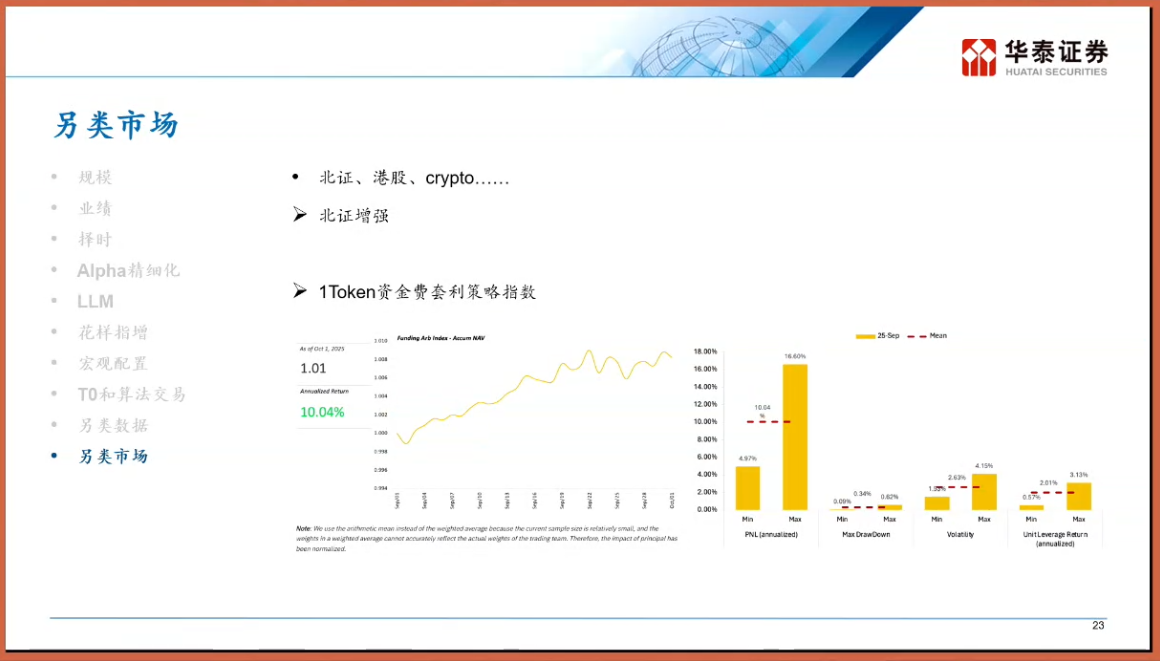
For traditional finance practitioners, the significance of paying attention to indices like those from 1Token is that it provides a window to observe the Web3 liquidity premium. When funding rates remain high for a long time, it signifies extremely exuberant market sentiment and is a warning of spot selling pressure; conversely, it may be a good opportunity to buy the dip.

Looking ahead to 2026, the keywords given by Dr. He Kang are "Dynamic" and "Anti-fragile."

From Static Allocation to Dynamic Game Theory. In the past, doing FOF (Fund of Funds) or major asset allocation often involved setting a static weight (e.g., a 60/40 portfolio). But in the future, a dynamic adjustment mechanism must be introduced. For example, when the crowding degree of a certain strategy (e.g., micro-cap index enhancement) becomes too high, due to the "stampede risk" brought by homogenized trading, its weight must be actively reduced, even if its historical performance is excellent.

The "Airbag-ization" of Products. Having experienced the pain of drawdowns, investor aversion to downside risk has peaked. Derivative products with "airbag" or "snowball" structures, as well as index enhancement products protected by options, will become mainstream in 2026. This logic is identical to that of DeFi structured products—sacrificing a portion of potential upside gains in exchange for higher certainty and principal protection.

Finding Low-Correlation Assets. Whether seeking independent Alpha within A-shares or allocating to Hong Kong stocks, US stocks, or even Crypto assets, the core goal is to reduce the overall correlation of the portfolio. Dr. He Kang specifically mentioned that while making pure Alpha in Hong Kong stocks is difficult (poor liquidity, expensive shorting tools), its value as part of a diversified allocation still exists. And the Crypto market, with its unique driving logic, will become an important piece for hedging traditional financial risks.

Dr. He Kang's speech, in fact, reveals the essence of financial engineering: the process of finding certainty within uncertainty.

In the 2025 quantitative industry, the traditional low-hanging fruit has been picked. Practitioners face only two paths: either persevere technologically, using large models to mine deeper nonlinear patterns; or go overseas on the asset side, conducting dimensional reduction strikes in blue oceans like Crypto.

For Web3 natives, this is also a warning: as top institutions like Huatai Securities begin to deeply research and focus on this field, the entry of正规军 (regular army/institutional players) is only a matter of time. When traditional quantitative dragon-slaying skills are applied to decentralized trading markets, new红利 (dividends/opportunities) and new brutal competition will arrive simultaneously.

In 2026, whether in TradFi or Crypto, only the evolvers will survive.


Twitter:https://twitter.com/BitpushNewsCN

Bitpush TG Discussion Group:https://t.me/BitPushCommunity

Bitpush TG Subscription: https://t.me/bitpush

Original link:https://www.bitpush.news/articles/7605979

Perguntas relacionadas

QWhat are the key trends and challenges facing the quantitative trading industry in 2025, as discussed in the article?

AThe quantitative trading industry in 2025 is characterized by 'high prosperity' and 'high volatility.' A key trend is the rapid growth of public fund quantitative products, with enhanced index products surpassing 200 billion CNY in scale. The challenge is the exponential increase in the difficulty of obtaining alpha, forcing managers to adopt extreme flexibility and rapid strategy iteration to survive in a highly competitive market.

QHow is 'Order as Token' conceptualized in the application of large language models (LLM) to quantitative trading?

A'Order as Token' is the third and most advanced application level of LLMs in quantitative trading. It treats financial trading as a language, where the model inputs past price sequences, trading volumes, and order flows, and predicts the next 'price token.' This represents a revolutionary shift from traditional statistical models to using transformer architectures to capture long-term dependencies and complex nonlinear patterns, akin to AI generating future price paths.

QWhat is the 'Funding Rate Arbitrage' strategy in the cryptocurrency market, and why is it attractive to institutional investors?

AThe 'Funding Rate Arbitrage' strategy is a market-neutral strategy in crypto perpetual contracts. It involves buying spot assets while shorting an equivalent value of perpetual contracts. This hedges price volatility risk while allowing the investor to earn the funding fee, which is typically paid by longs to shorts in a bull market. It is attractive because it offers returns that far exceed traditional fixed-income products and has extremely low correlation with traditional assets like stocks and bonds.

QAccording to the article, what is the significance of 'sub-domain modeling' in modern quantitative strategies?

ASub-domain modeling is a strategy where the entire stock market is divided into distinct domains such as growth, cyclical, small-cap, and micro-cap stocks. A separate model is trained for each domain. This 'divide and conquer' approach allows quantitative strategies to extract higher alpha in local markets by accounting for their unique pricing logic, liquidity characteristics, and participant structure, much like using different logics to trade Bitcoin and meme coins in Web3.

QWhat are the key recommendations for asset allocation and risk management in 2026, as outlined by Dr. He Kang?

AThe key recommendations for 2026 are 'dynamic' allocation and building 'anti-fragile' portfolios. This involves moving from static asset weights to dynamic adjustments based on strategy crowding (e.g., reducing exposure to overly crowded strategies like micro-cap index enhancement). For risk management, products with 'airbag' or 'snowball' structures that use derivatives and options for capital protection will become mainstream. The core goal is to lower portfolio correlation by diversifying into assets like港股,美股, and Crypto.

Leituras Relacionadas

7 Months After the Collapse of Huiwang, Southeast Asia's Escrow Platforms Undergo a Major Reshuffle

Following the collapse of Huione Pay—dubbed the "Alipay of Southeast Asia"—seven months ago, the region's underground financial guarantee platform sector is undergoing a significant reshuffle. This power vacuum has been swiftly filled by emerging platforms such as XinBi, Tiger/Navigator, JinBei (renamed JinBo), Dali/Tiancheng, and FullyLight. These platforms, operating largely via Telegram and offering services like escrow for illicit transactions, have absorbed the vast user base and markets left behind by Huione. While positioning themselves as "trust intermediaries," their primary clientele consists of networks involved in online scams, money laundering, illegal gambling, and even human trafficking. For instance, the Tiger/Navigator platform explicitly provides "escrow" services for kidnapping-for-ransom operations ("强押车交易"). Data underscores the immense scale: Huione alone processed over $103 billion in cryptocurrency payments and facilitated over $31 billion through its escrow market before its downfall, linking it to Cambodia's notorious Prince Group. Since its collapse, competitors have seen explosive growth. For example, the XinBi platform has accumulated over $1.6 billion in total USDT revenue, while platforms like NewPay, OkPay (under Dali), and FullyLight Wallet collectively processed over $4.8 billion in USDT in a single year. This ecosystem thrives in regions like Cambodia and Myanmar, where regulatory gaps allow these platforms to act as critical financial infrastructure for sprawling cybercrime industries, from scam compounds to online casinos. The article concludes that the moniker "Southeast Asian Alipay" is a misnomer, obscuring the platforms' fundamental role in enabling serious criminal enterprises rather than representing legitimate financial innovation.

Odaily星球日报Há 20m

7 Months After the Collapse of Huiwang, Southeast Asia's Escrow Platforms Undergo a Major Reshuffle

Odaily星球日报Há 20m

The Changing Landscape: What Are Crypto VCs Experiencing?

Title: The Shifting Landscape of Crypto Venture Capital The era of dedicated crypto venture capital funds is undergoing a significant transformation. Once essential for navigating the sector's complexity and high risk, these specialized funds are now facing an identity crisis as the market matures. This shift mirrors historical patterns in other specialized investment classes like cleantech and SPACs, where initial information advantages dissipate as technologies become mainstream and integrated into existing industry frameworks. The article argues that crypto is reaching a critical inflection point, transitioning from a "building phase" to an "integration phase." Major players like Stripe, BlackRock, and Visa now engage with crypto not for its novel mechanics but as a foundational financial infrastructure. Their needs—regulatory compliance, banking partnerships, distribution channels—align with traditional fintech, a domain easily understood by large, generalist funds like Sequoia and Founders Fund. This evolution creates a "barbell effect" within the VC landscape. On one end are massive, diversified platforms that can incorporate crypto as one vertical among many. On the other are small, nimble funds focused on niche, experimental projects. The middle ground—medium-sized dedicated crypto funds—is being squeezed out. Their typical fund size makes it impossible to generate sufficient returns solely from early-stage crypto bets, yet they cannot compete with giants for later-stage deals. Consequently, leading crypto-native firms like Paradigm and Framework Ventures are expanding into AI, robotics, and other sectors, driven partly by LP pressure for better returns amid a broader VC DPI crisis. Others, like Dragonfly and a16z, have narrowed their crypto focus predominantly to financial infrastructure like stablecoins, reframing the sector's core narrative. For crypto entrepreneurs, this consolidation presents challenges. While generalist funds offer larger checks and broader resources, crypto projects now compete fiercely with AI for attention and capital within these firms. Furthermore, the long-term, non-commercial foundational work that built the ecosystem—funded by dedicated crypto VCs—is less likely to attract generalist capital focused on direct returns. The conclusion is that "crypto investor" as a standalone category is becoming obsolete, akin to "internet investor." Crypto is becoming a baseline infrastructure layer. The future will see a barbell structure: large-scale growth financing handled by generalist funds, while pioneering, speculative projects are funded by small, specialized vehicles. The dedicated crypto funds of the 2017-2021 boom, which incubated core infrastructure, are giving way to this new, bifurcated reality.

Foresight NewsHá 37m

The Changing Landscape: What Are Crypto VCs Experiencing?

Foresight NewsHá 37m

As Consensus Accelerates, What Are Young Investors Betting On?

Title: As Consensus Forms Faster, What Are Young Investors Betting On? In the rapid evolution of tech investment, a new generation of young investors is navigating a landscape where AI, robotics, commercial aerospace, and quantum computing are advancing simultaneously. Traditional investment logic based on financial models is giving way to a need for deep technical understanding and the ability to act before industry consensus forms. An analysis of trends from the "WAIC FUTURE TECH" list of young investment leaders reveals key shifts in focus. The first major trend is the movement of AI from the digital screen into the physical world. Investment is shifting from large language models and chatbots towards embodied AI, robotics, AI hardware, and edge computing. While demonstrations generate excitement, the real challenge lies in achieving scalable, reliable, and cost-effective delivery in complex real-world environments like factories and logistics. Success depends not just on algorithms but on the integration of sensors, actuators, and control systems. Second, the competitive focus for large models is moving beyond raw capability toward building an "intelligence flywheel." The goal is to create self-reinforcing systems where user interaction generates data, improving the model, which in turn enhances the user experience and attracts more engagement. Companies that successfully embed AI into workflows to create these closed-loop systems can build lasting value that isn't easily erased by the next model upgrade. Third, facing a potential bottleneck in high-quality human-generated data, investors are looking at new underlying technologies. Reinforcement learning and self-play, as demonstrated by AlphaGo Zero, offer paths for AI to generate its own experience. Scientific foundation models, which aim to build general AI capabilities for fields like life sciences and materials discovery, represent a non-consensus direction that could unlock new frontiers of knowledge and data. Finally, in deep-tech areas like quantum computing, commercial aerospace, and space-based infrastructure, patient capital is essential. These fields have long, uncertain development and validation cycles involving complex engineering, supply chains, and regulations. Investment here requires a long-term view, focusing on foundational team capabilities and the eventual emergence of market demand, even if commercial returns are distant. Collectively, these trends illustrate how young investors are adapting to a new era. They are learning to make earlier, technically-informed judgments, balance hype with real-world viability, and provide the patient capital needed to build the deep-tech foundations of the future.

marsbitHá 1h

As Consensus Accelerates, What Are Young Investors Betting On?

marsbitHá 1h

Trading

Spot
活动图片





