一周代币解锁预告:SUI解锁超6000万美元,三个项目解锁占比超2%

Odaily星球日报Publicado em 2024-03-03Última atualização em 2024-03-03

Resumo

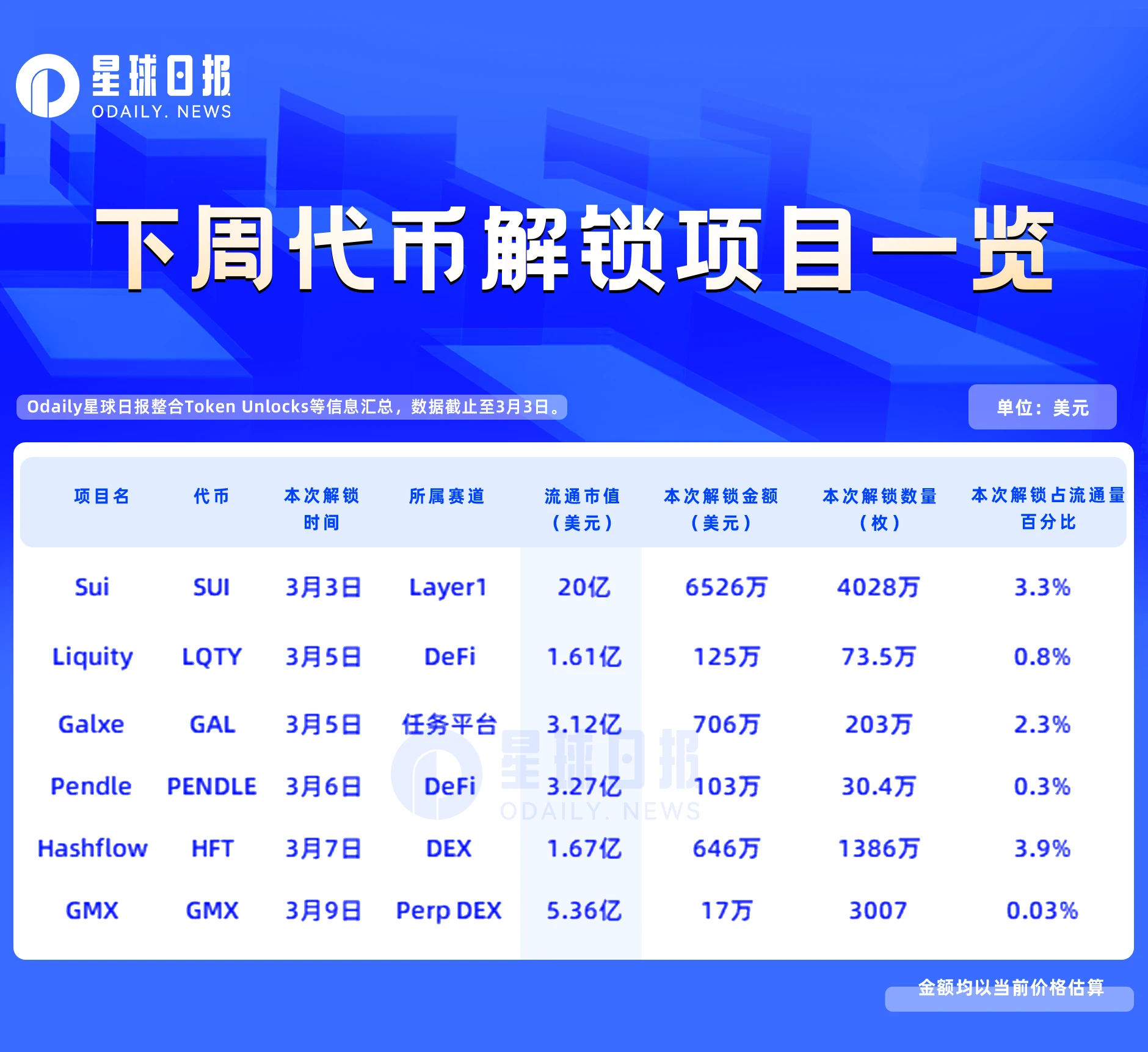
HFT、SUI、GAL 将有高比例解锁,但金额不高。

下周, 6 个项目迎来代币解锁事件。HFT、SUI、GAL 将有高比例解锁,但总体金额不大,其余项目解锁比例与金额均较小。

具体解锁详情如下:
一周代币解锁预告:SUI解锁超6000万美元,三个项目解锁占比超2%

Hashflow

项目推特:https://twitter.com/hashflow

项目官网:https://www.hashflow.com/

本次解锁数量: 1386 万枚

本次解锁金额:约 646 万美元

Hashflow 是一个去中心化的交易所,旨在实现零滑点和具备 MEV 保护的交易。Hashflow 目前可在以太坊、BNB Chain、Polygon、Avalanche、Arbitrum 和 Optimism 上使用。HFT 是 Hashflow 协议以及 Hashverse(Hashflow 的游戏化治理平台)的原生代币。

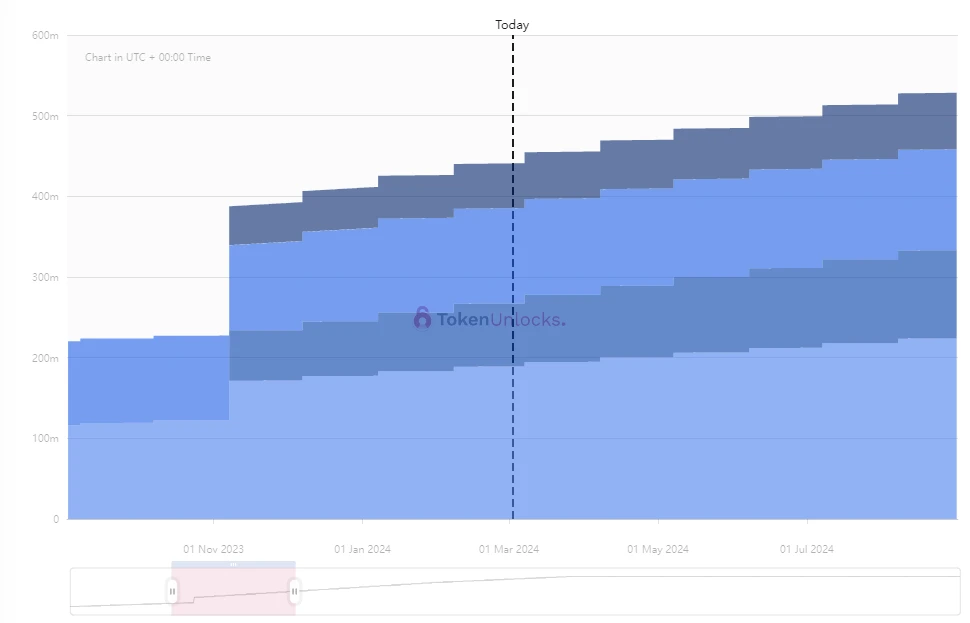
HFT 目前流通量达总量的 44% ,此前经历过一轮大额释放,目前月度释放 3% -4% 的代币,通胀速度中等。本轮将释放流通量的 3.9% ,主要为生态的 1.55% 、早期投资者的 1.45% 和核心团队的 0.67% 。今年内将保持相似的释放速度和对象。

具体释放曲线如下:
一周代币解锁预告:SUI解锁超6000万美元,三个项目解锁占比超2%

Sui

项目推特:https://twitter.com/SuiNetwork

项目官网:https://sui.io/

本次解锁数量: 4028 万枚

本次解锁金额:约 6526 万美元

Sui 是 Meta 系公链中起步最早的一个项目,由 Mysten Labs 团队开发。Sui 旨在创建一款环保、低成本、高吞吐量、低延迟的无权限区块链。相比传统区块链,Sui 最关键的创新在于 Sui 的数据模型及交易处理通道。

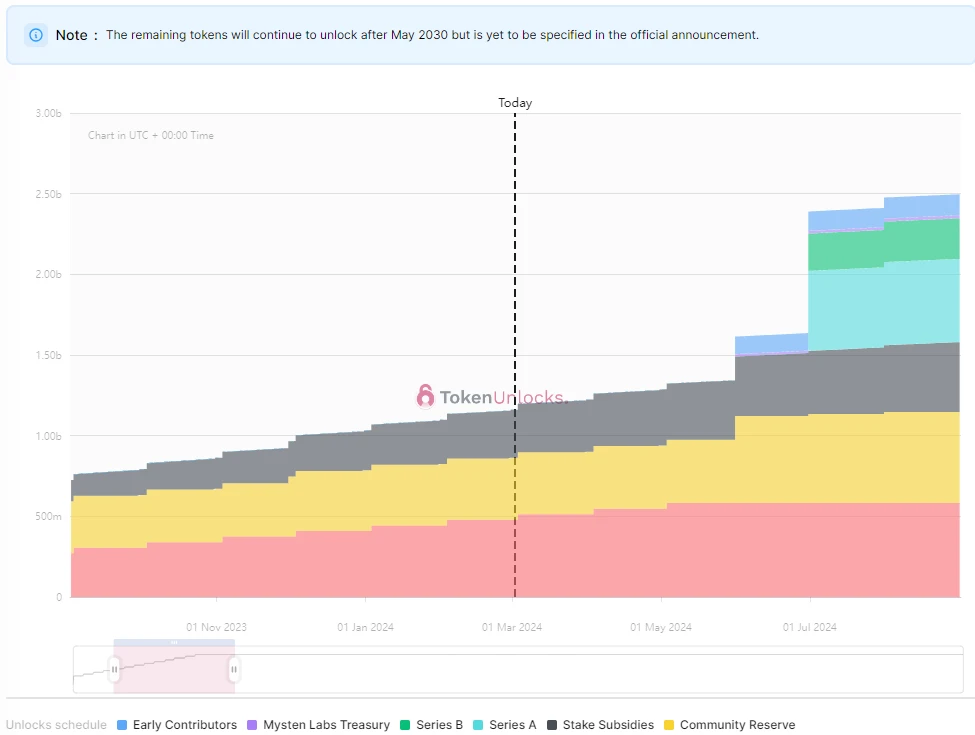
本轮解锁为常规线性解锁,全部面向社区项目(Community Access Program)解锁,一次性解锁 3462 万枚,价值 5608 万美元。后续的大额解锁将在五月末和六月末进行。

具体释放曲线如下:
一周代币解锁预告:SUI解锁超6000万美元,三个项目解锁占比超2%

Galxe

项目推特:https://twitter.com/Galxe

项目官网:https://galxe.com/

本次解锁数量: 203 万枚

本次解锁金额:约 706 万美元

Galxe 是一个Web3凭证数据网络。 Galxe 建立在开放和协作的基础架构之上,可帮助Web3开发人员和项目利用数字凭证数据和 NFT 来构建更好的产品和社区。

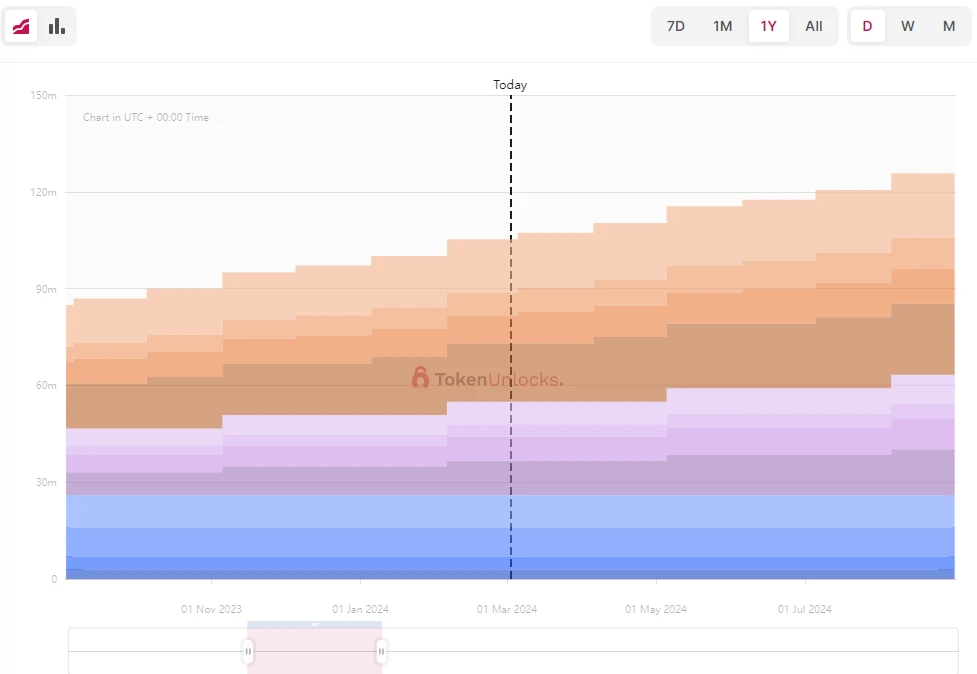
GAL 当前流通量已达总量的 53% ,常规解锁量影响不大,本次将释放流通量的 2.3% ,主要为基金会的 1.14% ,其余代币面向团队和社区释放,今年将整体保持微量通胀趋势。

具体释放曲线如下:
一周代币解锁预告:SUI解锁超6000万美元,三个项目解锁占比超2%

Leituras Relacionadas

Research Report Analysis: Is Intel Making a Comeback with Apple? Bernstein's Calculations Show the Right Direction, but the Price Is Already Overvalued

Bernstein analyst Stacy A. Rasgon published a report on June 18 regarding Intel, assessing the potential impact of recent political support for a US-based PC chip design and manufacturing collaboration between Apple and Intel. The report views this as a significant signal for the foundry landscape shift but concludes the initial financial contribution would be minimal. Key conclusions: 1) An Apple deal is seen as a small-scale "proof of concept." Even if Intel wins 40% of Apple's premium notebook chip orders (~5 million units/year), Bernstein estimates it would generate only about $500M in annual revenue and ~$0.03 EPS, negligible against Intel's ~$55B revenue. 2) Political encouragement is not equivalent to enforceable mandates. Winning orders ultimately depends on Intel demonstrating competitive technology (like its 18A node), cost, and reliable supply. 3) The path from validation to large-scale production involves significant challenges, capital investment, and time. Due to these uncertainties, Bernstein maintains a Market-Perform (Hold) rating with a $100 price target, implying potential downside from the ~$121.10 price at the report date. The analysis highlights the tension between near-term validation value—serving as a crucial trust signal for Intel's foundry ambitions and US supply chain resilience—and the long-term opportunity to attract larger cloud and AI chip customers. The investment thesis hinges on successful 18A execution and sustained policy support, not on immediate financial gains from Apple.

marsbitHá 5m

Research Report Analysis: Is Intel Making a Comeback with Apple? Bernstein's Calculations Show the Right Direction, but the Price Is Already Overvalued

marsbitHá 5m

27-Year Reign Ends: SK Hynix Market Cap Surpasses Samsung for First Time, an AI-Driven Reshuffle of Korean Chip Power

On June 22, 2026, SK Hynix made history by surpassing Samsung Electronics in market capitalization, ending Samsung's 27-year reign as South Korea's most valuable company. This dramatic reversal is powered by the AI boom and SK Hynix's dominant position in High Bandwidth Memory (HBM), a critical component for AI model training. Once a heavily indebted firm on the brink of bankruptcy, SK Hynix bet early on HBM, which has evolved from a niche product to essential AI infrastructure. It now commands a 59% share of the global HBM market. Its financial performance is staggering, with Q1 2026 net profit soaring nearly fourfold year-over-year to KRW 40.35 trillion, translating to over 2 billion RMB in daily net profit. HBM now drives roughly 40% of its revenue with exceptionally high margins. In contrast, Samsung, with its broad portfolio spanning memory chips, smartphones, and foundry services, has lagged in the HBM race while facing headwinds in other divisions. This shift signifies a deeper restructuring of South Korea's economy, moving from consumer electronics to AI-driven growth. However, the future remains competitive. With major capacity expansions planned industry-wide by 2028 and Samsung aiming to catch up in HBM technology, the new market leader cannot afford complacency. This event marks a pivotal moment in the global semiconductor industry's ongoing power realignment.

marsbitHá 16m

27-Year Reign Ends: SK Hynix Market Cap Surpasses Samsung for First Time, an AI-Driven Reshuffle of Korean Chip Power

marsbitHá 16m

Why Does 'AGI Godfather' Ben Goertzel Believe the Future of AI Relies on Blockchain?

Ben Goertzel, known as the "AGI Godfather," argues that the future of Artificial General Intelligence (AGI) must be built on blockchain to prevent its control by a few corporations or venture capital firms. He believes the core AGI code should be free and open-source, but that this alone is insufficient without a decentralized infrastructure to run it affordably. His blockchain project, SingularityNET, and the broader Artificial Superintelligence Alliance aim to create a user-owned, decentralized network for hosting and deploying AGI, contrasting with the closed models of companies like OpenAI and Anthropic. Goertzel criticizes the shift of other labs from open to closed development. He argues that while a closed path is simpler, an open, decentralized model—akin to Linux and the internet—is both possible and ultimately better for humanity. He envisions an "Agent economy" where individuals orchestrate teams of AI agents to perform tasks, including transactions, on an open network rather than corporate clouds. While his current model relies on cryptocurrency, plans include offering paid AI services to businesses with the decentralized blockchain as the backend. Goertzel predicts human-level AGI could arrive by 2029 and warns that a gap in understanding and access to AGI could drastically worsen inequality. The first test of his decentralized approach will be the upcoming release of the Agent Omega Claw.

Foresight NewsHá 47m

Why Does 'AGI Godfather' Ben Goertzel Believe the Future of AI Relies on Blockchain?

Foresight NewsHá 47m

Trading

Spot
Futuros
活动图片