Indonesia’s Crypto Watchdog Pushes for Friendlier Taxes as Regulatory Overhaul Looms

CoinDeskPolicyPublicado em 2024-02-29Última atualização em 2024-03-01

Resumo

Local exchanges have previously blamed falling trading volumes on commodities taxes on crypto.

  • Indonesia’s crypto regulator wants the government to reconsider taxes on the sector.
  • The country currently taxes crypto as commodities, but that classification may change next year when oversight falls under the financial services authority OJK.
10
10.5K

An official at Indonesia’s crypto regulator, the Commodity Futures Trading Supervisory Agency (Bappebti), has called on the Finance Minister to reconsider tax rates for digital assets.

Crypto is treated as commodities in the Southeast Asian nation, and is therefore subject to value-added tax (VAT) and income tax. But this is set to change when crypto oversight switches over to the country’s broader financial services regulator OJK in 2025.

"As crypto is expected to join the financial sector by January 2025, we urge the Tax Director General to review these taxes. It's been over a year since these rules were put in place, and taxes usually get checked every year," Tirta Karma Senjaya from Bappebti said during an event on Tuesday.

Advertisement
Advertisement

Tirta also said that the digital asset industry is still in its infancy and needs space to grow before making significant tax contributions to national revenue.

Existing taxes have been called out by the industry as burdensome for users and service providers. Indonesian crypto exchanges blamed a dramatic 60% drop in trading volumes last year from 2022 on taxes, which they fear could drive users away to foreign exchanges.

While Bappebti has not specified how it wants the Finance Ministry to revise the taxes, it is likely that it seeks the removal of VAT, to match how stocks are treated. The industry expects the shift in oversight to OJK – which oversees all financial services in Indonesia, including banking, capital markets, insurance and pensions – could mean crypto will be treated as securities in the country.

Dwi Astuti, a spokesperson for the Ministry of Finance, said on Wednesday that they "welcome input from Bappebti and the public" and that the issue of taxes "will certainly be discussed internally."


Edited by Sandali Handagama.


Leituras Relacionadas

Indices Strong, Natural Gas Soars | TradeXYZ Weekend Market Watch

Weekend Market Observations: Indices Show Strength, Natural Gas Surges Key regional developments centered on Iran. Iran and Oman indicated negotiations over reopening a key shipping channel are nearing completion, with Oman calling for a halt to military actions to facilitate an agreement. However, talks are stalled as Iran has raised its demands, linking Strait reopening to conditions like US sanctions relief, troop withdrawal, and war reparations—terms previously associated with nuclear talks. Iran's Revolutionary Guard stated it will maintain control until all demands are met. In response, the US administration has adopted a lower-key approach, describing a state of "semi-negotiations" while observing Iran's economic pressures. Amid this, reported attacks on a Saudi refinery and an Emirati vessel added to regional tensions. **Crude Oil & Indices:** Crude oil (CL) experienced volatility, initially dipping on comments from Iran's president before recovering. Prices later rose toward $79 after the US signaled a shift toward economic pressure over military escalation. Major equity indices (SP500, XYZ100) posted modest gains (0.13%, 0.22% respectively), demonstrating resilience despite rising oil prices. **Individual Stocks:** The market saw mixed sector performance. Memory stocks were divided (Micron up, SK Hynix down). The optical communications sector was strongest, with MRVL and LITE both gaining around 2.4%. Crypto-related stocks rebounded in pre-market trading after an early dip, closing higher. **Commodity Futures:** Precious and industrial metals (gold, silver, copper) advanced over the weekend, with futures showing V-shaped recoveries. The standout performer was natural gas, surging 3.10% at the open. The primary driver is a forecast for sustained hotter weather into mid-August across the southern and eastern US, boosting power generation demand. This is compounded by tighter supply margins due to pipeline maintenance, a slight dip in dry gas production, and high utilization of LNG export terminals.

marsbitHá 2m

Indices Strong, Natural Gas Soars | TradeXYZ Weekend Market Watch

marsbitHá 2m

Bitcoin Withstood 10 Bearish Blows in 2026, Yet Experienced Its Mildest Bear Market

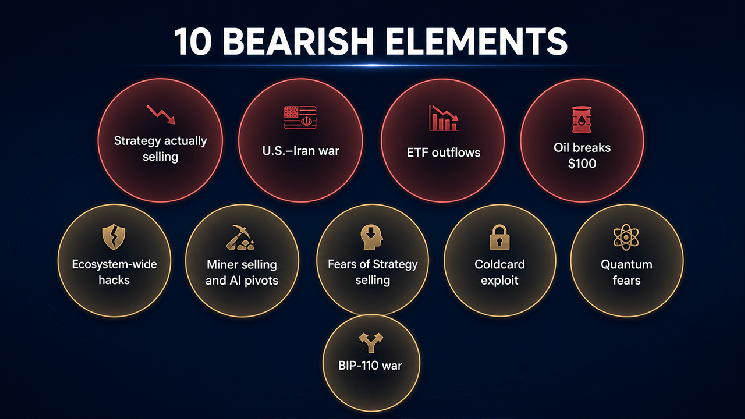
Bitcoin, the leading cryptocurrency by market cap, peaked above $126,000 in early October before entering a prolonged decline. By August, it was mainly trading between $63,000 and $65,400, inflicting losses on late buyers but resulting in what is, historically for Bitcoin, an unusually shallow bear market—down about 49% from its peak, compared to typical 75-80% plunges. Throughout 2026, Bitcoin faced multiple headwinds yet demonstrated notable resilience. Geopolitical tensions in the Middle East and volatile oil prices revived inflation concerns but failed to trigger the panic-driven sell-offs seen in prior cycles. A significant psychological blow came from corporate seller MicroStrategy, a longtime accumulator, which began strategic sales to bolster its cash position, reducing its holdings. U.S. spot Bitcoin ETFs also faced sustained outflows, though a late-week inflow hinted at potential relief. Pressure also came from within the ecosystem. A contentious blockchain proposal, BIP-110, failed after a minority chain stalled. Miners, facing tighter economics, sold reserves and pivoted infrastructure toward AI. A major security breach involving Coldcard hardware wallets saw an estimated 2,000 BTC stolen, shaking confidence in self-custody. Long-term threats like quantum computing resurfaced in discussions. Despite this confluence of corporate selling, ETF outflows, miner capitulation, geopolitical shocks, internal conflict, and security issues—any one of which could historically cause sharp declines—Bitcoin stubbornly held above a key $60,000 support level. Deeper market liquidity, regulated products, and long-term holders appear to be absorbing selling pressure that once would have caused deeper crashes. This resilience suggests a maturing market structure, though risks remain. Another shock could still push Bitcoin toward $50,000. For now, its 49% decline, severe for most assets, is relatively moderate by Bitcoin's own volatile standards. The remaining months of 2026 will test whether $60,000 is a durable floor or merely the next major line of defense.

cryptonews.ruHá 1h

Bitcoin Withstood 10 Bearish Blows in 2026, Yet Experienced Its Mildest Bear Market

cryptonews.ruHá 1h

Trading

Spot
活动图片