Starknet空投到来,一览值得交互的生态项目

Odaily星球日报Publicado em 2024-02-14Última atualização em 2024-02-14

Resumo

目前生态已有多个DeFi项目设有积分系统,zkLend明牌空投即将到来。

2 月 14 日,以太坊 Layer 2 网络 Starknet 终于不负万众期待,公布了代币 STRK 的空投细则, 2 月 20 日起,用户即可以领取 STRK 空投,以 STRK 为 Gas 参与生态项目交互。详细空投分配可参考本站文章《Starknet 空投来了! 130 万地址获资格,全览 STRK 代币分配细节》。

去年 3 月,Arbitrum 也差不多同期公布空投细则,随后为一众生态项目带来大量曝光,项目空投接连不断,项目代币价值水涨船高。且 ARB 发布空投时的市场活跃度无法和当下比拟,无论 Starknet 生态能否完美承接市场热度,生态项目的交互都是值得参与的。
Starknet空投到来,一览值得交互的生态项目

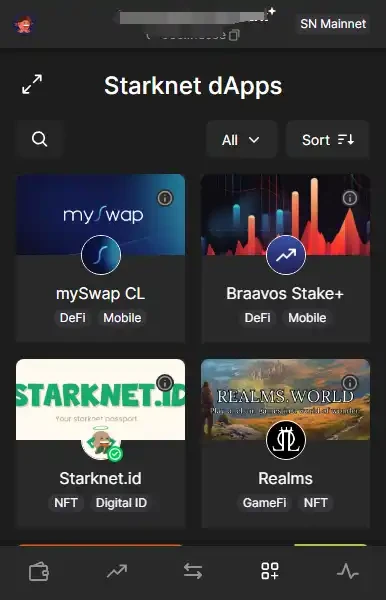
使用 Braavos 钱包的用户可在 Starknet dApps 导航页面便捷参与生态项目交互,比较方便。以下是一些推荐交互项目整理:

Nostra Finance

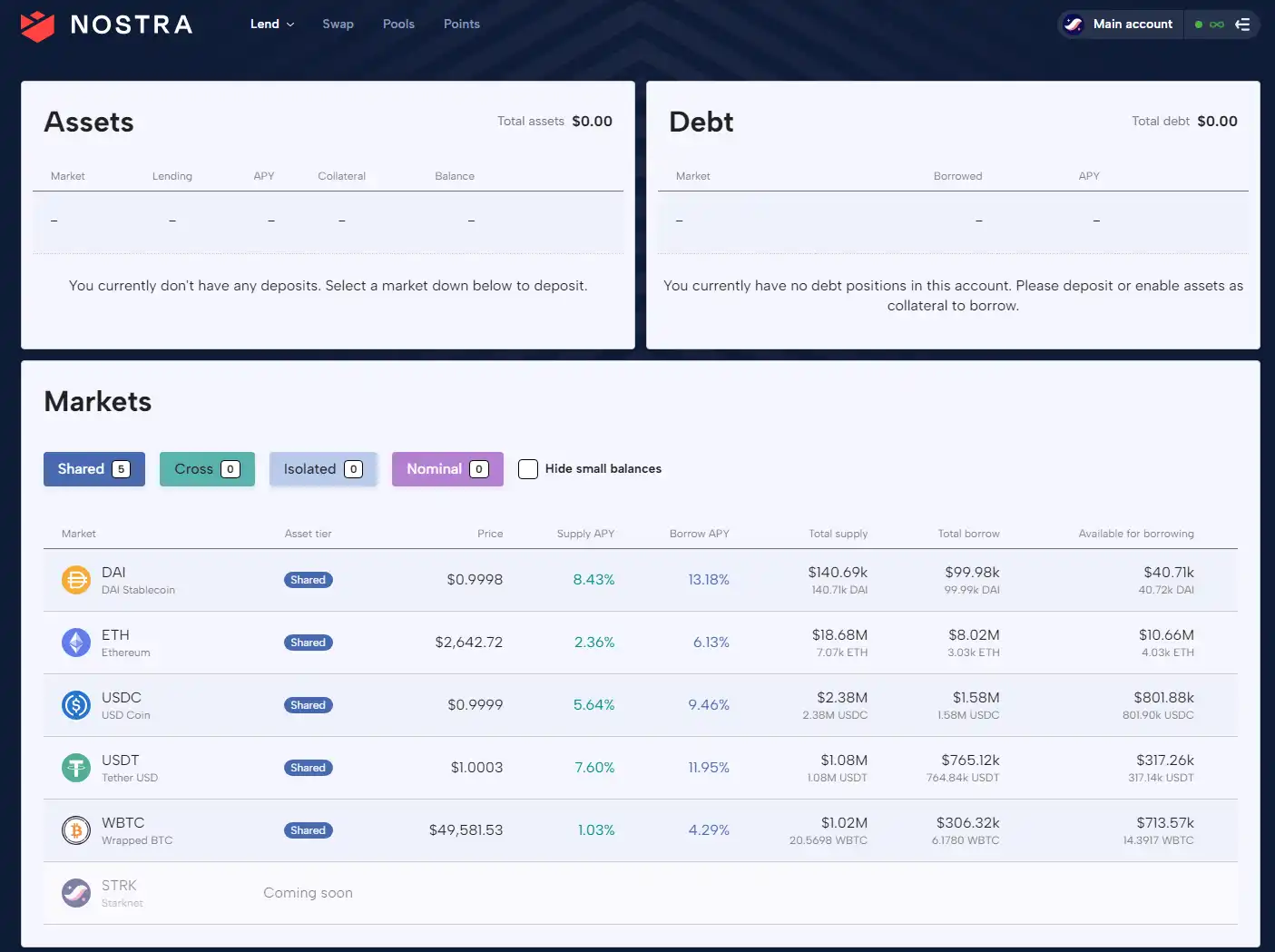
Nostra Finance 目前是 Starknet 上 TVL 最大的 DeFi 协议,平台目前支持基本的借贷和 Swap 功能(集成的 AVNU)。此外,Nostra 也计划推出 Starknet 首个与美元锚定的原生稳定币 UNO。
Starknet空投到来,一览值得交互的生态项目

值得注意的是,Nostra 目前是有积分计划的,会根据用户在 Nostra 的行为进行积分。大致积分情况如下:

  • 借出

稳定币:每 1 美元= 1 积分/每天

波动资产:每 1 美元= 2 积分/每天

  • 借入

稳定币:每 4 美元= 1 积分/每天

波动资产:每 8 美元= 2 积分/每天

  • 为池子提供流动性

稳定币/稳定币池中,每 1 美元= 2.5 积分/每天

波动资产/波动资产池中,每 1 美元= 5 积分/每天

波动资产/稳定币池中,每 1 美元= 10 积分/每天

此外,用户在存入第一笔资金后会自动生成邀请链接,可邀请新用户来增加积分。

zkLend

zkLend 是建立在 StarkNet 上的加密借贷协议,结合 zk-rollup 的可扩展性,卓越的交易速度,并通过以太坊的安全性节省成本。zkLend 满足用户对高效交易速度和低廉交易成本的需求,支持 ETH/wBTC/USDC 等多种代币。

该协议提供了双重解决方案:一个以许可和合规为重点的解决方案,面向机构客户,以及一个无许可的服务,面向 DeFi 用户——且不会牺牲去中心化。

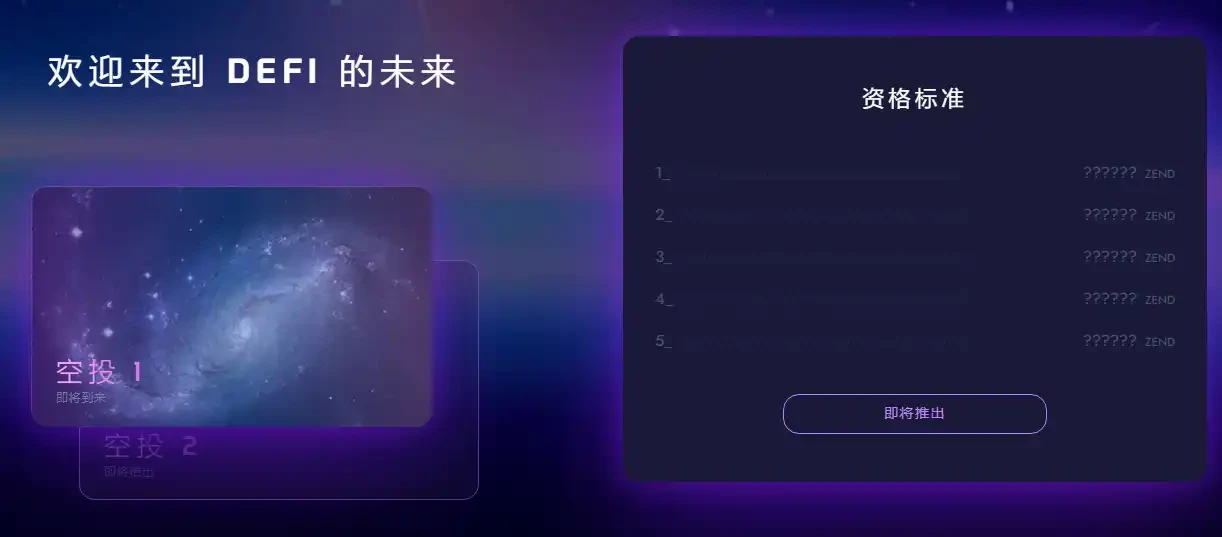
ZEND 空投页面预览也已于 2 月 6 日上线,也算是目前 Starknet 生态 DeFi 里少有的明牌空投项目了。
Starknet空投到来,一览值得交互的生态项目

AVNU

AVNU 是一种去中心化交易协议与流动性基础设施,旨在始终寻求为 Starknet(以及更广泛的 L2s)上的交易者和 dApp 提供最佳执行策略。该项目通过在多个去中心化交易所 (DEX) 中搜索最佳交易路线来优化交易执行并最大限度地减少滑点。此外,其询价 (RFQ) 系统集成了做市商的流动性、优化价格发现、消除滑点并提供 MEV 保护。

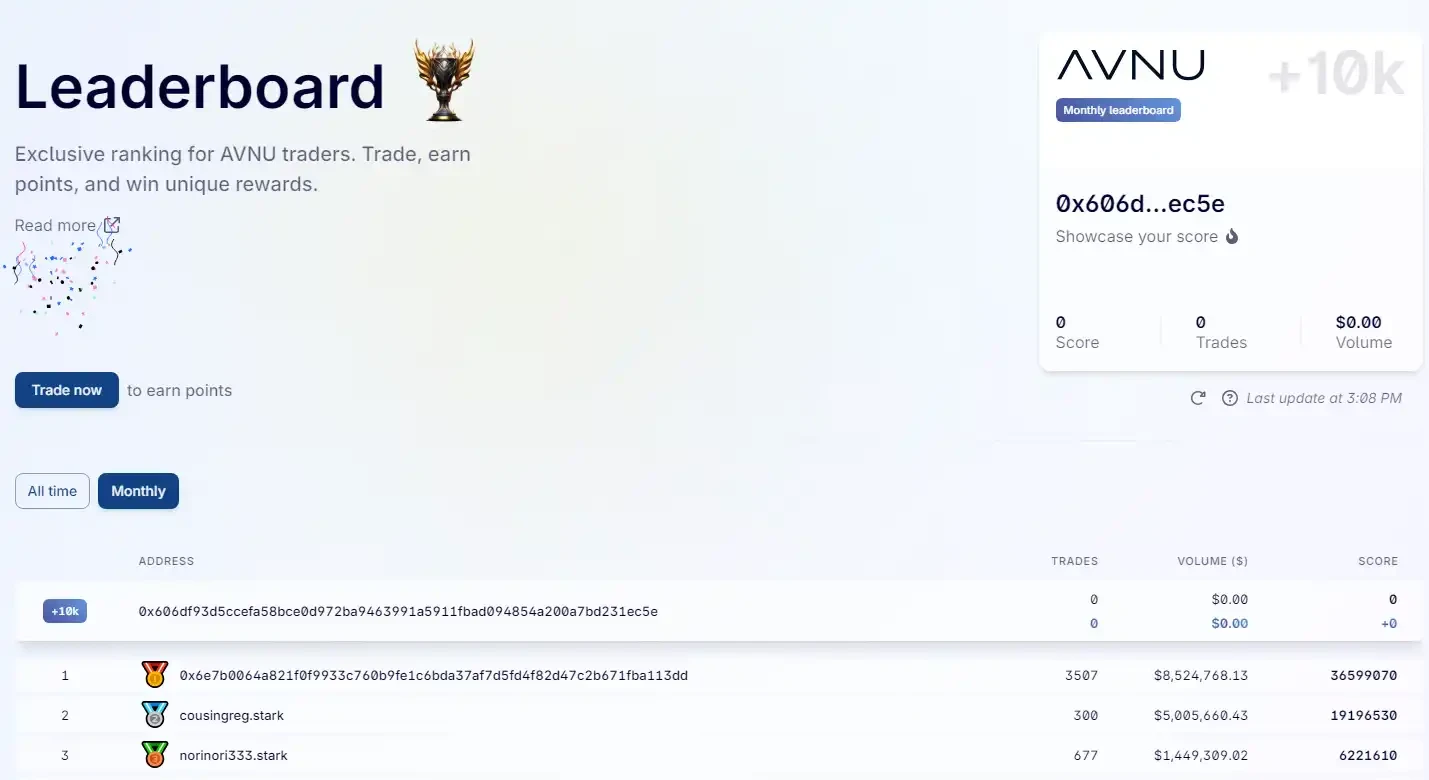
AVNU 同样也有积分排行,产品 UI 及交互体验较为优秀,参与 AVNU 交互可以使用 USDT 兑换 USDC 的刷分策略,仅支付 Gas 即可,每日参与交易对积分的累计有一定增益效果。
Starknet空投到来,一览值得交互的生态项目

Ekubo

Starknet空投到来,一览值得交互的生态项目

Ekubo 是一个和 Nostra 非常类似的协议,同样支持用户进行 Swap 或提供流动性,也有积分功能,但详细积分公式写的并不清晰。目前 TVL 没有 Nostra 高,也不支持借贷功能。但如果单纯存一些富裕的资金进来博一下也没什么问题。

其他雷同 DEX 项目

除上述项目外,包括 10 KSwap、JediSwap 以及 mySwap 在内的 3 款 Swap 的功能和使用体验基本雷同,都属于比较早期的 DEX 项目,唯一区别是 Myswap 有积分系统,其他 2 个平台没有,舍得花费 Gas 可以同样使用 USDT 兑换 USDC 的策略进行简单交互。

Starknet.id

Starknet 生态域名项目,目前 Mint 新域名的价格是 0.085 ETH/年(约合 225 美元)。
Leituras Relacionadas

The Reality of Payments in Latin America Is Not What You Think

The payment landscape in Latin America is undergoing a fundamental shift, driven by on-the-ground realities that challenge common perceptions. Based on over 500 hours of field research across the region, key insights emerge. Firstly, QR code payments, like Brazil's Pix, are becoming the dominant payment method in most emerging markets, overtaking cards. However, these domestic instant payment systems lack international interoperability, creating a significant gap for cross-border users. Secondly, the narrative around crypto cards is often misunderstood; their primary volume comes from high-net-worth professionals using them for salary conversions (e.g., USDT to local currency via Pix), not retail micro-payments. Competition in payments is shifting from customer acquisition to controlling the settlement layer, leading fintechs to acquire banking licenses for efficiency. Thirdly, treating "Latin America" as a single market is a mistake. Countries like Argentina, Brazil, and Mexico have distinct economic realities, user segments, and regulatory approaches. Brazil alone has at least five distinct user segments with different financial flows. Overlooked markets like Guatemala, Honduras, and El Salvador (the "forgotten five") offer high remittance volumes with lower competitive density. Finally, regulation in Latin America is often ahead of the US, with clearer frameworks for digital assets and a pragmatic approach from regulators focused on safety rather than obstruction. The margin on stablecoin forex is rapidly compressing toward zero, meaning future winners will be those building value-added services on top of the infrastructure, not just the cheapest exchange.

marsbitMesmo agora

The Reality of Payments in Latin America Is Not What You Think

marsbitMesmo agora

Making Music in a Bear Market: The Survival Experiment of a Bitcoin Band

"Orange Pill Jam: A Bitcoin Band's Survival in the Bear Market" Orange Pill Jam is a musical group exploring themes of financial sovereignty and privacy, born from the Bitcoin community. Formed after singer Mermaid performed her song "Dollar Apocalypse" at a 2022 conference, the band creates music intended for both Bitcoin enthusiasts and general audiences. Their creative process involves Mermaid writing lyrics and melodies, which producer/multi-instrumentalist Michi then shapes with a precise, rhythm-focused approach, often demanding numerous retakes to achieve his unique standard of timing. Their songs, like "Cypherpunks' Manifesto" and "Fire of Freedom," tackle concepts of digital privacy, the pitfalls of "free" services, and personal sovereignty, influenced by experiences in places like El Salvador. Despite operating in a crypto bear market with a Copyleft model (offering music for free sharing/remixing and accepting optional Bitcoin donations), they face practical challenges. Their growth is slow on platforms like YouTube and Spotify, which aren't optimized for their niche content. The band also navigates the rise of AI-generated music. While acknowledging AI's efficiency for certain tasks, they believe human creativity occupies a unique space that algorithms cannot replicate—the ability to create new genres and capture intangible rhythmic feeling. For Orange Pill Jam, the core argument for both Bitcoin in a downturn and human artistry in the AI age lies in this irreplaceable, intentional, and imperfectly human creative process. Their project persists as an anti-algorithm experiment, valuing the unquantifiable impact of music over scalable metrics.

marsbitHá 6m

Making Music in a Bear Market: The Survival Experiment of a Bitcoin Band

marsbitHá 6m

Latin America's Payments Landscape Is Not What You Think It Is

This report challenges common misconceptions about Latin America's payment landscape, based on over 500 hours of firsthand research. Key findings include: 1) Crypto card transaction volume primarily comes from high-net-worth individuals receiving USDT salaries, not retail spending. 2) QR code payments (e.g., Brazil's Pix, Argentina's Mercado Pago) are the dominant payment method across most emerging markets, not cards. 3) A major untapped opportunity lies in enabling cross-border interoperability between domestic instant payment systems. 4) Payment competition is shifting from customer acquisition to owning the settlement layer (e.g., acquiring banks). 5) Latin America is not a single market; Brazil, Mexico, Argentina, and smaller "forgotten five" countries (e.g., Guatemala, Honduras) have vastly different dynamics. 6) Stablecoin-to-fiat conversion margins are collapsing toward zero, pushing companies to build value-added services on top. 7) Future payment winners will be multi-country brands, not single-corridor specialists. 8) Marketing must target specific user segments (e.g., digital nomads, unbanked immigrants) with tailored messaging, not a generic "Brazilian" audience. 9) Contrary to perception, Latin American regulators are often ahead of the US in creating frameworks for digital assets and instant payments, with clear licensing deadlines. The core takeaway is that the region's payment rules are being rewritten, moving beyond cards and stablecoin arbitrage towards integrated, cross-border QR-based solutions.

链捕手Há 17m

Latin America's Payments Landscape Is Not What You Think It Is

链捕手Há 17m

Trading

Spot
Futuros
活动图片