
Value Locked in Decentralized Finance Slides 17% Lower Over the Last 30 Days

newsbtcPublicado em 2022-05-09Última atualização em 2022-05-09

Resumo

Decentralized finance (defi) protocols have lost lots of value during the last month, as 17.77% has been shaved off the TVL in defi since April 8, 2022.

Value Locked in Decentralized Finance Slides 17% Lower Over the Last 30 Days

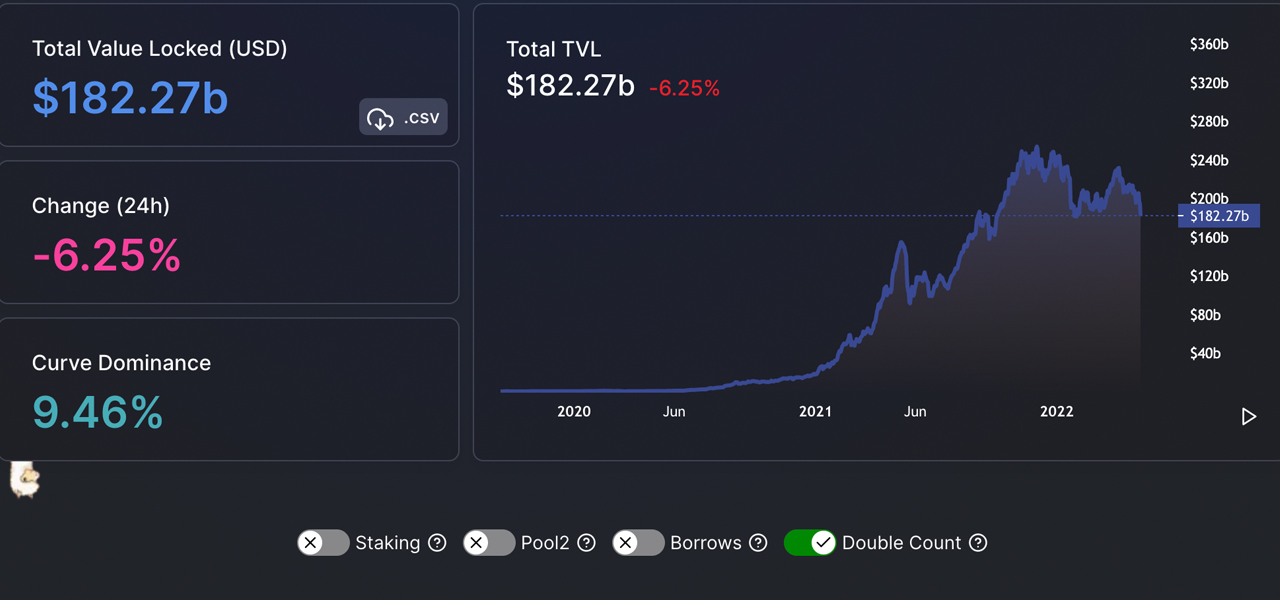
The value locked in decentralized finance (defi) protocols has lost 17.77% over the last 30 days, falling from $221.67 billion to today’s $182.27 billion. Moreover, statistics show the total value locked (TVL) across a broad range of defi protocols shed significant value during the last seven days.

Defi Protocols Shed Considerable Value

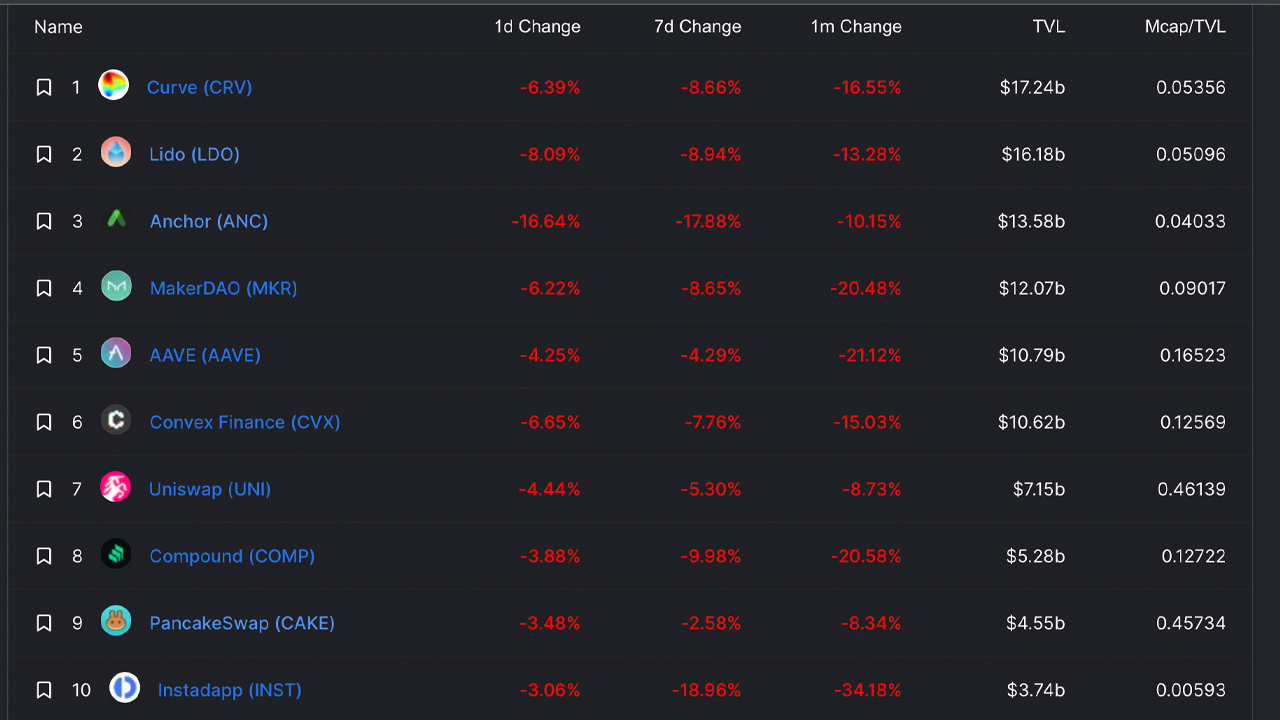
Decentralized finance (defi) protocols have lost lots of value during the last month, as 17.77% has been shaved off the TVL in defi since April 8, 2022. The largest defi protocol, in terms of TVL size, Curve Finance, lost 16.55% this past month, while Lido shed 13.28% in value over the 30 day range. Anchor’s TVL is down 10.15%, Makerdao has dipped by 20.48%, and Aave’s TVL has lost 21.12% this past month.
Value Locked in Decentralized Finance Slides 17% Lower Over the Last 30 Days

Total value locked in decentralized finance on May 8, 2022, according to defillama.com statistics.

Two protocols saw substantial 30-day TVL gains which include Aave’s version three (v3) and Tron’s Sunswap protocol. During the last 24 hours alone, the TVL in defi has slipped by 6.25% in value, and the largest protocol by TVL today is Curve Finance. As of Sunday afternoon (ET), Curve’s $17.24 billion TVL currently dominates the aggregate by 9.46%.
Value Locked in Decentralized Finance Slides 17% Lower Over the Last 30 Days

Top ten defi protocols in terms of TVL on May 8, 2022, according to defillama.com statistics.

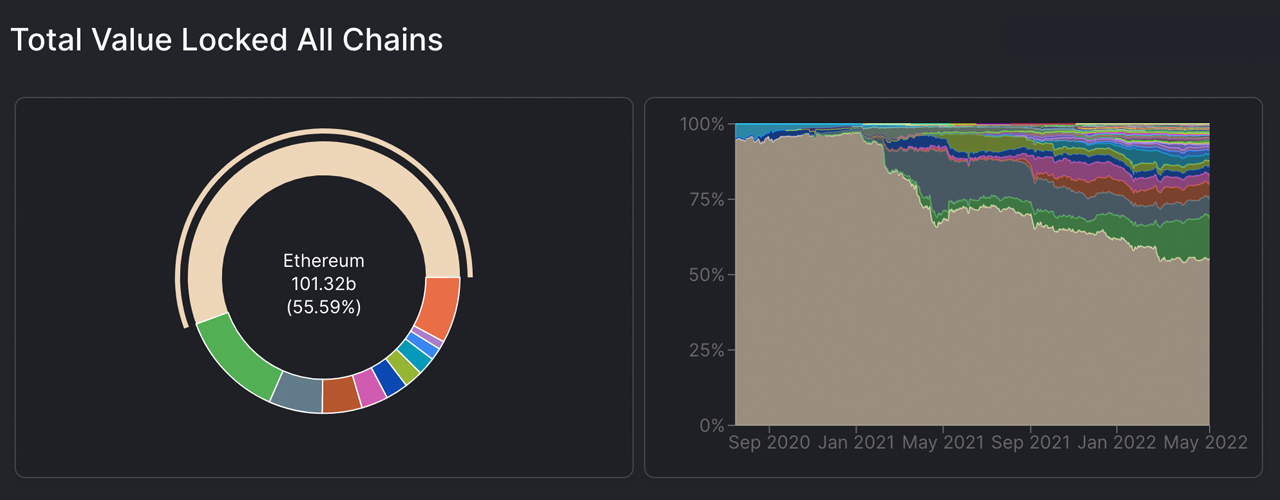
Ethereum still dominates the defi TVL by 55.59%, as $101.32 billion of the $182.27 billion TVL is held on the ETH chain. Terra is the second largest, in terms of defi TVL, as Terra’s $23.44 billion represents 12.86% of the defi TVL aggregate. Lastly, Binance Smart Chain (BSC) is the third-largest blockchain in defi with 6.37% of the total, which is roughly $11.6 billion today.
Value Locked in Decentralized Finance Slides 17% Lower Over the Last 30 Days

Total value locked by blockchain, according to defillama.com statistics on May 8, 2022. Ethereum commands by 55.59% with its $101.32 billion locked in defi.

In terms of the top smart contract platforms with tokens by market capitalization today, the entire lot is valued at $546 billion. However, the top smart contract tokens have lost 6.1% in collective value during the past 24 hours. Although, tron (TRX) has managed to jump 5.3% higher during the last day.

One of the biggest losers today, in terms of smart contract platform tokens, was counterparty (XCP), as the coin lost 19.4%. Terra (LUNA) was also a big percentage loser, shedding double digits during the last 24 hours, as LUNA lost 11.1% in USD value today. 30 day statistics also show that cross-chain bridge TVLs are also down 21.1%. There’s currently $16.78 billion TVL across a myriad of blockchain bridges.

The top three ranking cross-chain bridge TVLs today include Polygon, Avalanche, and Arbitrum respectively. The top three crypto assets leveraged on cross-chain bridges today include USDC, wrapped ethereum (WETH), and tether (USDT). While the entire crypto economy has lost 5.1% in value over the last 24 hours down to $1.65 trillion, it’s likely the value locked in defi will follow.


Leituras Relacionadas

Unveiling the Whales of the World Cup Prediction Market: Smart Money Stumbles on the Pitch, 'Buy No' Outperforms 'Buy Yes'

**Title: Unveiling the Whales of the World Cup Prediction Market: "Smart Money" Stumbles on the Pitch as "Buying No" Outperforms "Buying Yes"** An analysis of pre-match trades over $5,000 on Polymarket for 20 completed group stage matches reveals a counterintuitive finding: large "smart money" bets were not consistently accurate. Aggregated pre-match buying volume was $89.55 million, with a weighted hit rate of only 48.5%. Holding these positions would have resulted in an estimated net loss of about $1.76 million (ROI -2.0%), challenging the notion that big money reliably predicts outcomes. The data highlights several key dynamics. Draws proved to be a major risk, significantly impacting bets on favored teams, as seen in Belgium-Egypt and Spain-Cape Verde. Markets were more efficient for clear mismatches (e.g., Germany's big win) but became prone to bias when favorites were overvalued. Notably, buying "No" shares (betting against a specific outcome) significantly outperformed buying "Yes," with hit rates of 62.4% vs. 37.5%. This suggests the market often overprices popular narratives, creating value in contrarian positions. Individual trades showed extreme volatility. One wallet (mintblade) earned an estimated $6.77 million by betting against Iran, while another (LEEEROYJENKINS) lost roughly $8.39 million on a Belgium win. The market favors high-risk, high-reward information trading rather than steady arbitrage. For sustained insight, wallets with consistent performance across multiple matches (e.g., swisstony) are more telling than one-off big bets. Ultimately, the Polymarket acts less as a crystal ball and more as a mirror, reflecting crowd bias and the inherent unpredictability of football. True "smart money" may lie not in predicting the future, but in identifying and exploiting market mispricings while respecting risk.

marsbitHá 18m

Unveiling the Whales of the World Cup Prediction Market: Smart Money Stumbles on the Pitch, 'Buy No' Outperforms 'Buy Yes'

marsbitHá 18m

Bezos' Third Startup Still Can't Avoid Musk

Jeff Bezos Returns as CEO for Third Venture, Still Can't Avoid Musk After stepping down as Amazon CEO in 2021, Jeff Bezos has returned to the front lines as co-CEO of Prometheus, an AI startup he founded. In a recent CNBC interview, Bezos described the experience as "Type 2 fun"—exhausting but ultimately rewarding. Founded less than a year ago, Prometheus has already raised over $18 billion in two funding rounds, achieving a staggering $41 billion valuation. Prometheus aims to develop a "General Engineer AI" to accelerate the entire "invention loop"—design, simulation, testing, and manufacturing—for complex physical products like jet engines, spacecraft, and medical devices. This positions the company at the intersection of Bezos's past experiences: Amazon's platform-building scale and Blue Origin's rigorous physical engineering. This marks Bezos's third major venture, following Amazon and Blue Origin. His co-CEO is Vik Bajaj, bringing expertise from life sciences and hard tech. Bezos now dedicates most of his time to Prometheus, signaling his belief in its transformative potential. The move also comes as Bezos's space company, Blue Origin, faces challenges, including a recent test explosion delaying its New Glenn rocket. Meanwhile, Elon Musk's SpaceX achieved a record-breaking IPO, surpassing Amazon's market cap. While Musk focuses on AI for executing physical tasks (like Tesla's robots and SpaceX's engineering), Bezos is betting on AI to *invent* in the physical world. Prometheus enters a crowded industrial AI field with players like OpenAI, NVIDIA, and Tesla's Optimus. Its lofty valuation bets on the unproven but massive opportunity to become the foundational platform for engineering in the AI era—a "blue ocean" Bezos hopes to define before Musk does.

marsbitHá 21m

Bezos' Third Startup Still Can't Avoid Musk

marsbitHá 21m

Won't US Stocks Ever Fall Again? The 'Great Melt-up' Trap in the Era of High Debt

The article analyzes a popular theory circulating online that the U.S. stock market may be mathematically incapable of a true, sustained decline due to the country's massive and growing national debt. The argument suggests that the government's only path to managing this debt is through inflation and money printing, which would nominally lift asset prices like stocks, creating a perpetual "melt-up." The author places this idea within the historical context of market melt-ups, such as the dot-com bubble and Japan's asset bubble, where prices detach from fundamentals driven by momentum and FOMO. While acknowledging that a high-debt environment creates incentives for inflation, which is generally favorable for assets over cash, the article refutes key claims of the online theory. It clarifies that interest payments are not about to exceed GDP, that printing money is not the only option for the government, and that stocks do not reliably rise in lockstep with hyperinflation, citing historical examples from Germany, Zimbabwe, and Venezuela. The more probable outcome, according to the author, is a prolonged period of financial repression—moderate inflation above interest rates that slowly erodes debt and cash purchasing power, leading to nominally higher asset prices but potentially lower real returns. The core warning is that while long-term market trends may be upward, this does not eliminate the risk of significant interim crashes (30%, 40%, or more) or guarantee real wealth creation during inflationary times. The conclusion advises against betting one's entire financial future on a smooth, perpetually rising market narrative. Instead, it recommends a disciplined, diversified strategy involving productive assets (stocks, real estate, some gold, short-term bonds) and an adequate cash buffer to avoid forced selling during downturns. The key takeaway is to avoid extreme concentration in expensive assets and leverage, and not to base investment decisions on the hope that every market dip will inevitably be rescued.

marsbitHá 41m

Won't US Stocks Ever Fall Again? The 'Great Melt-up' Trap in the Era of High Debt

marsbitHá 41m

Trading

Spot
Futuros
活动图片