'Lord, You Told Me to Do This': Pastor Defends Taking $1.3M From Failed Crypto

CoinDeskPolicyPublicado em 2024-01-22Última atualização em 2024-01-24

Resumo

Eli Regalado said God told him to start the INDXcoin project and he's waiting on further guidance after Colorado securities officials accused him of running a crypto scam.

  • Pastor Eli Regalado said he was under God's orders to set up his failed crypto project and he's now counting on a miracle.
  • He said it's true that he and his wife took $1.3 million from the investors, and that God told them to spend hundreds of thousands to remodel their home.
  • He'll have a chance to start explaining that beginning with a court hearing scheduled for January 29.
13.4K

To err is human. But Colorado securities officials said that what Pastor Eli Regalado has been doing is more like fraud.

Regalado and wife Kaitlyn launched a crypto token last year called INDXcoin. Colorado Securities Commissioner Tung Chan filed charges last week against the couple and the entities they ran, accusing them of pocketing $1.3 million in crypto proceeds while more than 300 investors had no way to recover any of their money.

The pastor – who had worked in digital marketing – responded in a video message posted on the project's website, sharing a sentiment that's unusual from a crypto founder cornered by government authorities: "Those charges are true."

"We sold a cryptocurrency with no clear exit," he said, explaining that God told him to build it and give investors ten times the money they put in. "We did. We took God at his word."

Advertisement
Advertisement

"The Lord told us to walk away from our parking company. ... He took us into this cryptocurrency ... well, that cryptocurrency turned out to be a scam.... And I said Lord ... you told me to do this," he said in the video.

The couple also took about $1.3 million from more than $3 million raised for the project. Regalado said about $500,000 went to the Internal Revenue Services, and a "few hundred thousand" was devoted to a home remodeling project that "the Lord told us to do."

The pastor, described in the token's white paper as an "ordained Marketplace Minister of the Gospel of Jesus Christ," said he insisted to God before the project began, "I don't have any experience in this industry. I don't know what I'm doing."

He and his wife launched the Kingdom Wealth Exchange, and investors began pouring money in.

"The exchange technology failed; things went downhill," he said. "We've just been waiting on the Lord, literally, for a miracle."

At this point, according to Colorado officials pursuing the charges in Denver District Court, the crypto is "Illiquid and practically worthless."

"We allege that Mr. Regalado took advantage of the trust and faith of his own Christian community and that he peddled outlandish promises of wealth to them when he sold them essentially worthless cryptocurrencies," Chan said in a statement.

A hearing is scheduled in the case on January 29, according to a search of the Colorado state court docket.

Most of the comments posted on the INDXcoin site are supportive of the pastor, quoting biblical passages and praising the way he's handling the accusations.

Advertisement
Advertisement

"We were just always under the impression that God was going to provide, that the source was never ending," Regalado said, granting that he knows this situation "looks terrible" and that he doesn't know what's coming next. "I don't know how God is going to turn this around."

But he asserted, "God is not done with INDXcoin."

Edited by Marc Hochstein.

Leituras Relacionadas

a16z: In the AI Era, Company Competition for Talent Starts with Job Title Naming

The article discusses how companies in the AI era are competing for talent through strategic "title arbitrage," or the renaming of key roles to reflect and attract new, high-value capabilities. It uses Palantir's creation of the "Forward-Deployed Engineer" (FDE) as a prime example. This title reframed client-facing technical work from a peripheral "implementation" role into a core, high-status engineering function. The move was strategic, allowing Palantir to attract talent that blended technical skill with business acumen and to dominate the market's perception of this capability. The piece argues that job titles are an organizational language that signals the value and authority of certain work. Effective new titles, like "Data Scientist" or "Site Reliability Engineer," emerge when a role's strategic importance genuinely outgrows its old name. Conversely, mere title inflation without substantive change is ineffective. For AI companies, particularly in B2B, this is a crucial strategy. AI transformation creates new high-leverage roles (e.g., "Legal Engineer," "GTM Engineer") that combine domain expertise with technical automation. By naming these roles, a company can help clients internally legitimize these change-makers. This, in turn, builds market mindshare, associating the company with the new capability. In conclusion, as AI blurs the lines between product and service, the ability to accurately name and organize the critical, client-adjacent work that defines product learning will be a key competitive advantage. The first to define this new organizational language plants a flag in the market's mind.

marsbitHá 42m

a16z: In the AI Era, Company Competition for Talent Starts with Job Title Naming

marsbitHá 42m

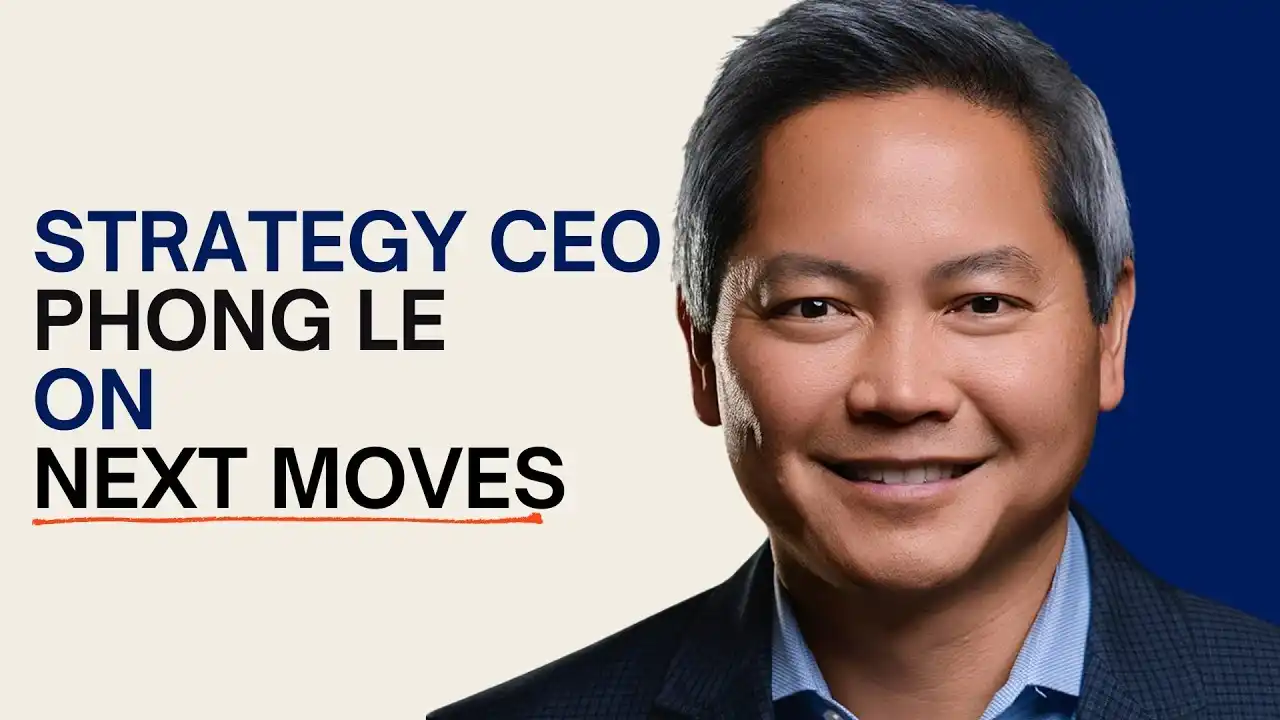
Interview with Strategy CEO: Can STRC Recover After Selling Bitcoin?

Interview with Strategy CEO Phong Le on the recent sale of 32 Bitcoin and its impact. He clarifies the move was a small, strategic action to demonstrate liquidity to debt holders, test internal processes, and prove operational discipline—not a response to fears of a "death spiral" from DeFi protocols leveraging STRC (Strategy's preferred stock product), which he notes holds less than 10% of STRC. Le emphasizes Strategy’s long-term focus as the largest corporate Bitcoin holder, using the adage that markets are a "voting machine" short-term but a "weighing machine" long-term. Decision-making is data-driven, involving the board, complex modeling, and multiple stakeholder considerations, moving beyond a founder-centric model. He outlines various capital options but stresses the strategic importance of "doing nothing" as a valid choice, citing resilience built during the 2022 bear market. Le expresses unwavering belief in Bitcoin's foundational value for global sovereignty and its future role in an AI-driven economy with trillions of autonomous agents. Addressing STRC's current price below its $100 face value, Le explains recent pressure was due to using dollar reserves for bond buybacks. He expects STRC to return to par as reserves are replenished and its semi-monthly dividend payments begin, noting the product is heavily over-collateralized. Finally, Le confirms the company sold Bitcoin the week prior to May 31st, as disclosed in an 8-K filing, leaving prediction market interpretations to others. The overarching philosophy remains "Spread Bitcoin with love," embracing all methods of gaining Bitcoin exposure.

marsbitHá 1h

Interview with Strategy CEO: Can STRC Recover After Selling Bitcoin?

marsbitHá 1h

Trading

Spot
Futuros
活动图片