The Ethereum Merge is the most critical aspect of the ETH 2.0 upgrade, since it will convert from a proof-of-work to a proof-of-stake system.
The move from proof-of-work to proof-of-stake consensus is the focus of the upgrade. The improvement, as previously reported, has been postponed until the end of 2022, with no specific deadline in sight.
The world’s second-largest cryptocurrency was meant to be weeks away from the “merge” a June upgrade of its blockchain Ethereum that would make it faster, cheaper, and less power demanding, promising a meaner and cleaner crypto future.
Ethereum Merge Will Help ETH
Messari’s senior research analyst Tom Dunleavy believes in a report titled “The Decoupling Thesis” that the Ethereum merger will likely be a major turning point in investors’ economic outlook.
He points out that in the past, the crypto market leaders, Bitcoin and Ethereum, had a high positive association with the broader US stock market. For longer durations, the correlation between the two cryptos and the Nasdaq and S&P 500 index was 40-50 percent, while for shorter periods, it was about 90 percent.
Gold and US government bonds, on the other hand, have historically had a negative correlation with stocks. However, this negative link is weakening at the moment. During the 2020 market slump, both gold and bonds, as well as equities, fell.
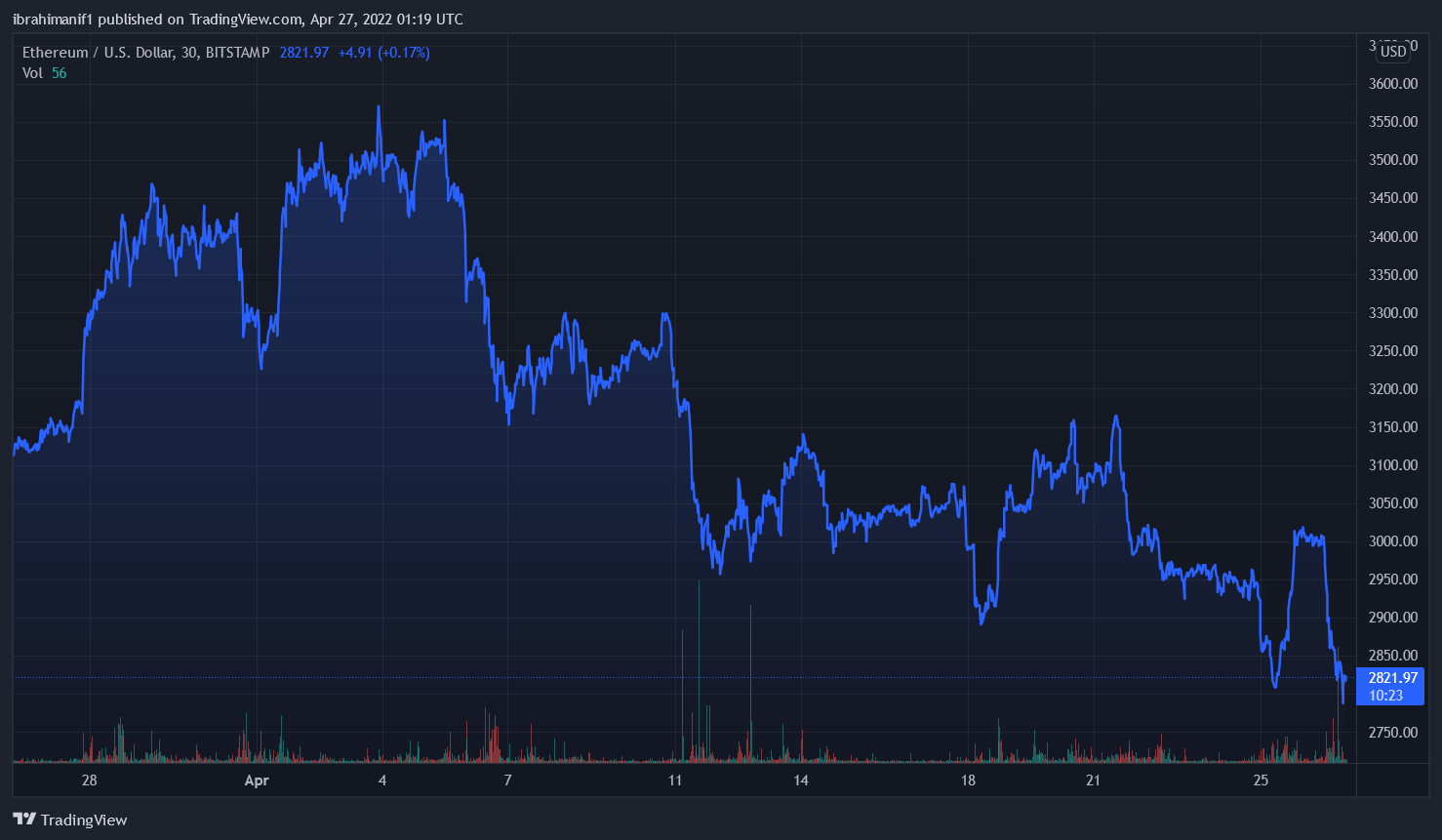
ETH/USD trades at $2,821. Source: TradingView
“The timeline for seeing this launch continues to extend,” said Brendan Playford, founder and CEO of decentralized financial data platform Masa Finance. She added, “It’s certainly plausible that Ethereum’s highly anticipated upgrade to a proof-of-stake system could be delayed again given that this transition is highly complicated and still uncertain as to whether it can actually deliver on its promise of lowering costs and increasing transaction speeds.”
On April 11, Ethereum declined 8% from $3,215 to $2,947, the day Ethereum principal developer Tim Beiko announced on Twitter that the June deployment had been postponed as testing proceeded. This month, it has dropped 13% to $2,844.
Following the merger, ETH will function as a quasi-government bond. Stakers will put up money in exchange for a fixed rate of return, similar to a bond principle. This will also cement Bitcoin’s status as a form of digital gold.
The Merge May Push The Flippening Forward
Messari has projected that the broader crypto industry would divorce from global markets by 2022. Various segments of the crypto business will continue to gain traction, according to the market research firm.
Meanwhile, predictions that the merger will propel Ethereum over Bitcoin are still circulating. Noelle Acheson, head of market analytics at Genesis Trading, told Reuters that after the merger, more funds will flock to Ethereum.
ETH is currently trading at around $2,850, with a market value of $343.98 billion, while Bitcoin is currently trading at around $38,200, with a market capitalization of $726.69 billion.