时代落幕:SBF七项罪名全部成立

Odaily星球日报Publicado em 2023-11-03Última atualização em 2023-11-03

Resumo

SBF呆呆地站在那里,低着头,浑身发抖,双手紧握。

原创 | Odaily星球日报

作者 | Azuma

时代落幕:SBF七项罪名全部成立

美国当地时间 11 月 2 日,在经过了四个半小时的审议之后,曼哈顿联邦法院的 12 人陪审团针对 SBF 案件作出了裁决,认定检方所诉的两项欺诈罪以及五项共谋罪全部成立,合计共犯七项罪名。

在今日的审议之前,法院已久该案进行了长达 15 日的庭审,传唤了 FTX  前首席技术官 Gary Wang、Alameda Research 前首席执行官(兼 SBF 前女友)Caroline Ellison、主要投资方之一 Paradigm 的联合创始人 Matt Huang 等多位关键证人,并对 SBF 本人进行了为期三天的直接问询。

虽然陪审团已就 SBF 有罪作出了裁决,但究竟会如何量刑暂时仍然未知,根据目前的日程安排,关于此案的量刑听证会将于 2024 年 3 月 28 日进行。鉴于 SBF 辩护律师在审判之前及审判期间的反对态度,预计后续 SBF 一方还会就此提起上诉。

时代落幕:SBF七项罪名全部成立

Odaily星球日报注:非今日审议画面。

在今日陪审团宣读裁决结果之时,SBF 本人的脸色非常难看。

陪审团解散之后,SBF 呆呆地站在那里,低着头,浑身发抖,双手紧握。

SBF 身后几英尺处,他的父母 Joe Bankman 和 Barbara Fried 就站在一旁看着他,当 SBF 被押出房间时,他转头对父母笑了笑,他的父亲 Joe 用手搂住他母亲 Barbara 的肩膀,随着儿子的身影消失,Barbara 泪流满面。

针对陪审团所给出的裁决结果,SBF 的辩护律师并不满意,首席辩护律师 Mark Cohen 随后在一份声明中表示: “我们尊重陪审团的决定。但我们对这一结果非常失望,Bankman Fried 先生坚称自己无罪,并将就这些指控继续积极抗争。”

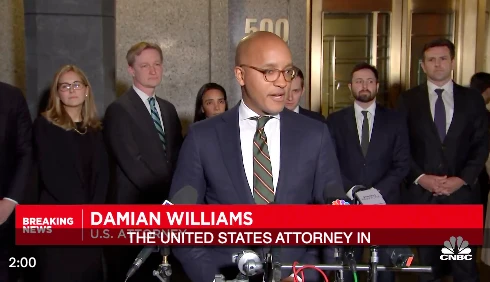
另一边,检方则已作为胜诉方发表了“胜利宣言”,检察官 Damian Williams 在审议结束后于曼哈顿法院外发表了讲话,称赞了陪审团的判决,并再次强调美国政府对欺诈和腐败 “没有耐心”。

Damian 提到:“像 SBF 这样的(Crypto)案例可能很新鲜,但我们对欺诈、腐败本身并不陌生。”
时代落幕:SBF七项罪名全部成立

随着这一 Crypto 历史上的最大案件逐渐走向尾声,各大相关方也相继在社交媒体上就此作出了评论。

曾主导对 FTX 进行投资的红杉资本(Sequoia Capital)合伙人 Alfred Lin 在 X 上发表声明,表示认同对 SBF 的定罪,且对这一结果感到欣慰。

Lin 提到,此次判决确认了一些公众早已知晓的事实,SBF 曾误导和欺骗了众多人,包括客户、员工、商业伙伴以及投资者,其中就包括他自己和红杉资本。

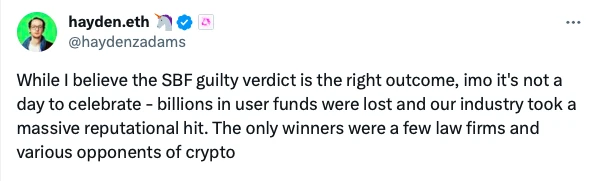
Uniswap 创始人 Hayden Adam 亦在 X 发文表示,SBF 身处一个以去中心化为愿景的行业,但其所从事和支持的一切事业却高度中心化,看起来更像是业界希望改进的东西。SBF 被判有罪不值得庆祝,用户蒙受了数十亿美元的资金损失,行业声誉也遭受了巨大打击,唯一的赢家是几家律师事务所和各种 Crypto 反对者。
时代落幕:SBF七项罪名全部成立

比较另人唏嘘的是,在 SBF 逐渐滑落人生谷底的同时,曾与之牵涉颇深的 Solana 却在与大西洋彼岸的阿姆斯特丹召开着一年一度的大会「Breakpoint」,详细跟进了该会议的 Delphi Digital 投资助理 Alexander Golding 发文提到了 SBF 的定罪结果,但却仅用了寥寥数语带过,因为“那些事都已经过去了”。

一个时代正在缓缓落幕。
Leituras Relacionadas

From Ethereum to AI's 'CROPS': What Exactly is This Set of 'Slow Variables' That Vitalik Repeatedly Emphasizes?

In recent discussions, Vitalik Buterin has frequently emphasized the concept of "CROPS," a framework defining core values for Ethereum's development. CROPS stands for Censorship Resistance, Capture Resistance, Open Source, Privacy, and Security. Initially outlined in the Ethereum Foundation's "EF Mandate," it represents a commitment to user sovereignty, ensuring that the network resists external control, remains open, protects privacy, and prioritizes security. The relevance of CROPS extends beyond Ethereum's foundational principles, becoming crucial in the context of AI integration. As AI agents begin handling wallet operations and automated transactions, the risk increases that users may cede control over their digital assets, privacy, and intentions to centralized AI service providers. A "CROPS AI" would therefore emphasize local execution where possible, privacy-preserving remote model calls (e.g., using zero-knowledge proofs), and transparent, verifiable processes to maintain user agency. Vitalik highlights a significant convergence between "CROPS Ethereum access layer" and "CROPS AI." Both address the same fundamental challenge: how users can access powerful services—be it blockchain data via RPCs or AI models—without exposing sensitive information or relinquishing ultimate control. This intersection points toward a future digital entry point that is more private, secure, and user-controlled. Ultimately, CROPS is not merely an abstract ideal but a practical guidepost. It steers development—from protocol resilience and wallet design to AI agent safety—towards a future where users retain self-sovereignty even as digital systems grow more complex and powerful. In an era of accelerating AI adoption, these "slow variables" of censorship resistance, openness, privacy, and security may define Ethereum's enduring value.

marsbitHá 3m

From Ethereum to AI's 'CROPS': What Exactly is This Set of 'Slow Variables' That Vitalik Repeatedly Emphasizes?

marsbitHá 3m

Silicon Valley 'Startup Guru' Steve Hoffman: Web3 + AI Could Be a Trap

Silicon Valley investor and "Godfather of Startups" Steve Hoffman warns that combining Web3 with AI is likely a trap, not a promising venture. In an interview, Hoffman argues that while AI is a foundational technology touching all industries, Web3 adds complexity, friction, and regulatory risk without solving mainstream consumer or business needs. He advises founders to focus on deep, specialized applications where startups can out-iterate giants, rather than on generic features easily replicated by large tech companies. Hoffman observes that Silicon Valley will lead foundational AI research, while China excels at rapid, large-scale application and commercialization, particularly in robotics. He stresses that AI-driven autonomous agents capable of collaborative, multi-step tasks are 2-4 years away, which will cause significant job displacement. The solution is not to slow AI but to redesign business models around human-AI collaboration and reform social systems like education and retraining. For startups, Hoffman recommends focusing on vertical, expertise-heavy domains to build defensibility. He sees major opportunities in AI fraud detection and cybersecurity. Key founder mindsets include systemic thinking over feature-focus, relentless customer centricity, building adaptive teams, and deeply understanding AI's capabilities and limits. Hoffman is also leading a non-profit initiative to establish university centers aimed at training future leaders in responsible, human-value-aligned AI innovation.

marsbitHá 1h

Silicon Valley 'Startup Guru' Steve Hoffman: Web3 + AI Could Be a Trap

marsbitHá 1h

Token Inefficient, Economy Tokenless

The article "Tokens Aren't Economical, Economics Aren't Tokenized" analyzes a pivotal shift in the AI industry from a technology-driven narrative to one dominated by capital efficiency. It highlights two concurrent trends: a severe capital shortage due to the exorbitant and recurring costs of compute (e.g., OpenAI's high burn rate) and a wave of corporate spin-offs where major tech companies are separating their AI units (like Kuaishou's Kling and Baidu's Kunlunxin). The core argument is that AI's "anti-internet" business model, where user growth increases costs rather than profits, has created a disconnect between high valuations and actual cash flow. Spin-offs address this by allowing AI assets to be valued independently. Within a parent company, they are seen as cost centers, but as standalone entities, they are priced based on their growth potential and scarcity in the primary market, leading to massive valuation premiums (e.g., Kling's estimated value tripling post-spin-off). The industry is at an inflection point, moving from "model worship" to "value realization." The competition is evolving from a pure compute (GPU) race to a broader focus on systemic efficiency and full-stack engineering (involving CPUs and orchestration) to achieve viable commercialization. The year 2026 is framed as a critical moment where the industry must definitively answer how to economically translate AI capability into tangible business value, reshaping the sector's future power structure.

marsbitHá 1h

Token Inefficient, Economy Tokenless

marsbitHá 1h

Crossing the 'Memory Wall': The Wafer-Level Revolution and Computing Power Routes in the AI Inference Era

In 2026, a historic shift occurred in AI as major cloud providers' inference spending surpassed training spending for the first time, signaling a move from "building large models" to "using large models." This shifts the core challenge from computing power to the "memory wall"—the bottleneck of data movement (model weights, activations, KV Cache) between external DRAM and processors, where energy and latency from data transfer far exceed computation itself. Companies like Nvidia face GPU idle time due to bandwidth limits. In contrast, Cerebras Systems adopts a radical "wafer-scale" approach with its Wafer-Scale Engine (WSE). Instead of cutting a silicon wafer into many chips, Cerebras uses almost the entire wafer as one massive chip (WSE-3). This design provides 44GB of on-chip SRAM, delivering memory bandwidth thousands of times higher than traditional HBM (e.g., 21 PB/s vs. Nvidia B200). For LLM inference, weights are streamed layer-by-layer from external MemoryX storage to the chip, avoiding HBM bottlenecks. This results in token generation speeds 1.5–5 times faster than Nvidia's B200 in some models and significant advantages in first-token latency and long-context tasks. Additionally, Cerebras's architecture offers much lower interconnect power consumption (0.15 pJ/bit vs. GPU's ~10 pJ/bit). However, Cerebras faces challenges: SRAM scaling has slowed with advanced nodes, limiting future capacity gains; the chip requires specialized liquid cooling and custom software stacks; and its external I/O bandwidth (150 GB/s) is low compared to NVLink, hindering multi-system scaling for very large models. Competition is intensifying. Major players are pursuing three paths: 1) Developing proprietary inference ASICs (e.g., Google TPU, Microsoft Maia), 2) Leveraging advanced packaging (e.g., TSMC's SoW) to democratize wafer-scale-like integration, potentially eroding Cerebras's process advantage within a few years, and 3) Exploring optical interconnects for ultimate bandwidth. Commercially, Cerebras is transitioning from a hardware vendor to a service provider, facing the immense challenge of building high-power, specialized data centers to meet large contracts (e.g., 250MW/year from 2026–2028). In conclusion, the AI inference era presents a fundamental architectural trade-off. Cerebras opts for extreme physical optimization for low-latency, single-task performance, while Nvidia prioritizes versatility and massive cluster throughput. The path forward remains uncertain, with technology and business models still evolving in the race toward advanced AI.

marsbitHá 1h

Crossing the 'Memory Wall': The Wafer-Level Revolution and Computing Power Routes in the AI Inference Era

marsbitHá 1h

Trading

Spot
Futuros
活动图片