$15 Billion in Ammunition: What Is a16z Secretly Planning?

比推Publicado em 2026-01-12Última atualização em 2026-01-12

Resumo

a16z (Andreessen Horowitz) has raised a record $15 billion in new funding, with a significant focus on cryptocurrency and AI as key future technologies. The funds are allocated across six main areas: American Dynamism, App, Bio + Health, Infrastructure, Growth, and Other Venture Strategies. The App, Infrastructure, and Growth funds are expected to drive most crypto investments, targeting application-layer projects, protocol-layer infrastructure, and mature platforms like exchanges. In 2025, a16z made 31 investments in crypto, emphasizing prediction markets (e.g., Kalshi), wallet services, privacy blockchains, stablecoins, and AI-crypto integrations. Looking ahead to 2026, a16z highlighted 17 key areas of interest, including privacy enhancements, prediction markets, stablecoin innovation, AI agents, decentralized communication, and tokenization of real-world assets. The firm aims to support groundbreaking solutions in these domains, leveraging its capital to advance the crypto ecosystem.

Source: Odaily Planet Daily

Author:Azuma(@azuma_eth)

Original Title: Following the Clues: What Will a16z, Armed with $15 Billion, Invest In?


On January 9, amidst a highly active cryptocurrency market, the venture capital giant Andreessen Horowitz (a16z) announced the completion of a new $15 billion fundraising round. This is the largest fundraising effort in the firm's history, accounting for over 18% of the total venture capital raised in the U.S. in 2025.

In the relatively short official announcement, a16z mentioned cryptocurrency twice. The most critical statement, "Our mission is to ensure that America wins the technology competition for the next 100 years, which begins with winning the key architectures of the future—artificial intelligence and cryptocurrency technology," indicates that a16z, now well-supplied, will continue to actively deploy in the cryptocurrency market.

Breakdown of the Six Major Directions

According to a16z's plan, this batch of funds will be allocated to six major directions: the American Dynamism fund is allocated $1.176 billion, the App fund $1.7 billion, the Bio + Health fund $700 million, the Infrastructure fund $1.7 billion, the Growth fund $6.75 billion, and the Other Venture Strategies fund $3 billion.

Although a16z did not explicitly designate a dedicated cryptocurrency fund in this fundraising, these six directions actually have significant overlap with the cryptocurrency space.

First is the American Dynamism fund. This is a direction with a clear "political" focus that a16z has been promoting in recent years. Its core goal is to use venture capital to rebuild America's "hard power" and national competitiveness. The fund will primarily invest in aerospace, defense, public safety, education, housing, supply chain, industry, and manufacturing. Objectively speaking, this fund has little crossover with cryptocurrency.

Second is the App fund. This is one of a16z's most traditional and VC-centric funds. Its core goal is to focus on application-layer products that can be used directly by users. The fund will mainly invest in consumer internet products, AI applications, creator tools, social products, content services, gaming, fintech, and Web3 applications, among others. This is the direction where a16z's cryptocurrency narrative is most easily realized.

Next is the Bio + Health fund. This is a16z's long-term bet outside "pure technology." Its core goal is to transform the life sciences and healthcare systems using software, data, and engineering thinking. The fund's main investment areas include biotechnology, drug development platforms, gene editing, synthetic biology, medical data and AI diagnostics, and healthcare infrastructure software. There is little direct overlap with cryptocurrency here, but DeSci could be a potential intersection point.

The Infrastructure fund focuses on infrastructure. Its core goal is to provide an indispensable technical foundation for the next generation of applications and platforms. The fund's main investment areas are cloud computing and distributed systems, AI infrastructure, data platforms, developer tools, network protocols, and blockchain underlying protocols (L1, L2, other tools). This is another core battleground for a16z in the cryptocurrency space, alongside the App fund.

The Growth fund primarily invests in Series C and later stages, as well as Pre-IPO stages. Its core goal is not to find new opportunities but to amplify returns by supporting proven winners. The fund mainly invests in mature tech companies, AI platforms, fintech unicorns, and mature Web3 infrastructure or applications. Information on a16z's official website shows that Coinbase and Kalshi are explicitly categorized under this fund.

The Other Venture Strategies fund is relatively special. It does not have a single theme but acts more like a flexible "tactical capital pool," often used for special structure transactions, cross-fund collaborative investments, emerging field experimentation, secondary market opportunities, regional or thematic experimental funds, etc. This fund has little direct crossover with cryptocurrency, but it cannot be ruled out that temporary associations may occur at special junctures, such as responsive moves during certain policy windows.

Looking at the six intended directions for this $15 billion, the App fund, Infrastructure fund, and Growth fund will be the main channels for a16z to inject capital into the primary cryptocurrency market. Among them, the App fund and Infrastructure fund will focus more on native application-layer and protocol-layer projects in the cryptocurrency market, respectively. The Growth fund will focus more on platform-type services like exchanges and prediction markets, with investments tending toward leading players in sectors that have already shown advantages.

a16z's Investment Review for 2025

According to incomplete statistics from Odaily Planet Daily, a16z made 31 investments in the broader cryptocurrency field over the past year, with two investments each in prediction market Kalshi, AI security company Doppel, and privacy blockchain Seismic. Particularly for Kalshi, a16z first co-led a $300 million Series D funding round for the company in October with Sequoia, at a valuation of $5 billion; it then invested again in November, participating in the company's $1 billion Series E round at a valuation of $11 billion. This was a16z's biggest bet in the cryptocurrency space last year.
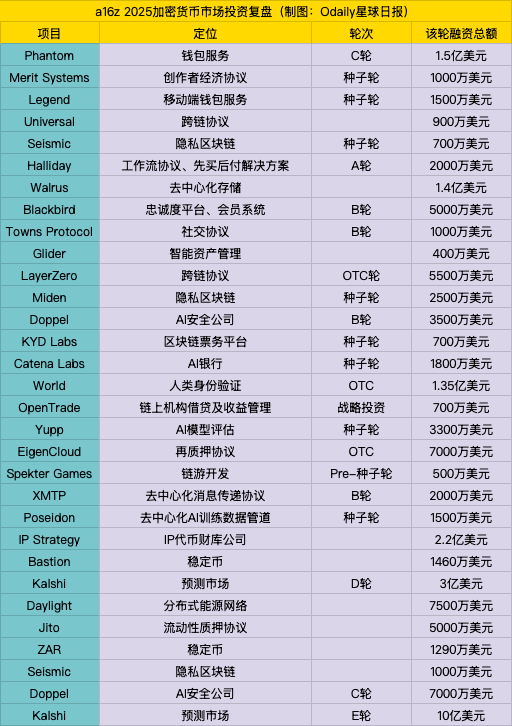
As can be seen from the statistics in the chart above, aside from the heavy bet on prediction markets, wallet services, privacy blockchains, stablecoins, and the intersection of AI and cryptocurrency were the focus of a16z's布局 in 2025. These sub-sectors can be classified under the blockchain underlying protocols and tools covered by the Infrastructure fund, as well as the fintech and AI applications covered by the App fund.

a16z's Predictions for 2026

On New Year's Day 2026, a16z Crypto officially published a New Year's outlook article. In the article, a16z mentioned 17 potential developments it is excited about for 2026, which may hint at the focus areas for the firm's future investments.
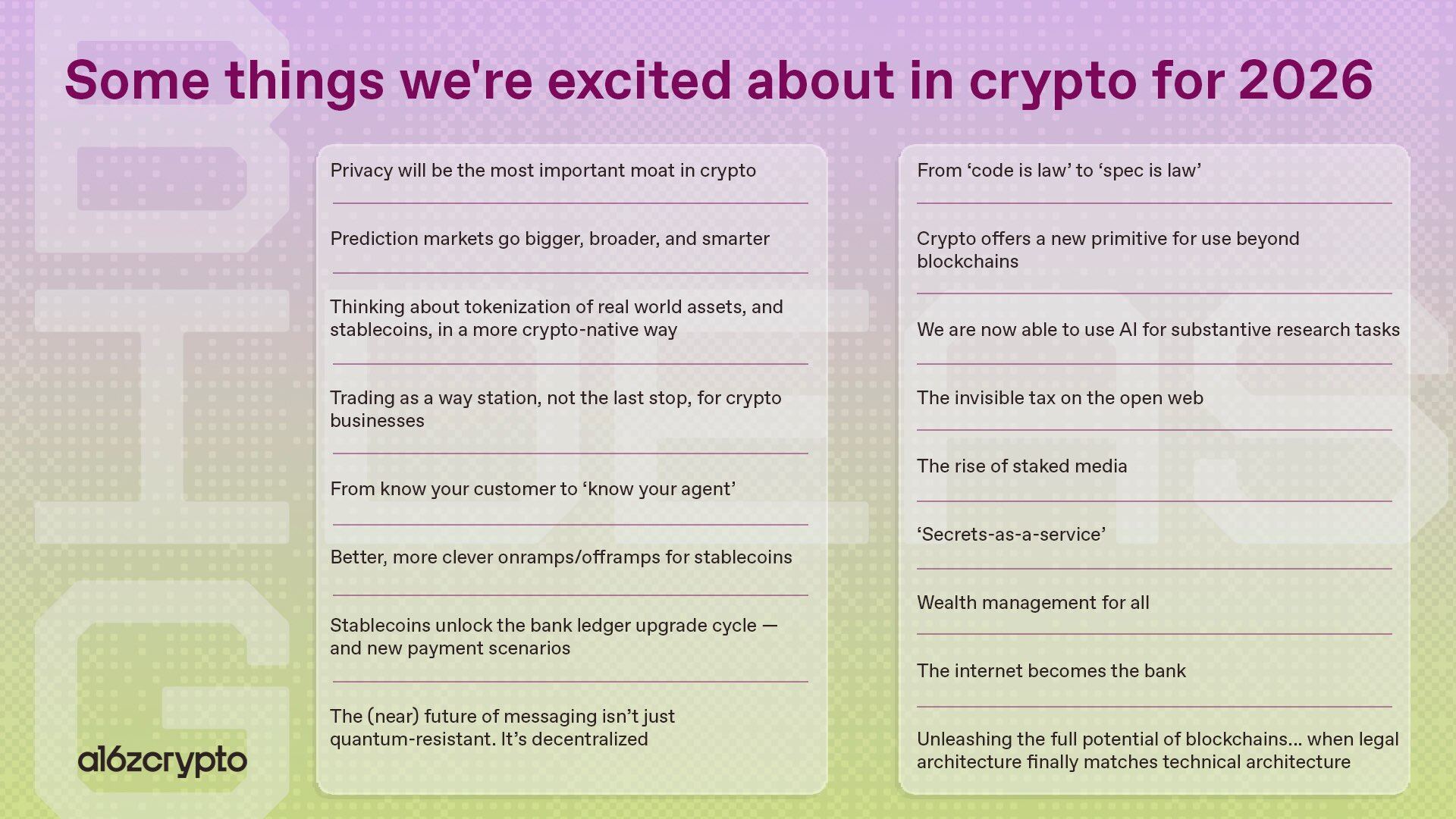
These 17 potential developments are:

  • Privacy will become the most important moat in crypto;

  • Prediction markets will become bigger, broader, and smarter;

  • Thinking more "crypto-natively" about real-world asset tokenization and stablecoins;

  • Trading is just a waystation, not the destination, for crypto businesses;

  • From "Know Your Customer" (KYC) to "Know Your Agent";

  • Better, smarter on-ramps and off-ramps for stablecoins;

  • Stablecoins will kick off a bank ledger upgrade cycle and enable new payment scenarios;

  • The future of instant messaging is not just quantum-resistant, it's decentralized;

  • From "code is law" to "norms are law";

  • Crypto is providing new kinds of foundational primitives that can be used beyond blockchains themselves;

  • We can now use AI to perform substantive research tasks;

  • The "invisible taxes" of the open internet;

  • The rise of Staked Media;

  • "Secrets-as-a-Service";

  • Wealth management for everyone;

  • The internet is becoming the bank;

  • When the legal framework finally matches the technical framework, the full potential of blockchains will be unlocked.

Among these 17 potential developments, some explicitly mention specific business models, including the sectors a16z has already heavily invested in, such as privacy, prediction markets, stablecoins, and AI. a16z also directly suggests optimization paths for these models, such as the need for smarter on-ramp and off-ramp solutions for stablecoins.

At the same time, other potential developments belong to imaginings of future states, such as the internet eventually becoming the bank. However, how these imaginings will be realized is not clearly answered by a16z. This question is left for entrepreneurs who can bring innovative solutions, and they are precisely the targets that a16z's $15 billion is most eager to find.


Twitter:https://twitter.com/BitpushNewsCN

BitPush TG Discussion Group:https://t.me/BitPushCommunity

BitPush TG Subscription: https://t.me/bitpush

Original link:https://www.bitpush.news/articles/7601990

Perguntas relacionadas

QWhat is the total amount of new funds raised by a16z, and what percentage of the total US venture capital in 2025 does it represent?

Aa16z raised $15 billion in new funds, which represents over 18% of the total US venture capital in 2025.

QWhich two key technologies did a16z mention as critical for winning the future in their mission statement?

Aa16z mentioned artificial intelligence and cryptocurrency technologies as the key architectures critical for winning the future.

QWhich three funds from the $15 billion allocation are the main channels for a16z's cryptocurrency investments?

AThe App Fund, Infrastructure Fund, and Growth Fund are the main channels for a16z's cryptocurrency investments.

QWhat was the largest project a16z bet on in the cryptocurrency field in 2025, and what was its valuation in the E-round financing?

AThe largest project a16z bet on in 2025 was the prediction market Kalshi, which had a valuation of $11 billion in its E-round financing.

QAccording to a16z's New Year outlook article, what are two specific areas they are excited about for potential progress in 2026?

Aa16z is excited about privacy becoming the most important moat in crypto and prediction markets becoming larger, broader, and smarter in 2026.

Leituras Relacionadas

Has the 'Digital Gold' Narrative for BTC Failed?

**Title: Has the "Digital Gold" Narrative for Bitcoin Failed?** The article argues that Bitcoin's "digital gold" narrative remains valid despite a recent sharp price decline (from a peak near $126k in Oct 2025 to briefly under $61k in Feb 2026). It presents a long-term investment framework based on three core points: **1. Viewing Bitcoin as an Asset:** Bitcoin is presented as a superior potential store of value compared to gold. Key arguments are its absolute scarcity (21 million cap), superior portability, and transparent auditability via its public ledger. While acknowledging its current use in early, volatile stages (~3-4% global adoption), the author draws parallels to the early, disruptive phases of the internet and e-commerce. **2. Understanding the Recent Downturn:** The current ~50% correction is framed as a predictable, consensus-driven cycle following its post-halving peak (the 2024 halving preceded the Oct 2025 high). A crucial factor is a historic "changing of hands": the influx of new institutional buyers via ETFs allowed early, low-cost holders (miners, OG believers) to take profits. The author notes that while severe, Bitcoin's historical drawdowns (e.g., 93% in 2011, 77% in 2021-22) have been progressively smaller, suggesting maturing holder structure and decreasing volatility over time. **3. The Long-Term Perspective:** The long-term thesis hinges on Bitcoin capturing a portion of gold's market value. With Bitcoin's market cap at ~$1.4 trillion (at $70k) versus gold's ~$20 trillion, significant upside potential exists if the "digital gold" narrative is partially realized. However, the author strongly cautions that short-term risks remain, the bottom is unpredictable, and high volatility is inherent. The real risk is not Bitcoin failing but poor personal position management (over-leverage, wrong capital) and a lack of deep understanding, which can force investors out during severe downturns. The conclusion uses Amazon's 95% crash post-2000 dot-com bubble and subsequent 42x recovery as an analogy. The ultimate question is not if Bitcoin's price will rise, but if an investor's strategy and conviction can withstand the volatility to see the long-term play out. The recent divergence (gold up, Bitcoin down) is posed not as a narrative failure, but as potential evidence of this ongoing, painful transition from a speculative asset to a mainstream allocation.

marsbitHá 33m

Has the 'Digital Gold' Narrative for BTC Failed?

marsbitHá 33m

Has BTC's 'Digital Gold' Narrative Failed?

The article discusses Bitcoin's "digital gold" narrative, its recent price drop, and long-term outlook through the perspective of "Jason". It argues the narrative is not a failure but that Bitcoin represents a superior, new asset class due to its fixed supply (21 million), portability, and auditability. The piece compares its current ~3-4% global adoption rate to early internet/e-commerce, suggesting significant growth potential. Regarding the 2025-2026 price decline (from ~$126k to briefly under $61k), the author views it as a predictable, consensus-driven sell-off within Bitcoin's ~4-year cycle post-halving, exacerbated by a major "handover" from early, low-cost holders to new institutional buyers via ETFs. A key observation is that historical peak-to-trough drawdowns have lessened over time (e.g., 93% in 2011 to ~50% in 2026), indicating maturing volatility as holder structure changes. For the long term, the author uses a simple framework: Bitcoin's total market cap (~$1.4T at $70k) is only about 7% of gold's (~$20T). Even capturing 30-50% of gold's value would imply substantial upside. However, the article strongly cautions against viewing this as investment advice, emphasizing extreme volatility and the critical importance of risk management, position sizing, and deep fundamental understanding to survive severe drawdowns. It concludes by drawing a parallel to Amazon's 95% crash in 2000 and subsequent 42x recovery, stressing that the key is surviving market cycles to realize long-term potential.

链捕手Há 43m

Has BTC's 'Digital Gold' Narrative Failed?

链捕手Há 43m

From Code to Cognition: A Ten-Thousand-Word Guide to the Evolution of the Robot Brain

"From Code to Cognition: The Evolution of Robot Brains" The journey of robotic intelligence has shifted dramatically from manually coded systems to AI-driven brains. For decades, robots relied on layered software stacks—perception, state estimation, planning, control—each handcrafted. While predictable, they lacked adaptability. The 2010s saw deep learning revolutionize perception (e.g., object detection) and control (via reinforcement learning), but learned skills remained narrow. The arrival of Large Language Models (LLMs) marked a turning point. LLMs acted as high-level planners, interpreting natural language instructions and generating sequences of actions for traditional robotic systems to execute. However, true integration came with Visual-Language-Action (VLA) models, which fused vision, language, and motion prediction into a single network. Pioneered by models like RT-2 and open-source projects like OpenVLA, VLAs enable robots to reason and act directly from visual input and commands. The most advanced humanoid robots now employ a "dual-brain" architecture: a slow-thinking, large VLA (System 2) for reasoning and planning, and a fast-reacting, small network (System 1) for high-frequency motion control, sometimes with an even lower-level System 0 for balance. This split balances cognition with the physics of real-time movement. Computation is split between onboard hardware (e.g., NVIDIA Jetson) for safety-critical control loops and cloud/edge servers for non-critical tasks like learning and interfaces. A crucial driver is the open-source ecosystem—models like GR00T and OpenVLA allow startups to build upon pre-trained brains and fine-tune them with their own data, accelerating development. Despite progress, current systems struggle with recovery from errors, sample inefficiency, and long-horizon tasks. This has spurred the rise of **World Models**—neural networks that predict the consequences of actions. By simulating possible futures before acting (like NVIDIA Cosmos or Meta V-JEPA), robots can plan, recover, and generalize better. This represents the next frontier: shifting intelligence from learned reactions to an internal model of physics and cause-and-effect. The field is rapidly evolving. While not yet at its "ChatGPT moment," the convergence of cheaper hardware, scalable simulation, and world models points toward robots that are increasingly capable, adaptive, and useful. The question is shifting from "what can robots do?" to "what *should* they do?"

marsbitHá 1h

From Code to Cognition: A Ten-Thousand-Word Guide to the Evolution of the Robot Brain

marsbitHá 1h

AI Bubble Is Bursting

The AI Bubble is Bursting: A Necessary Purge on the Path to Ubiquitous Intelligence Market volatility has reignited debates about an AI bubble, with figures like Ray Dalio pointing to high valuations. However, this parallels the dot-com bubble, which, despite its crash, laid the physical infrastructure for today's internet era. The current AI investment frenzy, with tech giants planning trillions in infrastructure spending far outstripping current AI application revenues, appears similarly imbalanced. This 'bubble' is seen as an inevitable phase for a disruptive technology, paying the "innovation tax." Critically, AI inference costs have plummeted over 99.7% since 2023, making intelligence nearly free at the margin. This hasn't reduced spending but has instead unlocked massive new demand, as seen in enterprise AI cloud expenditure tripling. This follows the Jevons Paradox: efficiency gains lead to greater total consumption. The market is now entering a cleansing phase, weeding out speculative ventures lacking real moats. The deeper shift is a move from capital expenditure (CapEx) on hardware to value creation in operational expenditure (OpEx) through AI applications that solve real industry problems. While infrastructure valuations are high, rapid earnings growth from widespread AI adoption across sectors—from manufacturing and finance to law and healthcare—may digest these valuations over time. Ultimately, this creative destruction will leave behind robust infrastructure and optimized models, cheaply powering an AI-augmented future for all industries, much as the internet became indispensable after its own bubble burst. The core productive potential remains undiminished.

链捕手Há 1h

AI Bubble Is Bursting

链捕手Há 1h

Trading

Spot
Futuros

Artigos em Destaque

Como comprar T

Bem-vindo à HTX.com!Tornámos a compra de Threshold Network Token (T) simples e conveniente.Segue o nosso guia passo a passo para iniciar a tua jornada no mundo das criptos.Passo 1: cria a tua conta HTXUtiliza o teu e-mail ou número de telefone para te inscreveres numa conta gratuita na HTX.Desfruta de um processo de inscrição sem complicações e desbloqueia todas as funcionalidades.Obter a minha contaPasso 2: vai para Comprar Cripto e escolhe o teu método de pagamentoCartão de crédito/débito: usa o teu visa ou mastercard para comprar Threshold Network Token (T) instantaneamente.Saldo: usa os fundos da tua conta HTX para transacionar sem problemas.Terceiros: adicionamos métodos de pagamento populares, como Google Pay e Apple Pay, para aumentar a conveniência.P2P: transaciona diretamente com outros utilizadores na HTX.Mercado de balcão (OTC): oferecemos serviços personalizados e taxas de câmbio competitivas para os traders.Passo 3: armazena teu Threshold Network Token (T)Depois de comprar o teu Threshold Network Token (T), armazena-o na tua conta HTX.Alternativamente, podes enviá-lo para outro lugar através de transferência blockchain ou usá-lo para transacionar outras criptomoedas.Passo 4: transaciona Threshold Network Token (T)Transaciona facilmente Threshold Network Token (T) no mercado à vista da HTX.Acede simplesmente à tua conta, seleciona o teu par de trading, executa as tuas transações e monitoriza em tempo real.Oferecemos uma experiência de fácil utilização tanto para principiantes como para traders experientes.

469 Visualizações TotaisPublicado em {updateTime}Atualizado em 2026.06.02

Como comprar T

Discussões

Bem-vindo à Comunidade HTX. Aqui, pode manter-se informado sobre os mais recentes desenvolvimentos da plataforma e obter acesso a análises profissionais de mercado. As opiniões dos utilizadores sobre o preço de T (T) são apresentadas abaixo.

活动图片