This Is the Most Crypto-Friendly Country in the World, According to Analysis Firm Coincub

Daily HodlPublicado em 2022-04-16Última atualização em 2022-04-16

Resumo

A new study from crypto insights firm Coincub is shedding light on the most accommodating...

A new study from crypto insights firm Coincub is shedding light on the most accommodating markets in the world for the digital asset industry.
Coincub’s latest report says that Germany has now replaced Singapore as the most crypto-friendly country on earth.
The analytics firm highlights a number of key developments over the past year that have helped Europe’s largest economy to overtake Singapore.
“Germany is already one of the world’s most crypto-friendly countries. The country also has the highest number of Bitcoin nodes besides the US, but with a smaller population and GDP demonstrating an even greater commitment to crypto. There have been several positive developments over the last few months.
The Federal Financial Supervisory Authority issued a crypto custody business license for Coinbase’s German arm earlier this year. German stock market operator Deutsche Boerse has also listed more than 20 crypto exchange-traded products on its digital exchange, Xetra. The Sparkasse savings bank looking into offering wallets to trade crypto is a huge step for institutional acceptance.”
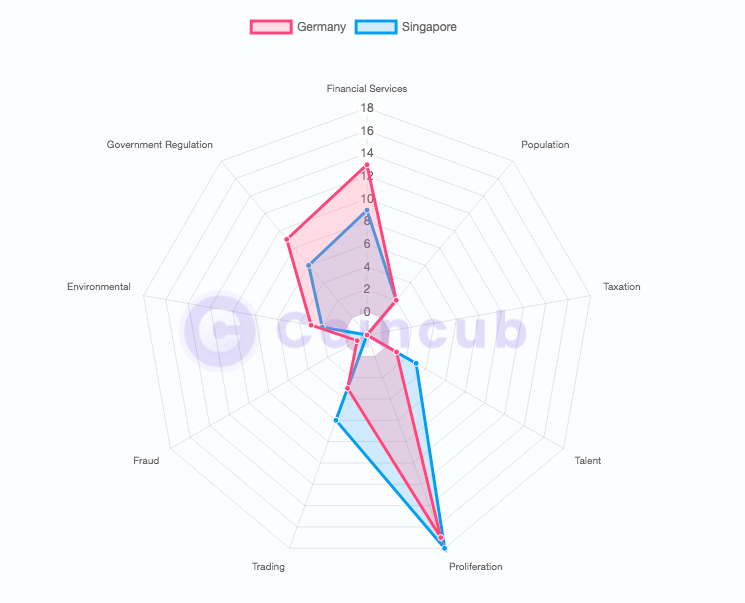
Source: Coincub With Singapore now ranked second, the United States now sits in third, followed by Australia, Switzerland and Hong Kong.
Coincub says that the United Arab Emirates (UAE) has become a new country on the list, appearing at number 22 after previously taking a hard stance against crypto with bans on trading and other activity. India has moved up to number 19, but as Coincub says, suffers from indecisive government policy.


Leituras Relacionadas

Circle CEO: Stablecoins Are at the Internet's 2002 Stage, Will Reach Trillions of Dollars in the Future

Circle CEO Jeremy Allaire, in a Q2 2026 earnings AMA, discussed the current state and future of stablecoins and Circle's strategy. He compared stablecoins today to the internet in 2002, predicting they will grow from hundreds of billions to trillions of dollars. Key points include: * **Current Use Cases**: Stablecoins have achieved product-market fit in digital asset markets (for trading/settlement), as a digital dollar store of value in emerging markets, and for cross-border payments and settlement. * **Future Growth Areas**: Allaire highlighted opportunities in the AI agent economy, merchant payments (especially via QR codes and stablecoin cards), and the convergence of traditional and on-chain finance. * **Circle's Strategy**: Circle aims to grow USDC through global partnerships. Its economic engines will include reserve income, transaction fees from its on-chain payment network (CPN), and its upcoming "economic operating system," Arc. * **Arc's Vision**: Arc, launching its mainnet on September 16, is a stablecoin-native blockchain designed for seamless user and developer experience. It aims to power the future "on-chain" economy where businesses and AI agents operate. * **Global Adoption**: Allaire emphasized that stablecoin adoption is a global phenomenon, driven by regulatory clarity in regions like Europe (MiCA) and the US (GENIUS Act), and will continue regardless of specific US legislation like the CLARITY Act. * **EURC Growth**: Circle's euro stablecoin, EURC, has surpassed €400 million in circulation, benefiting from early preparation for European regulations and existing distribution networks. Allaire expressed confidence in Circle's execution, citing strong team cohesion and the adoption of AI tools, while identifying cybersecurity and global local operations as key areas for continued strengthening.

marsbitHá 21m

Circle CEO: Stablecoins Are at the Internet's 2002 Stage, Will Reach Trillions of Dollars in the Future

marsbitHá 21m

With Revenue 3.8 Billion Lower Than CXMT, Net Profit Is 8.6 Billion Higher: What Secrets Are Hidden in YMTC's IPO?

Chinese NAND flash giant Changcun Holdings has submitted its IPO prospectus to the Shanghai Stock Exchange. In Q1 2026, the company reported revenue of 47.042 billion yuan and a net profit attributable to parent company shareholders of 33.379 billion yuan. This presents a striking contrast with its competitor Changxin Technology, which had higher revenue (50.8 billion yuan) but a significantly lower net profit of 24.762 billion yuan. The key to this discrepancy lies in their ownership structures of core assets. Changcun Holdings fully owns its main operating entity, Yangtze Memory Technologies Co., Ltd., allowing nearly all group profits to flow to the parent company. In contrast, Changxin Technology controls but does not fully own its key production subsidiaries, meaning a substantial portion of its consolidated profits (approximately 8.25 billion yuan in Q1 2026) belongs to minority shareholders, reducing its reported net profit. Despite Changcun's higher net profit, its pre-IPO valuation is estimated lower than Changxin's. Analysts attribute this to differing market expectations: Changxin, focused on DRAM and the high-growth HBM market for AI servers, is seen as having greater long-term growth potential. Changcun, while dominant in NAND flash, operates in a market with inherent size constraints, making its future valuation more dependent on successfully upgrading its product mix toward higher-value segments like enterprise SSDs.

marsbitHá 33m

With Revenue 3.8 Billion Lower Than CXMT, Net Profit Is 8.6 Billion Higher: What Secrets Are Hidden in YMTC's IPO?

marsbitHá 33m

Perpetual Contract Liquidation Wave Resurges, Bitcoin $62k - $67k May Become the 'Disaster Zone'

A wave of liquidations has hit the crypto perpetual futures market, with analysts warning of continued volatility. Following Bitcoin's drop below $76,000 and subsequent rebound, over $84 million in long positions were liquidated in one hour, demonstrating the amplified impact of leverage. The U.S. CFTC's recent approval of a spot Bitcoin perpetual contract on the Kalshi exchange has opened this "previously closed" asset class to American institutions, with the platform reporting $5.5 billion in volume in its first two weeks. However, critics like Better Markets warn that perpetuals are "among the most dangerous crypto products" for retail investors due to a lack of enhanced protections. Recent price action saw a massive $529 million in hourly liquidations, predominantly longs. Analysts note that while a $3.3 billion short squeeze cleared liquidity above $80,000, a significant pool of long liquidations now sits between $62,000 and $67,000, posing a downside risk if key resistance holds. Experts caution new traders against using leverage or options, which can expire worthless, without proper experience and risk management. Despite the dangers, the demand for leveraged products persists, with some institutional players preferring on-chain platforms for their transparency and self-custody. As Kalshi expands its perpetual offerings beyond crypto, the core warning remains: leverage can lead to sudden, severe losses for unprepared investors.

marsbitHá 33m

Perpetual Contract Liquidation Wave Resurges, Bitcoin $62k - $67k May Become the 'Disaster Zone'

marsbitHá 33m

Trading

Spot
活动图片