Ethereum Merge a 'few months after' June: Dev clears up what’s going on

CointelegraphPublicado em 2022-04-14Última atualização em 2022-04-14

Resumo

The long-awaited Ethereum Merge is set for yet another delay, with developers working on the upgrade estimating a completion time a “few months after” June.

The long-awaited Ethereum Merge is set for yet another delay, with developers working on the upgrade estimating a completion time a “few months after” June.
Owing to the success of testing, there was a general expectation the Merge would go through mid year, however the latest setback is unsurprising given that Proof of Stake has been delayed constantly ever since it was first proposed.
That said, the signs are promising that the Ethereum mainnet will actually merge with the beacon chain to become a Proof-of-Stake (PoS) network this year. For real.
Ethereum developer Tim Beiko provided the updated timeline via Twitter yesterday, tentatively stating that the core devs are into the final stretch:
“It won't be June, but likely in the few months after. No firm date yet, but we're definitely in the final chapter of PoW on Ethereum.”
After noting that his comments caused a stir amongst Ethereum proponents and haters alike, Beiko followed up today by observing “that it can be hard to parse the progress on The Merge when you aren't deep in the process.”
To provide further context, Beiko published a blog post with a deeper rundown.
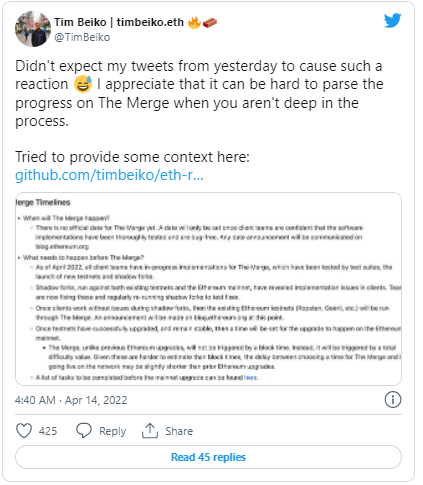
According to the developer, a specific date will not be set until “client teams are confident that the software implementations have been thoroughly tested and are bug-free.”
Central to these latter stages are the trial runs of public test nets such as Kiln, and the roll out of shadow forks which enable devs to test various merge/PoS-related implementations on the network.
Difficulty bomb ticking
Another important factor is the difficulty bomb (an automated increase in mining difficulty designed to make PoW mining less attractive), which Beiko says will start to be noticeable on Ethereum around May and make blocks “unbearably (read 15-20 seconds) slow by August.”
“If client developers do not think they can deploy The Merge to mainnet before block times are slowed too much, it will need to be delayed again,” he said.
Beiko put forward two ways in which the difficulty bomb could potentially be delayed to usher in the Merge upgrade beforehand, firstly combining a bomb delay with merge client releases to delay the “bomb at a certain block, restoring 13s block times, and then activate The Merge shortly after.”
Secondly to separate the bomb delay via network upgrade “which only delays the difficulty bomb” prior to the merge.
“The Merge, unlike previous Ethereum upgrades, will not be triggered by a block time. Instead, it will be triggered by a total difficulty value. Given these are harder to estimate than block times, the delay between choosing a time for The Merge and it going live on the network may be slightly shorter than prior Ethereum upgrades.”
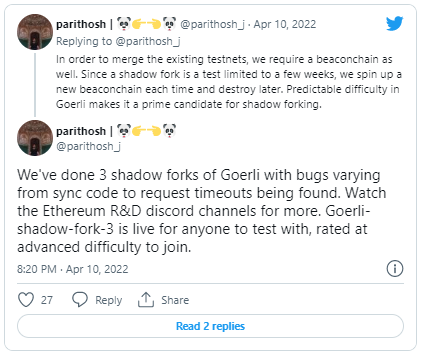
Earlier this week Ethereum Foundation developer Parithosh Jayanthi suggested there is still a fair amount of trial and error to go, after he noted that the testing of three shadow forks resulted in “bugs varying from sync code to request timeouts being found.”
Following the successful implementation of The Merge and transition to a PoS consensus mechanism, the final landmark on the road map for Ethereum (formerly known as Eth2) is the sharded chains upgrade slated to go live in early 2023. Until then however, the network will utilize Layer-2 networks like Polygon and Optimism to handle scalability and high transaction volumes.
The price of Ether (ETH) has seen a significant uptick over the past 30 days, gaining 20.5% to sit at $3,126 at the time of writing.
Leituras Relacionadas

Dalio Warns: AI Boom Shows Signs of a Bubble, Day of Reckoning Will Be the Time of Burst

Ray Dalio, founder of Bridgewater Associates, warns that the current artificial intelligence investment boom shows classic signs of a bubble, which he expects will eventually burst. In a Bloomberg Television interview, he noted that great technological revolutions often lead to capital inflows that create bubbles, making it difficult for investors and companies to calibrate their spending accurately—either overspending to capture market share or underspending and losing their competitive position. This caution comes amid significant rallies in AI-related assets, particularly chipmakers, driven by soaring demand for data centers and high-bandwidth chips, raising debates about overheating valuations. In contrast, Nvidia CEO Jensen Huang recently asserted that investors embracing the AI wave would see "crazy" returns and dismissed concerns over return on investment for data center spending as outdated. Dalio, however, focuses on the risks in the profit realization phase. He argues that bubbles tend to show signs of破裂 when markets transition from investment to the need for tangible returns, describing the burst as a process of converting paper wealth into cash. While acknowledging AI's intrinsic value, he expressed concern over the future profitability of some AI companies, suggesting the market is repeating a familiar pattern. The 76-year-old billionaire, who fully exited Bridgewater in 2025, has a net worth estimated at $21.5 billion according to the Bloomberg Billionaires Index.

marsbitHá 33m

Dalio Warns: AI Boom Shows Signs of a Bubble, Day of Reckoning Will Be the Time of Burst

marsbitHá 33m

Privacy Coin Crisis of Confidence! ZEC Plunges Over 56% in a Single Day

Zcash (ZEC), a leading privacy-focused cryptocurrency, experienced a severe crash on June 5th, plummeting over 56% in a single day and erasing nearly two months of gains. The flash crash was triggered by the disclosure of a critical zero-knowledge proof vulnerability within Zcash's Orchard privacy pool, which had existed since the pool's launch in May 2022. The flaw theoretically allowed an attacker to forge unlimited ZEC undetectably due to the pool's privacy features. The vulnerability was discovered on May 29th by independent security researcher Taylor Hornby during a proactive audit commissioned by Shielded Labs, utilizing AI-assisted analysis. The Zcash development team responded swiftly, implementing an emergency soft fork to disable Orchard transactions on June 2nd and executing a permanent hard fork fix (NU6.2) on June 3rd. Despite the technical fix, a major crisis of confidence emerged. The core issue is that Orchard's privacy design makes it cryptographically impossible to prove whether the vulnerability was exploited over the past four years, casting permanent doubt on the historical supply integrity of ZEC. While Shielded Labs argues exploitation was unlikely, the inability to provide definitive proof has severely damaged market trust. This sentiment was exacerbated when BitMEX co-founder Arthur Hayes, a prominent ZEC supporter, announced he was selling his entire position. He stated that privacy assets require "perfect security" rather than "probable safety." The combined effect of the disclosure and Hayes's exit ignited widespread panic selling, leading to massive liquidations and significant price decline. Analysts note the event highlights a fundamental tension within privacy coins: the conflict between verifiable supply and cryptographic privacy.

链捕手Há 36m

Privacy Coin Crisis of Confidence! ZEC Plunges Over 56% in a Single Day

链捕手Há 36m

Trading

Spot
Futuros
活动图片