Coin price today 10/07: Bitcoin continues to retest $30,000 as the week ends in the red, altcoins drop slightly

Tap Chi BitcoinPublicado em 2023-07-10Última atualização em 2023-07-10

Resumo

Bitcoin closed the week in the red, as the leading asset continued to retest the $30,000 region.
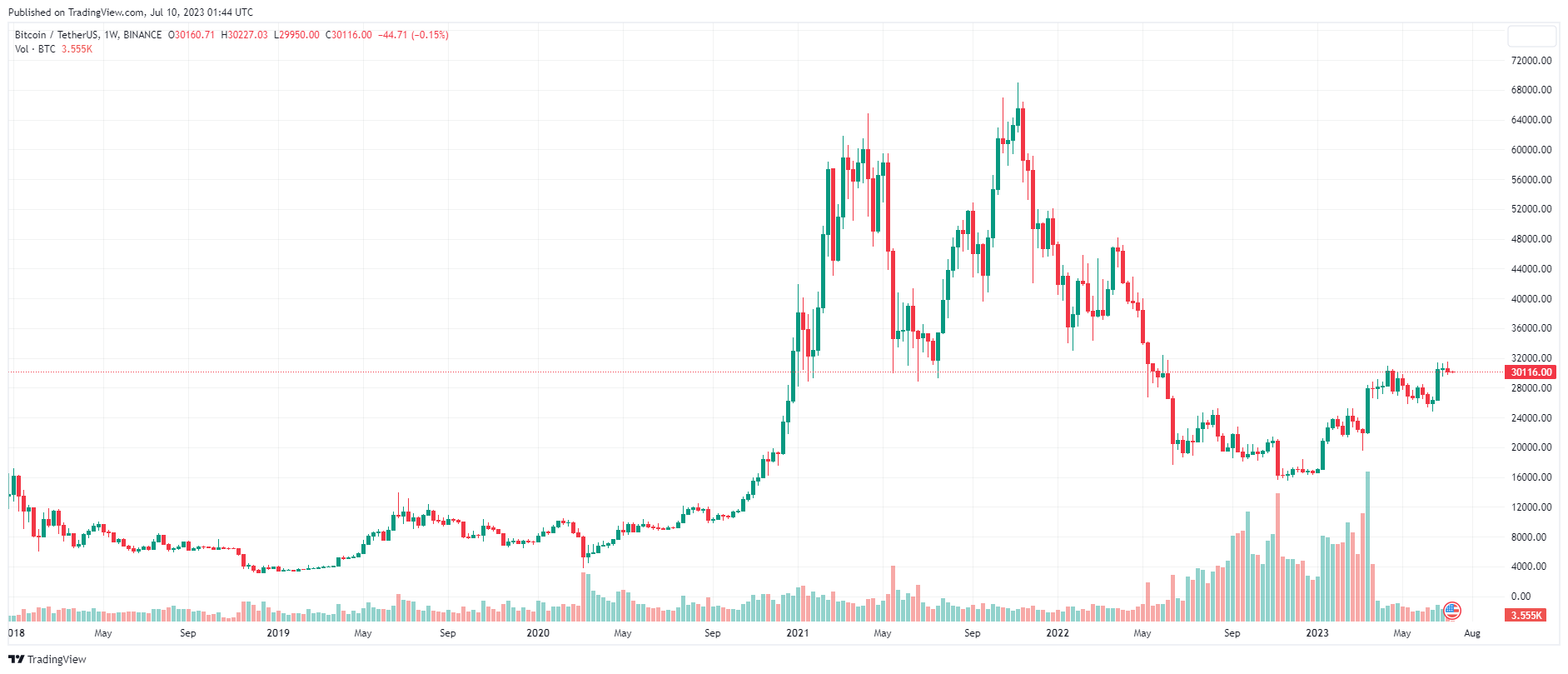
Bitcoin closed the week in the red, as the leading asset continued to retest the $30,000 region.

BTC Price Chart – 1 week | Source: TradingView

Stock market futures rallied on Sunday night as investors braced for a flurry of inflation data on Wednesday and Thursday and the start of second-quarter earnings season.

Futures contracts tied to the Dow Jones Index rose 38 points, or 0.1%; Nasdaq 100 futures are up 0.01% while S&P 500 futures are up about 0.1%.

Stocks are entering a new week after closing lower on jobs data from ADP and the Labor Department last week. Although nonfarm payrolls growth has cooled somewhat, investors are signaling that the economy is still wobbling enough for the Federal Reserve to continue raising interest rates.

As a result, all three major indexes posted losses last week. The S&P 500 fell 1.16%, while the Nasdaq Composite and Dow Jones Industrial Average lost 0.92% and 1.96%, respectively.

Investors will also be keeping an eye on the quarterly earnings report this week. Financial giants BlackRock, JPMorgan Chase, Wells Fargo and Citi will all report and kick off second-quarter earnings season.

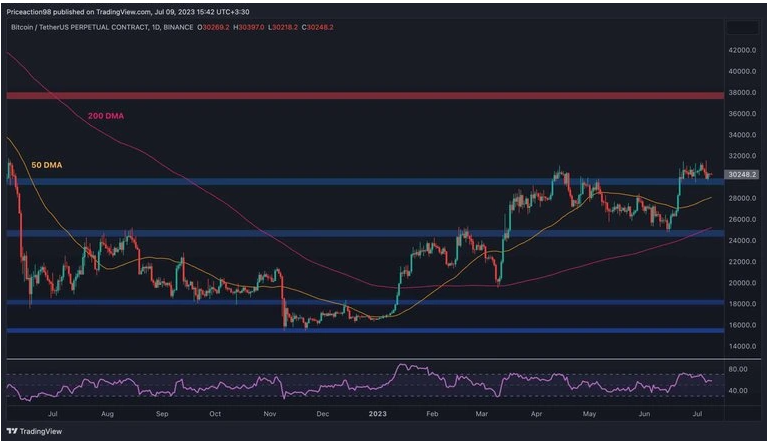
After the recent Bitcoin rally and successful breakout above the $30,000 resistance, the market is currently going through an accumulation phase. However, notable signals are emerging during this period.

On the daily chart, the price has repeatedly tested the $30,000 level since breaking through it. While this level has provided support so far, there are worrying signs in the form of a bearish divergence on the RSI.

This shows the possibility of correction or reversal in the near term. If a pullback occurs, the 50-day and 200-day moving Medium near $28,000 and $26,000, respectively, could act as key support levels.

Conversely, if the upside momentum continues, a move towards the $38,000 resistance area becomes the logical scenario.
Source: TradingView

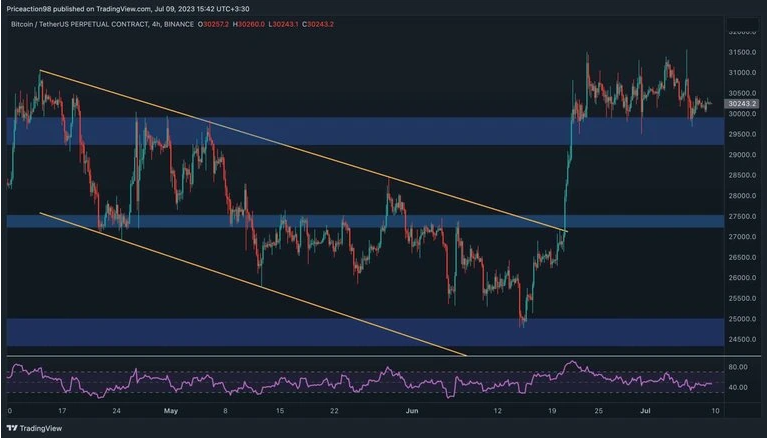
On the 4-hour chart, the price has shown erratic and unpredictable movements in recent weeks, making it difficult to determine its future direction. The market is retesting $30,000 once again and the possibility of a breakdown could lead to a drop to $27,500.

The RSI is relatively flat, hovering around the 50 mark, indicating a clear lack of dominance from buyers or sellers. The ongoing battle near the key $30,000 area further reinforces the near-term uncertainty in the market.
Source: TradingView

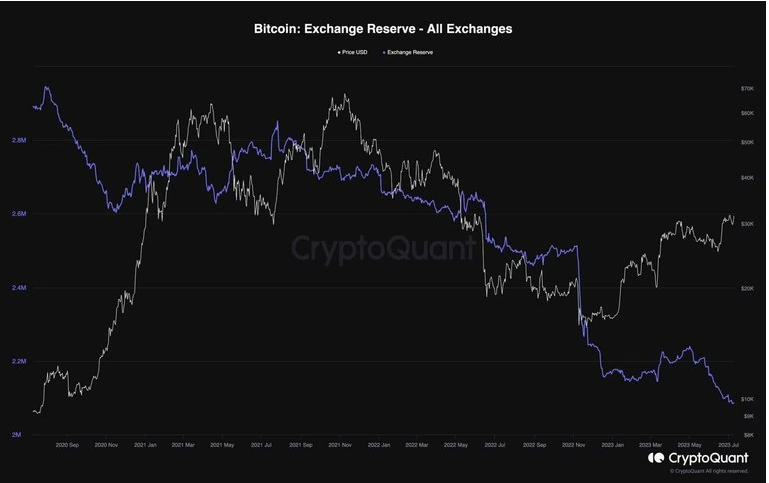
Bitcoin's recent bullish movement has sparked discussions about whether market participants are selling their BTC for a profit or choosing to hold them longer.

By analyzing the Bitcoin reserve index on exchanges, we can better understand investor behavior. The increase in this metric shows that investors are depositing their funds in exchanges, with the possibility of selling them. Conversely, the drop shows that investors are withdrawing their BTC from exchanges, indicating that they want to hold the money for a long time.

Recent data shows that Bitcoin reserve figures on exchanges have plummeted in the past month. This decline shows the optimistic sentiment of the market participants, as they anticipate the price to rise further and tend to keep their money.
Source: CryptoQuant

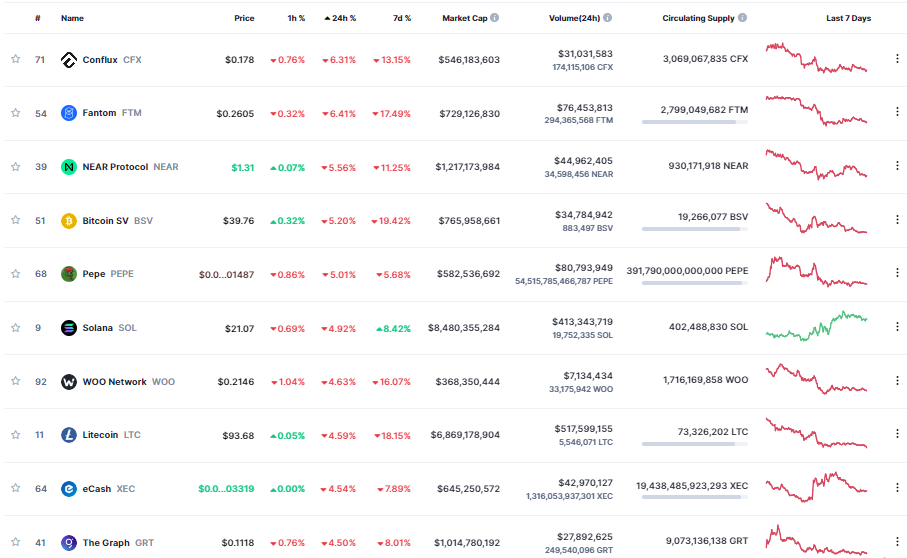
On the altcoin side, the market fell slightly as Bitcoin closed the week in the red and once again retested the $30,000 region.

In the past week, most altcoins are recording in the red, erasing almost all of the gains of the previous week.

In short, projects like Conflux (CFX), Fantom (FTM), NEAR Protocol (NEAR), Bitcoin SV (BSV), Pepe (PEPE), Solana (SOL), WOO Network (WOO), Litecoin (LTC) , eCash (XEC), The Graph (GRT), EOS (EOS), … all dropped from 3-6% all at once.
Source: Coinmarketcap

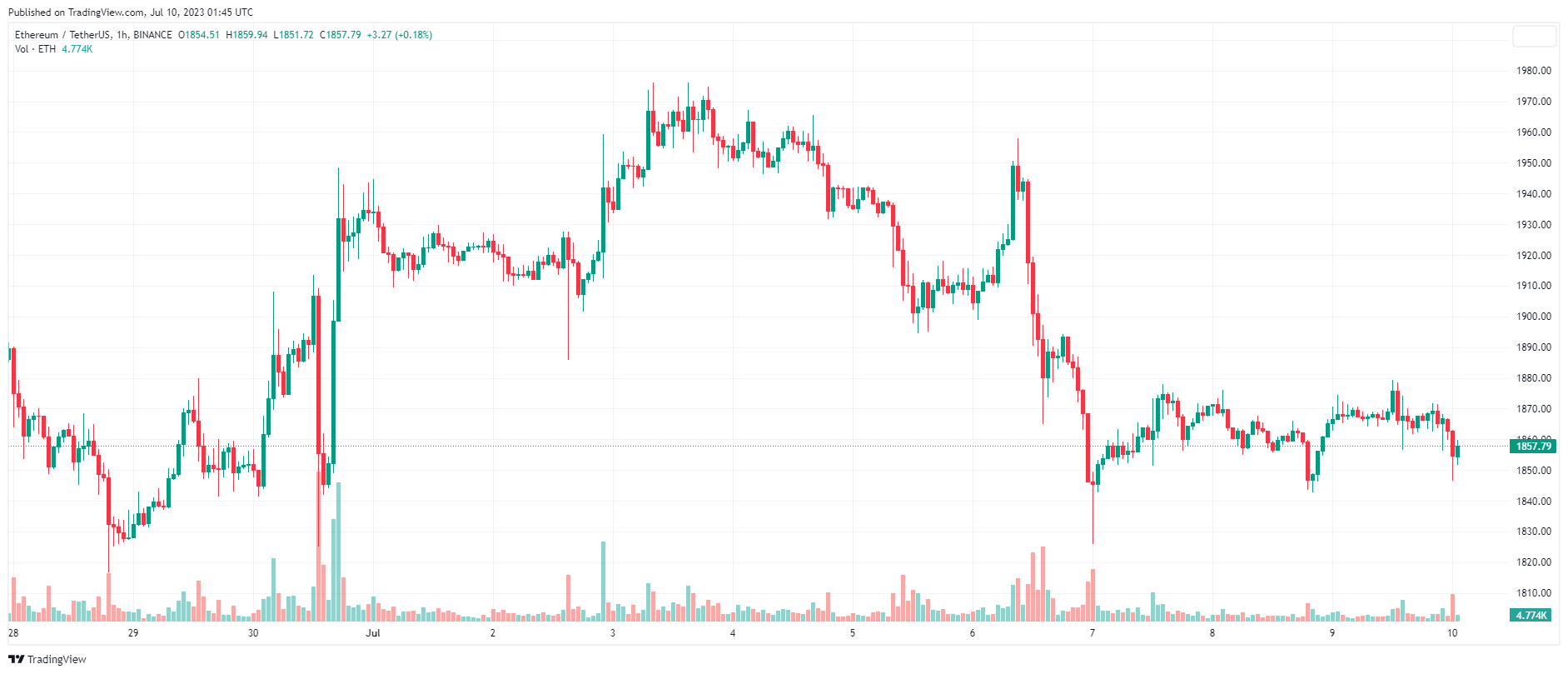
After being rejected above the $1,900 area, Ethereum (ETH) is still trying to defend the $1,850 area as price action seems to have been flat around it for the past three days. The 2nd largest Cryptoasset by market Capital is currently trading around $1,856, down slightly by 0.6% in 24 hours.
ETH price chart – 1 hour | Source: TradingView

Leituras Relacionadas

Podcast Notes: Hyperliquid Has Become the Top Interest Point for Traditional Hedge Funds

Empire Podcast hosts Jason Yanowitz and Santiago Santos discuss the surging institutional interest in Hyperliquid, a decentralized perpetual exchange, marking the highest level of engagement from traditional hedge fund managers since Paul Tudor Jones endorsed Bitcoin in 2020. The primary driver is the demand for weekend trading of commodities like oil, especially during geopolitical tensions such as the Iran conflict, as Hyperliquid provides the only active price discovery venue when traditional markets are closed. Trade XYZ, a front-end on Hyperliquid, has seen significant growth, with weekend oil price predictions having a median error of only 50 basis points. Santos predicts commodity trading volume on Hyperliquid will surpass Bitcoin within the year and that its market cap could rise from $25 billion to $100 billion. Other key points include Kraken raising $200 million at a reduced valuation of $13.3 billion, and the SEC clarifying that self-custodied DeFi frontends like MetaMask are not subject to broker-dealer rules, resolving a major regulatory uncertainty. The hosts also note the strong correlation between crypto and macro markets, with the S&P 500 posting one of its best 10-day rallies since 1950. They highlight MicroStrategy's continued Bitcoin acquisitions and the potential of real-world asset (RWA) tokenization as a key trend. The discussion concludes with skepticism towards many L2 projects, predicting a wave of protocols truly going to zero as capital concentrates in proven assets like Bitcoin and Hyperliquid.

marsbitHá 35m

Podcast Notes: Hyperliquid Has Become the Top Interest Point for Traditional Hedge Funds

marsbitHá 35m

a16z: The Next Frontier of AI, The Triple Flywheel of Robotics, Autonomous Science, and Brain-Computer Interfaces

a16z presents a comprehensive investment thesis for the next frontier of AI: Physical AI, centered on a synergistic flywheel of robotics, autonomous science, and novel human-computer interfaces (HCIs) like brain-computers. While the current AI paradigm scales on language and code, the most disruptive future capabilities will emerge from three adjacent fields leveraging five core technical primitives: 1) learned representations of physical dynamics (via models like VLA, WAM, and native embodied models), 2) embodied action architectures (e.g., dual-system designs, diffusion-based motion generation, and RL fine-tuning like RECAP), 3) simulation and synthetic data as scaling infrastructure, 4) expanded sensory channels (touch, neural signals, silent speech, olfaction), and 5) closed-loop agent systems for long-horizon tasks. These primitives converge to power three key domains: * **Robotics:** The literal embodiment of AI, requiring all primitives for real-world physical interaction and manipulation. * **Autonomous Science:** Self-driving labs that conduct hypothesis-experiment-analysis loops, generating structured, causally-grounded data to improve physical AI models. * **Novel HCIs:** Devices (AR glasses, EMG wearables, BCIs) that expand human-AI bandwidth and act as massive data-collection networks for real-world human experience. These domains form a mutually reinforcing flywheel: Robotics enable autonomous labs, which in turn generate valuable data for robotics and materials science. New interfaces provide rich human-physical interaction data to train better robots and scientists. Together, they represent a new scaling axis for AI, moving beyond the digital realm to interact with and learn from physical reality, promising significant emergent capabilities and value.

marsbitHá 54m

a16z: The Next Frontier of AI, The Triple Flywheel of Robotics, Autonomous Science, and Brain-Computer Interfaces

marsbitHá 54m

Conversation with Bitwise Advisor: From K-Shaped Economy to AI Taking Jobs, How Can Bitcoin Save the Younger Generation?

Jeff Park, a macro strategist and advisor at Bitwise, argues that the traditional financial system is broken, particularly for young generations. He describes a "K-shaped economy" where asset inflation enriches the wealthy while leaving others behind, with unaffordable housing as a key symptom. Park explains that real estate is often a depreciating asset due to maintenance costs and taxes, yet it remains unattainable for many young people due to distorted demand from global capital flows. He proposes Bitcoin as a superior store of value—scarce, portable, and free from maintenance costs or excessive taxation. By diverting capital away from real estate, Bitcoin could help lower housing prices and increase accessibility. Park also discusses the decline of traditional "smart investing" (e.g., value stocks) and the rise of "ideological investing" in non-correlated assets like crypto, luxury goods, and collectibles. On AI, Park warns it could trigger extreme social inequality by eliminating jobs while boosting corporate profits. He believes this will push younger generations toward Bitcoin, not only as a hedge but also as a symbol of decentralization and data sovereignty—offering an alternative to centralized AI systems that use personal data without fair compensation. He advises a diversified portfolio with Bitcoin as a core holding to hedge against currency devaluation and systemic risk.

marsbitHá 2h

Conversation with Bitwise Advisor: From K-Shaped Economy to AI Taking Jobs, How Can Bitcoin Save the Younger Generation?

marsbitHá 2h

Trading

Spot
Futuros
活动图片