Why is Bitcoin price down today?

CointelegraphPublicado em 2023-07-07Última atualização em 2023-07-07

Resumo

In the long term, market participants still expect the price of Bitcoin to recover, especially as more financial institutions are seemingly embracing BTC.

The bullish momentum that propelled Bitcoin price to a 2023 high over $31,500 on July 6, vanished after investors’ concerns of potential rate hikes resurfaced.

The contraction in Bitcoin price briefly sent BTC below $30,000 and on top of the renewed worries, traders are concerned that Bitcoin miners sending BTC to exchanges could be a sign of an impending sell-off.

Let’s take a closer look at the factors impacting Bitcoin price today.

Will the Federal Reserve restart interest rate hikes?

Despite the Federal Reserve pausing interest rate increases on June 14, Fed chair Jerome Powell seems committed to reducing inflation by restarting rate hikes.

After Powell’s Federal Open Markets Committee (FOMC) speech on June 14, the market seemed to confidently believe that the Fed would begin increasing interest rates again. CME’s FedWatch tool shows the market's belief that such increases are coming at the next FOMC meeting on July 26. As of July 6, the probability of interest rate hikes sits at 92.4%.
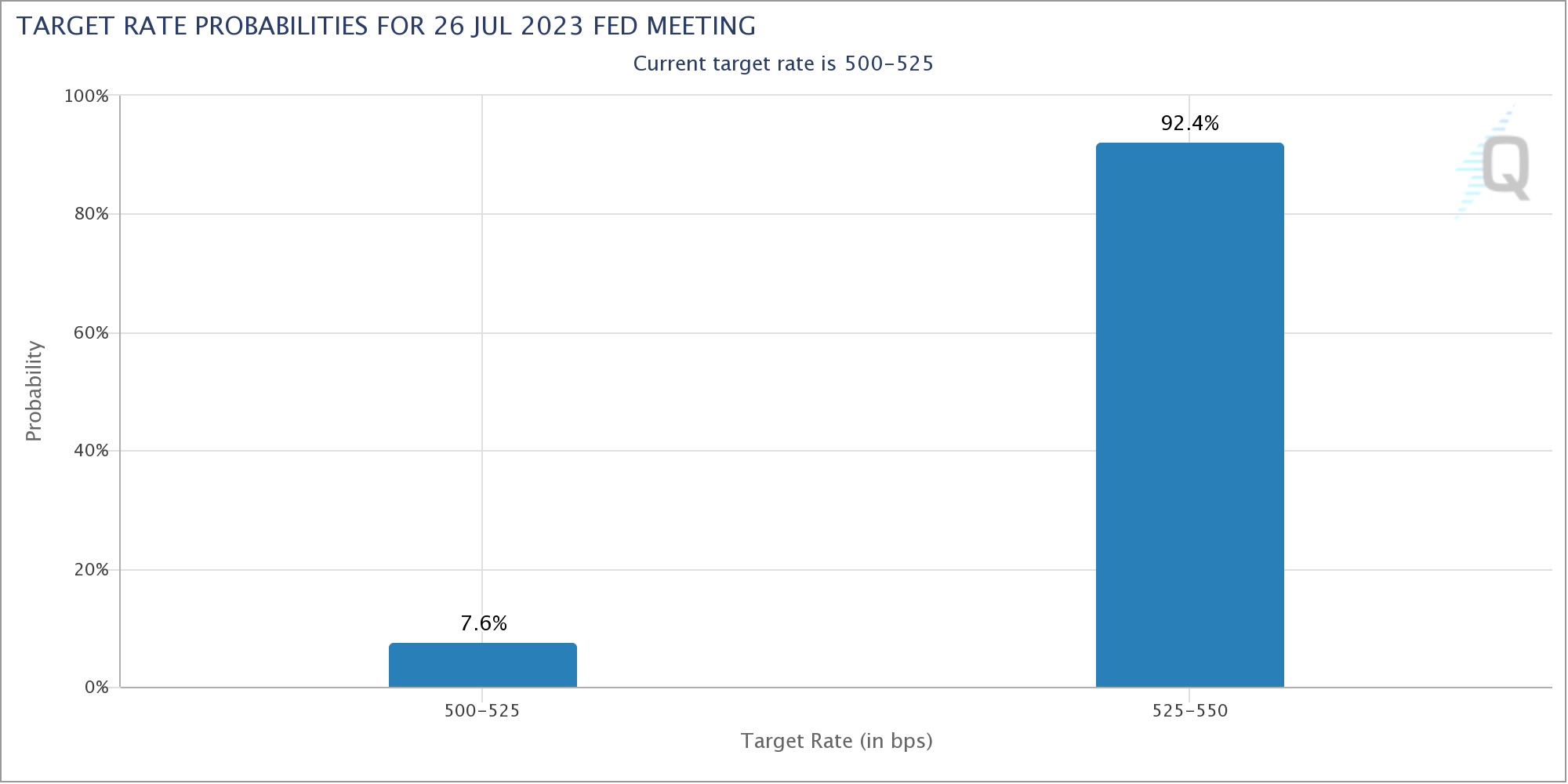
Target interest rate probabilities. Source: CME Group

To date, crypto prices are still highly correlated with the Dow and S&P 500 and most major banks still expect the U.S. to experience a sharp recession at some point in 2023.

According to U.S. Bank analysis which incorporates more than 1,000 data points, investor sentiment about the current state of the economy remains low.
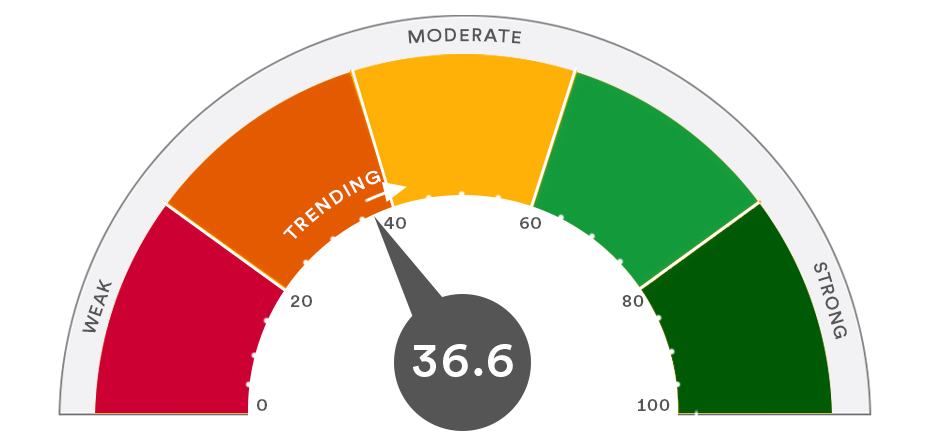
“Persistent inflation, elevated interest rates and uncertainty over the pace of earnings growth in 2023 remain headwinds to advancing equity prices. Although the pace of inflation is waning, the Fed is becoming less hawkish and earnings projections have stabilized.”

US-led regulatory pressure against crypto exchanges continues to impact markets

Despite the recent wave of institutional interest in Bitcoin, the actions of U.S. regulators is still seen as unknown. On July 5, Larry Fink, the CEO BlackRock suggested that Bitcoin is digital gold and he briefly spoke about the firm's recent Bitcoin ETF application.

While countries like Hong Kong and the United Arab Emirates are embracing Bitcoin, on June 5 and June 6, the United States Securities and Exchange Commission filed civil lawsuits against two of the largest centralized exchanges in crypto, Binance and Coinbase. The action has led to Binance.US seeing market share drop from 22% to under 1%.

While the SEC has previously noted Bitcoin is not a security, some market analysts are weighing if the current increase in actions is a renewed attempt for the Operation Chokepoint 2.0 initiative which aims to restrict access to all digital currencies.

Coinbase may have a pending lawsuit but ETFs, including BlackRock and Valkyrie are listing Coinbase as their required surveillance partner. Coinbase has filed a lawsuit against the SEC for clarity and the SEC is expected to respond by July 13.

While some commentators are excited about the prospect of Bitcoin ETFs, not all analysts agree that the structure is healthy for Bitcoin price, noting “paper BTC” concerns.

Can Bitcoin price reverse course?

The short-term uncertainty in the crypto market does not appear to have changed institutional investors' long-term outlook. Recently, despite a hostile U.S. regulatory environment, large institutions are pushing for Bitcoin financial instruments which may spark a bull run.

Bitcoin price continues to be directly impacted by macroeconomic events, and it is also likely that further regulatory actions and interest rate hikes will continue having some effect on BTC price.

In the long term, market participants still expect the price of Bitcoin to recover, especially as more financial institutions are seemingly embracing BTC.

Leituras Relacionadas

Goldman Sachs: July Smashes Through Crowded Trades, U.S. Stock Bull Market Not Broken but Harder to Navigate

Goldman Sachs: July Sees Crowded Trades Unwound, U.S. Bull Market Intact but Getting Tougher. The U.S. stock market in July did not see an index-level crash, but rather a significant unwinding of speculative positions. While the S&P 500 remained stable—trading within a narrow 3.5% range and staying within 2% of its high—underlying market dynamics were volatile. Heavily crowded trades, particularly in high-momentum tech, AI-linked stocks, and Asian strategies, faced severe pressure and forced deleveraging. Data indicates this was a meaningful cleanse, not a minor adjustment. Global tech exposure saw its largest sell-off in over five years, leverage in Korean equity ETFs plummeted, and Goldman's prime brokerage recorded the largest gross exposure reduction since late 2022. Leverage on momentum factors among fundamental long/short clients fell to the 28th percentile of its one-year range. The AI trade narrative shifted from pure potential to a focus on tangible returns. While Meta failed to show clear AI monetization, Microsoft and Amazon provided evidence that massive capital expenditure is translating into scalable revenue and product growth, preventing a blanket sell-off of the AI sector. The Federal Reserve's more opaque communication style and volatility in long-end Treasury yields have introduced new friction, particularly for rate-sensitive growth and tech stocks. The broader outlook for U.S. equities remains favorable, supported by a strong economy, robust earnings, and substantial AI capital expenditure. However, risk/reward is no longer cheap, and the market's upward elasticity has weakened. The Nasdaq 100's trajectory—up 12% year-to-date despite significant pullbacks—illustrates that the bull trend persists but the path is becoming more difficult. The key lesson from July is that the market no longer rewards crowded, highly leveraged trades, requiring more disciplined and liquid portfolio approaches.

marsbitHá 2h

Goldman Sachs: July Smashes Through Crowded Trades, U.S. Stock Bull Market Not Broken but Harder to Navigate

marsbitHá 2h

Interview with Robinhood Executive: Meme + Tokenized US Stocks as "Barbell" Customer Acquisition Strategy, All Business Lines Achieve Hundreds of Millions in Revenue

Interview with Robinhood executive Johann Kerbrat reveals the company's "barbell" customer acquisition strategy for its new Robinhood Chain, combining meme tokens with tokenized stocks. Three weeks after mainnet launch, the chain has seen over $3B in weekly DEX volume and 105M transactions. Kerbrat explains the logic behind the permissionless chain: meme tokens attract DeFi users, while tokenized real-world assets (RWA), currently over 90 US stocks and ETFs accessible in 120+ countries, serve global users. The goal is to bring Robinhood's 27 million funded accounts on-chain by simplifying DeFi with a user-friendly interface, exemplified by features like Robinhood Earn which offers yield without requiring wallet management. Built on Arbitrum's technology stack for its speed, low cost, and Ethereum's security, the chain focuses on financial products like Earn, spot trading, and perpetuals. Kerbrat downplays direct competition with platforms like Base, emphasizing the goal of expanding the overall market for on-chain assets. He details selective partnerships (e.g., Morpho, Lighter) based on compliance, unique UX, and differentiation. While regulatory clarity is pending for US perpetuals, the expansion continues via Bitstamp in Europe. Finally, Kerbrat positions Robinhood as a "super app" integrating stocks, options, crypto, banking, and AI trading, with all major business lines generating hundreds of millions in revenue. For the chain, current priority is driving adoption over maximizing gas fee revenue.

marsbitHá 5h

Interview with Robinhood Executive: Meme + Tokenized US Stocks as "Barbell" Customer Acquisition Strategy, All Business Lines Achieve Hundreds of Millions in Revenue

marsbitHá 5h

Trading

Spot
活动图片