Vitalik Buterin says Ordinals have revived ‘builder culture’ on Bitcoin

CointelegraphPublicado em 2023-07-07Última atualização em 2023-07-07

Resumo

The Ethereum co-founder said new developments on Bitcoin provide "good" pushback against “laser-eye” maximalists.

The advent of Bitcoin Ordinals signals the “organic return of builder culture” to the network, according to Ethereum co-founder Vitalik Buterin.

Buterin made the comments in a July 7 Twitter space where he spoke at length with Bitcoin proponents Eric Wall and Udi Wertheimer about what Bitcoin developers could learn from Ethereum devs.

Buterin praised Ordinals and the BRC-20 token standard which he sees as a rejection of “stagnant” politics in the Bitcoin ecosystem.

“Ordinals are starting to bring back a culture of actually doing things. It feels like there's real pushback to the laser-eye movement, which is good,” Buterin said.
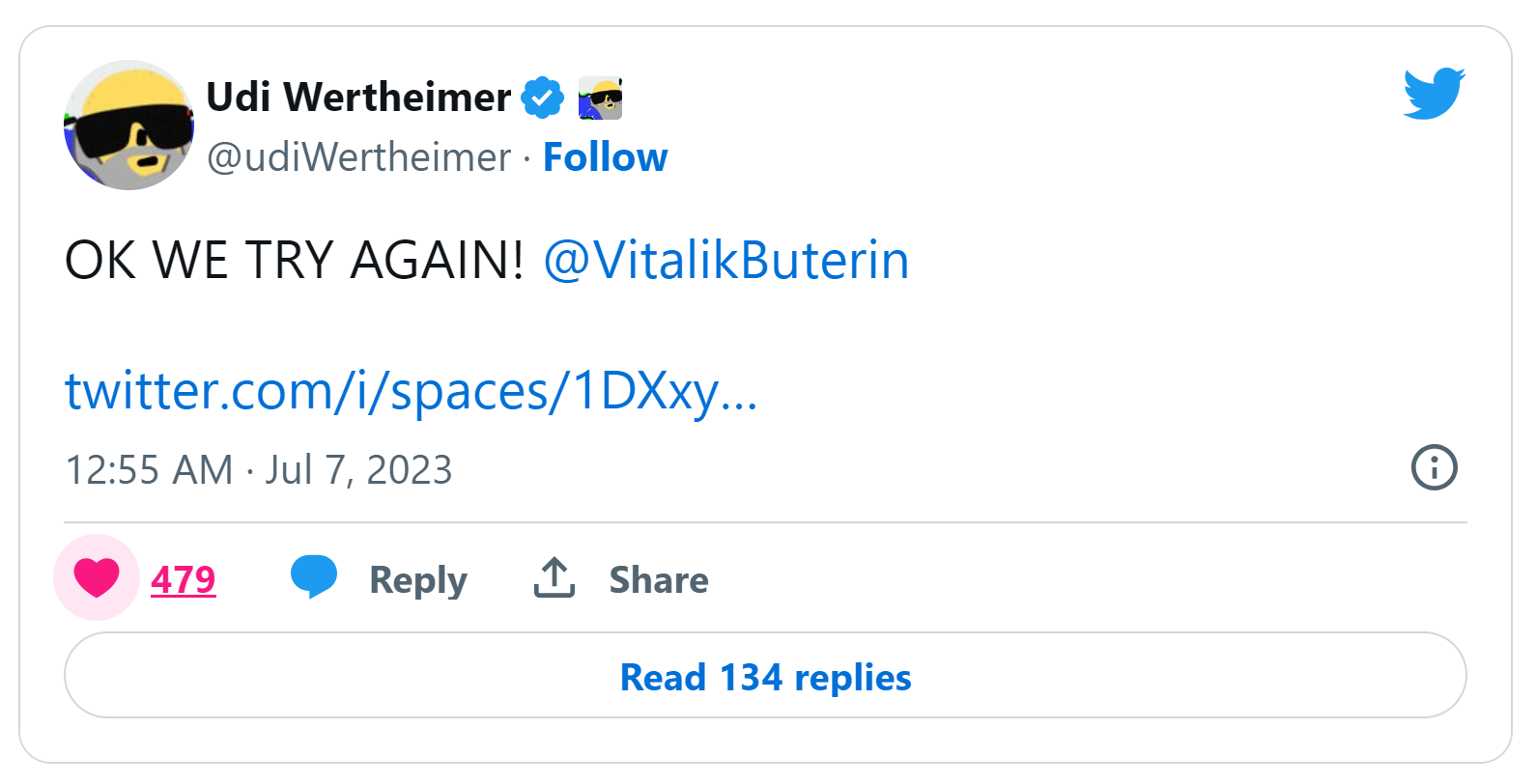
The nearly two-hour-long conversation centered around the issue of scalability. Wall claimed Bitcoin’s Lightning Network can’t scale for future users and it fails “frequently” when processing “even medium-sized payments.”

In response, Buterin suggested the best approach would be to focus on implementing different types of layer-2 solutions along with looking for ways to make the Bitcoin base layer more efficient.

“I think focusing on rollups is good and so is being open to ZK-snark-based scaling solutions.”

Wertheimer believed the introduction of rollups could create an interesting side effect.

“If we adopted rollups for Bitcoin, we actually get an execution environment too […] We can do smart contracts,” Wertheimer said.

Wall and Wertheimer — two key figures behind the Ordinals project Taproot Wizards — are outspoken exponents of Ordinals and routinely advocate for building increased functionality on top of the Bitcoin network.

Related: Bitcoin miners raked $184M in fees in Q2, surpassing all of 2022

Their stance has drawn criticism from more fundamentalist Bitcoiners who claim NFTs and smart contracts on Bitcoin dilute its supposed primary function as a peer-to-peer cash network.

Such critics include Jan3 CEO Samson Mow, who believes Ordinals waste block space that could otherwise be dedicated to Bitcoin payments.

Wall noted these criticisms and explained that Bitcoin could be used as a “proof system” for zero-knowledge proofs which wouldn’t congest the network.

“My perspective is that we [Bitcoiners] always wanted to do DeFi adjacent things but we just wanted the Bitcoin base layer to just act as sort of a judge or an arbiter of that computation and not have to run the computation on-chain,” Wall said.

“We shouldn't necessarily just be thinking about second layers as a way to make payments, but I think we could also think about them [as a way of doing] expressive things.”

The discussion yielded fresh controversy in the Bitcoin community, with Wertheimer slamming Mow and Blockstream CEO Adam Beck for being dismissive of the conversation with Buterin.


Leituras Relacionadas

Podcast Notes: Hyperliquid Has Become the Top Interest Point for Traditional Hedge Funds

Empire Podcast hosts Jason Yanowitz and Santiago Santos discuss the surging institutional interest in Hyperliquid, a decentralized perpetual exchange, marking the highest level of engagement from traditional hedge fund managers since Paul Tudor Jones endorsed Bitcoin in 2020. The primary driver is the demand for weekend trading of commodities like oil, especially during geopolitical tensions such as the Iran conflict, as Hyperliquid provides the only active price discovery venue when traditional markets are closed. Trade XYZ, a front-end on Hyperliquid, has seen significant growth, with weekend oil price predictions having a median error of only 50 basis points. Santos predicts commodity trading volume on Hyperliquid will surpass Bitcoin within the year and that its market cap could rise from $25 billion to $100 billion. Other key points include Kraken raising $200 million at a reduced valuation of $13.3 billion, and the SEC clarifying that self-custodied DeFi frontends like MetaMask are not subject to broker-dealer rules, resolving a major regulatory uncertainty. The hosts also note the strong correlation between crypto and macro markets, with the S&P 500 posting one of its best 10-day rallies since 1950. They highlight MicroStrategy's continued Bitcoin acquisitions and the potential of real-world asset (RWA) tokenization as a key trend. The discussion concludes with skepticism towards many L2 projects, predicting a wave of protocols truly going to zero as capital concentrates in proven assets like Bitcoin and Hyperliquid.

marsbitHá 5h

Podcast Notes: Hyperliquid Has Become the Top Interest Point for Traditional Hedge Funds

marsbitHá 5h

a16z: The Next Frontier of AI, The Triple Flywheel of Robotics, Autonomous Science, and Brain-Computer Interfaces

a16z presents a comprehensive investment thesis for the next frontier of AI: Physical AI, centered on a synergistic flywheel of robotics, autonomous science, and novel human-computer interfaces (HCIs) like brain-computers. While the current AI paradigm scales on language and code, the most disruptive future capabilities will emerge from three adjacent fields leveraging five core technical primitives: 1) learned representations of physical dynamics (via models like VLA, WAM, and native embodied models), 2) embodied action architectures (e.g., dual-system designs, diffusion-based motion generation, and RL fine-tuning like RECAP), 3) simulation and synthetic data as scaling infrastructure, 4) expanded sensory channels (touch, neural signals, silent speech, olfaction), and 5) closed-loop agent systems for long-horizon tasks. These primitives converge to power three key domains: * **Robotics:** The literal embodiment of AI, requiring all primitives for real-world physical interaction and manipulation. * **Autonomous Science:** Self-driving labs that conduct hypothesis-experiment-analysis loops, generating structured, causally-grounded data to improve physical AI models. * **Novel HCIs:** Devices (AR glasses, EMG wearables, BCIs) that expand human-AI bandwidth and act as massive data-collection networks for real-world human experience. These domains form a mutually reinforcing flywheel: Robotics enable autonomous labs, which in turn generate valuable data for robotics and materials science. New interfaces provide rich human-physical interaction data to train better robots and scientists. Together, they represent a new scaling axis for AI, moving beyond the digital realm to interact with and learn from physical reality, promising significant emergent capabilities and value.

marsbitHá 5h

a16z: The Next Frontier of AI, The Triple Flywheel of Robotics, Autonomous Science, and Brain-Computer Interfaces

marsbitHá 5h

Trading

Spot
Futuros
活动图片