Coin Price Today 03/07: Bitcoin closes for 3 consecutive weeks in the green, altcoins continue to rally as Wall Street goes flat

Tap Chi BitcoinPublicado em 2023-07-03Última atualização em 2023-07-03

Resumo

Bitcoin closed its first week of July in the green at $30,617, recording three consecutive bullish weekly candles since mid-June.
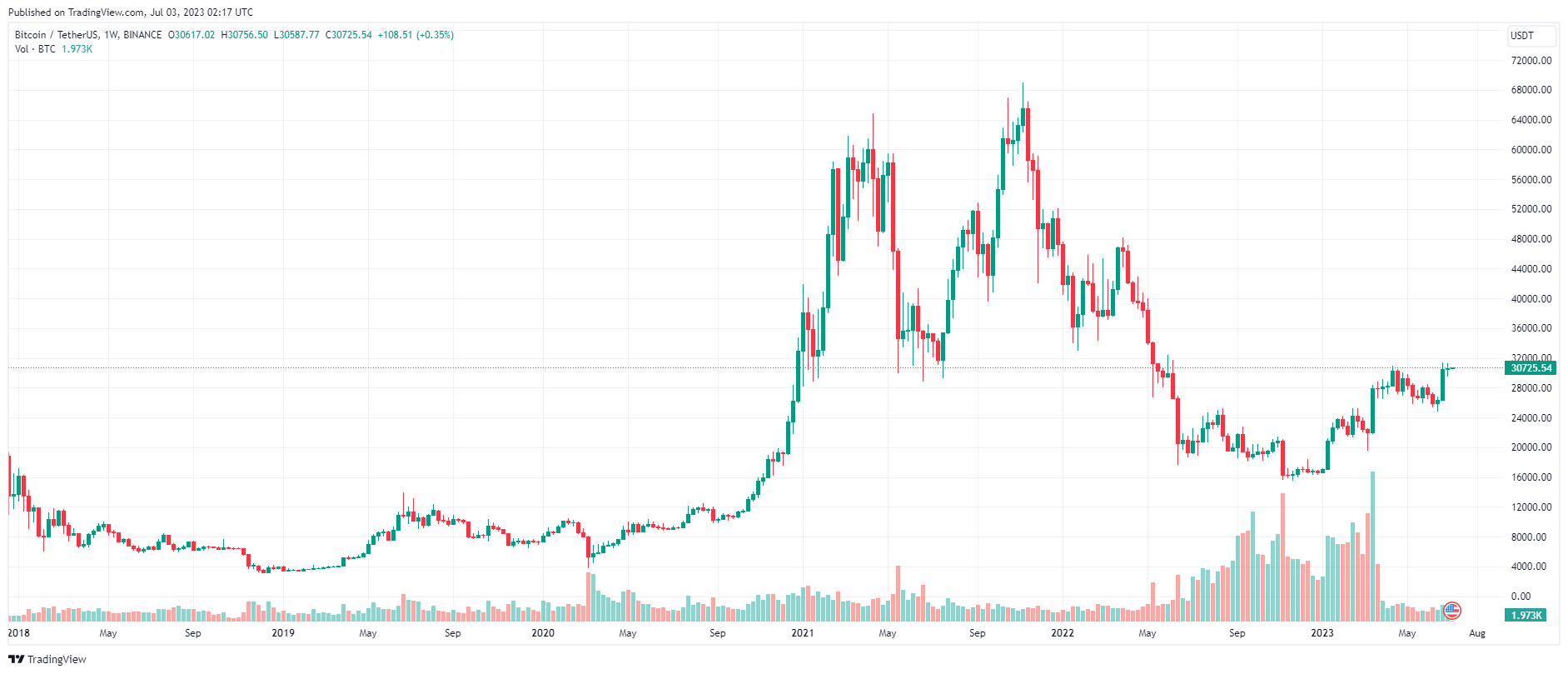
Bitcoin closed its first week of July in the green at $30,617, recording three consecutive bullish weekly candles since mid-June.

BTC Price Chart – 1 week | Source: TradingView

U.S. stock market futures were little changed on Sunday night, as traders braced for the second half of the year, as the market closed out the first half of 2023 with strong growth.

Futures contracts tied to the Dow Jones Index fell 17 points; S&P 500 and Nasdaq-100 futures were mostly unchanged.

Tesla shares were little changed in overnight trading after the electric-car maker reported delivery and production numbers that beat analyst expectations. Shares of United fell slightly as bad weather contributed to flight disruptions for the airline over the long holiday weekend.

Stocks are gearing up for the start of 2023. On Friday, the Nasdaq Composite closed with its highest first-half growth since 1983, up 31.7%; while the S&P 500 gained 15.9%, marking its best first half of the year since 2019. The Dow Jones index, up 3.8% for the period.

This comes as enthusiasm around artificial intelligence drives tech stocks. Recent data showing the US economy is resilient despite higher interest rates also helped lift investor sentiment, easing some fears on Wall Street about the recession that has been awaited since long.

Stocks began a short trading week on Monday, with markets closed for the National Day holiday. Investors will look at the latest PMI data for June on Monday morning, ahead of Friday's key jobs report.

Journalist Wu Blockchain shared a report showing that the value of Bitcoin increased by 83.8% in the first half of 2023, topping and outpacing other major assets in the world. In second place is Nasdaq with a value increase of 31.7%.

With a 37% drop, natural gas was in last place after prices of other energy sources also plummeted during the year.

Bitcoin's trajectory in 2023 is clear and bullish. The leading cryptocurrency has started the year with strong bullish sentiment, having bounced up 47% in the first month of the year, setting the stage for the following weeks.

Bitcoin's price then dropped to $19,569 in March, after crossing the $25,000 mark for the first time since August 2022.

Many Bitcoin analysts have identified a rise above $25,000 as the key move to confirm the end of the bear market. Despite the subsequent drop, the majority of Bitcoin supporters see this as an opportunity for consolidation and accumulation. That belief is supported by predictions of a bull run before the next halving event, which takes place in 2024.

Another phase of the uptrend returned to the Bitcoin market in mid-March. The top Cryptoasset surged more than 58% in about 4 weeks, as the price surpassed the $30,000 mark for the first time since June 2022.

After that spike, Bitcoin entered another accumulation phase, returning to the $25,000 support area. After hitting a local Dip at $24.756, the upside momentum has returned above $30,000.

Data from TradingView shows that Bitcoin closed June above the $30,000 region. Bitcoin also just ended the first week of July in the green at $30,617, recording three consecutive weeks of growth since mid-June.

Altcoin markets continue to thrive after Bitcoin stoked hopes of a fresh bull run.

Leading the way is Compound (COMP) with a strong growth of nearly 30% on the day, bringing the total profit this project has recorded in the past 7 days to more than 76%.

The Graph (GRT) and Flow (FLOW) are two projects that have shown gains of over 10% in the last 24 hours, bouncing 14% and 11% respectively.

BitDAO (Bit), Maker (MKR), Litecoin (LTC), Bitcoin Cash (BCH), Filecoin (FIL), Polkadot (DOT), Solana (SOL)… are also projects with good day activity, with profit from 4-9%.
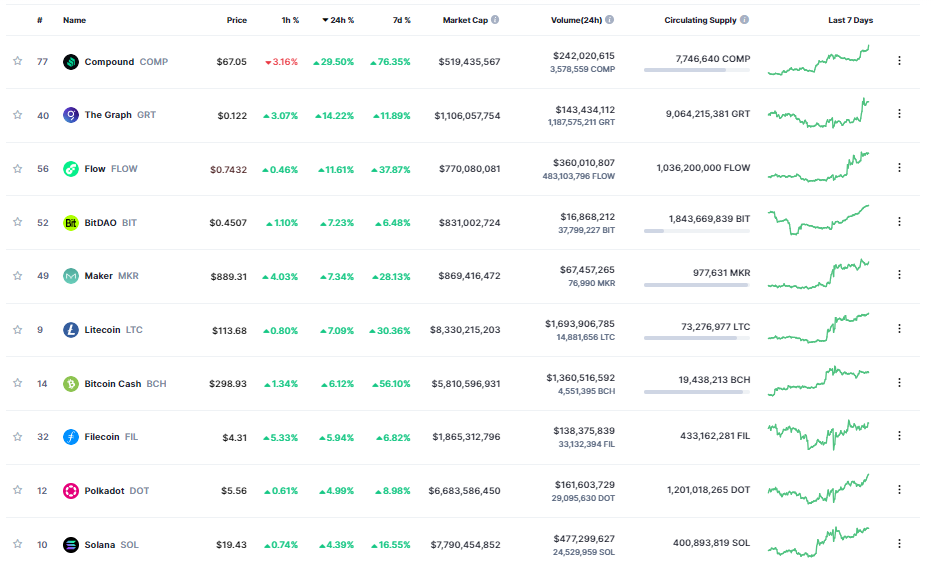
Source: Coinmarketcap

Ethereum (ETH) continues to show strength during the day. After successfully defending the price above the $1,900 area, the market's largest smart contract Token has been trying to break through $1,950, in an attempt to head towards its highest peak since early June.
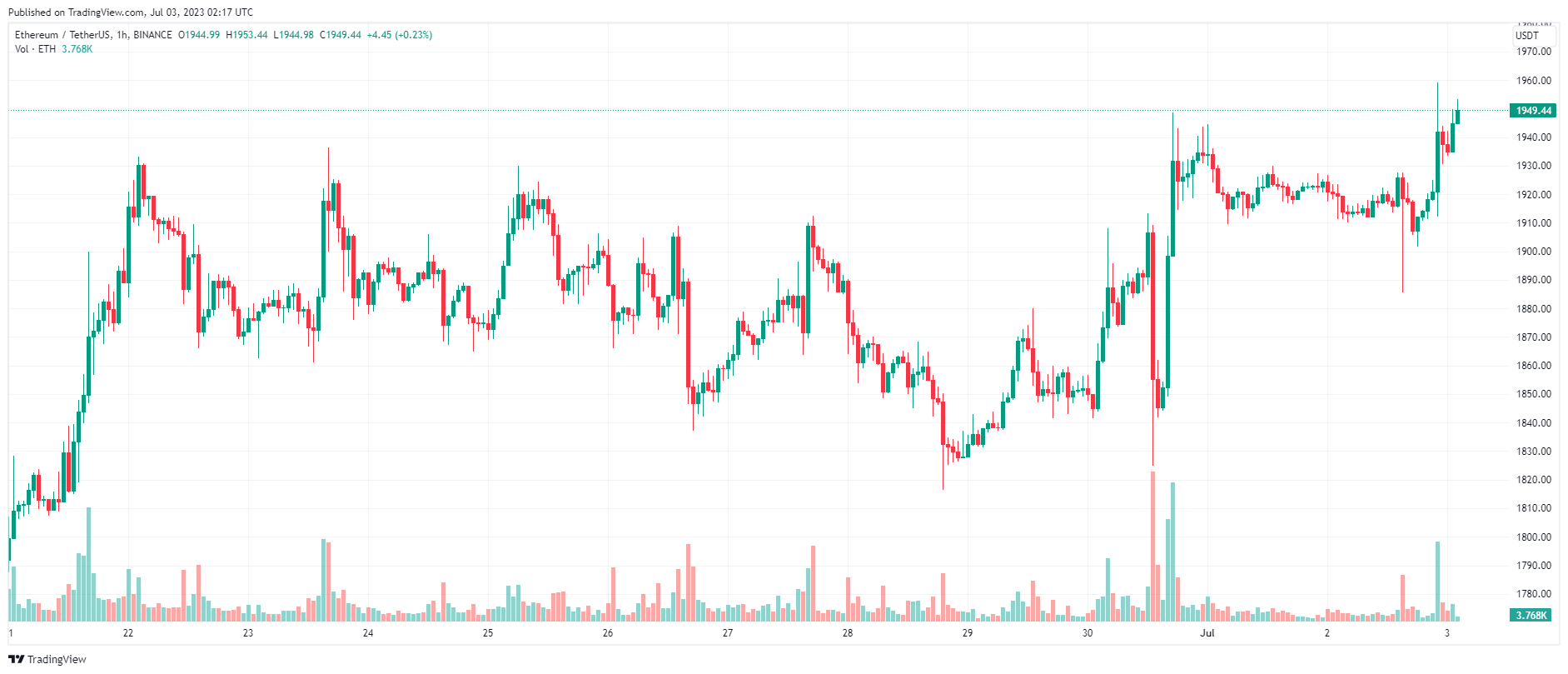
ETH price chart – 1 hour | Source: TradingView


Leituras Relacionadas

When Real Estate Ownership Goes Digital: What Happens to Your Rights, Risks, and Liquidity?

"Tokenizing Real Estate: Rights, Risks, and the Path to Liquidity" While tokenizing real-world assets (RWA) gains traction, real estate presents unique complexities. Beyond technical token issuance, critical challenges remain: enforcing legal rights, managing the underlying physical asset, and creating genuine secondary market liquidity. This article explores these issues through OneAsset, a Dubai-based commercial real estate (CRE) tokenization platform. OneAsset moves away from simply offering asset fragmentation. Instead, it focuses on institutional-grade infrastructure, prioritizing asset quality, legal enforceability, and operational fundamentals. Each property is held in an independent, single-asset vault, backed by a legally separate Special Purpose Vehicle (SPV) for bankruptcy remoteness. Investors acquire tokens representing the economic rights to a specific property, with precise legal claims defined by the underlying SPV structure. OneAsset emphasizes that tokenization cannot transform a poor-quality asset. Its initial focus is on institutional investors and quality Dubai-based CRE, selected for stable tenant cash flows and a clear regulatory environment. The platform integrates compliance by design, aiming to embed investor qualification and transfer rules directly into the token architecture. A core insight is that asset fragmentation does not automatically create liquidity. True liquidity depends on the asset's inherent quality—its location, cash flow, and valuation—as well as sufficient buyer demand. The goal is not just tradability, but making real estate rights more easily priced, verified, and reallocated. Looking ahead, the article discusses the potential for "AiFi" (AI-powered finance). For AI agents to autonomously allocate capital, investment assets like real estate tokens must become truly "machine-readable." This requires a high degree of standardization in legal rights, valuations, cash flows, and compliance data—a direction OneAsset is pursuing through its structured data reporting. In conclusion, real estate tokenization is shifting from a technology narrative to a focus on asset fundamentals. Blockchain can enhance efficiency and programmability, but it cannot replace sound underwriting, property management, or legal execution. The real work begins after the asset is on-chain.

marsbitHá 23m

When Real Estate Ownership Goes Digital: What Happens to Your Rights, Risks, and Liquidity?

marsbitHá 23m

After Affecting Two Generations, Meta Ordered to Pay $18 Billion in Damages

After more than two decades, a legal parallel has emerged. In 1998, major U.S. tobacco companies settled for $206 billion, leading to strict advertising bans and warning labels that significantly reduced smoking rates. On August 26, 2026, Meta reached a landmark settlement with U.S. attorneys general, agreeing to pay up to approximately $18 billion and implement mandatory changes to Facebook and Instagram. This historic settlement, one of the largest against a tech company, stems from allegations that Meta deliberately designed addictive features like infinite scroll and push notifications, harming youth mental health and violating child privacy laws. Facing a potential $1.4 trillion lawsuit and a series of unfavorable jury verdicts, Meta chose to settle on the eighth day of trial to avoid a catastrophic ruling. The core of the agreement is not just the financial penalty, which Meta will pay over 10 years, but a series of strict, 10-year product mandates for young users. These include a hard two-hour daily time limit (combined across apps), a default "nighttime block" from midnight to 6 AM, restricted notifications during school hours, hidden "like" counts, an optional non-algorithmic feed, and stronger age verification. An independent auditor will monitor compliance. Crucially, roughly 30% ($5.3 billion) of Meta's payment is contingent on YouTube and TikTok adopting similar measures and paying around $5 billion each. This move aims to create an industry-wide standard and prevent Meta from being competitively disadvantaged. The settlement is being likened to Big Tobacco's "tobacco moment." By legally framing addictive algorithm design as a "public nuisance," it sets a powerful precedent. Nearly 3,000 similar cases are pending against other social media giants, signaling a fundamental shift in regulatory pressure. The era where platforms could deny the addictive impact of their designs on children is effectively over.

marsbitHá 29m

After Affecting Two Generations, Meta Ordered to Pay $18 Billion in Damages

marsbitHá 29m

Trading

Spot
活动图片