Coin Price Today 07/06: Bitcoin recovers to $27,000, Altcoin bounce as US stocks hit 9-month highs

Tap Chi BitcoinPublicado em 2023-06-07Última atualização em 2023-06-07

Resumo

Bitcoin (BTC) rebounds strongly, a day after a sell-off caused by the US Securities and Exchange Commission (SEC) suing Binance and Coinbase.
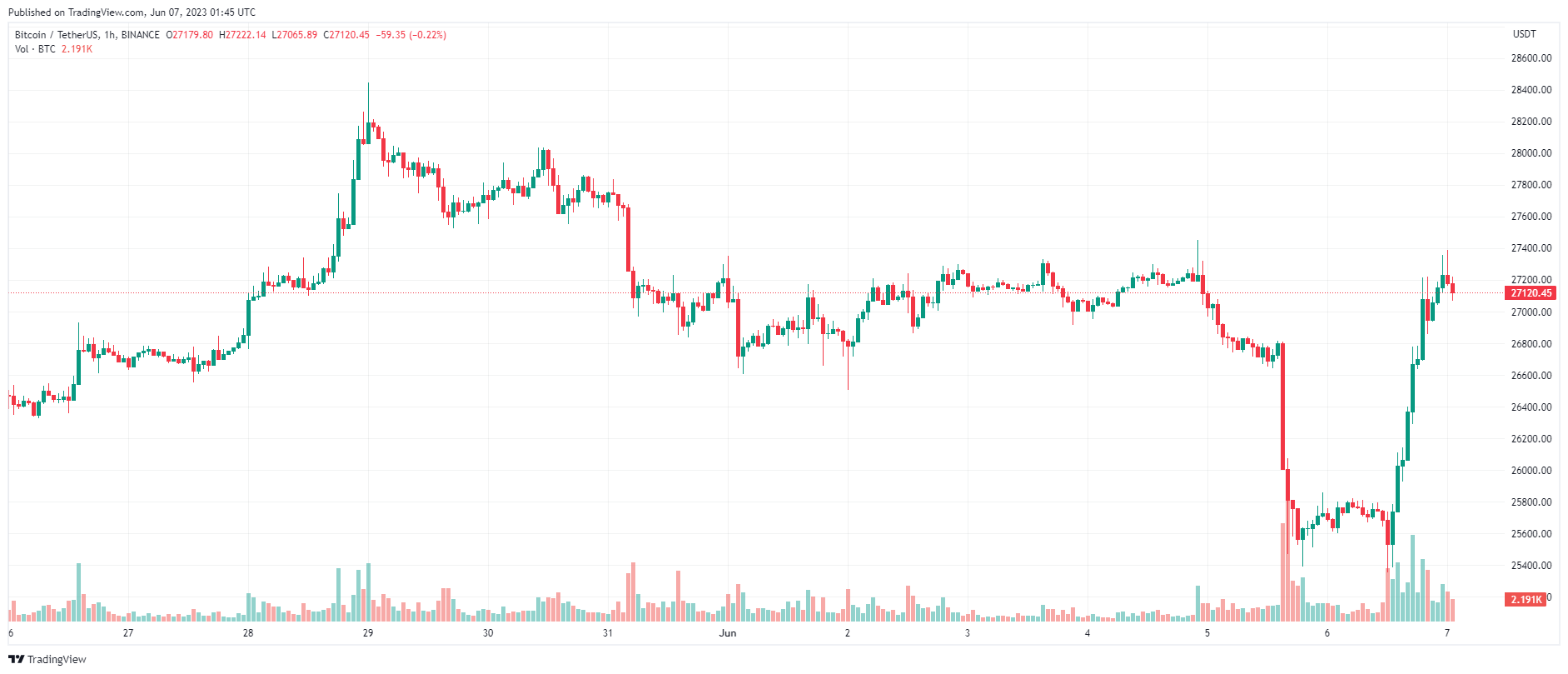
Bitcoin (BTC) rebounds strongly, a day after a sell-off caused by the US Securities and Exchange Commission (SEC) suing Binance and Coinbase.

BTC Price Chart – 1 hour | Source: TradingView

The S&P 500 index rose slightly on Tuesday (June 6) to its highest close since early 2023, as Wall Street embraced the recent rally that took the index to a nine-month high.

Closing the session, the S&P 500 index gained 0.24%, hovering near a nine-month high, to 4,283.85 points. This is also the index's highest closing level since August 2022. The Nasdaq Composite added 0.36% to 13,276.42 points, also closing the session at its highest level in 2023. The Dow Jones rose 10.42 points (or 0.03%) to 33,573.28 points, due to Merck and UnitedHealth stocks fell more than 2%, putting pressure on the index.

Coinbase shares fell more than 12% after the United States Securities and Exchange Commission (SEC) sued the company. The SEC accused Coinbase of operating as an unregistered broker and exchange.

Apple shares lost 0.2 percent, a day after the tech giant unveiled its much-anticipated virtual reality headset and new software at its annual Worldwide Developers Conference. In the previous session, this stock climbed to ATH before the announcement of the new product.

Jeff Kilburg, CEO of KKM Financial, said that the market can avoid major fluctuations as investors get ready for the policy meeting of the US Federal Reserve (Fed) next week. However, Mr. Kilburg said it is worth noting that the market has maintained above the range seen in recent months.

Meanwhile, gold prices traded in a narrow range on Tuesday (June 6), as investors waited for more signals to assess the US Federal Reserve's (Fed) interest rate roadmap before making the decision. policy meeting next week.

At the end of the session, the spot gold contract edged up 0.1% to $1,964.27 an ounce. Gold futures added 0.4 percent to $1,981.5 an ounce.

Oil prices fell on Tuesday (June 6), on concerns that sluggish global economic growth could dampen energy demand.

Ending the session, the Brent oil contract fell 42 cents, or 0.6%, to $76.29 a barrel. The WTI oil contract lost 41 cents, or 0.6%, to $71.74 a barrel.

The largest cryptocurrency by market capitalization recently spiked above $27,000, establishing a local top at $27,391, up more than 6% in 24 hours. On Monday, BTC dropped to around $25,350 as investors conducted a sell-off when the SEC said Binance violated securities laws.

Notably, the SEC avoided mentioning BTC and ETH in its filings against Binance and Coinbase, a sign of reassuring investors that U.S. regulators treat both tokens as commodities.

In a market report on Tuesday, Vetle Lunde, senior analyst at research firm K33 Research, suggested that BTC 's initial steep drop following the Binance lawsuit was an overreaction.

“Bitcoin is classified as a commodity. Americans can buy BTC through a variety of exchanges, swaps, payment apps, etc., and the market will not drop more than 5% for this event.”

In another market report, senior analyst Edward Moya at exchange Oanda, wrote that the SEC crackdown on Altcoin could even benefit Bitcoin.

“​Bitcoin is becoming an interesting asset as many crypto investors may decide to abandon Altcoin and move to BTC. With the SEC calling Solana, Polygon, Cardano, and BNB securities, some traders may decide to abandon positions on major exchanges, move assets to cold wallets, or reopen new positions with Bitcoin.

Altcoin markets bounced sharply as BTC rebounded back above the $27,000 region.

Leading the way were Stacks (STX) and Pepe (PEPE) when both projects recorded impressive profits of over 10%. However, on a weekly timeframe, the PEPE memecoin is still showing a loss of more than 8%.

Other projects like Lido DAO (LDO), MX TOKEN (MX), Render Token (RNDR), Optimism (OP), ApeCoin (Ape), Casper (CSPR), dYdX (DYDX), Bitcoin Cash (BCH)… on from 6-8%.
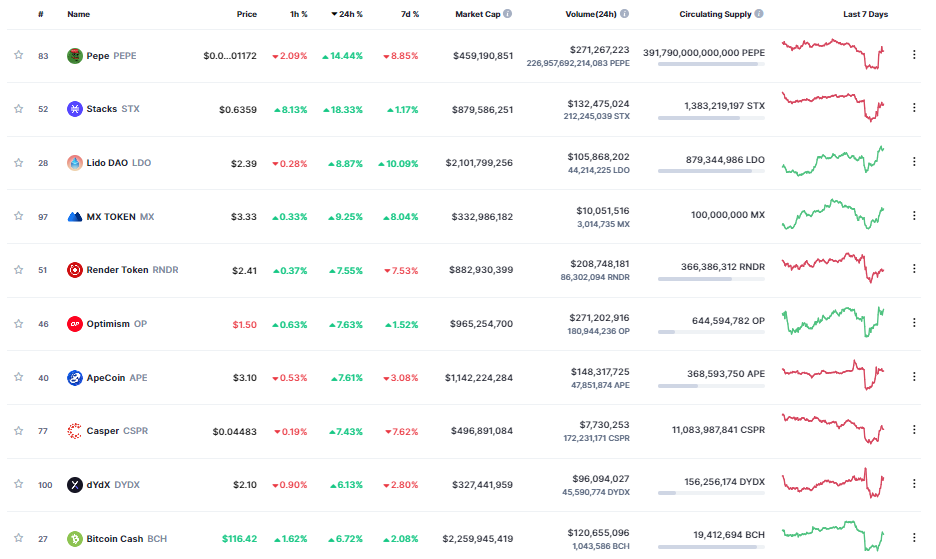
Source: Coinmarketcap

Following the Bitcoin rally, Ethereum (ETH) is also up more than 4% from the low of $1,778 on June 5 to around $1,880 at the present time and is trying to reclaim the $1,900 area.
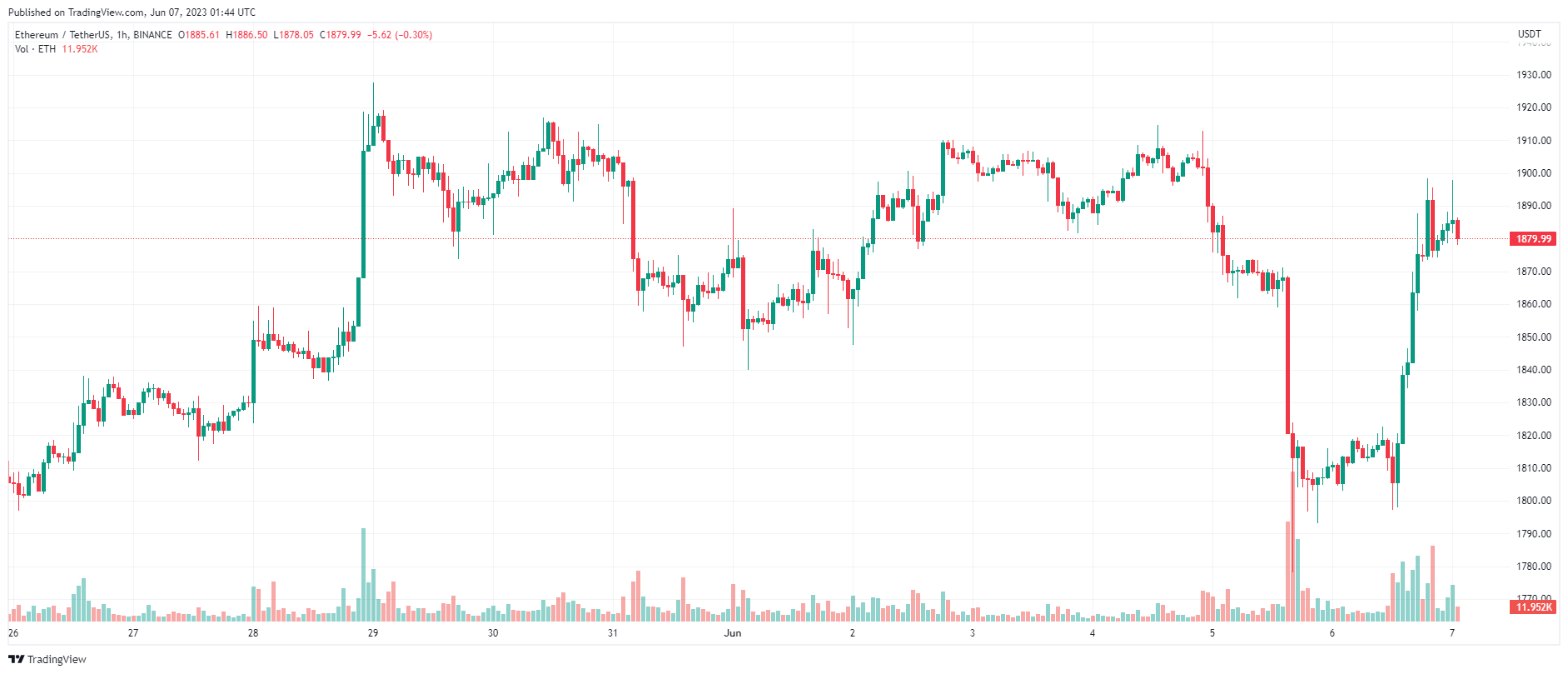
ETH price chart – 1 hour | Source: TradingView

The column “Coin Price today” will be updated at 9:00 daily with general market news, readers are welcome to follow.

Leituras Relacionadas

Gold Price Achieves Strongest Rally in 46 Years, Tokenized Gold Trading Volume Already Exceeds Full-Year 2025

Gold is experiencing its strongest rally since 1979, with prices reaching a record high near $5,600 per ounce in January. This surge is driven primarily by central banks, not retail investors. In 2025, central banks net purchased 863 tonnes of gold, with a similar increase expected in 2026. Traditional gold investment methods—physical bullion and ETFs—present trade-offs like storage issues, limited access, or management fees. Tokenized gold emerges as a third option: digital tokens representing ownership of physical bars stored in professional vaults. These tokens are globally transferable in seconds, divisible, and redeemable for physical metal. The potential impact mirrors that of dollar stablecoins. Stablecoins digitized the dollar, enabling cheap, instant, global transfers and driving adoption from $27 billion in 2020 to over $3 trillion today. Similarly, tokenized gold solves gold's "form problem"—its lack of divisibility, portability, and accessibility. Adoption is accelerating. In Q1 2026, tokenized gold trading volume hit $90.7 billion, surpassing the $84.6 billion for all of 2025. Its market cap exceeded $6 billion, growing 5.5 times faster than physical gold holdings in the quarter. While concerns about counterparty risk exist, tokenized gold represents a direct claim on allocated bars, with major issuers providing regular attestation reports. Just as stablecoins placed dollars on a digital, global rail, tokenized gold now offers a more practical form for this ancient asset, potentially expanding access to billions.

marsbitHá 16m

Gold Price Achieves Strongest Rally in 46 Years, Tokenized Gold Trading Volume Already Exceeds Full-Year 2025

marsbitHá 16m

Japanese Rates Return to 1996 Levels, Can Bitcoin Withstand the September Rate Hike?

Japanese borrowing costs have hit their highest levels since 1996, with yields on 30-year bonds reaching 4.185%. This marks a significant shift for a country long reliant on negative rates. Concurrently, Bitcoin surged 22% past $80,000, seemingly decoupled from the bond market turmoil. Historically, the massive yen carry trade has fueled global risk assets, predicated on near-zero Japanese rates. This assumption is now challenged. A potential rate hike by the Bank of Japan in September could strengthen the yen, forcing carry trade unwinds and potentially triggering a global deleveraging event, as seen in August 2024 when Bitcoin fell sharply. Conversely, if the yen weakens further, Bitcoin could attract Japanese investors as a hedge against currency depreciation and the country's massive debt burden. Institutional adoption in Japan is growing, with regulatory changes paving the way for potential crypto ETFs by 2027. The key variable is the BoJ's September policy signal. If it hints at a rapid tightening cycle to combat inflation and support the yen, risk assets like Bitcoin may face selling pressure from carry trade liquidation. However, if debt sustainability concerns limit its hawkishness, leading to a weaker yen, Bitcoin could benefit. Currently, the market is betting on a slow-motion debt crisis, not a sudden collapse. While Bitcoin shows resilience, its fate remains tied to the direction of the yen and the scale of any carry trade unwind.

marsbitHá 19m

Japanese Rates Return to 1996 Levels, Can Bitcoin Withstand the September Rate Hike?

marsbitHá 19m

How Can Bitcoin Resist Quantum Computers? A Comparison of Three Lattice-Based Signature Schemes

"Bitcoin's Quantum Defense: A Comparison of Three Lattice-Based Signature Schemes" by the Blockstream Research Team explores how Bitcoin can transition to quantum-resistant digital signatures, as current schemes like Schnorr and ECDSA are vulnerable to quantum computers. The report evaluates three lattice-based signature candidates—Dilithium, Falcon, and Hawk—against criteria like on-chain cost (key/signature size), implementation complexity, deployment risks, and support for Bitcoin's key derivation standard (BIP-32). The analysis recommends a minimum Security Level 3 for Bitcoin due to its long-term security needs. Dilithium (ML-DSA) is praised for its simplicity and integer-only operations, making it easier to implement securely, but it has the largest signature size (~5.3 KB for Level 3). Falcon (FN-DSA) offers the most compact signatures (e.g., ~3.1 KB for Level 5) and the fastest verification, though its signing requires complex floating-point sampling—a solvable engineering challenge. Hawk, despite its small size, was withdrawn from NIST standardization after a security vulnerability was discovered, highlighting the importance of conservative security margins. Currently, neither Dilithium nor Falcon has a fully viable, production-ready BIP-32 key derivation method. The report concludes that if a lattice-based scheme had to be chosen now, Falcon-1024 would be the preferred option for its balance of size, speed, and mature security assumptions. However, the short-term recommendation remains hash-based signatures (like SPHINCS+) for their lower risk, with a potential future hybrid or full transition to Falcon once its standard (FN-DSA) is finalized and well-supported.

marsbitHá 21m

How Can Bitcoin Resist Quantum Computers? A Comparison of Three Lattice-Based Signature Schemes

marsbitHá 21m

Trading

Spot
活动图片