Fed Uncertain About More Rate Hikes, Minutes Show

BarronsPublicado em 2023-05-25Última atualização em 2023-05-25

Resumo

Fed officials continue to debate whether to raise interest rates or hold them steady when the policy committee next meets in mid-June.

Federal Reserve officials appear increasingly divided over the appropriate path forward for monetary policy, with participants acknowledging significant uncertainty at their May meeting and emphasizing a need to keep their options open as they debate whether to continue raising interest rates or holding them steady in the coming months.

Minutes from the central bank’s May 2-3 meeting show that while officials remain focused on reining in “unacceptably high” inflation, they are balancing the need to rein in price growth with the growing likelihood that fallout from recent banking failures will have a dampening impact on economic growth.

“Participants generally expressed uncertainty about how much more policy tightening may be appropriate,” the minutes say.

Several officials felt the impact of stricter financial conditions and the lag with which monetary policy operates could mean their tightening campaign was nearly finished if the economy continued to evolve in line with the current outlook, the minutes say. Some others, however, felt the progress in bringing inflation back in line with the Fed’s 2% target would continue to be “unacceptably slow” and further rate hikes would be necessary.

Officials were able to agree in general on the need to keep a close eye on incoming economic data and to keep their options open ahead of the next policy meeting, scheduled for June 13-14.

The fresh insight, released Wednesday afternoon, underscores how seriously Fed officials considered changing course and holding interest rates steady when they met earlier this month. Officials voted unanimously in May to raise interest rates by a quarter-point to a range of 5-5.25%. The minutes suggest there was significant discussion over what the Fed should do after that and whether it would be time to pause the tightening campaign and hold rates steady.

“In short, the hawks were still in charge in early May,” wrote Ian Shepherdson, chief economist with Pantheon Macroeconomics, after the minutes were released. “But the next round of CPI, PPI, and labor market data likely will strengthen the case for a June pause.”

After the minutes were released on Wednesday, traders put the probability that the Fed holds rates steady at the June meeting at 72%, according to the CME FedWatch Tool.

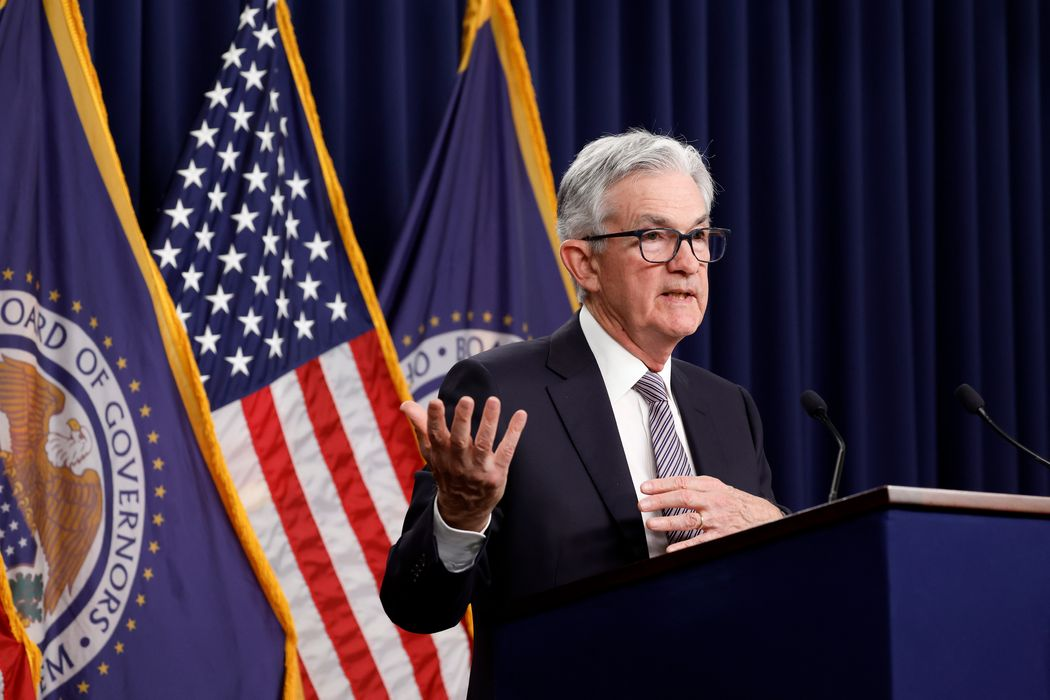
Fed Chairman Jerome Powell laid the groundwork at his postmeeting press conference in May for the central bank to hold rates steady at its next meeting, and officials deleted a line from their policy statement that said “ongoing increases” in the policy rate would be appropriate.

But Powell was careful not to suggest that officials had made a decision about what was coming next, and the minutes show other participants were focused on making sure the shift in their stance wasn’t misinterpreted. Some officials emphasized during the meeting the need to make clear that the changes to the statement didn’t mean the central bank had ruled out further rate hikes this year, or that it was leaning toward cutting rates, the minutes show.

Fed officials have said for months that they don’t anticipate lowering the federal-funds rate this year but will instead be holding it steady once they determine that they have reached a sufficiently restrictive level. That view stands at odds with the consensus forecast among investors, who continue to price in a significant likelihood of at least one quarter-point rate cut by the end of this year.

The Fed’s May rate hike came despite a view from committee staff economists that tightening in the pipeline so far, alongside the expected further tightening in bank credit conditions, would lead to a mild recession beginning later this year, the minutes show. Staff first released their recession forecast during the March meeting, which was held in the immediate aftermath of the failures of Silicon Valley and Signature Banks. The May meetings show committee staff see the downturn being followed by a “moderately paced” recovery.

Fed officials appeared to take a somewhat less dour view of the economic outlook, however, noting that while tightening credit conditions were likely to weigh on economic activity, “the extent of these effects remained uncertain.”

Ultimately, though, their decision on how to move forward in the coming meetings will depend largely on what forthcoming economic data show. April’s personal-consumption expenditures price index—the Fed’s preferred inflation gauge—will be released Friday, while May jobs numbers arrive next week and May consumer-price-index data will come the week after.

Leituras Relacionadas

Standard Chartered Bank’s 50-Fold Fantasy: Predicting AAVE to Reach $3,500

Standard Chartered Bank has issued an optimistic research report predicting that the AAVE token could surge 50-fold to $3,500 by 2030. This forecast is based on the projection that the total value locked (TVL) in DeFi will grow 37x to approximately $2.7 trillion, driven by stablecoin expansion and the tokenization of real-world assets (RWA). The bank's model links Aave's potential valuation directly to its protocol revenue, which is primarily driven by net interest margins. The report highlights Aave's current dominant position, noting it captures over 80% of the net earnings ("protocol retained earnings") in the lending sector while holding only about half of its TVL. It also points to the recent launch of the Aave V4 architecture and a healthy revenue stream of $142 million in 2025 as positive fundamentals. Grayscale's separate analysis, applying traditional valuation metrics like DCF, concluded AAVE is currently undervalued. However, the article notes significant challenges. Aave's peer-to-pool lending model suffers from inherent capital inefficiency, with an estimated $52 million annual "deadweight loss" due to idle funds needed for liquidity buffers. This structural flaw was exposed during the April KelpDAO exploit, which locked a WETH pool at 100% utilization for days. Emerging protocols like Morpho, with more efficient point-to-point models, are cited as growing competitive threats. In summary, while institutional forecasts paint a macro picture of massive growth fueled by RWA adoption, Aave's path forward hinges on addressing its core structural limitations and competitive pressures within the evolving DeFi lending landscape.

链捕手Há 49m

Standard Chartered Bank’s 50-Fold Fantasy: Predicting AAVE to Reach $3,500

链捕手Há 49m

Tidal Investment: We Remain Bullish on the AI Industry Chain, But the Reasons Have Changed

Tidal Investment remains optimistic about the AI industry chain, but the rationale has shifted. The market narrative has changed. While recent large-scale IPOs (e.g., SpaceX) and major fundraising plans by tech giants like Alphabet and Meta have caused some nervousness, this isn't a sign of an AI peak. The focus has moved from the initial question of AI's viability to the sustainability of massive investment cycles. The key players—primarily the major cloud providers—are not slowing down; their capital expenditure (Capex) guidance for 2026 has been increased across the board (e.g., Alphabet to $180B, Amazon to $200B). This investment cycle is proving resilient and difficult to stop. Unlike traditional hardware cycles, current AI Capex is distributed across multiple physical layers—computing, memory, networking, and critically, power infrastructure. Bottlenecks are shifting from chips to elements like electricity, transformers, and cooling systems, which have much longer lead times and cannot be easily pre-built like fiber optics during the dot-com bubble. Supply chain data (e.g., Eaton's 240% YoY data center orders) confirms this broad-based, project-driven expansion. Market concerns are acknowledged but viewed differently. First, while Capex growth currently outpaces revenue growth, raising ROI questions, this mirrors the early scaling phase of cloud computing itself. A change in view would require concrete signals like downward Capex revisions or missed AI product targets, which haven't materialized by mid-2026. Second, comparisons to the 2000 dot-com bust are flawed. That crash was driven by a massive, parallel oversupply of cheap capacity (fiber). The current cycle faces *supply constraints* in critical, capital-intensive physical infrastructure that cannot be overbuilt as easily. In conclusion, the wave of fundraising reflects the next, more complex act of the AI story. Physical bottlenecks and sustained high Capex plans suggest this is not the finale but an ongoing, capital-intensive build-out phase. The script has changed, but the play is far from over.

marsbitHá 1h

Tidal Investment: We Remain Bullish on the AI Industry Chain, But the Reasons Have Changed

marsbitHá 1h

Tidal Investment: We Remain Bullish on the AI Industry Chain, But for Different Reasons Now

Tidal Investments remains optimistic about the AI industry chain, but the rationale has shifted. The market is concerned about massive concurrent fundraising by tech giants like SpaceX, OpenAI, Alphabet, and Meta, fearing an AI peak. However, the authors argue this signals the next act of AI development, not its end. Capital expenditure (Capex) from major cloud providers (Alphabet, Amazon, Meta, Microsoft, Oracle) continues to surge aggressively into 2026. This investment cycle is more resilient than past hardware cycles due to its scale and complexity. Bottlenecks have shifted from chips to critical physical infrastructure like power grids, transformers, cooling, and data center construction—areas with long lead times and limited capacity for rapid expansion. Supply chain data (e.g., Eaton's orders) confirms substantial, tangible progress. Key market concerns are addressed: 1. **ROI vs. Capex Growth**: While Capex growth outpaces revenue, the authors note cloud giants have historically overcome similar phases through scale. The cycle will only be in danger if Capex guidance is cut, orders are canceled, or AI product demand falters—none of which are currently observed. 2. **Comparison to the 2000 Dot-com Bubble**: Unlike the telecom bubble, where cheap, oversupplied fiber crashed prices, AI infrastructure (especially power) is constrained, customized, and subject to lengthy approvals, making a similar supply glut and crash unlikely. In conclusion, the wave of fundraising reflects the immense, ongoing capital needs for AI's next phase, constrained by slow-moving physical bottlenecks. The AI cycle is not over; the script has simply changed.

链捕手Há 2h

Tidal Investment: We Remain Bullish on the AI Industry Chain, But for Different Reasons Now

链捕手Há 2h

Grayscale: These 15 Profitable Crypto Protocols Are Severely Undervalued

Grayscale Research identifies 15 top-revenue crypto protocols trading at significant valuation discounts, with many at single-digit or even 1x revenue multiples. Protocols like Pump.fun, PancakeSwap, and Meteora have market capitalizations roughly equal to their annual revenue. The report argues these financially-focused protocols (DEXs, lending, staking) are fundamentally undervalued and could benefit from the potential passage of the CLARITY Act, expected as soon as next month. This legislation aims to clarify digital asset regulation, potentially reducing institutional barriers and driving on-chain activity. The analysis breaks down the protocols into three groups: the "1x Club" (market cap ≈ revenue), mid-tier protocols with 3-9x multiples (e.g., Aave, Lido, Jupiter), and high-multiple protocols like Hyperliquid (15x) and Uniswap (37x), where valuation reflects future potential rather than current cash flows. Grayscale applies a traditional DCF model to Aave, suggesting a one-year price target of ~$175, representing ~130% upside from current levels. The report notes a risk-off macro environment since the Iran conflict has further compressed valuations, creating a potential entry window. The conclusion highlights that while the valuation data presents an intriguing opportunity, the investment thesis is contingent on the CLARITY Act's passage and subsequent institutional capital flows. Investors are cautioned to consider Grayscale's inherent conflict of interest as a crypto asset manager with products tied to these assets.

marsbitHá 2h

Grayscale: These 15 Profitable Crypto Protocols Are Severely Undervalued

marsbitHá 2h

Trading

Spot
Futuros
活动图片