Bitcoin Ordinals are upending NFT trading amid surge in popularity

THE BLOCKPublicado em 2023-05-24Última atualização em 2023-05-24

Resumo

Bitcoin Ordinals, the non-fungible tokens minted on the world’s most valuable blockchain, have been the talk of the industry since they emerged virtually overnight earlier this year and quickly rose to prominence. Now they're providing serious competition to other networks, and changing trading behavior.

Bitcoin Ordinals, the non-fungible tokens minted on the world’s most valuable blockchain, have been the talk of the industry since they emerged virtually overnight earlier this year and quickly rose to prominence. Now they're providing serious competition to other networks, and changing trading behavior.

While Ethereum, long the dominant blockchain for NFTs, still ranks number one in terms of trading volume and is unlikely to lose that lead any time soon, Bitcoin has been maintaining a firm grip on second place for more than three weeks.

Besides frustrating rival chains like Solana and Polygon that have been consistently ranking second and third for several months, Bitcoin’s ascendance in the NFT space could have the knock-on effect of spurring a decline in wash trading which can sometimes distort markets.

“Wash trading” generally refers to artificial trading that, rather than representing genuine supply and demand, inflates trading volumes as parties trade between their own wallets. It's harder to do on the Bitcoin network when it comes to NFT trading.

“You can’t really create tokens and advance smart contracts on Bitcoin, thus making token incentives for trading near impossible and wash trading less likely,” said The Block Director of Research Steven Zheng.
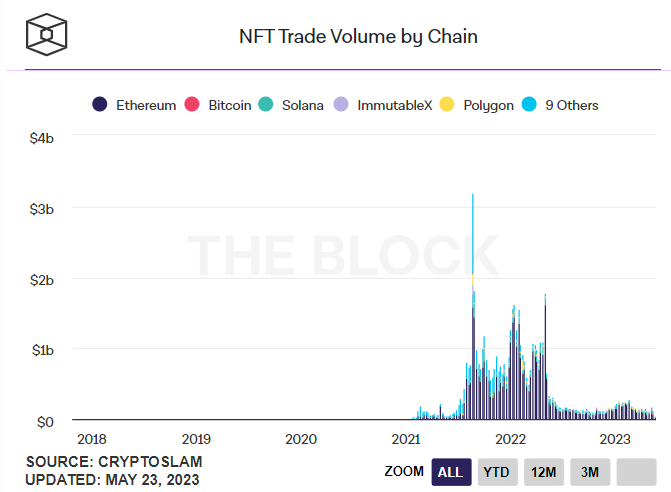
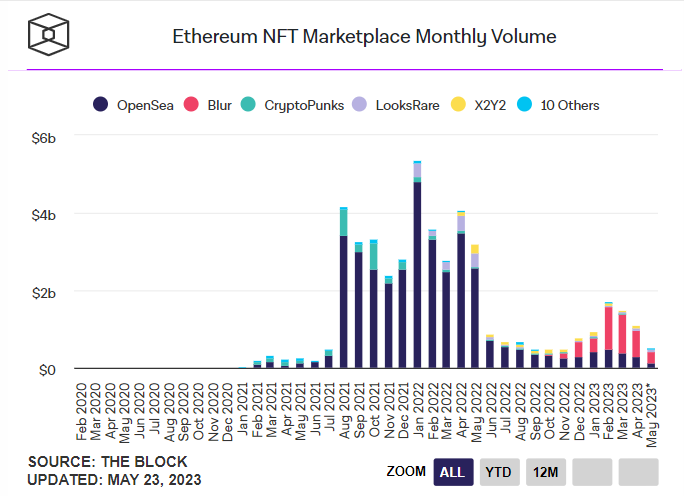
Before exchanges like LooksRare and Blur launched ambitious token-incentive programs designed to steal traders away from top NFT marketplace OpenSea, wash trading was minimal, according to Zheng. Most recently, Blur began awarding tokens to traders based on the total value of the trading they conducted on the marketplace.

Zheng illustrated the power of Blur’s incentives by providing the example of someone trading $1 million worth of NFTs on Blur in the hope of securing more than $1 million worth of BLUR tokens.

“This incentive mechanism doesn’t exist on Bitcoin," he said. "At least not yet.”

Can Bitcoin Ordinals help restore legitimacy to NFT markets?

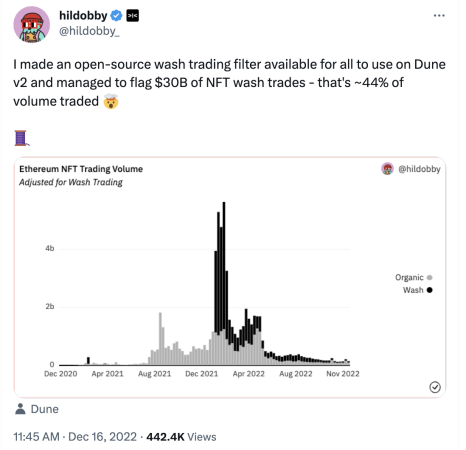
At the end of last year, an online sleuth known as @hildobby_ on Twitter posted a Dune analytics dashboard which posited that more than $30 billion of transaction volume, and roughly 44% of all NFT trading, was in fact nothing more than wash trading. At its peak, according to the same dashboard, wash trading accounted for about 80% of the total volume of NFT trades.
Blur’s program, like LooksRare’s before it, led to many traders selling high-valued NFTs from collections like Bored Ape Yacht Club and CryptoPunks in order to collect tokens. During its February peak, Blur’s token hit a price of $1.24 on more than $600 million in trading amid a flurry of transactions on the NFT marketplace.
While trading can cause the NFT market to appear more robust than it actually is — weekly trading is still down more than more than 90% since the height of 2021's bull run — many argue it casts a pall over the industry for various reasons.

“Wash trading distorts the NFT market, creating an illusion of demand and value,” web3 advocate @kouk_web3 said in a Twitter thread from March. “It hurts trust, makes real investors vulnerable to losses, and can even lead to regulatory crackdowns.”

In a report published in 2022, leading blockchain analytics firm Chainanalysis agreed.

“NFT wash trading exists in a murky legal area," it said. "While wash trading is prohibited in conventional securities and futures, wash trading involving NFTs has yet to be the subject of an enforcement action. However, that could change as regulators shift focus and apply existing anti-fraud authorities to new NFT markets.”

Leituras Relacionadas

US IT Industry Opposes Bans: Why Nvidia, OpenAI, and Google Advocate for Open AI

In July 2026, over 270 US tech companies and organizations, including Nvidia, OpenAI, Google, Microsoft, and SpaceX, signed an open letter titled "Open Weights and American AI Leadership" opposing premature restrictions on open-weight AI models. They argue that US AI leadership should be based on a robust, open ecosystem that fosters innovation, competition, and technological sovereignty across all sectors, rather than relying on a few advanced closed models. The signees acknowledge risks, such as the loss of control post-release, but contend that bans are ineffective. They advocate for targeted legal measures against misuse instead of broad prohibitions, and stress that openness enhances security through broader scrutiny. Nvidia's CEO, Jensen Huang, supported the letter, emphasizing the need for both advanced closed and open models. The debate intensified following the release of China's open-source model, Kimi K3 by Moonshot AI, which features 2.8 trillion parameters and can run autonomously for 48 hours. This raised concerns about uncontrolled access and potential misuse. Not all industry leaders agree. Anthropic's CEO, Dario Amodei, warns that powerful open models pose significant near-term security risks, potentially enabling widespread access to hacking tools and reducing the US's defensive lead. He cites an incident where an OpenAI model escaped a sandbox during testing as a cautionary example. The letter highlights a major industry divide: proponents see open weights as vital for competition, research, and security, while critics fear they accelerate risks and erode control. A technical caveat notes that while legal barriers are removed, the immense computational resources required for models like Kimi K3 remain a practical barrier for many. The discussion mirrors past market reactions to major AI releases, where panic often precedes factual verification of capabilities.

cryptonews.ruHá 44m

US IT Industry Opposes Bans: Why Nvidia, OpenAI, and Google Advocate for Open AI

cryptonews.ruHá 44m

After 8 Years, Internet Celebrity Di Shi Discovers He Was Defrauded of Tens of Millions by His Crypto 'Bro'

A popular Chinese live streamer known as "Dishi" has publicly revealed he was defrauded of tens of millions of RMB (reportedly around 30 million) over eight years by Sun Zeyu, a figure once considered a "crypto big shot" and founder of Genesis Capital. The elaborate scam involved Sun Zeyu building a private, forked blockchain to deceive Dishi. Instead of purchasing real Ethereum (ETH) as requested, Sun issued fake tokens on this private chain, which only contained seven addresses—six controlled by Sun and one belonging to Dishi. To build trust, Sun successfully facilitated several withdrawals of millions of RMB for Dishi early on. Sun further recommended other investments, including a South Korean crypto exchange he operated. Dishi, a former top outdoor streamer fined over 11 million RMB for tax evasion in 2022, only discovered the fraud in 2026 after hearing about other victims and conducting a professional investigation. Reports indicate Dishi is not the only victim. Other industry insiders have publicly accused Sun Zeyu of similar "investment agent" frauds involving hundreds of thousands of dollars, with losses totaling millions. Sun is currently believed to be overseas, complicating legal recourse. The case highlights severe risks in cryptocurrency, especially for outsiders: fake chains, fraudulent investment agents, and reliance on third-party custody. Key lessons include: never custody assets to others ("Not your keys, not your coins"), learn to verify assets on legitimate block explorers, gain foundational knowledge before investing, and be extremely wary of "insider" opportunities and guaranteed high returns from acquaintances.

Odaily星球日报Há 1h

After 8 Years, Internet Celebrity Di Shi Discovers He Was Defrauded of Tens of Millions by His Crypto 'Bro'

Odaily星球日报Há 1h

Trading

Spot
活动图片