First Mover Asia: Will Bitcoin Soon Begin a Retest of 30K?

CoinDeskPublicado em 2023-05-22Última atualização em 2023-05-22

Resumo

ALSO: Crypto companies and trade organization are spending a fraction of the amount that other industries are allocating for lobbying. That may change.

Prices: Bitcoin is in consolidation mode before an eventual retest of $30,000, says BitBull Capital.

Insights: The crypto industry is spending less than other industries on lobbying. That may need to change.
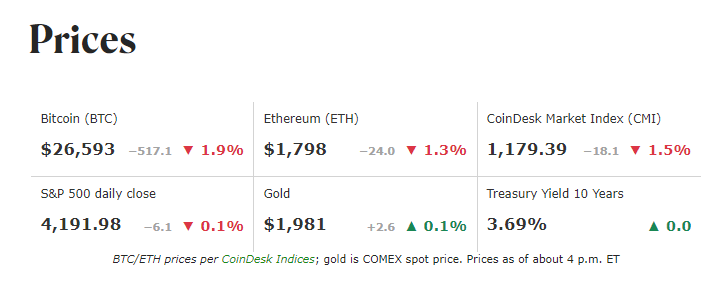
Bitcoin and ether are continuing their downward drift. Bitcoin is opening the Asia trading week down 1.3% to $26,779, while ether is down 0.8% to $1,806.

During the last month, bitcoin has primarily been in consolidation mode. Drifting downward ever so slowly, but still maintaining its value, down just 2% over the last 30 days – a much-needed break for investors from the roller-coaster of last year.

“Bitcoin has corrected to levels between $27k and $25k. This is where we’d like to see some consolidation before a retest of $30k in the coming days,” Joe DiPasquale, CEO of BitBull Capital, said to CoinDesk in a note. “While the market may not rally in the near term, the price action is following expectations as we witness consolidation during bearish sentiment.”

Meanwhile, Tornado Cash’s TORN token has begun to recover after the protocol’s DAO was the victim of vote fraud over the weekend. This attack – which was not an exploit or hack – involved an attacker putting forward a proposal that looked benign on the surface but allowed the attacker access to all governance votes via some hidden malicious code.

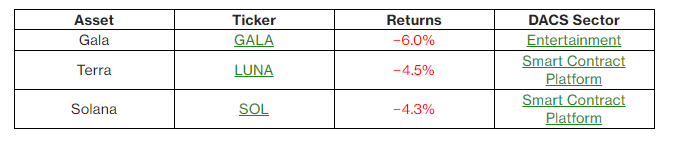
In the aftermath, the protocol’s TORN token dropped 40% to $3.59 from $5.76, but is now recovering and up to $4.66.

The Tornado Cash community is proposing solutions to revert the unauthorized code changes and considering creating a new contract with airdropped tokens for existing holders.
Insights

The Crypto Industry's Lobbying Deficit

A recent report from Washington, D.C.-based political watchdog Open Secrets shows that first-quarter federal lobbying has topped $1 billion for the second consecutive year.

Some expected industries lead the rankings in lobbying spend: healthcare, finance, real estate and energy.

Overall in 2022, industries and activist groups of all shapes and sizes spent $4.1 billion on federal lobbying efforts.

As for crypto? Despite increasing regulatory hostility from D.C, crypto’s actual lobbying spend came in at $21.6 million for the year, according to Open Secrets data. Certainly, this is an increase from years prior, but as an industry with a market cap of just over $1 trillion, it wouldn’t even crack the top-20 list for lobbying spend.

In comparison, big pharma spent $375.2 million in 2022. The automotive industry spent $82 million, and commercial banks paid $64.6 million to lobbyists that year.

The industry's political contributions to election campaigns grew tenfold from 2020 to 2022, totaling $2.3 million in the latter, Open Secrets recently reported. Major contributors included Coinbase, which alone spent $3.4 million on lobbying.

Open Secrets’ data shows that lobbying by crypto majors is up during the first quarter of the year.

Tether has spent $270,000 lobbying in the first quarter of 2023, which doesn’t sound like much, but is a huge jump over its first quarter 2022 spend of $100,000.
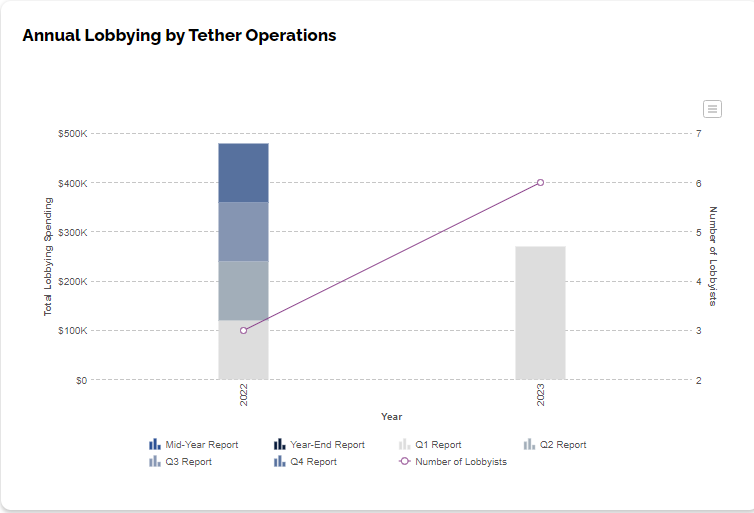
The Blockchain Association is up as well, to $490,000 spent this quarter compared to $460,000 for the same time last year. Stablecoin issuer Paxos also saw a huge jump, with its lobbying spend rising from $50,000 in Q1 2022 to $80,000 this past quarter.

Of course, this is all dwarfed by TradFi lobbying spending. The American Bankers Association spent $2 million during this past quarter, while Citigroup spent $1.4 million.

Sadly, successful businesses need to lobby to become more successful. That’s just the nature of modern politics. And it looks like crypto must do more of it.

Leituras Relacionadas

Tidal Investment: We Remain Bullish on the AI Industry Chain, But the Reasons Have Changed

Tidal Investment remains optimistic about the AI industry chain, but the rationale has shifted. The market narrative has changed. While recent large-scale IPOs (e.g., SpaceX) and major fundraising plans by tech giants like Alphabet and Meta have caused some nervousness, this isn't a sign of an AI peak. The focus has moved from the initial question of AI's viability to the sustainability of massive investment cycles. The key players—primarily the major cloud providers—are not slowing down; their capital expenditure (Capex) guidance for 2026 has been increased across the board (e.g., Alphabet to $180B, Amazon to $200B). This investment cycle is proving resilient and difficult to stop. Unlike traditional hardware cycles, current AI Capex is distributed across multiple physical layers—computing, memory, networking, and critically, power infrastructure. Bottlenecks are shifting from chips to elements like electricity, transformers, and cooling systems, which have much longer lead times and cannot be easily pre-built like fiber optics during the dot-com bubble. Supply chain data (e.g., Eaton's 240% YoY data center orders) confirms this broad-based, project-driven expansion. Market concerns are acknowledged but viewed differently. First, while Capex growth currently outpaces revenue growth, raising ROI questions, this mirrors the early scaling phase of cloud computing itself. A change in view would require concrete signals like downward Capex revisions or missed AI product targets, which haven't materialized by mid-2026. Second, comparisons to the 2000 dot-com bust are flawed. That crash was driven by a massive, parallel oversupply of cheap capacity (fiber). The current cycle faces *supply constraints* in critical, capital-intensive physical infrastructure that cannot be overbuilt as easily. In conclusion, the wave of fundraising reflects the next, more complex act of the AI story. Physical bottlenecks and sustained high Capex plans suggest this is not the finale but an ongoing, capital-intensive build-out phase. The script has changed, but the play is far from over.

marsbitHá 1h

Tidal Investment: We Remain Bullish on the AI Industry Chain, But the Reasons Have Changed

marsbitHá 1h

Tidal Investment: We Remain Bullish on the AI Industry Chain, But for Different Reasons Now

Tidal Investments remains optimistic about the AI industry chain, but the rationale has shifted. The market is concerned about massive concurrent fundraising by tech giants like SpaceX, OpenAI, Alphabet, and Meta, fearing an AI peak. However, the authors argue this signals the next act of AI development, not its end. Capital expenditure (Capex) from major cloud providers (Alphabet, Amazon, Meta, Microsoft, Oracle) continues to surge aggressively into 2026. This investment cycle is more resilient than past hardware cycles due to its scale and complexity. Bottlenecks have shifted from chips to critical physical infrastructure like power grids, transformers, cooling, and data center construction—areas with long lead times and limited capacity for rapid expansion. Supply chain data (e.g., Eaton's orders) confirms substantial, tangible progress. Key market concerns are addressed: 1. **ROI vs. Capex Growth**: While Capex growth outpaces revenue, the authors note cloud giants have historically overcome similar phases through scale. The cycle will only be in danger if Capex guidance is cut, orders are canceled, or AI product demand falters—none of which are currently observed. 2. **Comparison to the 2000 Dot-com Bubble**: Unlike the telecom bubble, where cheap, oversupplied fiber crashed prices, AI infrastructure (especially power) is constrained, customized, and subject to lengthy approvals, making a similar supply glut and crash unlikely. In conclusion, the wave of fundraising reflects the immense, ongoing capital needs for AI's next phase, constrained by slow-moving physical bottlenecks. The AI cycle is not over; the script has simply changed.

链捕手Há 1h

Tidal Investment: We Remain Bullish on the AI Industry Chain, But for Different Reasons Now

链捕手Há 1h

Grayscale: These 15 Profitable Crypto Protocols Are Severely Undervalued

Grayscale Research identifies 15 top-revenue crypto protocols trading at significant valuation discounts, with many at single-digit or even 1x revenue multiples. Protocols like Pump.fun, PancakeSwap, and Meteora have market capitalizations roughly equal to their annual revenue. The report argues these financially-focused protocols (DEXs, lending, staking) are fundamentally undervalued and could benefit from the potential passage of the CLARITY Act, expected as soon as next month. This legislation aims to clarify digital asset regulation, potentially reducing institutional barriers and driving on-chain activity. The analysis breaks down the protocols into three groups: the "1x Club" (market cap ≈ revenue), mid-tier protocols with 3-9x multiples (e.g., Aave, Lido, Jupiter), and high-multiple protocols like Hyperliquid (15x) and Uniswap (37x), where valuation reflects future potential rather than current cash flows. Grayscale applies a traditional DCF model to Aave, suggesting a one-year price target of ~$175, representing ~130% upside from current levels. The report notes a risk-off macro environment since the Iran conflict has further compressed valuations, creating a potential entry window. The conclusion highlights that while the valuation data presents an intriguing opportunity, the investment thesis is contingent on the CLARITY Act's passage and subsequent institutional capital flows. Investors are cautioned to consider Grayscale's inherent conflict of interest as a crypto asset manager with products tied to these assets.

marsbitHá 1h

Grayscale: These 15 Profitable Crypto Protocols Are Severely Undervalued

marsbitHá 1h

Sam Altman's Personal Alchemy of Wealth: Investing in 400 Companies, Over 10 Deeply Tied to OpenAI

The article investigates Sam Altman's personal wealth strategy, centered around his investments in approximately 400 companies while serving as OpenAI's CEO. Despite not holding direct equity in OpenAI, Altman has built a vast portfolio, with at least 10 of his investments having commercial ties or ongoing negotiations with OpenAI. This creates a complex network of potential conflicts of interest, drawing scrutiny from U.S. congressional committees and state attorneys general. Key investments highlighted include the anti-aging startup Retro Biosciences (valued at $258 million for his stake as of late last year) and the chipmaker Cerebras, whose value soared following an OpenAI procurement deal. His most significant financial gain is linked to the nuclear fusion company Helion, where a recent funding round reportedly increased his stake's value to at least $4.1 billion. The article details a decade-long relationship between Altman, Helion, and OpenAI, including a controversial non-binding power purchase agreement and Altman's efforts to secure investments from OpenAI and its backer SoftBank for Helion. Other points include internal investigations at Tools for Humanity (developer of Worldcoin) and OpenAI's massive contracts with tech giants like Nvidia. According to Forbes, Altman's net worth is around $3.4 billion, ranking him 1251st globally—a rise of over 1400 places since 2024. OpenAI's board states that Altman's external dealings are transparent and potential conflicts are carefully managed.

Odaily星球日报Há 1h

Sam Altman's Personal Alchemy of Wealth: Investing in 400 Companies, Over 10 Deeply Tied to OpenAI

Odaily星球日报Há 1h

Trading

Spot
Futuros
活动图片