On-chain data shows that Bitcoin taproot utilization has sharply surged recently as BRC-20 tokens like Pepe Coin have exploded in popularity.
Bitcoin Taproot Utilization Has Crossed The 43% Mark Recently
As pointed out by Rafael Schultze-Kraft, the co-founder of the on-chain analytics firm Glassnode, Taproot is currently being used in more BTC transactions than ever before. “Taproot” refers to a Bitcoin upgrade that went live in November 2021 and introduced some changes to make transfers more efficient and faster.
The upgrade initially saw little usage, but in the last few months, it has been coming in use a lot more. There are two different metrics available that aim to track the progress of Taproot being accepted: the “adoption” and the “utilization.”
The adoption measures the total percentage of the BTC transactions that contain at least one Taproot input. This indicator, however, isn’t considered the most reliable as it doesn’t contain the entire information about the actual adoption of the upgrade.
This is because even if five out of five inputs to a transfer use Taproot, this transaction’s weightage in the adoption will still be the same as a transfer that has only one out of five inputs that use Taproot.
Glassnode has made the utilization metric to solve this issue, and this new indicator tells us how in-use the upgrade is by measuring the actual amount of spent outputs that involve Taproot.
Now, here is a chart that shows the trend in both the adoption and utilization of this Bitcoin upgrade over the last year:
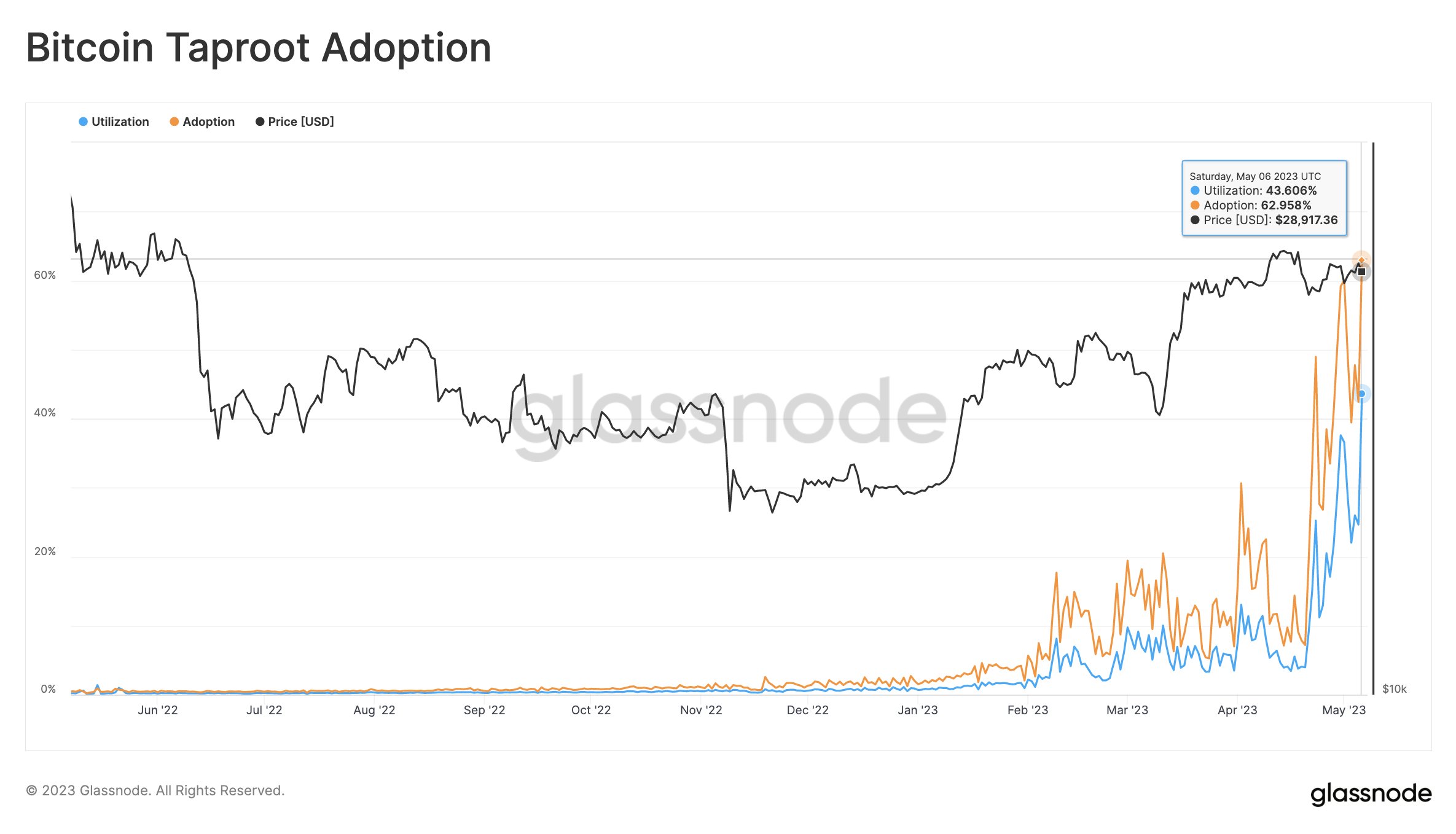
Looks like both these metrics have shot up recently | Source: Rafael Schultze-Kraft on Twitter
As shown in the above graph, these Bitcoin indicators had been at relatively low levels until February of this year, when their values suddenly started to blow up. The reason behind this spike in Taproot utility was because of the emergence of Ordinals.
The Ordinals protocol uses Taproot and has found a variety of applications on the blockchain. Thanks to this protocol, a method of inscribing data like images, text, videos, and other forms has been devised on the network in the form of Inscriptions.
The Inscriptions have quickly become popular on the blockchain, thus leading to a surge in the usage of Taproot. Recently, however, the adoption of the upgrade has gone up another level, and it’s all because of another application of the Ordinals: the BRC-20 tokens.
These tokens make use of the protocol to inscribe text on the chain that represents a fungible token. These coins work similarly to the ERC-20 tokens on the Ethereum network, although they have a lot more limitations.
A large amount of BRC-20 tokens have been minted recently, a lot of which are meme coins. One of the most prominent examples of these is Pepe Coin (PEPE), which has been the topic around the market thanks to its explosive price growth.
As a result of such BRC-20 meme coins becoming very popular recently, the Bitcoin Taproot adoption and utilization have both sharply surged to 63% and 43%, respectively.
BTC Price
At the time of writing, Bitcoin is trading around $27,900, down 2% in the last week.
BTC has gone down in the last 24 hours | Source: BTCUSD on TradingView
Featured image from iStock.com, charts from TradingView.com, Glassnode.com