Meme币热潮席卷比特币网络,铸币费创历史新高

BeosinPublicado em 2023-05-08Última atualização em 2023-05-08

Resumo

根据网络指标,Meme 硬币正在过渡到 BRC-20 标准。趋势表明,比特币网络上存在某种 BRC-20 模因硬币热潮。 在过去几个月里人气飙升的模因币开始接管比特币网络。这些新的 meme 硬币是使用 BRC-20 标准而不是以太坊铸造的,因为后者看到了新代币的拥堵。

根据网络指标,Meme 硬币正在过渡到 BRC-20 标准。趋势表明,比特币网络上存在某种 BRC-20 模因硬币热潮。

在过去几个月里人气飙升的模因币开始接管比特币网络。这些新的 meme 硬币是使用 BRC-20 标准而不是以太坊铸造的,因为后者看到了新代币的拥堵。

BRC-20代币每日铸币费创历史新高

5 月 7 日,BRC-20 的每日铸造费用达到247 BTC的历史新高,如 Dune 上所示。这些比特币序号的总费用为 641 BTC。该图表显示,这些费用在 4 月下旬出现了一个显着的峰值,当时比特币的日交易量因 Ordinals 而达到历史最高水平。

从另一个角度看,5月7日比特币交易手续费突破400 BTC ,较一个月前增长18倍。

比特币 BRC-20 铸造的每日 Ordinals 费用创下历史新高。就像 PEPE 和 WOJAK(模因币)堵塞以太坊一样,Ordinals 铸币正在堵塞比特币网络:
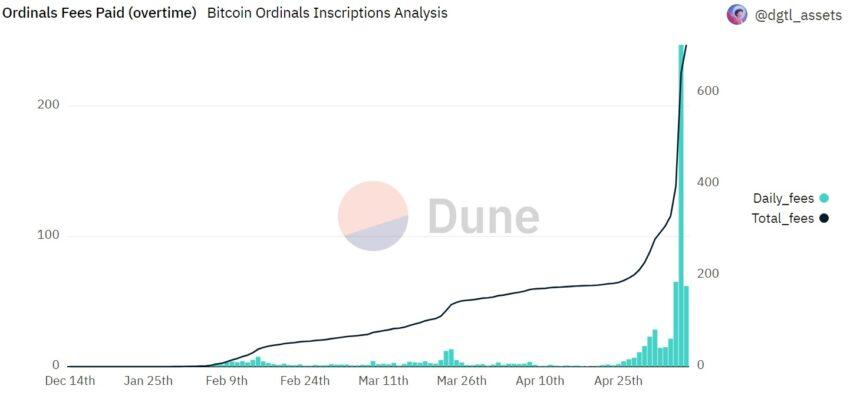
DuneBRC-20 铸币费:沙丘

BRC-20 代币显然已经接管了比特币网络,这些代币迄今为止的市值达到了5.41 亿美元。此类代币共有 14,079 个,其中许多是模因币。这是 Ordinals 与 NFT 一起增长的主要原因。

模因币转向 BRC-20 的一个可能原因可能是因为模因币阻塞了以太坊网络。一种流行的模因代币 PEPE 极大地加剧了这种拥堵。模因硬币最近接管了社区,飙升了约40,000 %。

米姆硬币堵塞比特币网络

Ordinals 的流行也导致 Binance 停止BTC提款。由于大量未决交易,该交易所在 12 小时内两次停止提款。这些 meme 硬币正在影响世界上最大的 CEX,这一事实证明目前存在一种狂热。

BRC-20 代币是比特币上的可替代代币。这是一个实验性的令牌标准,尽管用户已经开始蜂拥而至,正如高活跃度所证明的那样。

BRC-21代币标准已提出

虽然 BRC-20 一直在使用网络,但名为 BRC-21 的新标准的工作已经在进行中。新标准于 5 月 7 日首次提出。

BRC-21 将允许其他链上的代币在比特币区块链中被铸造和赎回。该文档将 BRC-21 标准的主要用例描述为“将去中心化稳定币部署到闪电网络或类似的支付协议上。”
Leituras Relacionadas

After R&D Investment Catches Up with the U.S., Is the Sino-U.S. Chip Competition Still Just About Money?

The article examines the significance of recent data showing China's total R&D expenditure, measured by purchasing power parity (PPP), catching up to or slightly surpassing that of the United States in 2024. It argues that while this milestone reflects China's immense capacity to mobilize research resources, the competition in semiconductors now extends far beyond sheer financial input. The analysis highlights key differences: China's R&D is heavily skewed towards experimental development (over 80%), focusing on product engineering and industrialization, whereas the U.S. allocates a proportionally larger share (about 15%) to basic research. Furthermore, leading U.S. semiconductor firms reinvest a significant portion of their substantial global sales revenue into R&D, creating a sustainable commercial innovation cycle that is difficult to replicate. The article emphasizes that semiconductor progress depends on converting R&D into commercially viable products that pass rigorous customer validation and achieve repeat orders, not just on spending levels. It concludes that as China enters the top tier of R&D spenders, the critical challenges shift to improving resource allocation efficiency, fostering long-term basic research, and building effective mechanisms to bridge the gap between laboratory discoveries and reliable, market-ready industrial capabilities.

marsbitHá 17m

After R&D Investment Catches Up with the U.S., Is the Sino-U.S. Chip Competition Still Just About Money?

marsbitHá 17m

Top 10% of American Households Capture 88% of Wealth, How Is the AI Era Cake Divided?

AI Worsens Wealth Inequality as Top 10% of US Families Garner 88% of Stock Gains (2019-2026) A report from the China Finance 40 Forum highlights that the AI boom is significantly widening wealth inequality in the United States. From 2019 to Q1 2026, wealth from directly held stocks by US households nearly doubled from $29 trillion to approximately $55 trillion, with rapid growth concentrated post-2023, coinciding with the AI-driven stock market surge. The distribution of these gains has been starkly uneven. Between 2022 and Q1 2026, the wealth increase of about $21 trillion was captured almost entirely by the wealthiest families: the top 10% secured roughly 88% ($18.5 trillion), while the bottom 50% received only about 1% ($0.2 trillion). This has contributed to a growing disparity in disposable income shares. The report, referencing economic historian Robert Allen, draws parallels to historical technological shifts like the "Engels' Pause" during the First Industrial Revolution, where worker wages stagnated despite productivity gains. It suggests AI could induce a similar period where capital收益 outpace labor income, exacerbating inequality. Huang Yiping of Peking University identifies four mechanisms through which AI impacts income distribution: capital-bias (reducing labor's income share), task polarization (hollowing out middle-skill jobs), skill-based digital divides, and wealth amplification through assets. He warns that if this trend continues, strong supply growth driven by AI could be undermined by persistently weak consumer demand, threatening sustainable economic growth. To address these challenges, the report proposes a three-pronged strategy: 1) Defensive measures like strengthening social safety nets and antitrust enforcement; 2) Empowering workers through education reform and lifelong learning to collaborate with AI; and 3) Rebalancing via policies such as potential taxes on AI超额收益 and mechanisms for broader sharing of technology's benefits, ensuring AI's红利 are more equitably distributed.

marsbitHá 23m

Top 10% of American Households Capture 88% of Wealth, How Is the AI Era Cake Divided?

marsbitHá 23m

Trading

Spot
活动图片