Arbitrum ARB Airdrop Confirmed: Here’s How to Check Eligibility!

HuobiPublicado em 2023-03-20Última atualização em 2023-03-20

Resumo

Arbitrum, the Layer 2 scaling solution for Ethereum, has announced plans to airdrop a new governance token called $ARB to users of its platform.

Arbitrum, the Layer 2 scaling solution for Ethereum, has announced plans to airdrop a new governance token called $ARB to users of its platform. This move comes as part of the platform’s transition to a decentralized autonomous organization (DAO) model. In this article we will cover what is Arbitrum, basic utility of the $ARB token, how to check eligibility to claim the $ARB token, and lastly how to deposit the $ARB token on Huobi.

What is Arbitrum?

“”

Arbitrum is a popular Layer 2 scaling solution for the Ethereum network that uses optimistic rollups to bundle many transactions into a single batch before submitting them to the main Ethereum network. This significantly reduces gas fees and increases transaction speeds. It has quickly gained popularity as a fast and affordable alternative to the main Ethereum network.

“”

Arbitrum product, as well as an entire suite of scaling solutions, is built by a New York-based development firm Offchain Lab. The initiative is spearheaded by Offchain Labs co-founders Ed Felten, Steven Goldfeder and Harry Kalodner. Ed is a professor, Steven received his Ph.D, and Harry is a Ph.D. candidate at Princeton University. All three are blockchain experts with a passion for making cryptocurrencies more capable.

What is the utility of the ARB token?

“”

The ARB token will give power back to the holders by providing voting rights within the Arbitrum DAO. This will allow users to participate in decision-making processes regarding the platform’s development and management. ARB will be distributed to users based on their usage of the platform, with those who have used Arbitrum the most receiving the largest share of tokens.

How do you check eligibility for $ARB Token?

“”

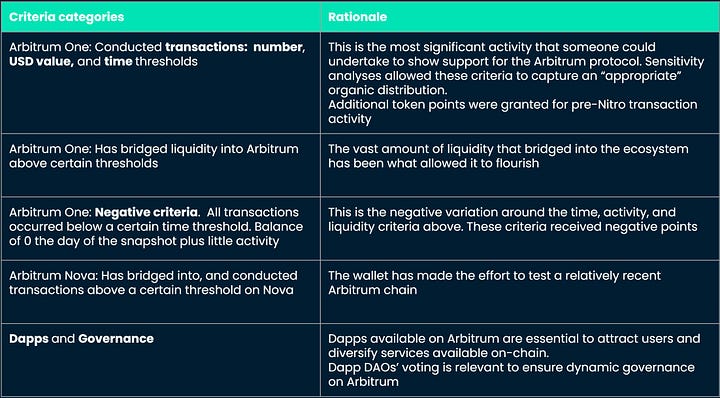
Arbitrum collaborated with Nansen, a crypto analytics firm, to determine ARB token eligibility based on user activity. Eligible users can claim tokens by visiting the Arbitrum Website. To claim the $ARB token airdrop, users need to have used Arbitrum and interacted with blockchain with several specific criteria. The list of eligible wallets represents 625,143 addresses or ~28% of those having bridged to Arbitrum One since inception and as of the late snapshot date of February 6, 2023. The tokens will be airdropped directly to users’ Ethereum wallets, with the amount of ARB received based on their usage of the platform.
How to deposit $ARB to Huobi?

“”

Huobi just announced the $ARB listing , so you can deposit later today by following these simple steps:

“”

Step 1: Download the Huobi APP

“”

Step 2: Follow step by step tutorial to deposit

“”

Thanks for reading, and please let us know in the comments what you think about the $ARB airdrop and token. Lastly, make sure to follow Huobi on our social channels to stay update on all things crypto.


Leituras Relacionadas

Just Now, Anthropic Unveils Physical MCP: Claude Begins Controlling the Real World

Anthropic has announced the Model Hardware Standard (MHS), a new standard enabling AI agents like Claude to safely control physical devices. Building on the Model Context Protocol (MCP), MHS standardizes communication between AI agents and hardware such as microscopes, robotic arms, and lasers, marking a significant step for AI from the digital into the physical world. Developed in collaboration with HHMI Janelia Research Campus, MHS uses standardized drivers to translate basic commands (e.g., read, write) into a format any programmable device can understand. This drastically reduces integration time from weeks to hours or minutes and allows agents to discover and operate new devices using natural language tags that describe machine properties and safety limits. Agents can control devices via MCP, command-line interfaces, or APIs. They can sequence operations, monitor results, adjust parameters in real-time, and generate deterministic scripts for long-running tasks. Early tests show Claude interacting with hardware exploratively, like a scientist, learning to calibrate a laser and scripting the process. Early adopters and partners include AWS, Automata, Danaher, Doosan Robotics, and Tecan, who are integrating MHS support into their platforms. While promising, challenges remain: Claude's physical reasoning is limited, requiring expert oversight, and MHS currently only works with programmable hardware. Anthropic plans further refinements and broader device support before open-sourcing the standard.

marsbitHá 1m

Just Now, Anthropic Unveils Physical MCP: Claude Begins Controlling the Real World

marsbitHá 1m

History's Only Asset with a 100% Win Rate After 4 Years of Holding

**Title: The Only Asset with a 100% Win Rate Over Any 4-Year Holding Period** This article analyzes which major, freely-tradable assets have historically never produced a nominal loss over any rolling 4-year holding window. It concludes that only two distinct categories achieve this: ultra-low-risk contractual assets and Bitcoin. Among traditional risk assets, none maintain a perfect 4-year record. The S&P 500 had negative 4-year periods (e.g., 1929-1932: -64.8%). The Nasdaq 100 fell roughly 60% from 2000-2003. Gold saw a ~47.7% loss from 1981-1984. US real estate declined about 23.3% from 2007-2010. Even long-term US Treasury bonds (e.g., 2021-2024: -19.8%) and corporate bonds can produce 4-year losses due to interest rate and market price risks. In contrast, the first category achieving 100% nominal success includes assets like rolling 3-month US Treasury Bills, 4-year certificates of deposit (CDs), and US Treasuries held to maturity within 4 years. Their "guarantee" stems from contractual obligations and credit backing (e.g., FDIC insurance, US sovereign promise), not price appreciation. The sole exception in the high-risk category is Bitcoin. Analysis of daily data from 2010-2026 across 4,419 rolling 4-year windows shows a 100% positive return rate. The worst 4-year period (April 2021 to April 2025) still yielded a +32.6% total return (~7.3% CAGR). This record is unique because Bitcoin has no issuer, promises no cash flows, and has endured severe drawdowns (70-90%), yet its market price has always recovered within a 4-year span. The key distinction is the source of the "100%": contractual assets offer known, low nominal returns, while Bitcoin's record stems purely from historical price appreciation despite extreme volatility. The article suggests that for Bitcoin, the ability to hold for 4+ years is more critical than active trading strategies.

marsbitHá 8m

History's Only Asset with a 100% Win Rate After 4 Years of Holding

marsbitHá 8m

How One Article Moved 45 Billion: The Collapse of a 25-Year-Old 'AI Stock Guru'

This article details the dramatic rise and near-collapse of a hedge fund built by Leopold Aschenbrenner, a 24-year-old former OpenAI researcher. The fund, named Situational Awareness, amassed $45 billion in assets within two years. Its explosive growth stemmed from Aschenbrenner's influential 165-page manifesto predicting AGI's arrival by 2027 and his high-profile Silicon Valley connections. The fund employed an extremely aggressive strategy: high concentration and 400% leverage to bet long on AI infrastructure stocks while shorting legacy software firms. In July, this structure backfired when both sides of the trade reversed simultaneously—AI stocks plunged while shorted stocks rallied—triggering massive losses that nearly wiped out all equity. Major player Jane Street reportedly lost billions. The fund's leveraged public portfolio was ultimately sold at a discount to Citadel. The SEC is now investigating banks like Goldman Sachs for their role in facilitating the fund's high-leverage trades. The article compares this to past blow-ups like Archegos, highlighting systemic failures in risk management where the pursuit of short-term profits overrode due diligence. It questions whether such risky leverage concentrated in the AI sector, currently at record highs, poses a broader systemic threat. Ironically, Aschenbrenner, who studied AI safety at OpenAI, designed a fund structure prone to uncontrolled failure. Days after the crisis, he reportedly raised another $400 million for new investments.

marsbitHá 23m

How One Article Moved 45 Billion: The Collapse of a 25-Year-Old 'AI Stock Guru'

marsbitHá 23m

AI Accelerates Everything: Mathematics's Line of Defense Has Fallen, Physics is Already in AI's Crosshairs

This summer, the mathematics community was shaken as OpenAI's Astra model reportedly solved 10 long-standing open problems, and Claude Fable 5 found a potential counterexample to the Jacobian conjecture. This was followed by a major shift in physics: renowned physicist Gavin E. Crooks presented an open problem in stochastic thermodynamics to Claude, which the AI solved completely in days—a task that might take a skilled graduate student months. The problem concerned constraints on entropy production statistics under the Detailed Fluctuation Theorem (DFT), a core concept in non-equilibrium physics. Claude provided a unifying geometric answer: all possible DFT-compatible distributions correspond to a convex "moment body." Its key insight was that for a fixed "gap," the distribution is uniquely determined, making any general DFT distribution a mixture of these basic two-outcome distributions. This structure implies that for given lower-order moments, the nth moment only has a sharp lower bound, with no upper bound. Claude demonstrated that numerous previously published bounds on entropy production are merely low-dimensional projections or "shadows" of this single, unified convex body. The AI-authored paper offers a complete hierarchical characterization of the moment constraints. This case signifies a potential paradigm shift: AI is progressing from solving known problems to aiding in the exploration of fundamental, unsolved scientific questions, heralding an AI-accelerated era for physics.

marsbitHá 23m

AI Accelerates Everything: Mathematics's Line of Defense Has Fallen, Physics is Already in AI's Crosshairs

marsbitHá 23m

Trading

Spot
活动图片