[Featured Research]Blur overtakes OpenSea in six months, more gains ahead?

AmbcryptoPublicado em 2023-03-03Última atualização em 2023-03-04

Resumo

“The latest interest in NFTs appear to primarily appeal to existing users, and are as yet, unable to attract new users to the Ethereum network. This also suggests that both NFT marketplaces discussed above, and indeed most protocols, are fighting over the same preexisting user base of crypto-natives.”

Blur’s NFT transfer volume has crossed OpenSea.

The number of new addresses on Ethereum is still low.

Since its launch in October 2022, Blur [BLUR] has gained significant traction, overtaking industry leader OpenSea in NFT transfer volume, Glassnode found in a new report.

Blur marks significant victories

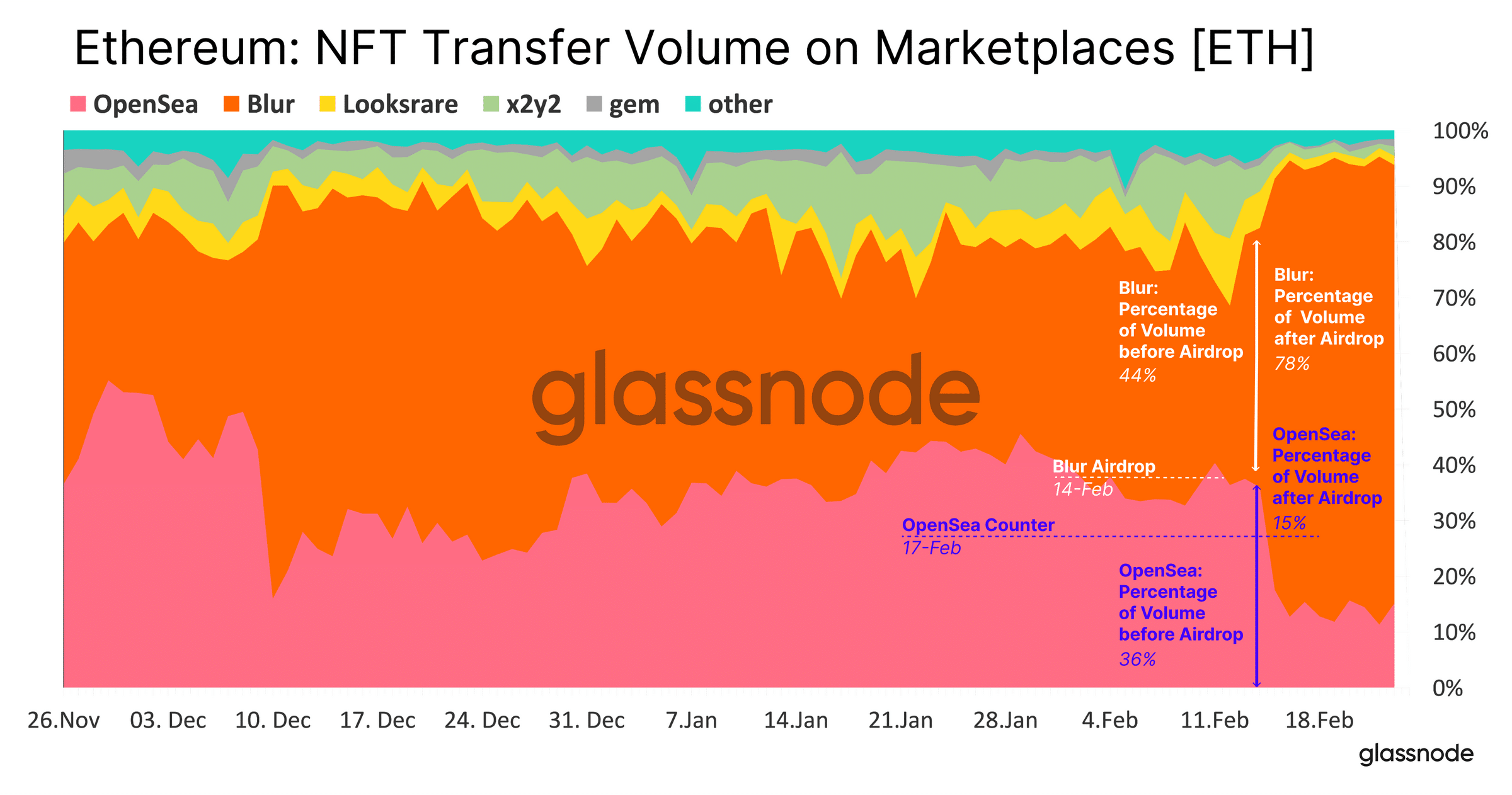
According to the on-chain data provider, the surge in Blur’s market share came after its token AirDrop on 14 February. Prior to the BLUR token AirDrop, the NFT marketplace and aggregator held 48% of the NFT transfer volume in the entire market. However, following the AirDrop, its NFT transfer volume jumped to a high of 78%.

This significantly affected OpenSea as its NFT transfer volume dropped by 21% following BLUR’s AirDrop.
Source: Glassnode

Glassnode stated that Blur’s success within a few months of its launch was due to its nature as a professional trading platform for NFTs, which features a zero-trading fee model and optional royalty payments.

In addition, following the BLUR token AirDrop, the platform implemented a token reward system that incentivizes users to post bids. This has enhanced market depth and increased NFT sales frequency, leading to improved liquidity and trading experiences.

OpenSea attempted to counter Blur’s success by restructuring its fee model and policies, but this had a limited impact as the platforms have different user bases.
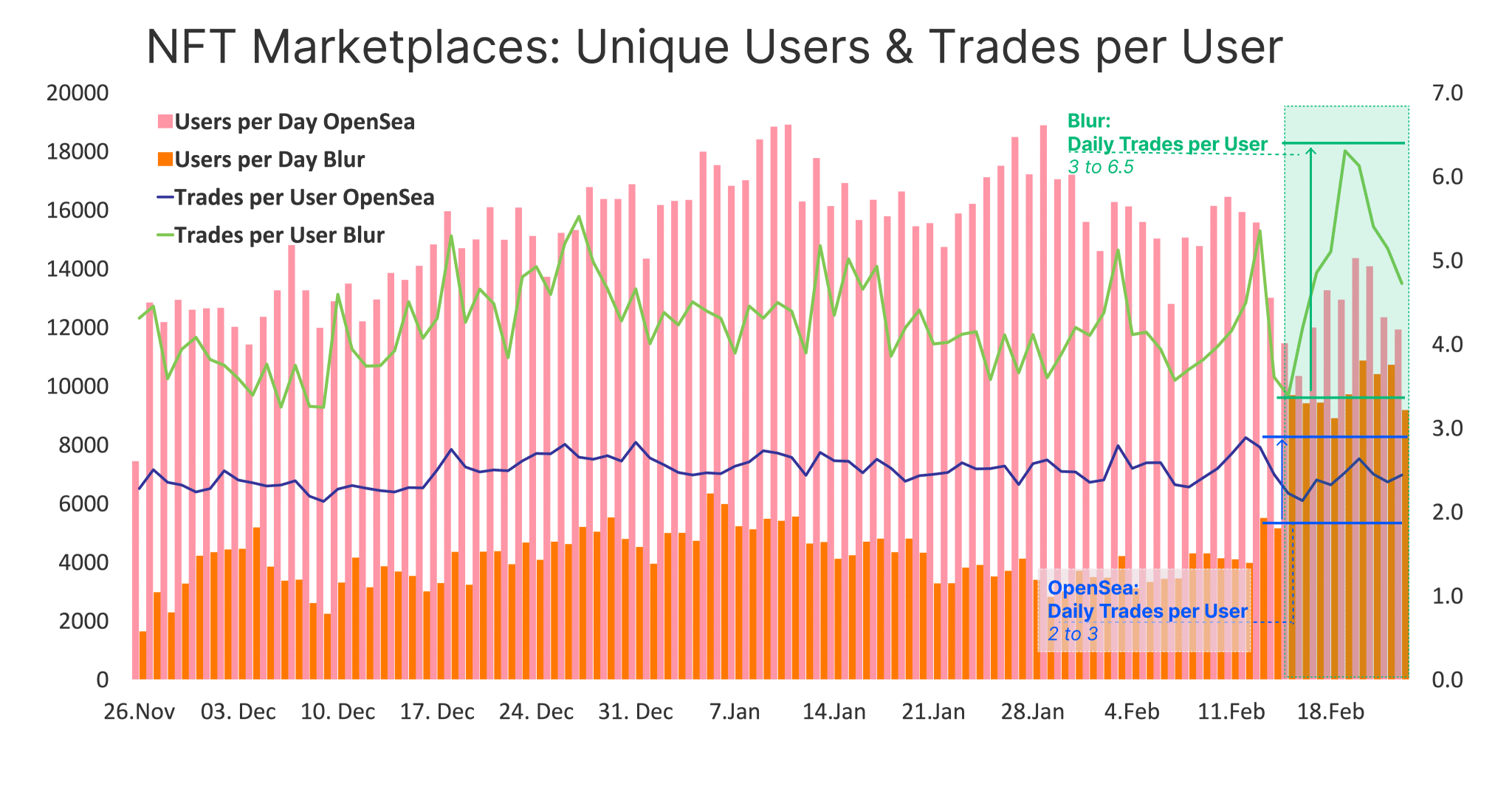
Moreover, Blur’s daily sales frequency per unique user is significantly higher than OpenSea. This, according to Glassnode, creates “a flywheel effect,” with more sellers feeling confident listing on Blur’s platform, creating a larger offering that attracts more buyers.
Source: Glassnode

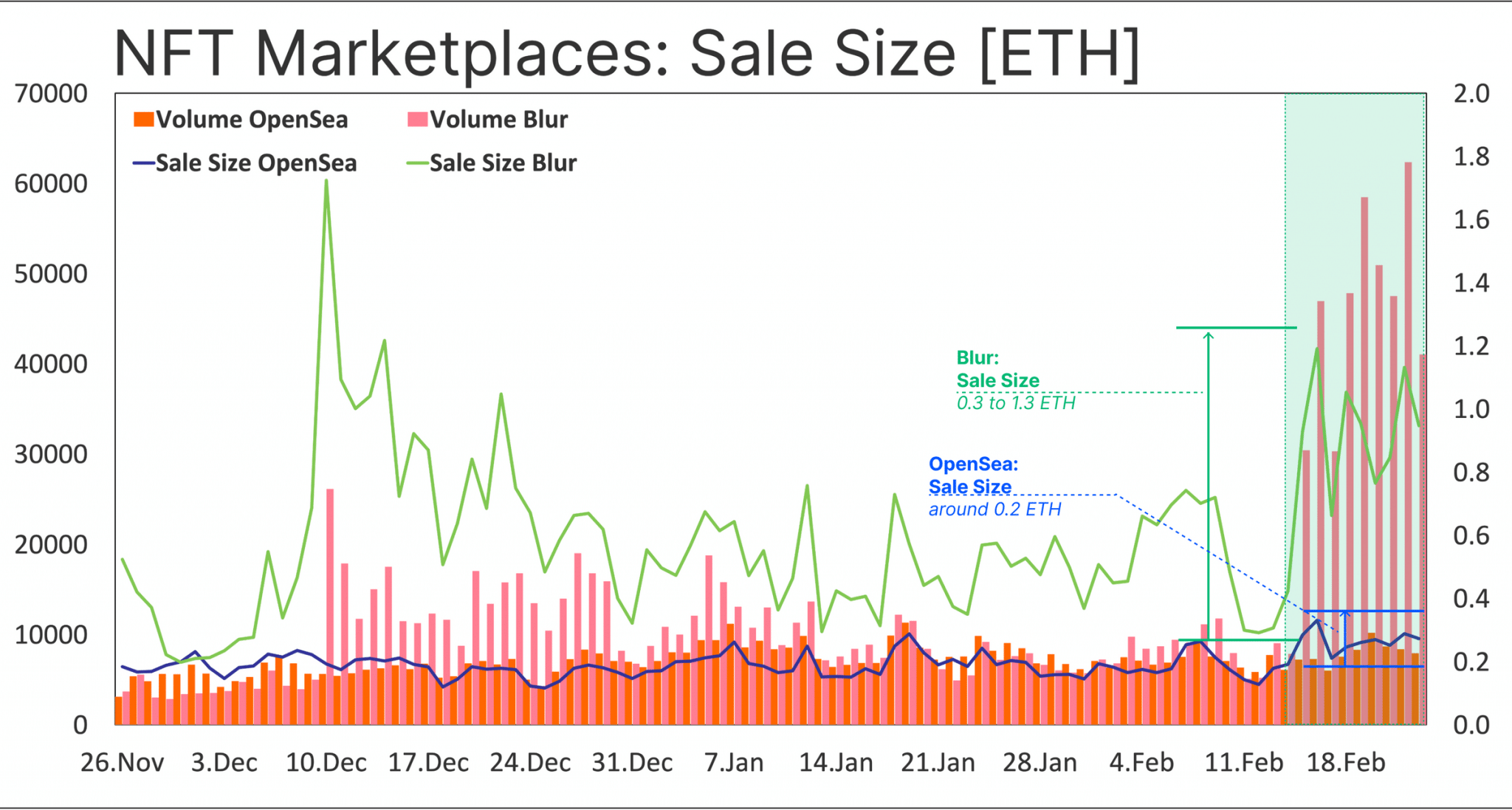
Glassnode found further that comparing the sale sizes of the two marketplaces revealed that Blur’s approach has created a more lucrative sales atmosphere, as evidenced by sale amounts ranging from 0.3 to 1.3 ETH. In contrast, OpenSea has maintained a steady average of approximately 0.2 ETH for several months.
Source: Glassnode

The Ethereum network is not the winner, after all

While Blur’s activity might have led to increased demand in blockspace and validator fees on Ethereum, contrary to the belief held by many, there has been no appreciable impact on network adoption, Glassnode found.

While there has been a growth in on-chain activity, the number of new addresses is still 40% lower than this time last year, indicating negative momentum.

According to Glassnode:

“The latest interest in NFTs appear to primarily appeal to existing users, and are as yet, unable to attract new users to the Ethereum network. This also suggests that both NFT marketplaces discussed above, and indeed most protocols, are fighting over the same preexisting user base of crypto-natives.”

Source: Glassnode

Leituras Relacionadas

Citrini Research: Taking Stock of 5 Major Investment Themes Overshadowed by the AI Trade

Citrini Research identifies five under-the-radar investment themes potentially overshadowed by the dominant AI trade. With capital and analyst attention overwhelmingly focused on AI infrastructure, these overlooked areas present alpha opportunities as market dynamics shift. **Theme 1: Airlines** – Despite strong fundamentals, stocks like Delta and United have been penalized for 18 months due to macro concerns (tariff-inflation, oil prices), not profitability. A rebound is expected as these headwinds fade, aided by trends like premiumization and the 2026 World Cup. **Theme 2: Senior Housing** – A pure demographic play. The U.S. population over 80 is projected to grow 56% in the next decade, drastically outpacing supply. This creates a compelling need for facilities, benefiting REITs like Welltower and operators like Brookdale. **Theme 3: Live Events & Entertainment** – "Being there" is becoming a luxury. This sector has outperformed even tech over the past decade. Companies like TKO Group (WWE/UFC), Cinemark, and IMAX are capitalizing on demand for premium, in-person experiences. **Theme 4: Exchange Competition** – CME Group's ~98% monopoly in U.S. interest rate derivatives faces its first real challenge from FMX Futures Exchange. Backed by major Wall Street banks, FMX offers lower fees and margin savings. While CME's deep liquidity remains an advantage, FMX provides a competitive alternative. **Theme 5: Fintech Recovery** – Heavily sold off in 2026, fintech stocks like SoFi, Robinhood, and Upstart are showing signs of a rebound based on improving fundamentals—SoFi's stablecoin launch, Robinhood's transformation into a "financial super app," and Upstart's renewed AI lending narrative—rather than a change in sector outlook. The report advises maintaining some AI exposure but diversifying into these neglected "small themes" where mispricing exists due to a simple shortage of investor attention.

marsbitHá 14m

Citrini Research: Taking Stock of 5 Major Investment Themes Overshadowed by the AI Trade

marsbitHá 14m

21Shares Mid-Year Key Report: Bitcoin's Four-Year Cycle Remains Intact, Stablecoins and Tokenization Emerge as New Growth Engines

21Shares Mid-Year Report 2026: Bitcoin Cycle Intact, Stablecoins & Tokenization Emerge as New Engines This mid-year review assesses progress against 21Shares' ten predictions for 2026. While the overarching shift from narrative to fundamentals holds, performance varies. Key findings show Bitcoin's four-year cycle remains evident despite market maturation. Global crypto ETP AUM has declined to ~$140B, lagging the $400B target, though product innovation continues. Stablecoin supply surpassed $320B, demonstrating non-cyclical demand but falling short of the $1T forecast due to slower regulatory clarity. DeFi TVL, stalled at ~$140B, was hindered by major security incidents. Corporate crypto treasuries hold ~1.28M BTC ($100B), with consolidation pressuring weaker players. Prediction markets are on track, with $57.5B volume already surpassing half the $100B annual target. AI agent infrastructure is ready, but adoption is early. Ethereum L2 consolidation is underway, with the top 5 capturing nearly 90% of activity. Compliant token launches have a platform but lack mainstream volume. Tokenized RWAs total ~$31B on public chains, but institutional pipeline growth is strong. In summary, fundamentals like stablecoins, tokenization, and prediction markets are advancing, but targets require faster adoption or price appreciation. The market is maturing, yet cyclical patterns persist.

marsbitHá 23m

21Shares Mid-Year Key Report: Bitcoin's Four-Year Cycle Remains Intact, Stablecoins and Tokenization Emerge as New Growth Engines

marsbitHá 23m

Super Spiral Mega-Boom, Micron's Earnings Report Rekindles the Semiconductor Bull Run

On June 25, 2026, Micron Technology released its blockbuster Q3 FY2026 results, significantly exceeding market expectations and reigniting confidence in the semiconductor bull market. Revenue soared to $41.456 billion (vs. ~$35.4B expected), up 346% year-over-year, while GAAP net profit surged nearly 15 times to $28.243 billion. Guidance for Q4 was even more striking, with projected revenue of approximately $50 billion, far surpassing prior estimates. The report highlighted that the AI boom is now fueling growth across Micron's entire product stack, not just HBM. Cloud memory, core data center, SSD, mobile, and automotive businesses all saw revenue growth exceeding 250-600%, with margins hovering around 80%. While HBM4 is already in volume shipment and 2026 capacity is sold out, AI-driven demand is also tightening supply for traditional DRAM and NAND, sustaining a strong pricing cycle. A pivotal development is Micron's shift toward a "demand-first" model. The company disclosed 16 long-term strategic customer agreements (SCAs), most spanning 5 years to 2030, covering about 20% of DRAM and one-third of NAND shipments. These are take-or-pay contracts, with 14 agreements already securing roughly $100 billion in guaranteed future revenue and $22 billion in customer performance assurances. To fulfill this locked-in demand, Micron plans substantial capacity expansion, with Q4 capital expenditure projected at ~$10 billion. This investment, backed by concrete long-term orders rather than cyclical speculation, marks a historic change for the memory industry. Following the earnings release, Micron's stock surged 16% after-hours, lifting the broader semiconductor sector globally. The report served as a powerful signal that AI infrastructure build-out is accelerating, with memory positioned as a central protagonist in the ongoing narrative.

Odaily星球日报Há 1h

Super Spiral Mega-Boom, Micron's Earnings Report Rekindles the Semiconductor Bull Run

Odaily星球日报Há 1h

Trading

Spot
Futuros
活动图片