Over the weekend, I've been renewing my personal thesis for $BLUR, why I think selling my airdrop was a mistake, and why Blur Bidding is a game-changer for the NFT space.
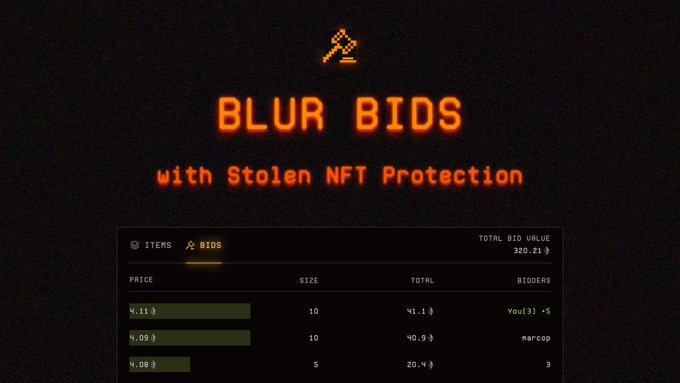
What is the most important aspect wrt product experience on NFT marketplaces? Ease of buying/selling NFTs.
ADVANTAGE OF BLUR
The majority of trading volume in the current state of the NFT market is from whales, and they want one thing: To be able to buy cheaper and sell quickly in SIZE
Compared to the DeFi space, the trading experience for NFTs is subpar. Before blur_io came along, the user experience was terrible and was not optimized for the professional, mass trading market.
NFT trading needs to (at least) attain the usability of fungible tokens in DeFi
Here comes the second (and likely the hardest) pain point: Liquidity.
While attempts have been made to solve this, including (but not limited to) NFT fragmentation, asset tokenization, and incentivization (via trading volume/listing rewards), liquidity is still extremely thin.
If I was looking to sell off 20 Doodles NFT today, it would've been impossible, likely taking days to weeks to unload fully, not to mention a downward spiraling floor price + me needing to actively re-adjust the floor price.
So what did @blur_io do? Introducing the Bid Points system.
Blur's bid mining model is essentially a liquidity pool transaction where users provide ETH (not WETH!) liquidity to a liquidity pool, a parallel comparison would be Uniswap's AMM innovation for the DeFi space.
On the other hand, opensea, LooksRare , and the_x2y2 models are pending order transactions, which makes them illiquid/inaccurate.
Blur's bidding system then incentivizes users who want the airdrop to provide liquidity and bear the risk of NFT prices once the bid is accepted.
In essence, what blur_io did right was find the right PMF (Pro NFT traders) and design a platform that focuses on the best-in-class product experience.
Users get deeper liquidity on Blur than OpenSea, allowing whales to buy/sell large amounts of NFTs frictionlessly.
GREAT AIRDROP
With $BLUR's release, the project imo is one of the most successful projects in transferring the power of protocol value distribution to the community.
The initial circulating supply of 360M tokens (12%) of supply) were distributed to the community, but what about the rest?
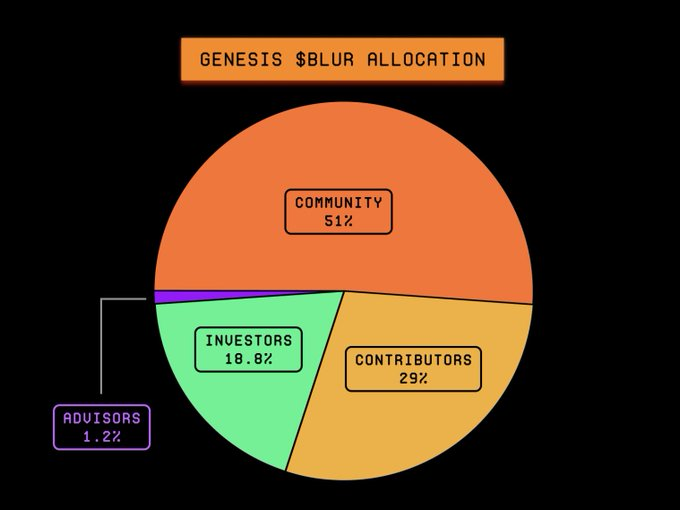
Majority of the airdrop in the first round has already been claimed, and over billions in $BLUR trading volume. Users who wanted to sell the airdrop would have already sold by now and the tokens are transferred to stronger hands.
The first year selling pressure is likely to be high, as circulating supply will increase by nearly 3x to 1 billion by the end of this year. Even so, the majority of the tokens are owned by the community. Investor/Team allocations are also subjected to a 4+ year vesting period
In my view, $BLUR is a proxy of the NFT market and a pure-play bet on the space since Blur benefits when NFT collections rise as a whole.
Assuming Blur becomes the market leader in the future, the current implied FDV of $2-3B is likely justified, given OS valuation of $13B
GREAT NEWS AHEAD
The largest exchange binance has yet to even list $BLUR, and once Blur's clear volume dominance is sustained and gains further traction, it will be inevitable.
Further, if that traction continues to gain steam, additional funding will come pouring in too.
ADVANTAGE COMPARE TO OTHER PLAYERS
Even if OS wanted to compete, they would have to reduce costs to traders and royalties (and they already did), but to really compete with Blur on liquidity, they likely have to switch to a similar model to Blur. (although that offers zero differentiation from Blur lol)
Further, building out a new product might potentially introduce bugs, which could completely destroy OS.
Wen $OS? Imo, highly unlikely, given the regulatory landscape and their desire to IPO. It also doesn't make sense from the business/investor POV; why would they give away their profits?
Also, PacmanBlur and the Blur team understand the NFT market deeply, perhaps better than OpenSea themselves. LooksRare and X2Y2 were focused on incentivizing trading volume instead of the most important thing: Liquidity.
The models used by Looksrare and X2Y2 incentivize wash trading, essentially fake volume that does nothing to improve the product experience. In other words, ponzinomics designed to attract retail who wants a dividend payout. Nothing wrong with that, btw. To each his own.
When the airdrop/token incentives end, how does Blur plan to sustain its liquidity depth? Good question, but this has been reiterated many times in multiple podcasts with @PacmanBlur, and the team is well aware of this and will be optimizing for growth long term.
Being a 2-sided marketplace, as long as user experience is top-notch and prioritized by the team, users will remain sticky to the platform. So product experience = #1
A case in point is OpenSea. Even without a token, users kept using it, of course, until Blur came along.
The Blur team is currently not making $$ themselves since marketplace fees are currently still 0%. And as everyone knows, they are @paradigm backed, but what does that even imply?
The key is product experience. Majority of their portcos prioritise this, Blur is no exception.