Bitcoin price could skyrocket to $28K if it clears this resistance

newsbtcPublicado em 2023-02-21Última atualização em 2023-02-21

Resumo

Bitcoin price is attempting an upside break above the $25,000 resistance. BTC could gain pace and rally if it settles above the $25,000 resistance zone.

Bitcoin price is attempting an upside break above the $25,000 resistance. BTC could gain pace and rally if it settles above the $25,000 resistance zone.
""

  • Bitcoin is struggling to clear the key $25,000 resistance zone.
  • The price is trading below $24,500 and the 100 hourly simple moving average.
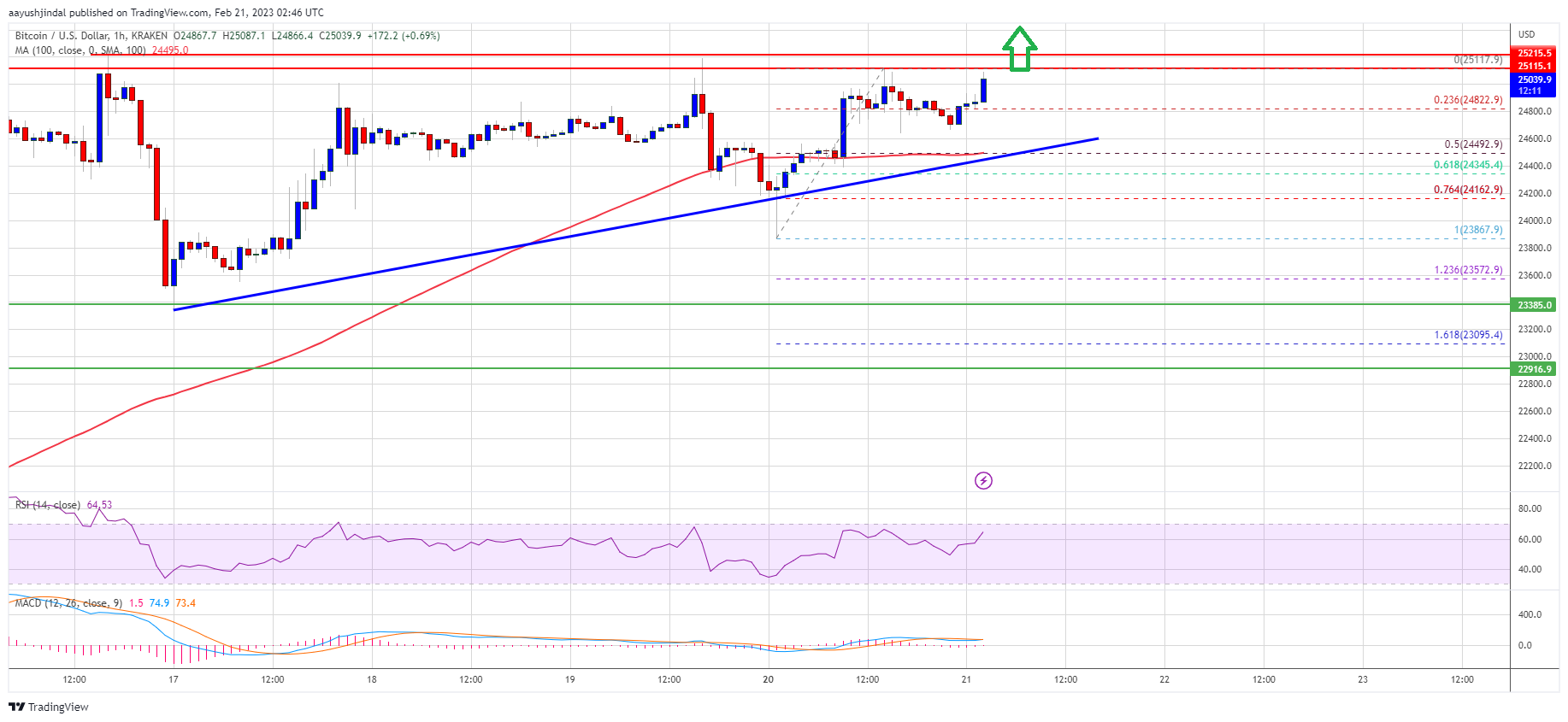
  • There is a key bullish trend line forming with support near $24,580 on the hourly chart of the BTC/USD pair (data feed from Kraken).
  • The pair could rally if there is a close above the $25,000 resistance zone.

""

Bitcoin Price Eyes Upside Break


Bitcoin price remained well supported above the $24,500 pivot zone. BTC mostly traded in a range and remained well bid for a move higher above $25,000.


However, the bears seem to be active near the $25,000 and $25,200 levels. It remained stable above the 50% Fib retracement level of the upward move from the $23,867 swing low to $25,117 high. The price is now attempting a fresh upside break above the $25,000 resistance zone.


Bitcoin price is also trading below $24,500 and the 100 hourly simple moving average. Besides, there is a key bullish trend line forming with support near $24,580 on the hourly chart of the BTC/USD pair.
Bitcoin Price


Source: BTCUSD on TradingView.com

On the upside, an immediate resistance is near the $25,100 level. The next major resistance is near the $25,200 zone. A clear move above the $25,200 resistance might start a strong rally. In the stated case, the price may perhaps rise towards the $26,200 level. The next resistance could be near the $27,500 level, above which the bulls could aim a test of $28,000.


Dips Supported in BTC?


If bitcoin price fails to clear the $25,200 resistance, it could start a downside correction. An immediate support on the downside is near the $24,600 zone and the trend line.


The next major support is near the $24,350 zone or the 61.8% Fib retracement level of the upward move from the $23,867 swing low to $25,117 high. If there is a downside break, the price might decline towards $24,000. The next major support is near the $23,570 level, below which the price might decline towards the $23,380 support.

Technical indicators:


Hourly MACD – The MACD is now gaining pace in the bullish zone.


Hourly RSI (Relative Strength Index) – The RSI for BTC/USD is now above the 50 level.


Major Support Levels – $24,580, followed by $24,350.


Major Resistance Levels – $25,100, $25,200 and $26,200.

Leituras Relacionadas

When Billions Begin to Operate Everything by Voice, How Far is ‘All Assets on Chain’?

In June 2026, WeChat began a limited rollout of "Xiaowei," its native AI assistant. This move is more than an upgrade to a smarter chatbot; it signals a crucial step from "universal internet access" toward the broader vision of "full asset tokenization." Xiaowei, powered primarily by WeChat's in-house WeLM model, demonstrates four key capabilities: 1) direct voice/web chat control of app functions, 2) automated access to mini-programs for services, 3) instant comprehension and summarization of complex documents like PDFs, and 4) generating functional mini-program prototypes from simple natural language requests. This represents a fundamental shift from GUI (Graphical User Interface) to LUI (Language User Interface), eliminating friction in human-digital interaction. The rollout is pivotal because it brings AI Agents to China's massive user base with zero friction—no new app downloads or accounts needed. This "seamless access" mirrors past platform revolutions like the App Store or WeChat Mini-Programs, potentially unlocking a global AI Agent market projected to grow from $7.92 billion in 2025 to nearly $295 billion by 2035. The article argues that China's internet evolution has moved from "connecting everyone" to "putting all services online." The next phase is "tokenizing all assets"—a concept broader than just Real World Assets (RWA) like real estate. It encompasses tokenizing personal assets like social influence, attention, and credit history. RWA tokenization itself is forecast to explode from $35 billion in 2025 to over $500 billion in 2026. The convergence of ubiquitous AI Agents and rapidly tokenizing assets points to a future paradigm for wealth management. Your AI Agent could autonomously manage a globally diversified, tokenized portfolio based on your preferences. Initiatives like EXIO Group's full-stack RWA services aim to lower investment barriers, paralleling WeChat's democratization of AI access. In conclusion, the launch of Xiaowei is not merely a technical upgrade but a historic inflection point. It marks AI Agents' transition from niche tools to essential utilities and accelerates the movement toward a future where voice commands seamlessly interact with tokenized value, redefining humanity's relationship with the digital and financial worlds.

marsbitHá 58m

When Billions Begin to Operate Everything by Voice, How Far is ‘All Assets on Chain’?

marsbitHá 58m

SoftBank CEO Masayoshi Son's New Trillion-Dollar "Gamble"

SoftBank founder Masayoshi Son is embroiled in a new trillion-dollar "bet" on Physical AI and humanoid robotics, even as his massive wager on OpenAI faces uncertainty ahead of its potential IPO. Recent reports reveal OpenAI's steep losses—$85 billion net loss by Q1 2026 and a $38.5 billion loss in 2025—casting doubt on its path to a trillion-dollar valuation. SoftBank, OpenAI's second-largest external shareholder with a planned 13% stake, stands to gain hugely if OpenAI succeeds. Undeterred, Son is already pushing forward with his next ambitious venture: consolidating SoftBank's AI and robotics assets into a new U.S.-based company named "Roze," targeting a $100 billion IPO as early as late 2026. This move aligns with his belief that Physical AI, merging AI cognition with robotic physical execution, is the next trillion-dollar frontier. Son's confidence stems from recent AI wins; SoftBank's stock surged and he briefly regained the title of Asia's richest person, largely due to OpenAI's soaring valuation. However, his aggressive strategy has raised internal concerns about over-reliance on OpenAI and strained finances. With competitors like Anthropic advancing rapidly and OpenAI's IPO timing uncertain, Son is racing to capitalize on the AI boom. His long-term vision for Physical AI includes a decade of investments in robotics, from Boston Dynamics to recent acquisitions like ABB's robotics unit, and a planned $1 trillion investment in U.S.-based AI robotics industrial parks. Yet, challenges remain: humanoid robotics firms like Figure AI lack the clear revenue paths of AI software companies, and Roze's lofty valuation faces skepticism. For Son, these bets are also driven by an unfulfilled promise of massive returns to key investors like Saudi Arabia's PIF. Despite risks, he continues to double down, betting that the fusion of AI and physical machines will define the next technological era.

marsbitHá 1h

SoftBank CEO Masayoshi Son's New Trillion-Dollar "Gamble"

marsbitHá 1h

Trading

Spot
Futuros
活动图片