Cardano (ADA) Whales Number Surges By 1.7% As Holders Increase Holdings

CoingapePublicado em 2022-03-30Última atualização em 2022-03-30

Resumo

The Cardano (ADA) market is showing robustly positive signs of growth.

The Cardano (ADA) market is showing robustly positive signs of growth. The number of whale wallets on the Cardano network has increased by 1.7% in the last eight days on-chain data reveals. 
The Cardano network is birthing new whale wallets
On-chain and technical analyst, Ali Martinez, who first pointed out the data shared that roughly 42 addresses holding 1 million to 10 million ADA were created since March 21.
This is a significant increase if the value of these holdings is taken into consideration Martinez notes in his tweet. He said:
The uptick may seem insignificant at first glance, but these whales hold between $1.2 million and $12 million in ADA.” 
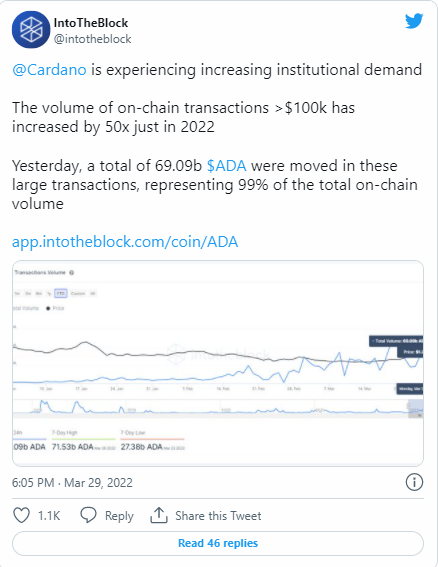
Supporting Martinez’s finding is also data from the crypto analytics and intelligence platform, IntoTheBlock. Per IntoTheBlock’s data, Cardano is currently experiencing increased institutional demand. Whale transactions (transactions greater than $100k) on the Cardano network have increased 50 fold in 2022 alone.
As of yesterday, the Cardano blockchain saw a total transactions volume of $69,09 billion, and 99% of this volume was institutional-level transactions.
Overall, the surge is a positive sign for ADA’s future price action. The price of ADA is already feeling the impact of the increasing whale accumulation.
ADA has been on a bullish streak. In the last week, ADA is up 24% and is currently trading at $1.20. This surge has driven up the assets market cap to over $40 billion. This makes ADA rank as the eighth largest crypto by market cap, ahead of Terra (LUNA) and Solana (SOL).
What has been attracting the whales to Cardano?
Developments going on in the Cardano ecosystem have undoubtedly been the cause of a lot of excitement in the ADA market. Among recent key developments is the launch of Milkomeda, a layer 2 interoperability sidechain of Cardano.
With Milkomeda, EVM compatible tokens can now be bridged over the Cardano blockchain. Milkomeda also offers a developer toolkit for Ethereum’s native programming language, Solidity. The sidechain opens the door for more projects to launch on the Cardano blockchain, and a lot of liquidity to flow into the ADA market.
Equally positive for Cardano is its inclusion in Grayscale’s latest fund, in which it comprises the largest percentage per share. Amidst all these, market participants also expect that following two network upgrades this year, Cardano should attract even more attention and the price of ADA will truly breakout. Crypto Stories View all


Leituras Relacionadas

Didier Zheng Answers: Will MicroStrategy Enter a Death Spiral? How Will the Macro Trend Unfold in the Second Half of the Year?

In the latest WuShuo Uncensored podcast, investor Didier Zheng analyzes recent market trends. He argues that Bitcoin's recent decline is primarily driven by market anticipation of MicroStrategy potentially selling small amounts of Bitcoin regularly to cover cash flow for its growing priority shares and debt, rather than macro factors or ETF outflows alone. This creates a new dynamic of expected continuous selling pressure. Didier views Token as the new form of labor in the AI era, replacing human roles in execution and driving the ongoing rally in U.S. stocks within the AI supply chain (semiconductors, data centers). This shift is seen as a long-term structural change, boosting corporate profitability. He notes that crypto exchanges are naturally expanding into U.S. stocks and real-world assets due to the scarcity of valuable native crypto assets beyond Bitcoin and major protocols. For traders, the transition may not require a drastic change in strategy, as similar speculative and fundamental assets exist in both markets. The analyst believes the native crypto altcoin rally is likely over, severely damaged by the liquidity destruction from the "1011" crash event. Liquidity has migrated to deeper markets like U.S. equities. For the macro outlook, Didier expresses increased caution for H2 2024 due to potential market pressure from mega-IPOs (e.g., SpaceX) and the U.S. midterm elections. A Democratic sweep could bring stricter regulation for Web3 and AI. Long-term, he remains optimistic about the convergence of AI and blockchain, enabling a more automated, machine-driven economy, but expects a shift towards a more mature, institutional phase for the crypto industry.

marsbitHá 14m

Didier Zheng Answers: Will MicroStrategy Enter a Death Spiral? How Will the Macro Trend Unfold in the Second Half of the Year?

marsbitHá 14m

Bitcoin's Historically Rare Pattern: When August Rises, September Always Pulls Back, Followed by an Average 44% Surge in October

Historical Seasonal Pattern for Bitcoin Resurfaces: Strong August (Up 25% YTD) Points to Potential September Dip, Followed by October Rally Bitcoin is on track for its strongest August performance since 2017, with gains of approximately 25% for the month as of late August, trading between $78K-$79K. This has revived discussion of a historical seasonal pattern observed since 2013. Data shows that in the four previous years where Bitcoin posted a positive return in August (2013, 2017, 2020, 2021), the following September consistently closed in negative territory, with an average decline of about -5.9%. Notably, a positive September has never followed a positive August in Bitcoin's history. However, the pattern shows a potential silver lining. Following each instance of a "Green August" followed by a "Red September," the subsequent month of October has historically seen significant rallies. The average gain for October after such a sequence is approximately +44%. While this pattern highlights a recurring seasonal trend, analysts caution that it is based on a limited sample size of only four occurrences. Each period had distinct macroeconomic and market conditions. Therefore, past performance is not a reliable indicator of future results, and whether 2026 will follow this sequence remains to be seen as September trading begins.

marsbitHá 14m

Bitcoin's Historically Rare Pattern: When August Rises, September Always Pulls Back, Followed by an Average 44% Surge in October

marsbitHá 14m

Strive CEO: US Bond Market Approaching a Critical Point, Bitcoin's "Home Run Moment" Taking Shape

The CEO of Strive argues that the U.S. Treasury market is approaching a critical juncture, setting the stage for a major opportunity in Bitcoin. He highlights that unsustainable U.S. fiscal deficits and expanding entitlement programs are creating fundamental pressure for higher long-term bond yields. However, the political system is unwilling to enact necessary fiscal discipline. Consequently, as the 10-year Treasury yield enters a key resistance zone of 5.25%–5.85%, the narrative will shift to a potential bond market crisis. This will force policymakers (the Treasury or Federal Reserve) to intervene aggressively to suppress yields through tools like large-scale bond buybacks or balance sheet expansion. Since the underlying fiscal imbalance remains unresolved, the adjustment pressure will be transferred to the U.S. dollar, making it the "pressure release valve" of the system. A trend decline in the dollar, potentially to multi-decade lows, would create a historically unique macro environment for Bitcoin. Bitcoin stands to benefit as a scarce, non-sovereign monetary asset, especially as AI erodes the scarcity of traditional corporate moats. The author concludes that if bond market stress causes a Bitcoin dip, it would be a major buying opportunity; if not, having exposure is still crucial. The overall expectation is that the market is still underestimating Bitcoin's long-term upside potential in this unfolding macro shift.

marsbitHá 23m

Strive CEO: US Bond Market Approaching a Critical Point, Bitcoin's "Home Run Moment" Taking Shape

marsbitHá 23m

Trading

Spot
活动图片