$1 Billion in Iranian Cryptocurrency Seized by the U.S., Could It Be Added to the U.S. Strategic Bitcoin Reserve?

marsbitPublicado em 2026-06-02Última atualização em 2026-06-02

Resumo

US Treasury Secretary Scott Bessent announced the seizure of approximately $1 billion in Iranian cryptocurrency assets. The critical unanswered questions are the specific assets seized (e.g., Bitcoin vs. stablecoins like USDT) and their precise legal status (frozen vs. formally forfeited). According to a 2025 executive order, only Bitcoin that has undergone complete judicial forfeiture can be placed into a permanent, non-saleable Strategic Bitcoin Reserve. Other forfeited digital assets go to a separate US Digital Asset Reserve. Currently, only $344 million in USDT frozen by Tether is publicly confirmed. The remaining $656 million in assets lack public details. The assets' final disposition hinges on three factors: 1) Asset type, 2) Completion of the forfeiture process, and 3) Whether funds are used for victim restitution, law enforcement costs, or other exemptions before treasury transfer. Without confirmed forfeiture of Bitcoin, the seizure may primarily demonstrate stable币 regulatory compliance rather than augmenting the US Bitcoin reserve.

Written by: Gino Matos

Compiled by: Saoirse, Foresight News

Key Takeaways

  • Treasury Secretary Scott Bessent stated that the U.S. seized approximately $1 billion in Iranian crypto assets but did not disclose the relevant wallet addresses or token composition.
  • Asset category is crucial: Bitcoins legally forfeited can be transferred to the Trump Strategic Bitcoin Reserve; other tokens will be handled separately.
  • It remains unclear whether the assets are frozen, seized, or officially forfeited. Their legal status directly determines if the funds can be added to the reserve.

Treasury Secretary Scott Bessent stated at the Reagan National Economic Forum that the United States has seized approximately $1 billion in Iranian crypto assets. This seizure of Iranian assets serves as the first practical test following the implementation of the Trump administration's crypto reserve policy. Bessent added that the U.S. "directly took control of the wallets involved." According to a CBS report, he characterized these funds as money stolen from the Iranian people. However, Bessent did not disclose the asset types or corresponding wallet information—key details that precisely determine whether the funds can flow into the Strategic Bitcoin Reserve established by Trump.

According to an executive order signed by Trump in 2025, U.S. government-owned digital assets are divided into two separate accounts: The Strategic Bitcoin Reserve, specifically designated to hold bitcoins forfeited through civil or criminal judicial proceedings or collected as civil monetary penalties. The order explicitly states that government bitcoins deposited into this account are permanently prohibited from being sold. The other account is the U.S. Digital Asset Reserve, which holds non-bitcoin digital assets that have undergone final forfeiture proceedings. This classification framework makes the current seizure of Iranian crypto assets a practical test case: Only bitcoins that complete the final forfeiture process can be added to the Strategic Bitcoin Reserve; all other remaining tokens will be placed into the U.S. Digital Asset Reserve.

If the seized Iranian assets include bitcoin and the legal forfeiture is successfully completed, they can be incorporated into the reserve. If they consist of stablecoins or other types of tokens, they will likely be transferred to the Digital Asset Reserve. Another possibility is that the assets are merely in a frozen state, in which case the U.S. has not yet obtained legal ownership.

Clarifying the Actual Legal Meaning of "Seizure"

As early as April, the U.S. Treasury Department imposed sanctions on multiple Iran-linked wallets. Tether simultaneously disclosed that it cooperated with U.S. regulators to freeze a total of $344 million USDT across two addresses. Blockchain risk management firm TRM Labs confirmed that these wallets were linked to the Central Bank of Iran, the IRGC Quds Force, and Lebanon's Hezbollah. For the remaining approximately $656 million in assets, there is no publicly available breakdown by wallet or token type.

"Physical seizure" does not equal "legal ownership." OFAC sanctions rules clearly state that blocked assets are only subject to account freezing; the U.S. does not automatically gain ownership rights. Taking stablecoins like USDT as an example, issuers cooperating with regulators to lock addresses constitutes a sanction freeze, not a judicial forfeiture in the criminal law sense. Seizure at the enforcement level only represents the government's temporary control of the assets; ownership still awaits the outcome of forfeiture litigation.

Final forfeiture is a mandatory threshold for assets to enter the reserve: After assets complete the forfeiture process, deductions are made for victim compensation, specialized enforcement expenses, allocations to local law enforcement agencies, legally exempted returns, etc. Only the remaining assets are eligible for transfer into the reserve or the reserve account. Bessent's public statements leave the legal status of these assets entirely uncertain.

At the current Bitcoin price of approximately $73,000, if the entire $1 billion consisted of Bitcoin, it would be equivalent to about 13,632 BTC. According to 2025 statistics, the U.S. government has accumulated about 200,000 compliant bitcoins through past judicial proceedings. If this amount of BTC is fully deposited, the increment would represent 6.8% of the existing reserve volume. In current public records, only the $344 million USDT freeze is documented; details regarding the remaining $656 million in assets—their token types and legal forfeiture progress—are not publicly disclosed. No assets have completed the statutory forfeiture process.

The Industry Basis for the $1 Billion Seizure Figure

Considering the scale of Iran's crypto industry, the $1 billion seizure figure is reasonable, but the asset composition remains opaque.

Chainalysis estimates: In 2025, Iran's annual crypto transfer volume reached $7.78 billion. In Q4 2025, funds flows related to the Iranian Revolutionary Guard accounted for half of the country's total crypto transaction volume. TRM Labs estimates Iran's total annual crypto activity to be nearly $10 billion. Iran's leading exchange, Nobitex, has 11 million users, handling 70% of the country's crypto transactions. Investigations show that this platform has long processed transfers worth hundreds of millions of dollars for sanctioned entities like the Central Bank of Iran and the Revolutionary Guard.

Combining the above industry data, multiple rounds of U.S. enforcement actions plus issuer freezes totaling $1 billion in locked assets is plausible from an industry logic perspective, but the specific asset breakdown cannot be verified. The publicly announced $344 million USDT constitutes only 33% of the total, leaving 65.6% of the funds unaccounted for.
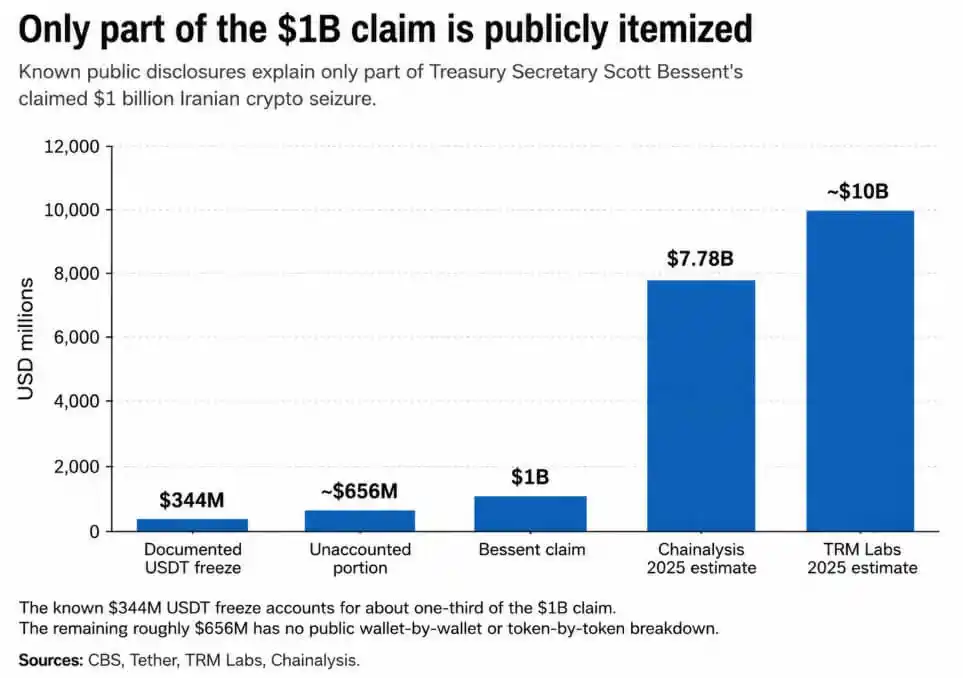
The known $344 million USDT freeze accounts for only 33% of the $1 billion in Iranian cryptocurrency that Bessent claims was seized, leaving $656 million publicly unaccounted for.

Projecting the Token Composition and Destination of the Seized Assets

If the $1 billion includes a significant amount of Bitcoin, and the U.S. completes the ownership forfeiture with no need for victim compensation and no diversion for enforcement expenses, the corresponding Bitcoin would enter the non-saleable strategic reserve. Crypto assets originally used by Iran to evade U.S. financial blockades would be transformed into a sovereign book reserve for the U.S. through sanction enforcement.

Currently, the only confirmed assets are $344 million USDT, frozen by Tether in cooperation with regulatory address freezes. If the remaining $656 million is also primarily stablecoins, the entire event essentially becomes a case of stablecoin regulatory compliance enforcement. Frozen USDT would remain locked; non-bitcoin assets, after forfeiture, would be transferred to the Digital Asset Reserve, with subsequent disposal plans determined entirely by the Treasury Secretary. A complete list of wallets and token types would directly change the nature of the event: it could either represent the implementation of U.S. sovereign Bitcoin accumulation or merely stablecoin regulatory compliance. Bessent has not disclosed any details at this stage.

The executive order also stipulates that forfeited assets can be returned to rightful victim claimants, allocated for case expenses, shared with state law enforcement agencies, or legally exempted from return. Any of these scenarios would prevent the assets from entering the reserve. These provisions represent multiple layers of hurdles for assets transitioning from "seized" to "treasury reserve," which can be triggered at any point before or after forfeiture.

The institutional framework established by Trump's reserve decree turns all future crypto seizures targeting adversarial nations into a matter of U.S. sovereign asset management.
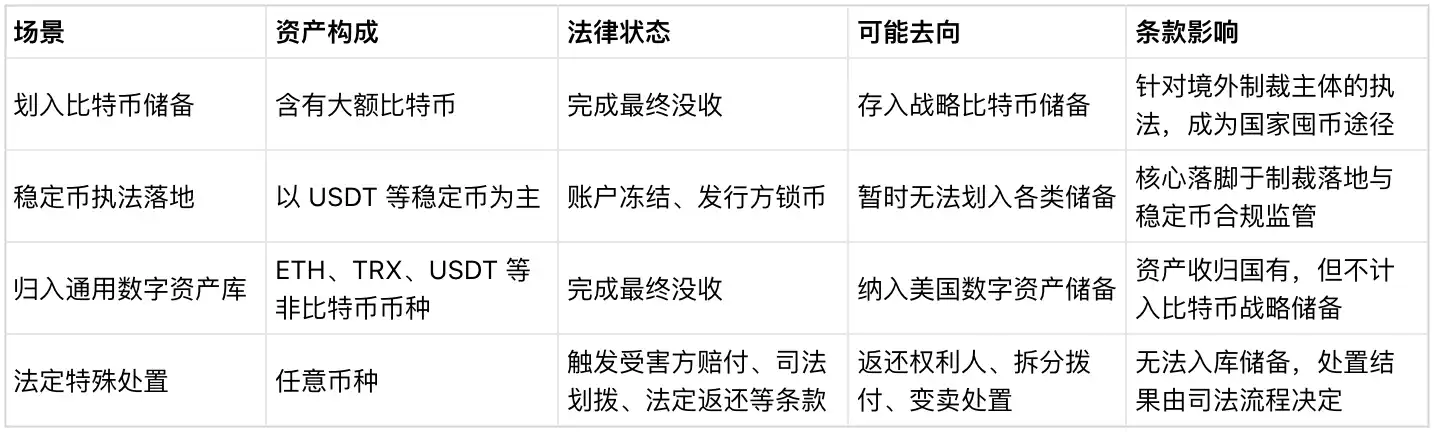
In the future, each U.S. crypto enforcement action against sanctioned entities like Iran and North Korea will involve three determinations: token type, legal status, and which treasury account to assign them to. Only by simultaneously meeting three conditions—the asset being Bitcoin, completing statutory forfeiture, and having no applicable compensation or allocation exemptions—can these Iranian assets potentially supplement the U.S. strategic reserve. As long as they successfully pass the two major hurdles of the forfeiture process and legal exemptions, crypto assets originally intended to circumvent U.S. financial controls would, in turn, become part of U.S. sovereign assets.


Perguntas relacionadas

QWhat are the two distinct accounts designated by the 2025 executive order for U.S. government digital assets, and what is the primary difference between them?

AThe two accounts are the Strategic Bitcoin Reserve and the U.S. Digital Asset Reserve. The Strategic Bitcoin Reserve is specifically for holding Bitcoin that has been legally forfeited or collected via civil monetary penalties, and these Bitcoins are permanently prohibited from being sold. The U.S. Digital Asset Reserve holds other, non-Bitcoin digital assets that have undergone final forfeiture adjudication.

QWhat is the key legal distinction between 'freezing' or 'seizing' assets and 'forfeiting' them, as it relates to the potential transfer of the $1 billion in Iranian crypto assets to the U.S. Strategic Bitcoin Reserve?

AFreezing or seizing assets represents temporary control or blockage by authorities, but legal ownership remains with the original holder until a court order. Forfeiture is the final legal process that transfers permanent ownership to the government. Only assets that have been formally forfeited are eligible for transfer into the Strategic Bitcoin Reserve.

QAccording to the article, what are the three main factors that will determine the final disposition of the seized Iranian crypto assets?

AThe three main factors are: 1) The type of cryptocurrency (e.g., Bitcoin vs. stablecoins), 2) The legal status of the assets (whether they are merely frozen/seized or have been formally forfeited), and 3) Which government account they can be assigned to (Strategic Bitcoin Reserve or U.S. Digital Asset Reserve) based on the type and legal status.

QWhat are some of the potential financial obligations that could prevent seized assets from entering the U.S. Strategic Bitcoin Reserve, even after forfeiture?

AAfter forfeiture, assets may be allocated to: victim restitution, law enforcement investigative expenses, sharing proceeds with state and local law enforcement agencies, or being legally exempted and returned to claimants. Any of these allocations would prevent the assets from being deposited into the Strategic Bitcoin Reserve.

QWhat portion of the claimed $1 billion in seized Iranian crypto assets has been publicly identified, and what specific asset does it consist of?

AOnly $344 million of the claimed $1 billion has been publicly identified. This portion consists of USDT (Tether stablecoins) that were frozen in two wallets by Tether in coordination with U.S. sanctions. The composition and status of the remaining $656 million are not publicly disclosed.

Leituras Relacionadas

Bloomberg Uncovered: How Do China's Wealthy Circumvent the Annual $50,000 Limit to Transfer Assets?

**Summary: How Wealthy Chinese Circumvent $50,000 Annual Foreign Exchange Limits** Despite China's strict capital controls, including an annual $50,000 per person foreign exchange quota, an estimated $150 billion in funds still leaves the country annually via various gray and underground channels. This report outlines the evolution of China's "capital wall" and the methods used to bypass it. **The Evolving Capital Controls:** * **Foundation (1994):** The system of "current account convertibility with strict capital account controls" was established. * **Quota Set (2007):** The $50,000 individual annual forex purchase limit was formalized. * **Crackdown Begins (2015-2017):** Following market volatility, enforcement tightened. Banks were required to scrutinize transactions, and channels like using UnionPay cards for Hong Kong insurance premiums or buying overseas property were blocked. * **Digital & Legal Upgrades (2024-2026):** Enhanced algorithms now flag suspicious patterns (e.g., "smurfing"). The Common Reporting Standard (CRS) provides Chinese tax authorities with data on citizens' offshore accounts. Unlicensed cross-border brokers have been targeted. **Five Primary Methods for Moving Capital:** 1. **Underground Banking / "Hawala" (Duiqiao):** The largest-scale method. No money crosses borders. Clients pay RMB to a domestic account; an overseas associate deposits equivalent foreign currency into the client's offshore account. Risks include high fees, account freezes, and legal penalties. 2. **"Smurfing" or "Ant Moving":** Using multiple individuals' $50,000 quotas to pool funds for one offshore recipient. Increasingly detected by anti-money laundering algorithms. 3. **Trade Invoice Manipulation:** Businesses over-invoice imports or under-invoice exports via offshore shell companies, creating a pretext to transfer excess funds abroad under the guise of trade. 4. **Channel Migration:** After a crackdown on internet brokers, funds flow toward more compliant but costly channels like major banks' cross-border wealth management services or Qualified Domestic Institutional Investor (QDII) quotas. 5. **Structural Arrangements:** High-net-worth individuals use complex, high-cost legal structures involving offshore trusts, insurance, and investment migration programs to transfer asset ownership. **Regulatory Response: Focusing on People, Not Just Money** The current strategy extends oversight from enterprises to **individual residents**. Tools like CRS allow retroactive visibility into offshore assets. Cryptocurrencies, once seen as a potential loophole, are now actively monitored and prosecuted as an illegal channel. The underlying driver remains: with significant wealth concentrated among millions of affluent households seeking diversification amid domestic economic shifts, the incentive to move assets offshore persists despite regulatory barriers.

marsbitHá 10m

Bloomberg Uncovered: How Do China's Wealthy Circumvent the Annual $50,000 Limit to Transfer Assets?

marsbitHá 10m

Ethereum's Ballmer Moment: As Everyone Is Bearish, the Circulating Supply Is Disappearing

"Ethereum's Ballmer Moment: Circulation Shrinks Amid Bearish Sentiment" Amid widespread bearish sentiment, with prominent figures like Bankless founder David Hoffman selling ETH and young developers flocking to Solana, some argue Ethereum is entering its "Ballmer era"—akin to Microsoft's perceived stagnation under Steve Ballmer. While surface-level criticisms about slow protocol development, cautious leadership, and competitive pressure are valid, underlying fundamentals tell a different story. Approximately 30% of ETH is staked, major holders like BitMine are accumulating, and spot ETFs continue to absorb supply. Regulatory clarity, including the SEC/CFTC's March ruling on staking rewards and the potential passage of the CLARITY Act, is transforming crypto from a regulatory threat into a legitimized framework. This institutionalization, alongside a shrinking circulating supply (with net issuance around 0.23% annually), creates significant buy-side pressure independent of fee-based value capture. The broader crypto total addressable market is expanding through regulated stablecoins, tokenized assets, and institutional adoption. While public chains face competition from permissioned alternatives, the winning model appears to be permissioned assets settling on public chains like Ethereum and Solana. The author advocates a non-maximalist, barbell strategy: holding ETH for its institutional role and supply squeeze, SOL for consumer/throughput trends, BTC as a macro hedge, and a basket of next-gen L1s. Key bullish drivers for ETH include rapid circulation shrinkage, potential Q2 staked ETF approvals, regulatory tailwinds solidifying its role as a default settlement layer, and the optionality of an eventual "Satya moment" leadership shift. Despite bearish consensus, the current setup—where crypto is "not hot" and regulatory groundwork is being laid—presents a compelling investment opportunity. The crypto cycle's focus may have shifted to AI, but blockchain infrastructure is gaining a legal and institutional foothold precisely while attention is elsewhere.

marsbitHá 11m

Ethereum's Ballmer Moment: As Everyone Is Bearish, the Circulating Supply Is Disappearing

marsbitHá 11m

Claude Code Introduces Dynamic Workflows: Enabling AI to Form Teams and Collaborate

Claude Code introduces dynamic workflows, enabling AI to coordinate teams of specialized agents for complex tasks. This transforms Claude from a code assistant into a programmable workbench. Workflows address key limitations of single-agent systems: agentic laziness (premature task completion), self-preferential bias (favoring own outputs), and goal drift (losing sight of original objectives). The system allows Claude to dynamically create execution frameworks using JavaScript. It can split tasks, dispatch parallel agents for isolated work (e.g., in separate worktrees), implement adversarial validation, run tournaments, and synthesize results. This multi-agent approach is valuable for tasks requiring deep research, factual verification, code migration, root cause analysis, large-scale triage, and qualitative sorting. Key patterns include: classify-and-route, fan-out-and-synthesize, adversarial verification, generate-and-filter, tournaments, and loop-until-done. While token usage is higher, workflows excel where tasks resemble programming—needing problem decomposition, isolated context, hypothesis testing, and handling many details. They extend Claude Code's utility beyond technical work to areas like business plan review, resume screening, and naming brainstorm. The feature is not a universal solution but points to a future where AI tool competitiveness depends on organizing reliable, reusable, and auditable execution flows for complex goals.

marsbitHá 52m

Claude Code Introduces Dynamic Workflows: Enabling AI to Form Teams and Collaborate

marsbitHá 52m

Hyperliquid, Wall Street's 24/7 Trading Convenience Store

Hyperliquid: The 24/7 Trading "Convenience Store" for Wall Street Hyperliquid, a decentralized cryptocurrency exchange, has become a go-to platform for Wall Street traders seeking to trade around the clock, especially during traditional market closures. Founded by Jeff Yan, a former quantitative trader, after the FTX collapse, the platform emphasizes user self-custody of assets. It offers a wide range of perpetual contracts—leveraged derivatives with no expiry—on assets from Bitcoin and crude oil to the S&P 500 and even pre-IPO companies like SpaceX. A notable example involves a hedge fund trader who capitalized on geopolitical news over a weekend, securing a 243% return on oil derivatives before markets reopened. The platform, run by just 11 employees, generated approximately $800 million in revenue last year, and its native token HYPE has seen significant growth. Its rise highlights the merging of traditional finance and crypto. While U.S. users are currently restricted, recent CFTC rule changes could open access. The platform is known for its transparency, having processed $10 billion in liquidations during a market crash while competitors faltered. Regulators warn of the high risks and complexity of perpetual contracts for retail investors. Key to its appeal is a strong community culture, direct engagement with founders, and a simple interface. Despite rules against VPN use, it attracts global users with its permissionless approach. Hyperliquid plans to expand into prediction markets and options, aiming to eventually host all financial activity.

marsbitHá 52m

Hyperliquid, Wall Street's 24/7 Trading Convenience Store

marsbitHá 52m

Trading

Spot
Futuros

Artigos em Destaque

O que é BITCOIN

Compreender o HarryPotterObamaSonic10Inu (ERC-20) e a Sua Posição no Espaço Cripto Nos últimos anos, o mercado de criptomoedas assistiu a um aumento na popularidade das moedas meme, cativando não apenas os traders, mas também aqueles que procuram envolvimento comunitário e valor de entretenimento. Entre estes tokens únicos está o HarryPotterObamaSonic10Inu (ERC-20), um projeto intrigante que mistura referências culturais no tecido das criptomoedas. Este artigo explora os principais aspetos do HarryPotterObamaSonic10Inu, examinando os seus mecanismos, a sua ética orientada pela comunidade e o seu envolvimento com o vasto panorama cripto. O que é o HarryPotterObamaSonic10Inu (ERC-20)? Como o nome sugere, o HarryPotterObamaSonic10Inu é uma moeda meme construída na blockchain Ethereum, classificada sob o padrão ERC-20. Ao contrário das criptomoedas tradicionais, que podem enfatizar a utilidade prática ou o potencial de investimento, este token prospera no valor de entretenimento e na força da sua comunidade. O projeto visa promover um ambiente onde utilizadores envolvidos possam reunir-se, partilhar ideias e participar em atividades inspiradas por diversos fenómenos culturais. Uma característica notável do HarryPotterObamaSonic10Inu é a zero taxa sobre transações. Este elemento atraente visa encorajar a negociação e o envolvimento da comunidade, isento de encargos adicionais que podem desencorajar os traders de pequena escala. A oferta total da moeda está fixada em mil milhões de tokens, uma cifra que marca a sua intenção de manter uma circulação substancial dentro da comunidade. Criador do HarryPotterObamaSonic10Inu (ERC-20) As origens do HarryPotterObamaSonic10Inu estão um pouco envoltas em mistério; os detalhes sobre o criador permanecem desconhecidos. O desenvolvimento deste token carece de uma equipa identificável ou de um plano explícito, o que não é raro no setor das moedas meme. Em vez disso, o projeto surgiu de forma orgânica, com o seu progresso a depender fortemente do entusiasmo e da participação da sua comunidade. Investidores do HarryPotterObamaSonic10Inu (ERC-20) No que diz respeito a investimentos externos e apoios, o HarryPotterObamaSonic10Inu também permanece ambíguo. O token não lista quaisquer fundações de investimento conhecidas ou apoio organizacional significativo. Em vez disso, o “sangue vital” do projeto é a sua comunidade de base, que informa o seu crescimento e sustentabilidade através da ação coletiva e do envolvimento no espaço cripto. Como Funciona o HarryPotterObamaSonic10Inu (ERC-20)? Como uma moeda meme, o HarryPotterObamaSonic10Inu opera principalmente fora dos quadros tradicionais que muitas vezes governam o valor dos ativos. Existem vários aspetos distintivos que definem como o projeto funciona: Transações Sem Taxas: Sem taxas sobre transações, os utilizadores podem comprar e vender o token livremente, sem a preocupação de custos ocultos. Envolvimento da Comunidade: O projeto prospera na interação da comunidade, aproveitando plataformas de redes sociais para criar entusiasmo e facilitar a participação. Discussões, partilha de conteúdo e envolvimento são elementos cruciais que ajudam a expandir o seu alcance e a fomentar a lealdade entre os apoiantes. Sem Utilidade Prática: Deve ser notado que o HarryPotterObamaSonic10Inu não oferece utilidade concreta dentro do ecossistema financeiro. Em vez disso, é classificado como um token principalmente para entretenimento e atividades comunitárias. Referência Cultural: O token incorpora de forma inteligente elementos da cultura popular para atrair interesse, conectando-se tanto com entusiastas de memes como com seguidores de criptomoedas. HarryPotterObamaSonic10Inu exemplifica como as moedas meme operam de forma diferente de projetos de criptomoedas mais tradicionais, entrando no mercado como construções sociais inovadoras em vez de ativos utilitários. Linha do Tempo do HarryPotterObamaSonic10Inu (ERC-20) A história do HarryPotterObamaSonic10Inu é marcada por vários marcos notáveis: Criação: O token surgiu de um meme viral, capturando a imaginação de muitos entusiastas de criptomoedas. Datas específicas de criação não estão disponíveis, sublinhando a sua ascensão orgânica. Listagem em Exchanges: O HarryPotterObamaSonic10Inu conseguiu entrar em várias exchanges, permitindo um acesso e negociação mais fáceis pela comunidade. Iniciativas de Envolvimento da Comunidade: Atividades contínuas direcionadas a melhorar a interação comunitária, incluindo concursos, campanhas em redes sociais e geração de conteúdo por fãs e defensores. Planos de Expansão Futura: O roteiro do projeto inclui o lançamento de uma coleção de NFTs, mercadorias e um site de eCommerce relacionado aos seus temas culturais, envolvendo ainda mais a comunidade e tentando adicionar mais dimensões ao seu ecossistema. Pontos-Chave sobre o HarryPotterObamaSonic10Inu (ERC-20) Natureza Orientada pela Comunidade: O projeto prioriza a contribuição coletiva e a criatividade, assegurando que o envolvimento dos utilizadores está na vanguarda do seu desenvolvimento. Classificação como Moeda Meme: Representa o epítome da criptomoeda baseada em entretenimento, destacando-se dos veículos de investimento tradicionais. Sem Afiliação Direta com o Bitcoin: Apesar da semelhança no nome do ticker, o HarryPotterObamaSonic10Inu é distinto e não tem qualquer relação com o Bitcoin ou outras criptomoedas estabelecidas. Foco na Colaboração: O HarryPotterObamaSonic10Inu é projetado para criar um espaço de colaboração e partilha de histórias entre os seus detentores, proporcionando uma via para a criatividade e o fortalecimento da comunidade. Perspectivas Futuras: A ambição de expandir além da sua premissa inicial para NFTs e mercadorias delineia um caminho para o projeto potencialmente entrar em avenidas mais mainstream dentro da cultura digital. À medida que as moedas meme continuam a capturar a imaginação da comunidade cripto, HarryPotterObamaSonic10Inu (ERC-20) destaca-se devido aos seus laços culturais e abordagem centrada na comunidade. Embora possa não se encaixar no molde típico de um token orientado para utilidade, a sua essência reside na alegria e camaradagem fomentadas entre os seus apoiantes, destacando a natureza em evolução das criptomoedas em uma era cada vez mais digital. À medida que o projeto continua a desenvolver-se, será importante observar como as dinâmicas comunitárias influenciam a sua trajetória no panorama em constante mudança da tecnologia blockchain.

1.6k Visualizações TotaisPublicado em {updateTime}Atualizado em 2024.12.03

O que é BITCOIN

Como comprar BTC

Bem-vindo à HTX.com!Tornámos a compra de Bitcoin (BTC) simples e conveniente.Segue o nosso guia passo a passo para iniciar a tua jornada no mundo das criptos.Passo 1: cria a tua conta HTXUtiliza o teu e-mail ou número de telefone para te inscreveres numa conta gratuita na HTX.Desfruta de um processo de inscrição sem complicações e desbloqueia todas as funcionalidades.Obter a minha contaPasso 2: vai para Comprar Cripto e escolhe o teu método de pagamentoCartão de crédito/débito: usa o teu visa ou mastercard para comprar Bitcoin (BTC) instantaneamente.Saldo: usa os fundos da tua conta HTX para transacionar sem problemas.Terceiros: adicionamos métodos de pagamento populares, como Google Pay e Apple Pay, para aumentar a conveniência.P2P: transaciona diretamente com outros utilizadores na HTX.Mercado de balcão (OTC): oferecemos serviços personalizados e taxas de câmbio competitivas para os traders.Passo 3: armazena teu Bitcoin (BTC)Depois de comprar o teu Bitcoin (BTC), armazena-o na tua conta HTX.Alternativamente, podes enviá-lo para outro lugar através de transferência blockchain ou usá-lo para transacionar outras criptomoedas.Passo 4: transaciona Bitcoin (BTC)Transaciona facilmente Bitcoin (BTC) no mercado à vista da HTX.Acede simplesmente à tua conta, seleciona o teu par de trading, executa as tuas transações e monitoriza em tempo real.Oferecemos uma experiência de fácil utilização tanto para principiantes como para traders experientes.

4.1k Visualizações TotaisPublicado em {updateTime}Atualizado em 2026.06.02

Como comprar BTC

O que é $BITCOIN

OURO DIGITAL ($BITCOIN): Uma Análise Abrangente Introdução ao OURO DIGITAL ($BITCOIN) OURO DIGITAL ($BITCOIN) é um projeto baseado em blockchain que opera na rede Solana, com o objetivo de combinar as características dos metais preciosos tradicionais com a inovação das tecnologias descentralizadas. Embora partilhe um nome com o Bitcoin, frequentemente referido como “ouro digital” devido à sua percepção como uma reserva de valor, o OURO DIGITAL é um token separado projetado para criar um ecossistema único dentro da paisagem Web3. O seu objetivo é posicionar-se como um ativo digital alternativo viável, embora os detalhes sobre as suas aplicações e funcionalidades ainda estejam em desenvolvimento. O que é o OURO DIGITAL ($BITCOIN)? OURO DIGITAL ($BITCOIN) é um token de criptomoeda explicitamente projetado para uso na blockchain Solana. Em contraste com o Bitcoin, que fornece um papel amplamente reconhecido como armazenamento de valor, este token parece focar em aplicações e características mais amplas. Aspectos notáveis incluem: Infraestrutura Blockchain: O token é construído na blockchain Solana, conhecida pela sua capacidade de lidar com transações de alta velocidade e baixo custo. Dinâmicas de Oferta: O OURO DIGITAL tem um fornecimento máximo limitado a 100 quatrilhões de tokens (100P $BITCOIN), embora os detalhes sobre o seu fornecimento circulante ainda não tenham sido divulgados. Utilidade: Embora as funcionalidades precisas não estejam explicitamente delineadas, existem indicações de que o token poderia ser utilizado para várias aplicações, potencialmente envolvendo aplicações descentralizadas (dApps) ou estratégias de tokenização de ativos. Quem é o Criador do OURO DIGITAL ($BITCOIN)? Neste momento, a identidade dos criadores e da equipa de desenvolvimento por trás do OURO DIGITAL ($BITCOIN) permanece desconhecida. Esta situação é típica entre muitos projetos inovadores no espaço da blockchain, particularmente aqueles alinhados com finanças descentralizadas e fenómenos de moedas meme. Embora tal anonimato possa fomentar uma cultura orientada pela comunidade, intensifica as preocupações sobre governança e responsabilidade. Quem são os Investidores do OURO DIGITAL ($BITCOIN)? As informações disponíveis indicam que o OURO DIGITAL ($BITCOIN) não tem apoiantes institucionais conhecidos ou investimentos proeminentes de capital de risco. O projeto parece operar num modelo peer-to-peer focado no apoio e adoção da comunidade, em vez de rotas de financiamento tradicionais. A sua atividade e liquidez estão principalmente situadas em exchanges descentralizadas (DEXs), como a PumpSwap, em vez de plataformas de negociação centralizadas estabelecidas, destacando ainda mais a sua abordagem de base. Como Funciona o OURO DIGITAL ($BITCOIN) A mecânica operacional do OURO DIGITAL ($BITCOIN) pode ser elaborada com base no seu design de blockchain e nas características da rede: Mecanismo de Consenso: Ao aproveitar o exclusivo proof-of-history (PoH) da Solana combinado com um modelo de proof-of-stake (PoS), o projeto assegura uma validação eficiente das transações, contribuindo para o alto desempenho da rede. Tokenomics: Embora mecanismos deflacionários específicos não tenham sido extensivamente detalhados, o vasto fornecimento máximo de tokens implica que pode atender a microtransações ou casos de uso de nicho que ainda estão por definir. Interoperabilidade: Existe o potencial para integração com o ecossistema mais amplo da Solana, incluindo várias plataformas de finanças descentralizadas (DeFi). No entanto, os detalhes sobre integrações específicas permanecem não especificados. Cronologia de Eventos Chave Aqui está uma cronologia que destaca marcos significativos relacionados ao OURO DIGITAL ($BITCOIN): 2023: O lançamento inicial do token ocorre na blockchain Solana, marcado pelo seu endereço de contrato. 2024: O OURO DIGITAL ganha visibilidade ao tornar-se disponível para negociação em exchanges descentralizadas como a PumpSwap, permitindo que os utilizadores o negociem contra SOL. 2025: O projeto testemunha atividade de negociação esporádica e potencial interesse em envolvimentos liderados pela comunidade, embora não tenham sido documentadas parcerias ou avanços técnicos notáveis até ao momento. Análise Crítica Forças Escalabilidade: A infraestrutura subjacente da Solana suporta altos volumes de transações, o que pode aumentar a utilidade do $BITCOIN em vários cenários de transação. Acessibilidade: O potencial preço de negociação baixo por token pode atrair investidores de retalho, facilitando uma participação mais ampla devido a oportunidades de propriedade fracionada. Riscos Falta de Transparência: A ausência de apoiantes, desenvolvedores ou um processo de auditoria publicamente conhecidos pode gerar ceticismo em relação à sustentabilidade e confiabilidade do projeto. Volatilidade do Mercado: A atividade de negociação depende fortemente do comportamento especulativo, o que pode resultar em volatilidade significativa dos preços e incerteza para os investidores. Conclusão O OURO DIGITAL ($BITCOIN) surge como um projeto intrigante, mas ambíguo, dentro do ecossistema em rápida evolução da Solana. Embora tente aproveitar a narrativa do “ouro digital”, a sua divergência do papel estabelecido do Bitcoin como reserva de valor sublinha a necessidade de uma diferenciação mais clara da sua utilidade pretendida e estrutura de governança. A aceitação e adoção futuras dependerão provavelmente da abordagem da atual opacidade e da definição mais explícita das suas estratégias operacionais e económicas. Nota: Este relatório abrange informações sintetizadas disponíveis até outubro de 2023, e desenvolvimentos podem ter ocorrido além do período de pesquisa.

92 Visualizações TotaisPublicado em {updateTime}Atualizado em 2025.05.13

O que é $BITCOIN

Discussões

Bem-vindo à Comunidade HTX. Aqui, pode manter-se informado sobre os mais recentes desenvolvimentos da plataforma e obter acesso a análises profissionais de mercado. As opiniões dos utilizadores sobre o preço de BTC (BTC) são apresentadas abaixo.

活动图片













