Отток альткоинов с бирж и активность китов: эксперты заявили о финальной стадии медвежьего цикла

cryptonews.ruPublicado em 2026-08-06Última atualização em 2026-08-06

Resumo

Analysts from Santiment reported the largest net outflow of PEPE and Chainlink (LINK) tokens from centralized exchanges in recent months. They noted that reducing exchange reserves lowers the amount of coins available for quick sale, potentially decreasing the risk of sharp price declines. Simultaneously, CryptoQuant stated that large holders of Bitcoin, Ethereum, and XRP are continuing to accumulate assets. Key data points include Bitcoin whale holdings (excluding exchanges and mining pools) rising to approximately 3.06 million BTC, accumulation during price drops below $60,000, large XRP holders maintaining spot orders between $1-$1.2, and Ethereum addresses with 10,000 to 100,000 ETH increasing their holdings to a record 19.6 million ETH. CryptoQuant analysts believe these factors, combined with market valuations approaching historical undervaluation zones, indicate weakening selling pressure and signal the final stage of the bear market, though they caution that some room for further price decline remains before a definitive market bottom is confirmed.

Аналитики Santiment сообщили о крупнейшем за последние месяцы чистом оттоке токенов $PEPE и Chainlink ($LINK) с централизованных бирж. В то же время в CryptoQuant заявили, что крупные держатели биткоина, Ethereum и $XRP продолжают накапливать активы, что может свидетельствовать о финальной стадии медвежьего рынка.

$PEPE и $LINK покидают биржи

По данным Santiment, за сутки с централизованных бирж было выведено 4,54 трлн $PEPE — это крупнейший чистый отток токена с 14 ноября 2024 года. Аналитики отметили, что сокращение биржевых резервов означает уменьшение количества монет, готовых к быстрой продаже, что потенциально снижает риск резкого падения цены.

В Santiment напомнили, что последние два месяца $PEPE преимущественно торговался в боковом диапазоне, тогда как рынок мемкоинов находился в фазе ротации капитала. Также они обратили внимание на поданную ранее заявку на запуск ETF, привязанного к $PEPE, решение по которой ожидается позже в этом году.
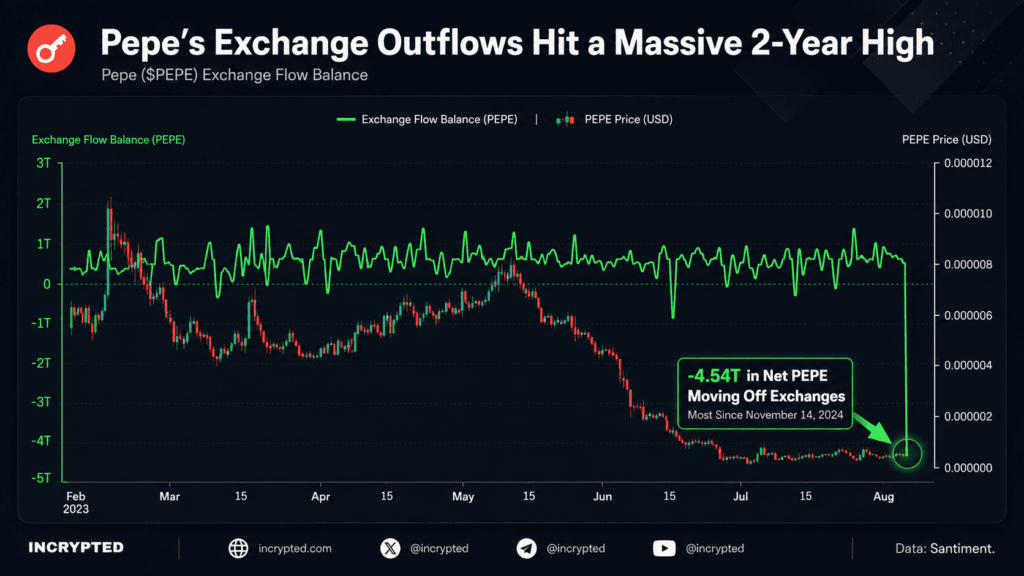
Отток $PEPE с криптобирж. Инфографика: Incrypted,

Отдельно компания сообщила о чистом суточном оттоке 1,26 млн $LINK — крупнейшем с 29 июня.

По мнению аналитиков, сокращение предложения $LINK на биржах совпадает с позитивными фундаментальными событиями. В частности, в июле DTCC провела операции с токенизированными ценными бумагами США, где Chainlink была среди технологических партнеров, а протокол CCIP расширил интеграции с институциональными и криптовалютными сетями, включая Canton и Robinhood Chain.

Крупные игроки накапливают активы

В CryptoQuant заявили, что крупнейшие участники рынка продолжают увеличивать позиции в основных криптоактивах. По данным компании:

  • запасы биткоин-китов (без учета бирж и майнинговых пулов) выросли примерно до 3,06 млн $BTC, при этом активное накопление происходило во время падения цены ниже $60 000 в июне;
  • крупные владельцы $XRP сохраняют большие спотовые ордера в диапазоне $1-$1,2, что, по мнению аналитиков, свидетельствует о накоплении без агрессивных рыночных покупок;
  • адреса с балансами от 10 000 до 100 000 $ETH увеличили запасы до рекордных 19,6 млн $ETH, тогда как кошельки с более чем 100 000 $ETH накопили около 1,8 млн $ETH с середины 2025 года.

Кроме того, в CryptoQuant отметили, что текущие рыночные оценки биткоина, Ethereum и $XRP приближаются к историческим зонам недооцененности.

Аналитики считают, что совокупность этих факторов свидетельствует об улучшении соотношения риска и потенциальной доходности.

«Давление продавцов ослабевает, поскольку крупные владельцы накапливают активы, что сигнализирует о финальной стадии медвежьего рынка. В то же время с точки зрения оценки стоимости определенное пространство для дальнейшего снижения цен все еще сохраняется до окончательного подтверждения рыночного дна», — подытожили в CryptoQuant.

Напомним, ранее аналитики Wintermute заявили о признаках завершения медвежьего цикла на крипторынке.

end-content

Perguntas relacionadas

QAccording to Santiment, which two altcoins experienced their largest net outflow from centralized exchanges in recent months?

APepe ($PEPE) and Chainlink ($LINK).

QWhat reason do analysts give for why a decrease in exchange reserves for an asset like $PEPE could be positive?

AIt reduces the number of coins readily available for quick sale, which potentially decreases the risk of a sharp price drop.

QWhich data analytics firm reported that large holders (whales) are continuing to accumulate major crypto assets like Bitcoin, Ethereum, and XRP?

ACryptoQuant.

QAccording to CryptoQuant, what specific price range are large $XRP holders placing their spot orders in, indicating accumulation?

AIn the range of $1 to $1.2.

QWhat overall market phase do the experts cited in the article believe these combined signals point to?

AThe final stage of the bear market cycle.

Leituras Relacionadas

Home Furnishing Listed Companies Are Trying to Turn Around with AI and Semiconductors

Chinese home furnishing listed companies are increasingly turning to AI and semiconductor cross-border ventures to revive their fortunes amid declining core businesses. A prominent example is PVC flooring giant **Elegant Home Furnishing**, whose stock price skyrocketed with 10 consecutive trading limits after announcing a plan to acquire a majority stake in **Ou Kang Nuo**, a semiconductor storage testing equipment and services company. Despite Elegant Home's own financial struggles—including recent losses and tight cash flow—the acquisition, funded through asset sales and loans, has dramatically boosted its market value. The deal involves a cross-shareholding structure with Ou Kang Nuo's controlling shareholder. This trend is widespread. Over the past year, numerous home furnishing firms with stagnant main operations have seen their stock prices surge after announcing moves into hot sectors like AI, semiconductors, or computing power. Key cases include: * **Markor Home Furnishings** ("high-end home furnishing first share"), after years of heavy losses, acquired an AI server high-speed copper cable company and later introduced AI computing power investors. * **Zhenai Meijia** ("blanket king") became the first A-listed manufacturer controlled by an AI large model company following a takeover. * **Fasilon** (integrated ceiling) saw its stock soar after establishing an AI subsidiary. * **Jinlong Decoration** experienced multiple trading limits after being linked to "commercial aerospace" and "AI computing," despite clarifying these segments contribute less than 1% of its business. Statistics show over 20 A-share companies announced semiconductor crossovers in 2025, with home furnishing and building materials firms being the most active. This shift is largely driven by pressures from the real estate downturn, shrinking overseas demand, and trade tariffs, pushing companies to seek growth through trendy concepts rather than core business improvement. However, the article warns that such speculative frenzies often end when the hype fades, leaving stock prices to eventually reflect the companies' weak fundamentals, as seen in Jinlong Decoration's subsequent sharp price correction. The repeated attempts to "ride the trend" highlight a desperate struggle for survival in a challenging traditional industry.

marsbitHá 4m

Home Furnishing Listed Companies Are Trying to Turn Around with AI and Semiconductors

marsbitHá 4m

"Sell America" Trade Resurfaces: Global Funds Reprice Washington Policy Risks, Dollar and Treasuries Bear the Brunt

"Sale of America" Trade Resurges as Global Funds Reprice Washington Policy Risks, Hitting Dollar and Treasuries First Recent policy signals from Washington are prompting global bond and foreign exchange investors to reignite the "Sale of America" debate. Uncertainty stems from Fed Chair Wash's shift towards less policy communication, Treasury Secretary Bessant's approval of joint intervention with Japan to support the Yen (the first such coordinated move in nearly 30 years), expanding fiscal deficits, and trade war fears. These factors are undermining confidence in U.S. assets. The 30-year Treasury yield recently broke above 5%, hitting a high not seen since 2007, while the Bloomberg Dollar Spot Index has fallen about 2% from its June peak. This dollar weakness is unusual given still-high U.S. interest rates. Investors cite policy uncertainty as a key driver, with one manager calling the Fed Chair and Treasury Secretary a "double whammy" creating a "Trump administration premium." While the S&P 500 continues hitting record highs and foreign holdings of U.S. Treasuries remain high, parts of the bond and FX markets are adjusting. A core concern is whether the Fed under Wash can effectively anchor inflation expectations; analysts warn that if the Fed lags the hiking cycle, long-end yields could face further upward pressure. The 30-year term premium has risen sharply. The U.S.-backed Yen intervention has also sparked debate on the dollar's structural outlook. While framed by Bessant as a "reallocation of reserves," market participants caution that if Japan—America's largest foreign creditor—must sell Treasuries to fund interventions, ripple effects could hit the bond market. Strategists predict moderate dollar depreciation ahead. Most experts are not predicting an end to dollar hegemony or the safe-haven status of Treasuries. However, a key underlying risk is highlighted: the pace of foreign buying of U.S. debt may not keep up with the speed of American borrowing, gradually eroding the structural advantages that have long supported "American exceptionalism."

marsbitHá 5m

"Sell America" Trade Resurfaces: Global Funds Reprice Washington Policy Risks, Dollar and Treasuries Bear the Brunt

marsbitHá 5m

Trading

Spot
活动图片